
The entire financial ecosystem runs on speed, trust, and accuracy. Even then, insurance, banks, and financial service providers mostly rely on decade-old platforms. These legacy systems were never designed for AI-powered decision-making, a cloud environment, or real-time processing. Therefore, legacy systems in banks, financial services, and insurance face increased maintenance costs, security risks, and slow innovation.
These days, AI for legacy modernization and automation in IT have become pivotal. These are transforming the way organizations used to update their outdated systems. Rather than undertaking risky, long, multi-replacement projects, most financial institutions have begun modernizing incrementally, intelligently, and more quickly.
Let us find out how AI-driven modernization has been reshaping modernization services across banking, finance services, and insurance.
The primary reasons for designing legacy systems in insurance and banking are stability rather than agility. While it can process transactions reliably, they also have serious operational limitations.
Some of the major challenges include the following.
This means delayed claim processing, slower customer onboarding, and difficulty while launching digital products for financial services. In today’s market, when customers expect immediate services, it can be a serious disadvantage for the institutions. Thus, this is exactly where AI for legacy modernization in the financial services industry can become a more effective choice.
Traditional modernization means rewriting from scratch. It can be risky, time-consuming, and highly expensive. However, AI can completely flip that model. Rather than blindly rebuilding, AI can help teams understand, prioritize and automate upgrades.
Major capabilities include the following
These are the capabilities that can reduce costs and risks while accelerating its delivery. To be precise, automation in IT can actually modernize systems rather than making them chaotic.
When it comes to finding the biggest obstacle in legacy system modernization, it involves understanding what already exists. There are many banking platforms that contain millions of lines of undocumented code that were written years ago. AI can solve this with intelligent analysis.
Advanced tools can do the following
It will help IT teams have a clear group before making any sort of change. Rather than guessing, they will be able to make data-driven decisions, which can reduce costly errors and downtime. For legacy banking systems modernization services, the visibility can dramatically improve planning and accuracy.
Testing and migration are traditionally known to be the most time-consuming part of modernization. Manual testing upon it can take weeks and still miss out on the critical bugs and details. With automation in IT, these processes can become faster and more reliable.
AI-enabled automated testing can help teams to do the following.
This will make sure that every change remains safe before it goes live. It is a must in regulated environments like banking, financial services, and insurance. The result is faster deployment without sacrificing stability or compliance.
Over the course of time, legacy systems can accumulate workarounds, patches, and outdated integration. This can grow technical debt, which makes every future upgrade riskier and harder. AI-driven modernization can therefore help teams to address that strategically.
So, instead of making full rewrites, the organization can strategically move in the following way.
It is a phased approach that can minimize disruption while maintaining steady system health. For financial institutions that operate 24/7, the method can be far more practical compared to shutting down the system for large-scale replacement.
Read this to learn more about Strategic Mainframe Modernization in BFSI
Modernization is not technical, as it can directly impact operational efficiency and customer experience.
AI for legacy modernization in banking, insurance, and financial services can deliver measurable improvements. It ensures speed, scalability, and accuracy.
Successful modernization is not just about tools, but it also needs domain experience. Hexaview combines deep experience in banking, financial services and insurance with AI for a legacy modernization framework. It helps to deliver safe and faster outcomes.
The structured approach focuses more on precision and incremental progress instead of risky overhauls.
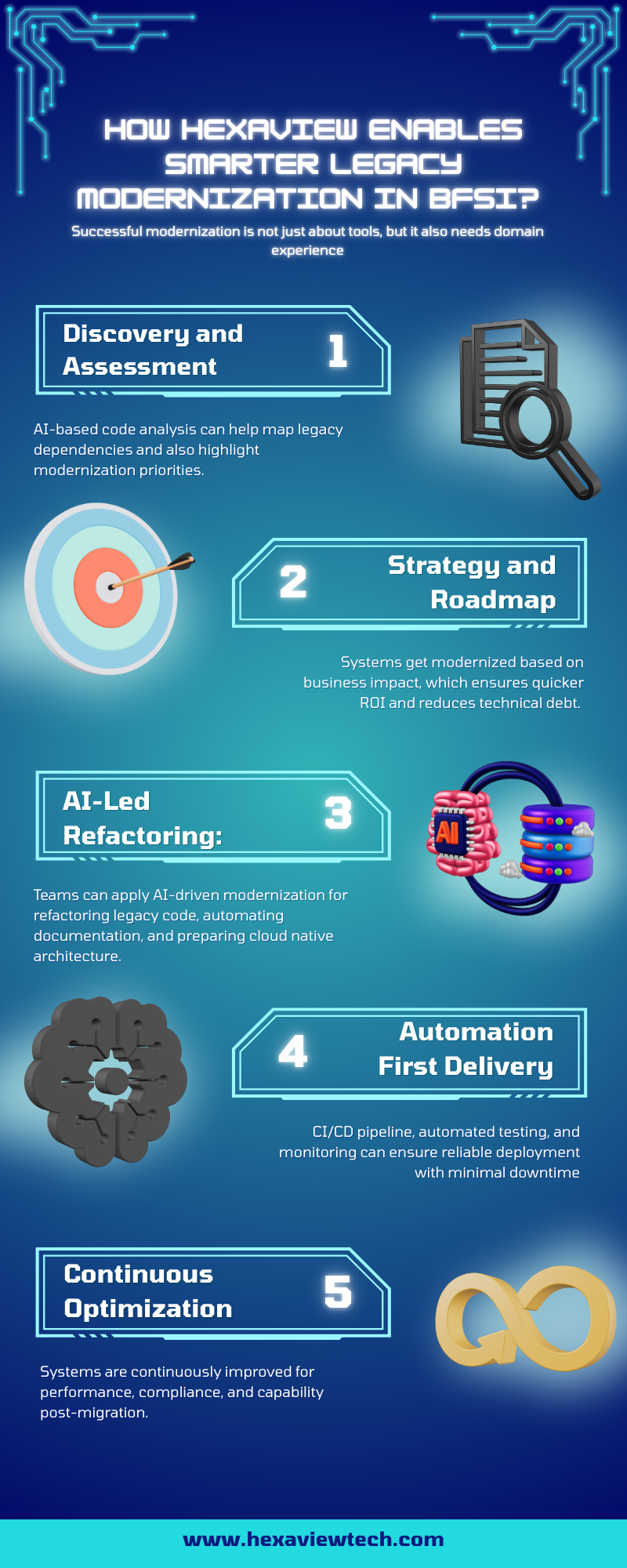
This approach taken by Hexaview can help institutions to easily make legacy modernization while providing uninterrupted services to their customers.
Organizations that adopt AI for legacy modernization in banking, financial services, and insurance will constantly experience the following.
The best part is that the IT systems will require less time to maintain their legacy systems and more time to innovate new products.
Legacy systems in banks that support financial stability can now become a major reason for slow growth and digital progress. Modern banking, finance services, and insurance organizations are part of the faster world. No longer can financial institutions afford slow and manual transformation approaches.
By combining AI for legacy modernization, automation in IT, intelligent analysis, and automated testing, institutions will be able to make legacy modernization incremental. It can reduce technical debt and improve their technology.
AI for legacy modernization uses artificial intelligence, automation tools, and analytics to analyze, refactor, test, and migrate outdated systems faster and more accurately. It reduces manual effort, lowers risks, and accelerates transformation in banking, finance services, and insurance environments.
AI-driven modernization provides intelligent code analysis, dependency mapping, and predictive testing. These capabilities identify potential failures before deployment, allowing teams to fix issues early and avoid costly downtime or compliance problems.
Automation in IT streamlines repetitive tasks such as testing, migration validation, and monitoring. For finance services, this ensures consistent releases, faster updates, improved accuracy, and 24/7 operational stability, all critical for regulated industries.
Automated testing continuously validates system performance, security, and integrations. It ensures every change is safe before going live, reduces human error, and significantly speeds up delivery cycles.
AI identifies outdated code, redundant modules, and inefficient processes contributing to technical debt. Teams can then prioritize refactoring and modernization, improving maintainability, and long-term scalability.
Banks, fintech firms, finance service providers, and insurance companies benefit the most. Legacy banking system modernization services help them modernize core platforms, enable digital innovation, and enhance customer experiences without disrupting operations.





.svg)



.svg)