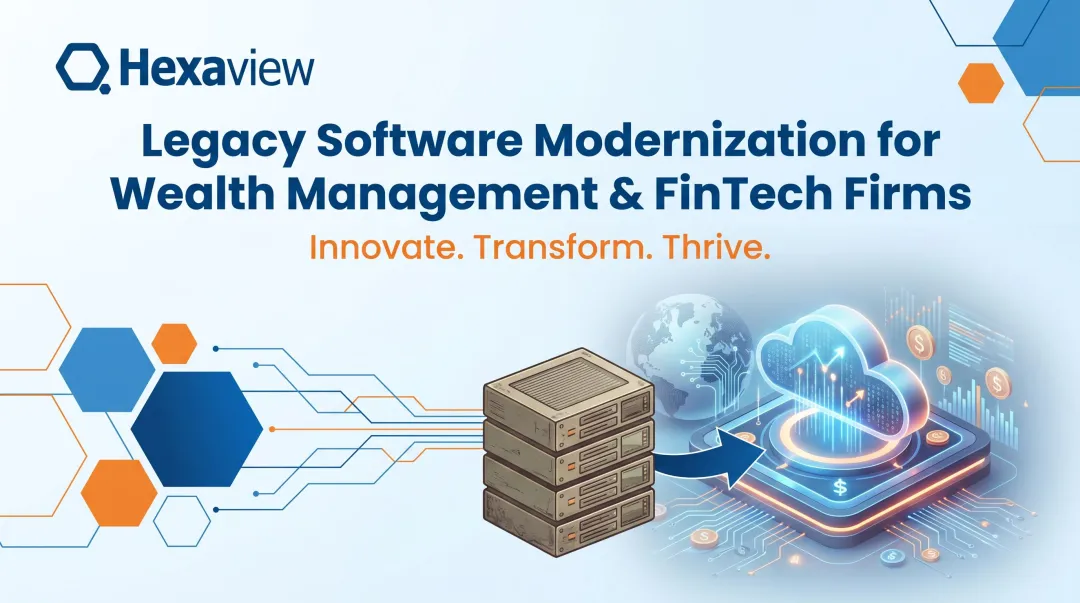

Application modernization services help businesses move these legacy systems onto secure, scalable, cloud-ready platforms without breaking what already works. But the stakes are real: modernization attempts fail roughly 70% of the time, going over budget or never launching at all (Hexaview internal data).
This article covers what modernization actually means, the strategic frameworks that guide it, what a modernization service typically includes, and how to pick a partner that won't add you to that failure statistic.
Key Takeaways
- Match each app to a proven strategy (rehost, refactor, replatform, or rearchitect) based on cost, risk, and business goals
- Use AWS's "7 R's" framework to decide which approach fits each application
- A preservation-first, phased approach prevents the downtime and lost business logic that sink most projects
- Domain expertise in regulated industries like fintech and healthcare cuts compliance risk
- Treat modernization as an ongoing discipline, not a one-time rewrite
What Is Application Modernization?
Application modernization means updating a legacy system's architecture, code, or infrastructure to meet current business, security, and performance requirements. Google Cloud frames it as a continuous cycle: assess the application portfolio, plan the transformation, implement changes, then measure results.
This goes well beyond a simple version upgrade. Modernization can involve:
- Cloud migration — moving workloads off on-premises servers
- Microservices decomposition — breaking monolithic applications into independent, deployable services
- Containerization — packaging applications for portability across environments
- AI-assisted code transformation — using automated tools to analyze and convert legacy codebases faster
Those tactics only work if you protect what the old system already knows how to do.
The Risk Hidden in Legacy Logic
Many businesses treat legacy systems as a background problem until something breaks. But undocumented COBOL and AS/400 systems often hold 40+ years of business logic that nobody currently on staff fully understands.
Hexaview's preservation-first methodology exists specifically to capture that logic before any code gets touched, validating it with domain experts at every stage rather than guessing.
Why Application Modernization Services Matter
Most in-house IT teams simply don't have bandwidth for large-scale modernization on top of daily operations. Specialized services bring proven frameworks, dedicated architects, and tooling that would take years to build internally.
That gap shows up in strategy, not just staffing. In Deloitte's survey of 504 US IT decision-makers at companies with revenue above $500M, 65% of C-level respondents called data modernization a key driver of their cloud migration strategy.
Meeting those priorities still depends on controlled execution. Professional modernization services reduce risk through:
- Structured assessment before any code changes begin
- Dependency mapping that reveals hidden risks automated tools would miss
- Phased execution instead of risky big-bang rewrites
- Rollback rehearsals built into every migration wave
Signs Your Business Needs Modernization Services
- Maintenance costs climbing year over year with no corresponding value gain
- Security vulnerabilities that patches can no longer fully address
- Poor scalability during peak demand or growth periods
- Difficulty hiring developers who know your legacy stack (COBOL talent is nearly extinct)
- Integration headaches connecting old systems to modern tools like Salesforce or AI platforms
The 7 R's of Application Modernization Strategies
AWS's framework outlines seven strategies for handling legacy applications. Not every application needs the same treatment. The right choice depends on cost, risk tolerance, and how critical the system is to the business.
- Rehost (lift-and-shift): Move the app to the cloud with minimal code changes. Fast, but performance and architecture problems stay in place.
- Replatform: Apply moderate optimization during the move (swapping a database engine or adopting managed cloud services) without a full rewrite.
- Refactor: Restructure the code for performance and maintainability while keeping functionality identical.
- Rearchitect: Redesign into a new architecture, often microservices, to unlock scalability and cloud-native capabilities.
- Rebuild: Rewrite from scratch on a modern stack when incremental change costs more than starting over.
- Replace: Swap in a SaaS or commercial alternative that already meets the business need.
- Retire: Decommission systems that no longer deliver value and reclaim the budget behind them.

Most real-world projects blend several of these. An enterprise portfolio might rehost non-critical apps quickly while rearchitecting the platform that runs the business.
Hexaview's internal research flags pure lift-and-shift as "mathematically destined for failure" when teams skip deep system understanding first. One Hexaview client transitioned an obsolete Silverlight application to HTML5 as a targeted refactor rather than a wholesale rebuild.
What Application Modernization Services Typically Include
A comprehensive engagement covers far more than "move it to the cloud." Here's what a serious modernization partner should deliver:
Assessment and Roadmap Planning
Before touching a single line of code, the team audits legacy architecture, maps dependencies, and quantifies technical debt. Hexaview's framework, for instance, crawls millions of lines of code to build automated dependency graphs mapping data flows, jumps, and calls—turning years of undocumented logic into an actionable execution roadmap.

Cloud Migration and Replatforming Support
Teams move workloads to AWS, Azure, or hybrid environments with minimal downtime. In one healthcare case, patient data and applications moved to Azure with zero downtime through phased planning and rollback rehearsals.
Legacy Stack Modernization
- Converting monoliths into microservices
- API-enabling legacy systems so they can talk to modern platforms
- Modernizing data layers without losing historical accuracy
Security and Compliance Upgrades
Fintech and healthcare clients need security designed in from the start. Modern authentication, encryption, and regulatory frameworks (HIPAA, SOX, GDPR, KYC/AML, SOC 2) should be built into the architecture, not bolted on afterward.
When evaluating a partner, look for concrete credentials: AWS Select Tier Service Partner status, SOC 2 Type 2 certification, and a decade-plus track record in regulated sectors like fintech and healthcare are strong signals of reliability.

AI-Assisted Modernization
AI-powered code analysis accelerates legacy transformation by tracing decades-old logic automatically, while engineers validate accuracy at each step.
How to Choose an Application Modernization Consulting Partner
Not every provider is equipped for complex, regulated environments. Focus your evaluation on:
- Domain expertise: Generalists often miss wealth management, healthcare, or insurance compliance details. Ask for case studies in your vertical and how they handled audit, access, and data controls.
- Certifications and security credentials: SOC 2 Type 2, ISO 27001, and cloud partner tiers (such as AWS Select Tier) signal audited processes—not just logos. Request the report scope and how controls map to your environment.
- Phased delivery approach: Prefer incremental releases with rehearsed rollback over “big bang” rewrites. Ask what happens mid-migration if a cutover fails, and who owns the rollback runbook.

Shortlist partners who can prove these points with references and a scoped pilot—not slideware alone.
Common Challenges in Modernization Projects
Even well-planned modernization runs into friction. The most common issues:
- Organizational resistance: Teams comfortable with legacy tools resist change. Training and upskilling need to happen alongside technical work, not after it.
- Undocumented dependencies: Decades-old systems rarely have accurate documentation. Automated dependency-mapping tools that build data-flow graphs replace guesswork with a clear map.
- Competing priorities: Business teams want new features; IT needs to modernize the foundation. Phased delivery lets both happen in parallel instead of forcing a painful choice.
Frequently Asked Questions
What does application modernization mean?
It means updating legacy software's architecture, code, or infrastructure to meet current business, security, and performance needs. This spans everything from cloud migration to full architectural rebuilds.
What are examples of application modernization strategies?
Common strategies include rehosting (lift-and-shift), refactoring, replatforming, and rearchitecting. A company might refactor a billing system's code while rearchitecting its customer portal into microservices.
What are the 7 R's of modernization?
AWS defines them as Retire, Retain, Rehost, Relocate, Repurchase, Replatform, and Refactor/Re-architect. Microsoft's version differs slightly, so always check which framework a vendor references.
What is cloud modernization and how does it work?
Cloud modernization means adapting applications to use cloud-native services, elastic scalability, and managed infrastructure instead of on-premises hardware. It typically involves replatforming or rearchitecting existing workloads.
What are legacy application modernization services?
These are specialized offerings covering assessment, migration, refactoring, and ongoing support for outdated systems. Providers typically combine technical execution with compliance and security upgrades.
What is application modernization consulting?
It's expert guidance on assessing, planning, and executing a modernization strategy tailored to your business goals. Good consulting starts with understanding your legacy system before recommending any technical fix.