

Advanced data science consulting has entered a new era. Businesses are no longer satisfied with static dashboards or quarterly model refreshes. In 2025, the most competitive organizations are deploying agentic AI in data science for systems that reason, decide, and act on data without waiting for human instruction. This guide covers what that shift looks like, why it matters, and how to choose the right partner to lead it.
Advanced data science consulting goes well beyond building spreadsheet models or training a single classification algorithm. It is a strategic engagement in which specialized teams design, build, and operationalize data intelligence systems that directly drive business outcomes.
Where traditional analytics consulting delivers reports, advanced data science consulting delivers capability like production-grade infrastructure that learns, adapts, and scales. The service spectrum spans three maturity tiers:
In 2024–2025, the definition expanded further to include AI agent orchestration: multi-step reasoning systems that coordinate tools, data sources, and APIs to complete complex analytical tasks end-to-end. That is the frontier where the most consequential advanced data science consulting work is now happening.
The most significant shift in enterprise data strategy over the past two years has been the emergence of agentic AI in data science. Unlike traditional machine learning models which produce a score or prediction and stop agentic systems, set intermediate goals, use tools, evaluate results, and take action in a continuous loop.
Think of the difference this way: a predictive churn model tells you which customers are likely to leave. An agentic AI in data science system identifies those customers, pulls their interaction history, drafts personalized retention offers, routes them through the appropriate channel, and logs outcomes, all without a human in the loop.
41% of enterprise data teams had active autonomous data workflows in 2025, up from just 8% in 2022 (McKinsey Global Survey on AI)
Companies using agentic AI in data science reduced manual reporting effort by an average of 62% (Gartner, 2025)
The global advanced data science consulting market is projected to reach $152 billion by 2027 (IDC)
This is not a trend confined to large tech companies. Mid-market firms in financial services, healthcare, retail, and manufacturing are actively deploying autonomous data workflows and the consulting partners who understand agentic architecture are the ones winning mandates.

Autonomous data workflows are not magic but they are a precisely engineered stack of four interconnected layers working in concert.
The ingestion layer pulls real-time data from APIs, cloud data warehouses, IoT sensors, and SaaS platforms continuously, not on a cron schedule. The orchestration layer uses tools like Apache Airflow, Prefect, or Dagster to trigger agent tasks based on data conditions, time triggers, or upstream events. The agent reasoning layer is where LLM-based agents evaluate incoming data, determine what action is warranted, use tools like SQL engines or external APIs to gather context, and decide or escalate to a human reviewer when confidence is low. Finally, the action layer executes generating reports, retraining models, sending alerts, updating downstream systems, or triggering business processes.
The outcome is a shift from "analysts reading dashboards and deciding" to "systems acting on data and flagging exceptions." That is the core value proposition of mature advanced data science consulting in 2025.
Signs your business is ready for autonomous data workflows:
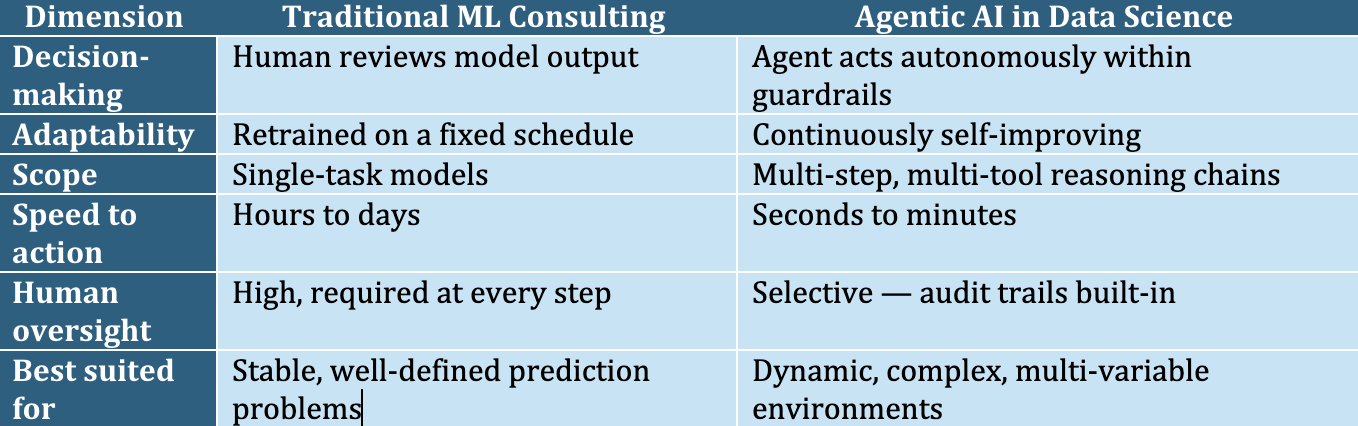
The distinction matters when scoping an engagement. Many firms selling advanced data science consulting are still operating in the traditional ML paradigm, building models, handing them off, and leaving operationalization as the client's problem. Genuinely modern agentic AI in data science partners own the full stack: from data architecture through agent design, orchestration, monitoring, and continuous improvement.
Advanced data science consulting delivers measurably different results depending on the industry context. Here is where autonomous data workflows and agentic AI in data science are creating the most impact right now.
Financial Services: Fraud detection agents evaluate thousands of transactions per second, cross-reference behavioral patterns, and escalate anomalies in real time — without human triage. Portfolio risk agents monitor market signals continuously and trigger rebalancing recommendations before human analysts have opened their morning dashboards.
Healthcare: Autonomous data workflows aggregate patient data across electronic health records, flag clinical deterioration risk, and notify care teams proactively. In pilot deployments, this has reduced response time from several hours to under ten minutes.
Retail and E-Commerce: Agentic AI in data science powers dynamic pricing engines that respond to competitor price shifts, inventory depletion, and demand signals simultaneously, updating thousands of SKU prices per hour without human intervention.
Manufacturing: Predictive maintenance models feed directly into autonomous workflow systems that schedule service tickets, order replacement parts, and reroute production lines before equipment fails, turning reactive maintenance into a fully automated, proactive operation.
The advanced data science consulting landscape is crowded with firms that offer predictive modeling but have limited depth when it comes to production-grade agentic AI in data science and autonomous data workflows. Hexaview operates differently and the difference is structural, not cosmetic.
Most consulting firms deliver a model and exit. Hexaview's engagement model covers the full lifecycle: data architecture, feature engineering, model development, agent orchestration, MLOps instrumentation, and continuous performance monitoring. Clients do not receive a notebook they receive a running, monitored, production system.
While many consultancies are still learning multi-agent frameworks, Hexaview has built production deployments using LangGraph, AutoGen, and proprietary orchestration layers. Their teams design autonomous data workflows that include built-in human escalation paths, audit logging, and drift detection — the elements that separate a proof-of-concept from an enterprise-grade system.
Hexaview brings vertical-specific experience across financial services, healthcare, retail, and SaaS, meaning their advanced data science consulting engagements start with domain knowledge, not a blank whiteboard. That translates to faster time-to-value and fewer costly scope revisions mid-project.
Hexaview structures engagements around measurable outcomes reduction in analyst hours, improvement in model accuracy, increase in automated decision coverage rather than time-and-materials billing. This alignment of incentives means their definition of success matches the client's.
Every autonomous data workflow Hexaview delivers is architected with data governance, access control, and compliance requirements embedded from the start not bolted on after. For regulated industries, this is not optional; it is the baseline.
In a market where agentic AI in data science is frequently promised and rarely delivered at production quality, Hexaview's track record of operationalizing autonomous data workflows at enterprise scale makes them a genuinely differentiated choice.
Not every firm offering advanced data science consulting has the capability to deliver agentic AI in data science at production scale. Here is a framework for evaluating partners before you sign.
What to look for:
Advanced data science consulting in 2025 is not about building smarter models in isolation, it is about building systems that think, act, and improve continuously. The organizations pulling ahead are those that have moved beyond predictive analytics into fully operationalized agentic AI in data science, where autonomous data workflows handle the work that used to require rooms full of analysts.
The right consulting partner does not just deliver a model. They deliver infrastructure your team can own, monitor, and scale and they stay accountable for the outcomes it produces. That distinction, more than any technical credential, is what separates genuine advanced data science consulting from expensive experimentation.
Q1: What is the difference between data science consulting and advanced data science consulting?
Standard data science consulting typically covers analytics, visualization, and basic model building. Advanced data science consulting includes production MLOps, agentic AI in data science, and autonomous data workflows that operate continuously in live business environments not just in controlled experiments.
Q2: What are autonomous data workflows?
Autonomous data workflows are end-to-end automated pipelines where data ingestion, analysis, decision-making, and action are handled by software systems, including AI agents without requiring human intervention at each step. They are the operational backbone of modern advanced data science consulting engagements.
Q3: How long does an advanced data science consulting engagement typically take?
Discovery and audit phases typically run four to eight weeks. Full production deployment of autonomous data workflows or agentic AI in data science systems generally requires six to eighteen months, depending on data infrastructure maturity and business complexity.
Q4: Is agentic AI in data science suitable for mid-market businesses or only enterprises?
Agentic AI in data science is increasingly accessible to mid-market organizations. Cloud-native tooling and modular agent frameworks have reduced infrastructure cost significantly. The most relevant question is data readiness, not company size. A mid-market firm with clean, structured data is often better positioned than a large enterprise with fragmented data architecture.
Q5: How do I know if my business data is ready for autonomous workflows?
Key readiness indicators include centralized or federated data storage in a cloud warehouse, consistent data labeling and schema management, at least one ML model already in production, and a defined business process where data-driven decisions are made repeatedly. If those conditions are met, advanced data science consulting partners can typically scope an autonomous data workflows engagement within a two-week discovery sprint.




.svg)



.svg)