
The way businesses use artificial intelligence inside Salesforce has changed more in the last two years than in the previous decade. Einstein AI, Salesforce's foundational intelligence layer, spent nearly a decade becoming the backbone of predictive CRM by scoring leads, forecasting pipelines, recommending the next best actions. It was, and still is, deeply embedded in how Salesforce users think about AI assistance.
But Agentforce changed the equation entirely.
Launched in 2024 and now maturing rapidly through 2026, Agentforce is not simply an upgrade to Einstein. It is a fundamentally different model of AI. It is an upgrade that moves from reactive assistance to autonomous action. Where Einstein answers questions and surfaces insights, Agentforce takes decisions, executes workflows, and operates independently across multi-step processes without waiting to be prompted.
For CTOs, Salesforce architects, and business leaders, this creates a genuine strategic question: which platform do you invest in, when do you use each, and how do you migrate without breaking what already works?
This guide answers all three with a clear technical breakdown, a practical decision framework, and a step-by-step migration roadmap built for 2026 realities.
Check the Top 10 Salesforce Implementation Partners
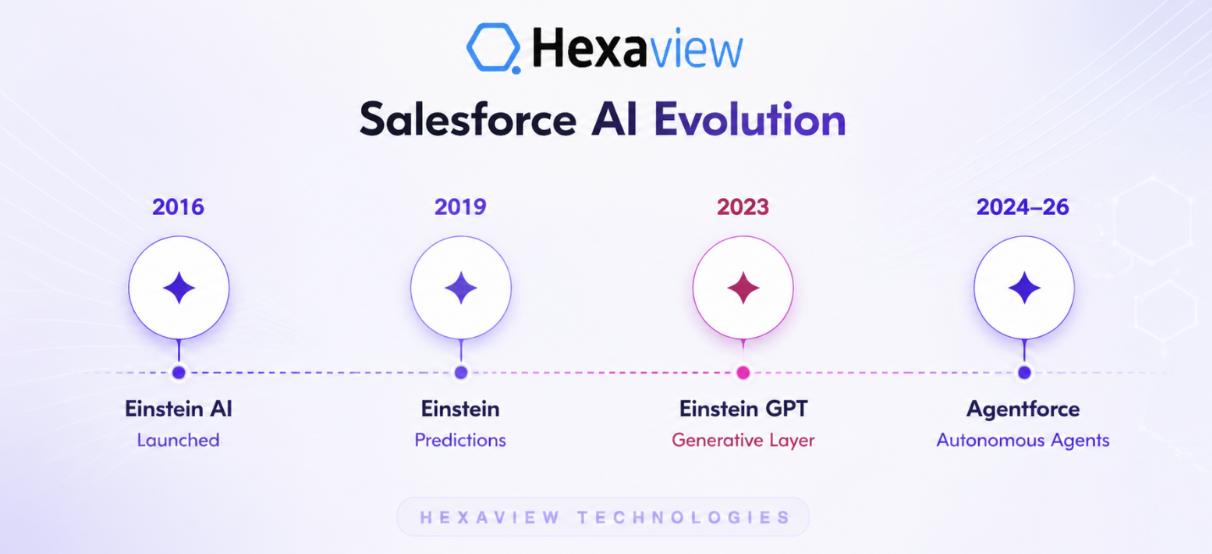
Einstein AI is not a single product. It is a suite of capabilities woven across every Salesforce cloud like Sales, Service, Marketing, Commerce, and Analytics. Since its launch in 2016, Einstein has given Salesforce users the ability to move beyond gut-feel decisions and into data-driven action.
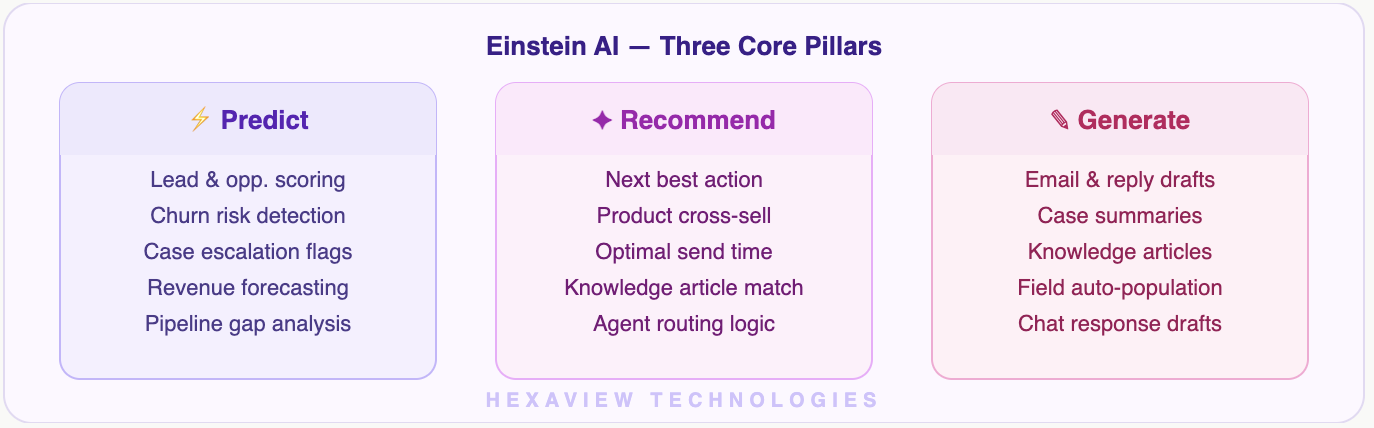
At its core, Einstein operates across three pillars.
What has always made Einstein powerful is how native it feels. Scores appear inside opportunity records. Recommendations surface in case queues. Generated content slots into the compose window without leaving the Salesforce interface. There is no separate tool to open, no API to call as Einstein meets users where they already work.
Einstein Copilot, Salesforce's conversational assistant layer, extended this further in 2023–24, allowing users to ask natural language questions like "show me deals at risk this quarter" or "summarize this customer's last five interactions" and receive intelligent answers without writing a single query.
Where does Einstein AI excel? Structured, single-turn intelligence tasks embedded directly in the CRM experience. It is a co-pilot that makes individual users faster and smarter.
Where Einstein AI shows its limits? Anything requiring multi-step execution, cross-system orchestration, or autonomous decision-making without a human in the loop. Einstein will tell your rep the lead is hot. It will not contact the lead, book a meeting, update the opportunity, and send a follow-up and that is Agentforce's territory.
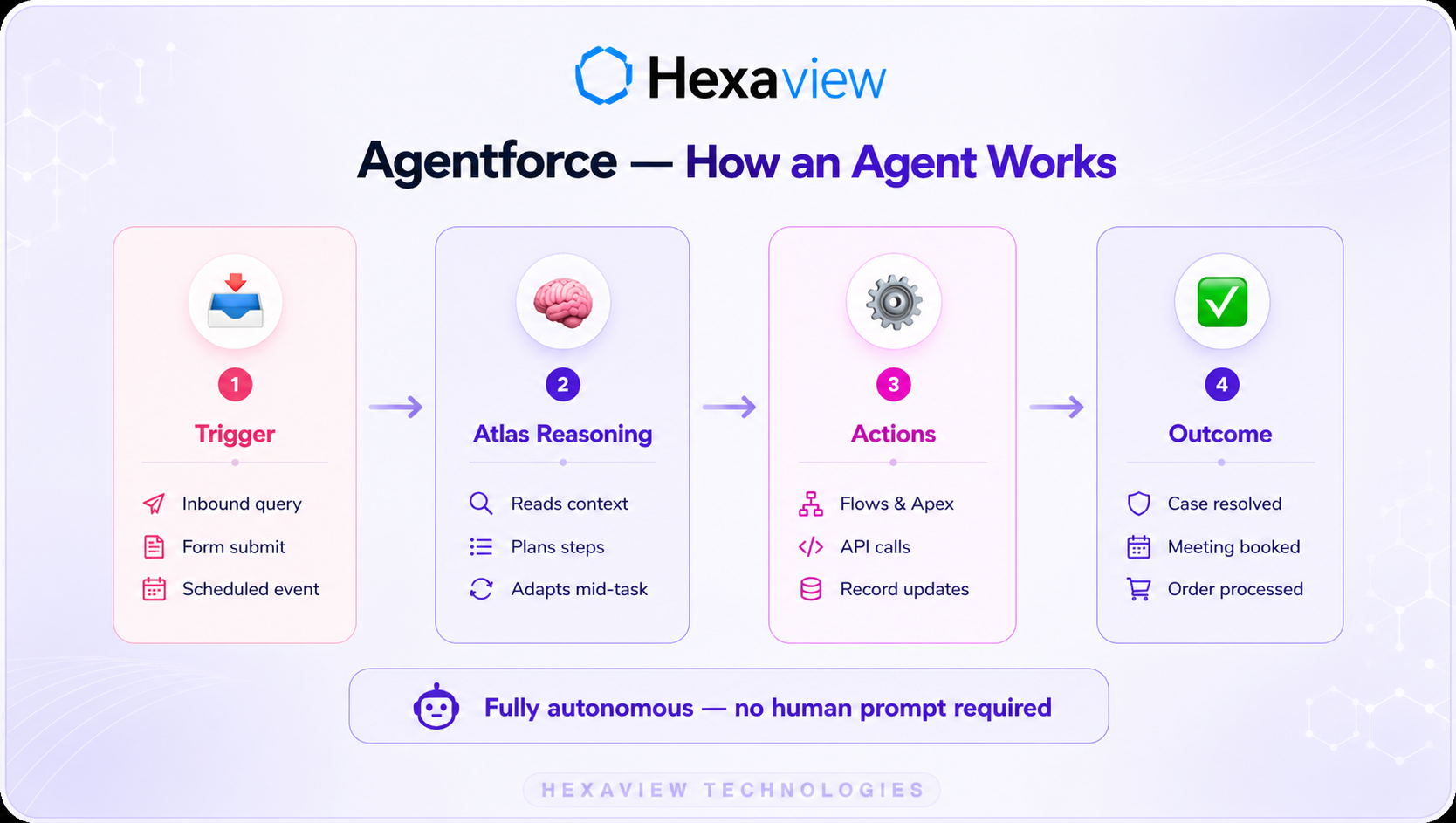
Agentforce represents a different philosophy of AI entirely. Rather than augmenting a human's decision-making, it replaces the need for human involvement in certain categories of work altogether. An Agentforce agent can observe a situation like an inbound customer query, a stalled deal, a submitted form and reason about what needs to happen and then take action across one or many systems without waiting for a user to approve each step.
The engine powering this is the Atlas Reasoning Engine, Salesforce's proprietary decision-making framework that allows agents to chain together multiple steps, evaluate outcomes, and adapt mid-task if something changes. Unlike a bot with a fixed script, an Agentforce agent interprets context dynamically, which means it can handle variation, exception cases, and incomplete inputs in ways that traditional automation cannot.
Read This To Know More About Salesforce Agentforce
Agentforce ships with a set of pre-built agents for common Salesforce use cases: a Sales Agent that qualifies leads and books meetings, a Service Agent that resolves Tier 1 cases without escalation, a Commerce Agent that manages order status and returns, and a Marketing Agent that executes personalized outreach sequences. Each can be deployed with relatively low configuration for teams that want speed.
For organizations with more complex needs, Agentforce Studio provides a low-code interface for building entirely custom agents, defining the topics an agent handles, the actions it can take, the data sources it can query, and the guardrails that govern its behavior. Coupled with Data Cloud for unified customer profiles and MuleSoft for external system connectivity, Agentforce can operate across Salesforce and beyond.
The key difference in one sentence: Einstein AI makes your people smarter. Agentforce makes certain tasks not require people at all.
Understanding where the two platforms truly diverge requires looking beyond the marketing language. The differences are architectural, philosophical, and commercial.
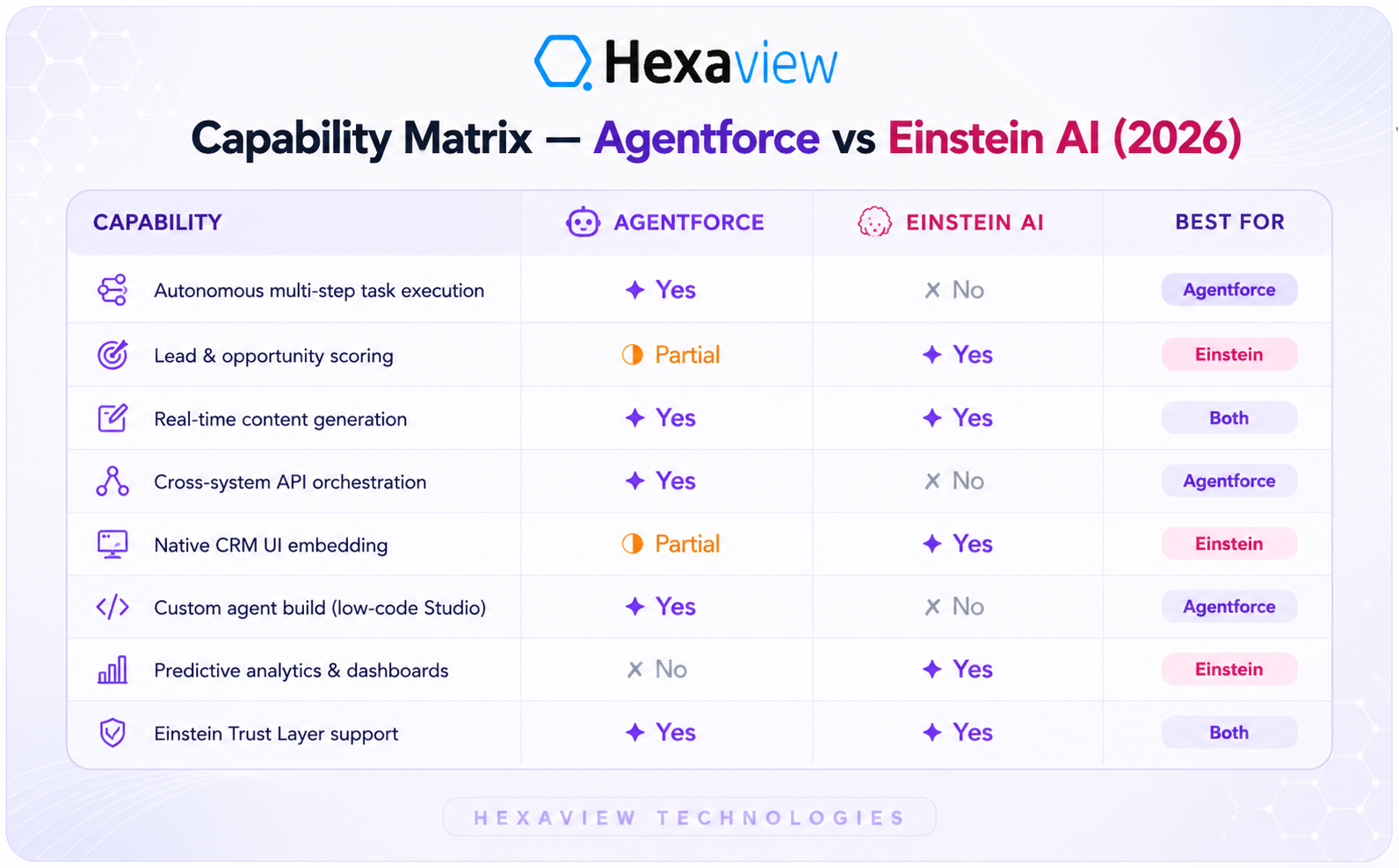
The most common mistake organizations make is framing this as an either/or decision. In most mature Salesforce orgs, the right answer is a deliberate combination of both with Einstein providing the intelligence layer and Agentforce providing the execution layer. The question is not which one wins, but which one owns which job.
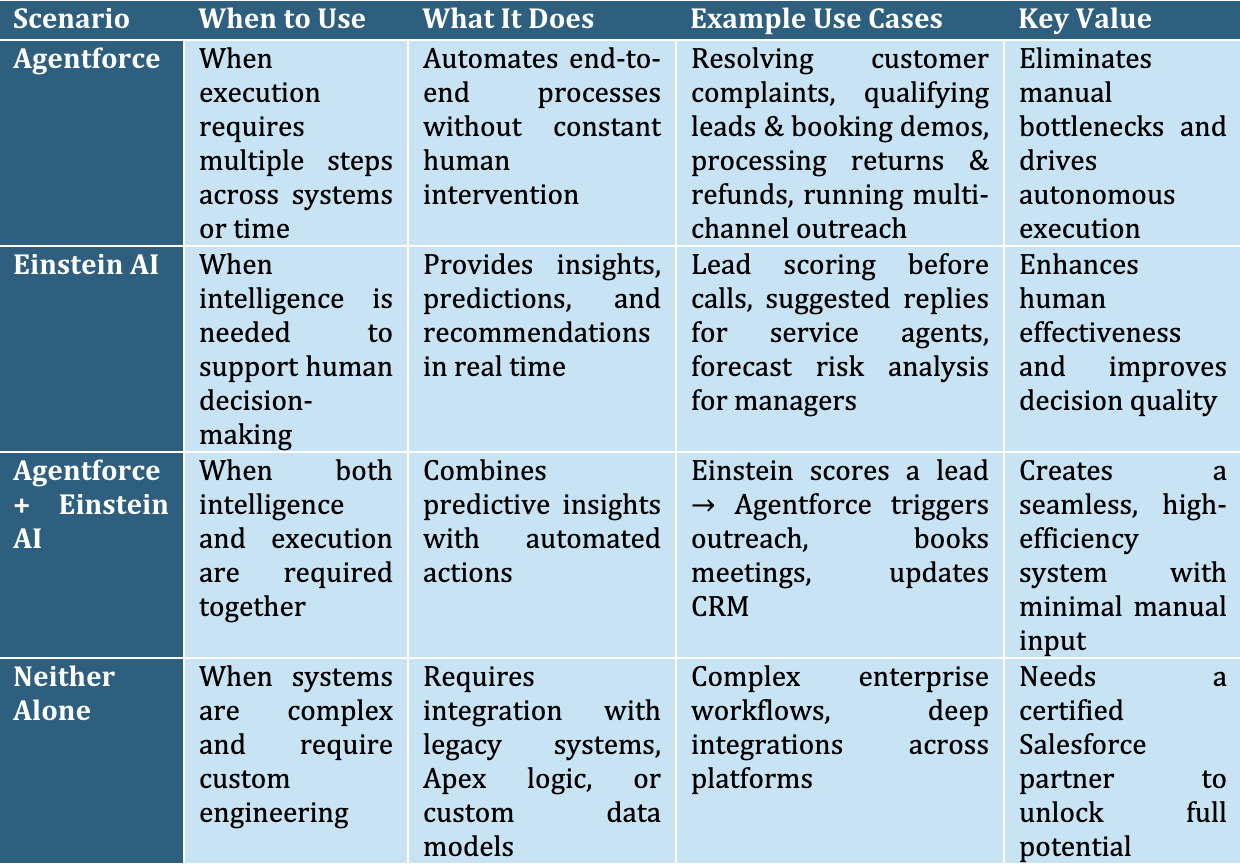
Migration is the wrong word for most organizations. A wholesale replacement of Einstein with Agentforce is neither practical nor advisable; they serve different purposes, and many Einstein capabilities have no direct Agentforce equivalent. The better frame is evolution: identifying which workflows are ready for Agentforce and standing up the new capability alongside what already works.
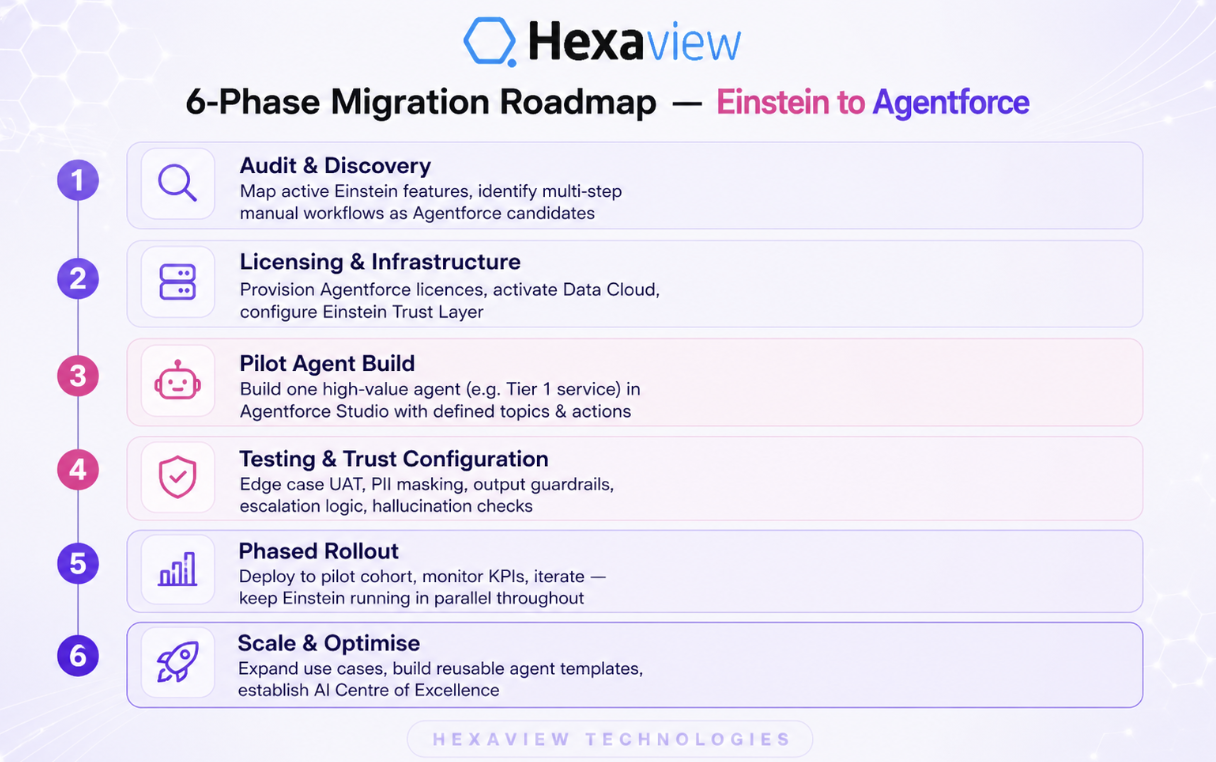
Phase 1: Audit & Discovery. Before touching a single configuration, map every Einstein feature currently active in your org: which scores are being used, which Copilot features are enabled, which automation flows depend on Einstein recommendations. Cross-reference this against your team's manual workflows; these are your Agentforce candidates. Any multi-step, repetitive, human-mediated process is worth evaluating.
Phase 2: Licensing & Infrastructure. Agentforce requires specific licensing that is separate from standard Salesforce clouds. You will also need Data Cloud provisioned if you want agents to work across unified customer profiles, which is where much of Agentforce's power comes from. Confirm the Einstein Trust Layer is configured for your org before any agent goes live.
Phase 3: Pilot Build. Choose one high-value, well-understood use case for your first agent. Tier 1 service resolution is the most common starting point; it is high volume, well-defined, and the business value of deflection is easy to measure. Build the agent in Agentforce Studio, define its topics, permitted actions, and escalation rules, and run it against test cases before exposing it to live traffic.
Phase 4: Testing & Trust Configuration. Agentforce agents need rigorous testing across edge cases, not just the happy path. Configure PII masking for any data the agent surfaces. Set output guardrails for tone and content. Define what the agent should do when it cannot resolve something, which a clean escalation to a human is always better than a confident wrong answer.
Phase 5: Phased Rollout. Do not flip the switch for the entire org at once. Release to a defined user cohort or customer segment, monitor closely, and iterate. Keep Einstein running in parallel for the use cases it owns. Measure agent resolution rate, escalation rate, customer satisfaction, and handle time against pre-Agentforce baselines.
Phase 6: Scale & Optimize. Once the pilot proves value, expand to additional use cases, build reusable agent templates, and establish a Centre of Excellence with clear ownership of agent governance, performance monitoring, and ongoing iteration.
Choosing the right platform is only half the equation. The real impact comes from how well it is implemented. The architectural decisions made in the first sprint, the way your data model is structured, the design of your agents, and the governance framework you put in place ultimately determine whether your Agentforce investment delivers measurable ROI or turns into an expensive experiment.
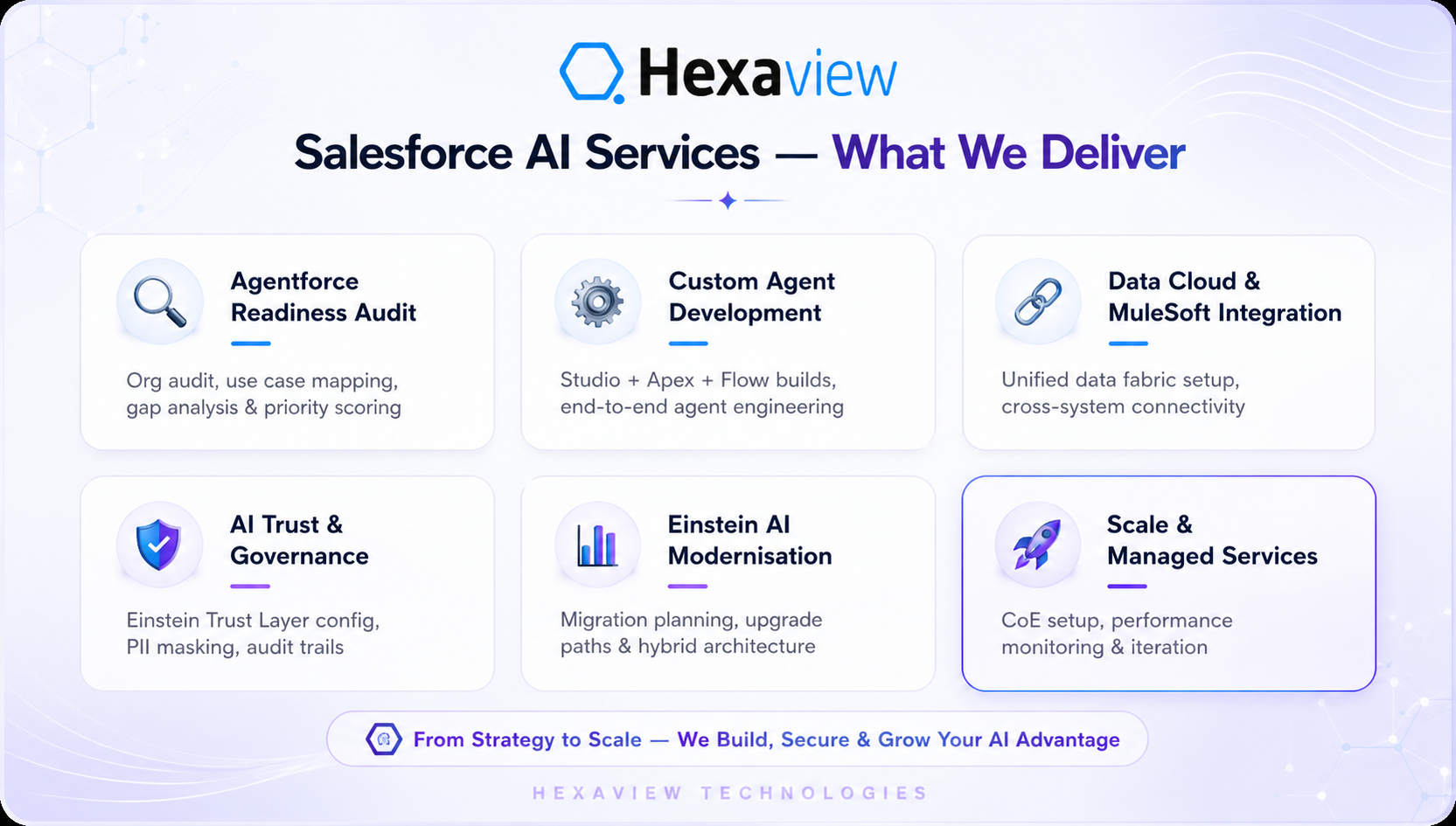
Hexaview Technologies stands out as a certified Salesforce development services partner with deep, hands-on expertise across both Einstein AI and Agentforce. Our experience spans the entire AI delivery lifecycle, ensuring that every implementation is strategic, scalable, and aligned with business outcomes.
Our capabilities include:
• Readiness audits to assess your current ecosystem
• Use case identification and prioritization based on impact
• Agent design and development tailored to your workflows
• Data Cloud integration for unified, real-time data access
• Post-launch optimization to continuously improve performance
We have successfully delivered Salesforce implementations across industries such as financial services, healthcare, retail, and manufacturing. This gives us a dual advantage: not only do we understand the platform in depth, but we also understand the real-world business environments your agents must operate in.
What truly differentiates Hexaview is our approach. We do not treat AI as a plug-and-play solution. Every engagement begins with a deep understanding of your data, your processes, and your people. An agent that does not align with your organization's data model will underperform, no matter how advanced the technology behind it is.
Our certified architects bring full-stack expertise, working seamlessly across:
• Agentforce Studio for intelligent agent configuration
• Custom Apex for advanced logic and scalability
• Salesforce Flow for process automation
• MuleSoft for complex system integrations
• Data Cloud for unified data architecture
This allows us to design and build agents that are not only functional but truly scalable and enterprise ready.
Our Agentforce development services cover:
• End-to-end agent design and implementation
• Einstein AI modernization and migration strategy
• Data Cloud and MuleSoft integration
• Einstein Trust Layer configuration for secure AI deployment
• Ongoing managed services for continuous improvement
Whether you are exploring your first agent or looking to scale an existing Agentforce implementation, Hexaview Technologies brings the expertise, structure, and accountability needed to ensure success.
Agentforce implementations that underperform almost always trace back to a small set of avoidable mistakes. Understanding them before you start is the difference between successful deployment and an expensive lesson.
Agentforce and Einstein AI are not competitors. They are complements where each doing what the other cannot. Einstein makes your people more intelligent. Agentforce makes certain work not require people at all. The organizations that will extract the most value from Salesforce's AI platform in 2026 are the ones that understand where each platform belongs and invest in implementing both with the care and expertise the opportunity deserves.
The decision framework is simpler than it appears: if a user needs an insight to make a better decision, that is Einstein. If a process needs to run from start to finish without a human in the loop, that is Agentforce. If a high-volume workflow needs both intelligence and autonomous execution, that is both working in tandem through a well-designed data architecture.
Hexaview Technologies is ready to help you make that happen. Whether you are starting with your first Agentforce readiness audit, planning a Data Cloud integration, or looking for a certified Salesforce Agentforce implementation partner to lead your full deployment, our team has the expertise, the track record, and the technical depth to deliver.
1. What is the main difference between Agentforce and Einstein AI?
Einstein AI provides predictive and generative intelligence that helps users make better decisions within Salesforce. Agentforce goes a step further by acting autonomously on those decisions, executing multi step workflows without requiring human input at each stage.
2. Can Agentforce replace Einstein AI entirely?
No, they serve different purposes. Einstein remains the stronger choice for embedded CRM intelligence such as lead scoring, forecasting, content generation, and recommendations. Agentforce focuses on autonomous execution. Most mature organizations will use both together.
3. Do I need Data Cloud to use Agentforce?
Technically, no. However, in practical terms, it is essential if you want meaningful results. Without Data Cloud providing unified customer profiles, agents operate on incomplete CRM data, which limits their reasoning quality and the value they can deliver.
4. Is Agentforce included in my existing Salesforce license?
No, Agentforce is licensed separately from standard Salesforce cloud subscriptions. Licensing is typically structured on a consumption or per seat basis, depending on the type of agent. You will need to work with your Salesforce account executive or an implementation partner to confirm pricing for your specific use case.
5. How long does it take to implement an Agentforce agent?
A focused pilot involving one well defined agent with a clear scope, clean data, and an experienced implementation partner typically takes four to eight weeks from discovery to go live. More complex deployments involving multiple agents or requiring Data Cloud setup and MuleSoft integration will take longer.
6. Is Agentforce safe to use with sensitive customer data?
Yes, provided the Einstein Trust Layer is properly configured. This includes PII masking, zero data retention by the underlying language model provider, toxicity filtering, and full audit logging. Proper configuration is essential before any agent interacts with live customer data.
7. What Salesforce clouds does Agentforce work with?
Agentforce offers prebuilt agent types for Sales Cloud, Service Cloud, Commerce Cloud, and Marketing Cloud. Custom agents created in Agentforce Studio can be designed to work across multiple clouds and can also connect to external systems through MuleSoft or custom API integrations.
8. What is the Atlas Reasoning Engine?
The Atlas Reasoning Engine is Salesforce’s proprietary decision-making framework that powers Agentforce agents. It enables agents to understand context, plan sequences of actions, execute tasks, evaluate outcomes, and adapt in real time rather than following a fixed or pre-scripted path.




.svg)




.svg)