

Most enterprises want to adopt AI. Few know where to start. This guide walks you through everything, from readiness assessment to full-scale roadmap execution, so you can turn ambition into measurable results.
Artificial intelligence is no longer a competitive advantage; it's becoming a baseline expectation. By 2030, the global AI market is projected to exceed $1.8 trillion. Yet despite massive investment in AI tools, platforms, and talent, a striking number of enterprise AI initiatives fail to deliver on their promise, not because the technology doesn't work, but because there was no coherent strategy behind it.
This is precisely where AI consulting services come in. Whether you're a financial services firm navigating regulatory complexity, a manufacturer exploring predictive maintenance, or a retailer seeking to personalize at scale, the difference between AI that transforms your business and AI that drains your budget is almost always strategic, not technical.
This guide covers everything you need to know what AI consulting services actually include, why your business needs an AI strategy before it needs an AI tool, how to build a roadmap that delivers measurable results, and how to choose the right AI advisory partner. Let's begin.
AI consulting services are expert-led engagements that help organizations identify, design, and deploy artificial intelligence solutions aligned to their specific business goals thereby reducing risk, accelerating time-to-value, and ensuring every AI investment generates measurable returns.
Unlike general IT consulting, AI advisory services require deep expertise at the intersection of business strategy, data science, machine learning engineering, and change management. The best firms don't just recommend a technology but they architect the path from your current state to a future where AI is embedded into how you operate.
"AI consulting services bridge the gap between AI ambition and AI execution, turning strategy into deployable, value-generating systems."
High-level roadmap design, AI readiness assessment, use case prioritization, and technology selection. Ideal for organizations beginning their AI journey.
Hands-on model development, data pipeline engineering, MLOps setup, and system integration. Where strategy becomes reality.
Ongoing model monitoring, retraining, performance governance, and continuous improvement. Ensure your AI stays accurate and relevant over time.
Independent review of existing AI systems for bias, explainability, security, and regulatory compliance. Critical for regulated industries.
The best AI consulting partners offer all four capabilities, because strategy without execution is just a document, and execution without strategy is just expensive experimentation.
Every week, a new AI tool promises to transform your business. And many of these tools are genuinely powerful. But purchasing AI software is not the same as having an AI strategy and confusing the two is one of the most expensive mistakes enterprises make.
According to McKinsey, only 20% of organizations that adopt AI at scale actually capture significant bottom-line values. The gap between adoption and value is almost entirely explained by the presence or absence of a coherent AI strategy.
Key Insight
The #1 reason AI projects fail is not technological limitation, it's the absence of strategic alignment between AI initiatives and business objectives. A well-designed AI strategy is the single most important factor in determining whether your AI investment pays off.
Without a strategy, businesses face a predictable set of problems:
The businesses pulling ahead in AI are not those with the largest AI budgets, they are those with the clearest AI strategies. A good AI strategy defines not just what AI you will build, but why, in what sequence, and how you will measure success. That's where AI strategy consulting becomes transformative.
A winning AI strategy is not a single document, it's a living framework built on six interconnected pillars. Each one reinforces the others, and neglecting any one of them creates structural weakness that eventually surfaces as a failed project or a missed business outcome.
Organizations that invest in all six pillars and not just the technical ones, consistently outperform those that treat AI as a pure engineering problem. AI strategy consulting firms help you build this complete framework before a single line of model code is written.
An AI roadmap translates your strategy into a sequenced, time-bound execution plan. Without a roadmap, even the most sophisticated AI strategy remains aspirational. Here is how the most effective AI consulting firms structure the roadmap process.
Conduct executive workshops, stakeholder interviews, and cross-functional discovery sessions. Document pain points, strategic priorities, and organizational constraints. Define your AI ambition level: efficiency-focused, differentiation-seeking, or disruption-oriented. Without this alignment, even the best roadmap gets stalled by internal politics.
Run ideation sessions across business units to surface AI use cases. Score each against ROI potential, data availability, implementation complexity, and strategic urgency. Produce a prioritized use case register that becomes the foundation of your roadmap. Not all ideas are worth pursuing; this step separates the transformative from the trivial.
Audit existing data sources for completeness, quality, and accessibility. Evaluate infrastructure readiness for AI and ML workloads. Identify integration requirements with legacy systems and third-party platforms. Many organizations discover their most valuable data is locked in siloed, unstructured, or low-quality sources, this step exposes those gaps before they become roadblocks.
Organize prioritized use cases into three horizons: short-term quick wins (0–6 months), medium-term transformation (6–18 months), and long-term strategic differentiation (18+ months). Define milestones, resource requirements, and success metrics per phase. Align the roadmap to annual budgeting cycles so every initiative has a funded path to execution.
Select a high-value, manageable-risk use case for your first POC. Define success criteria before building, not after. Run rapid iteration cycles with continuous business stakeholder feedback. A well-chosen POC does two things: it generates early ROI evidence, and it builds organizational confidence in AI as a business tool.
Move successful POCs into production with MLOps pipelines for monitoring, retraining, and deployment. Establish model performance dashboards tied to business KPIs. Expand additional use cases on the roadmap in a sequenced, resource-conscious manner.
Conduct quarterly AI strategy reviews. Track against business KPIs and refresh the roadmap as markets, technologies, and business priorities evolve. Govern the full AI portfolio for risk, cost efficiency, and value delivery. AI is not a one-time project, it is a continuous capability that compounds in value over time.
Effective AI advisory services help organizations identify which use cases are worth pursuing and which are better deferred. Here are the categories generating the highest ROI across industries in 2025, based on deployment data from leading AI consulting engagements.
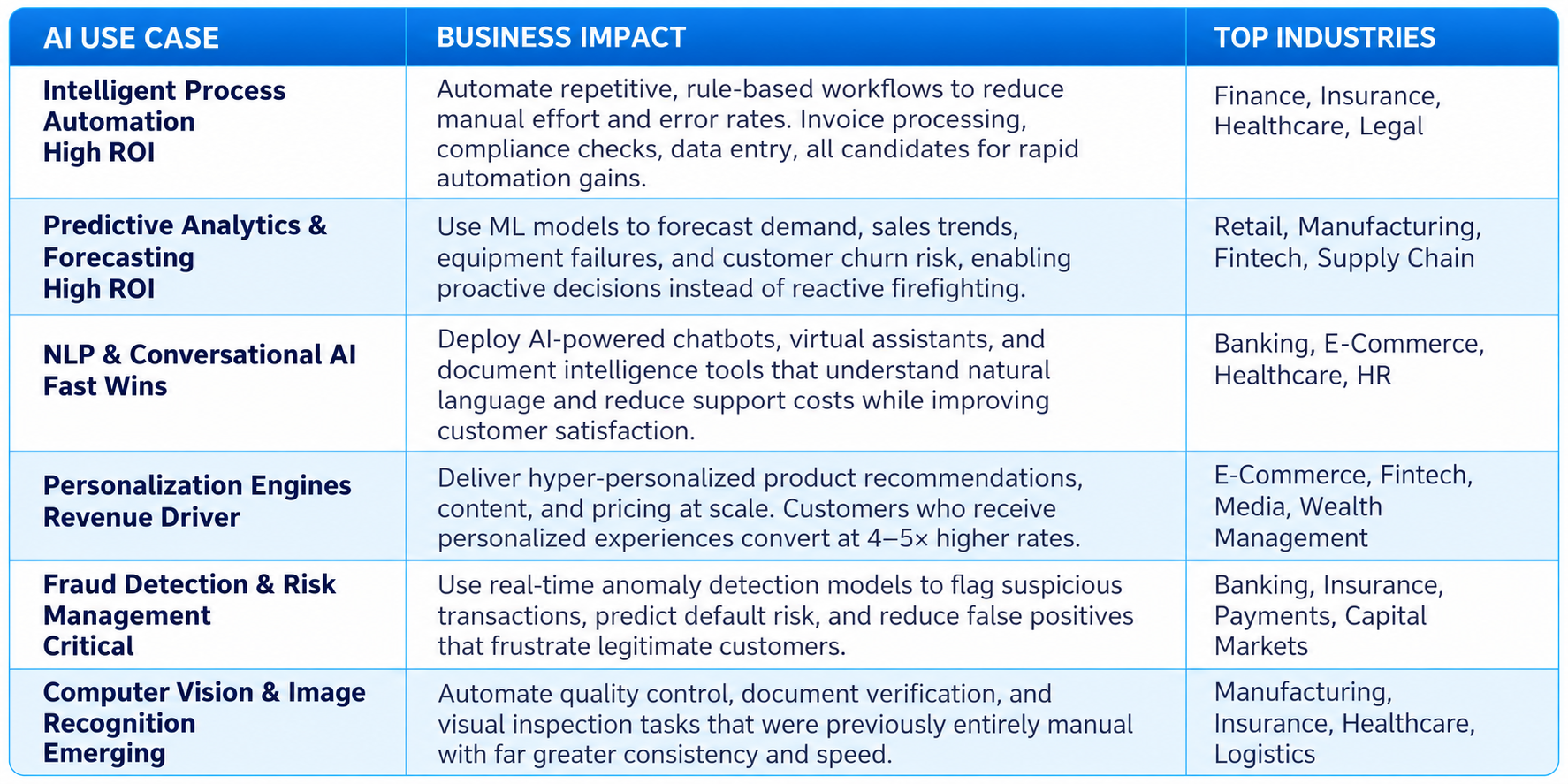
The right use case for your business depends on your industry, data maturity, and strategic priorities. A good AI strategy for consulting engagement helps you find the intersection of high impact and high feasibility and build there first.
Not all AI consulting firms are built the same. The right partner doesn't just deliver a strategy document, they act as a co-creator who can take you from a whiteboard concept to a production AI system that changes how your business operates. Here is how to evaluate your options.
Generic AI expertise is not enough. Look for proven, case-study-backed experience in your specific industry. A partner who has deployed AI in financial services understands compliance constraints that a general AI consultancy will have to learn on your dime.
The best AI consulting partners cover the full lifecycle: strategy → data engineering → model development → deployment → monitoring. Advisory-only firms hand you a plan with no way to execute it. Engineering-only firms build without strategic context. You need both.
A strong AI advisory partner recommends the best tool for your job, not just what they know, or what generates the most license revenue. Look for multi-cloud experience (AWS, Azure, GCP) and multi-framework capability (TensorFlow, PyTorch, scikit-learn, Hugging Face).
Ethical AI practices, model explainability, and regulatory compliance awareness should be embedded in your partner's methodology, not treated as an afterthought. Ask specifically how they handle bias auditing, model documentation, and governance.
The right partner builds your team's capability, not dependency on themselves. Knowledge transfer, internal documentation, training sessions, and pairing your staff with their engineers are all signs of a partner invested in your long-term success.
If you operate in banking, insurance, healthcare, or any other regulated sector, your AI consulting partner must understand compliance constraints as a first-class concern, not a footnote. Ask for specific examples of navigating regulatory environments similar to yours.
Building a successful AI strategy requires more than a polished roadmap document, it demands a partner who can bridge strategy and execution with real engineering depth. Hexaview Technologies is a purpose-built AI implementation partner for regulated enterprises, combining AI strategy consulting with hands-on machine learning development across the full technology stack.
Smart transformation of workflows, tech stacks, and entire organizations, enabling streamlined, exponential business growth through applied AI.
Robust algorithms built to automate processes across departments, minimize human intervention, reduce errors, and boost operational reliability at scale.
Real-time deep learning algorithms that uncover complex patterns and hidden opportunities in your enterprise data, going beyond surface-level analytics.
Next-generation virtual assistants and document intelligence tools that understand human language contextually and support smarter, faster decision-making.
Sales forecasting and predictive analytics that use historical data, seasonality, and economic signals to guide strategy and reduce operational uncertainty.
Unified, scalable data repositories that break down silos and create AI-ready data foundations; the infrastructure every AI strategy depends on.
Hexaview is trusted by leading organizations including BNY Mellon, LPL Financial, and multiple top-tier wealth management and capital markets firms, all operating in regulated environments where AI strategy and compliance must go hand in hand.
Even well-resourced organizations stumble when building their AI strategy. These are the most common and costly pitfalls, drawn from real-world AI consulting engagements across industries.
Buying an AI platform before defining the problem it solves is a near-guaranteed path to wasted budget. Every AI initiative must start with a business question, not a tool demo.
AI is only as good as the data feeding it. Poor data quality, siloed systems, and missing labels are the #1 hidden project killer. Most enterprises need 3–6 months of data preparation before serious modeling begins.
Moving directly from strategy to full-scale deployment without a proof of concept multiplies risk and cost exponentially. A well-scoped POC is the single best investment in de-risking your AI roadmap.
AI systems decay. Data drifts, business needs to evolve, and models trained on last year's data produce this year's wrong answers. AI strategy must include a continuous improvement and retraining framework from day one.
Technology adoption fails when the people it affects aren't brought along. Frontline employees who don't understand or trust AI outputs will work around them or actively resist them. Stakeholder buy-in is non-negotiable.
Deploying unmonitored or biased AI models creates legal, reputational, and regulatory exposure that can cost far more to remediate than it would have cost to govern properly from the start.
In AI consulting, a low-cost engagement that produces the wrong model, the wrong architecture, or a strategy disconnected from execution costs far more to fix than the money saved upfront. Expertise is the lever, not cost.
Return on investment from AI consulting services varies significantly by industry, use case, and the maturity of your existing data infrastructure. That said, well-planned AI deployments consistently deliver returns across three dimensions.
Intelligent process automation typically reduces operational costs by 20–40% in targeted workflows. Predictive maintenance alone can cut equipment downtime costs by 30–50%.
AI-driven personalization and demand forecasting generate measurable revenue lift. McKinsey reports that AI adopters in retail and banking see 10–20% revenue increases in AI-touched segments.
Organizations that build AI capabilities now create compounding advantages. Each dataset collected, each model trained, and each process automated makes the next initiative faster and more accurate.
In terms of timelines, early wins often appear within 3–6 months of a successful POC launch. Medium-term transformations, where AI is embedded into core business processes, typically take 12–18 months to fully realize. Long-term strategic differentiation compounds from there.
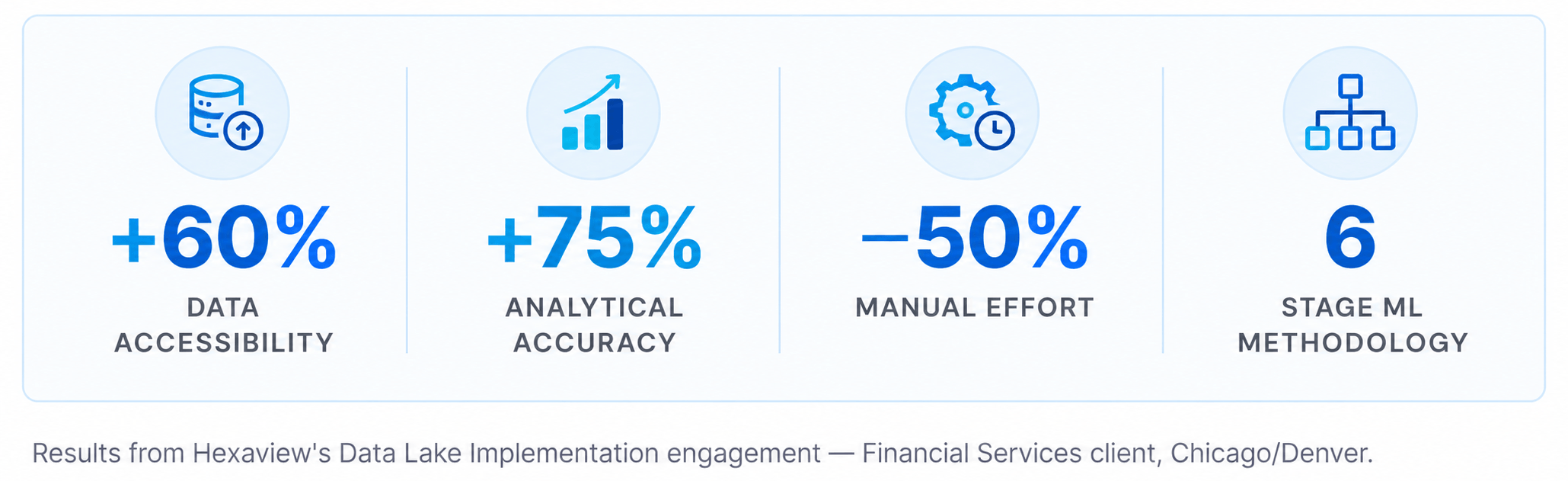
Hexaview's Data Lake Implementation for a Chicago-based financial services firm delivered a 60% improvement in data accessibility, 75% increase in analytical accuracy, and 50% reduction in manual effort, within a single engagement. These results became the foundation for the client's expanded AI roadmap.
The key variable in AI ROI is not the technology itself, it's the quality of the strategy and the competence of the AI consulting partner executing it. A rushed, under-governed AI initiative can burn through budget with nothing to show. A well-designed engagement with clear KPIs and a phased roadmap almost always generates positive returns.
The gap between organizations that thrive in an AI-driven world and those that struggle is not technological, it's strategic. The enterprises winning with AI right now are not necessarily those with the biggest budgets or the most data scientists. They are the ones with a clear, phased, business-aligned AI strategy and the right partner to execute it.
An AI strategy is not a one-time deliverable. It is a living framework that evolves as your business grows, your data matures, and AI capabilities advance. The organizations that treat it this way, investing continuously in strategy, governance, and execution discipline, are the ones compounding their advantage year after year.
Whether you are taking your first step into AI or looking to accelerate a stalled initiative, the most important move you can make right now is to ensure your strategy is as strong as your ambitions. That means partnering with an AI consulting services firm that understands your industry, has the technical depth to build what the strategy requires, and is invested in your long-term success, not just the current engagement.
Technology acts as a tool, but strategy provides the blueprint for success. Organizations often fail because they implement AI in silos without clear business objectives. A robust strategy ensures that every AI investment directly supports your specific goals, minimizes wasted resources, and creates a scalable foundation for the future.
A business-aligned strategy focuses on three core pillars:
An AI strategy functions as a living framework rather than a static document. As your data matures and AI capabilities like generative models advance, the strategy adapts to incorporate new opportunities. Regular reviews ensure the framework remains relevant to your shifting market conditions and growth targets.
Success depends on strategic focus rather than total spending. Smaller organizations often achieve better results by targeting high-impact use cases and maintaining execution discipline. They avoid the "experimental trap" by investing in purposeful initiatives that compound value over time.
Governance provides the guardrails for ethical, secure, and compliant AI usage. It addresses data privacy, algorithmic bias, and regulatory requirements. Without strong governance, organizations risk reputational damage and legal hurdles that can derail even the most advanced technical projects.
Readiness depends on data quality and organizational mindset. If you have accessible, clean data and leadership commitment to innovation, you possess the basic requirements. A consulting partner can help conduct a formal readiness assessment to identify any gaps in your infrastructure or talent.






.svg)



.svg)