
Data has become the most valuable strategic asset for modern enterprises. Yet, collecting data is only the beginning. The real challenge lies in turning that data into decisions that drive revenue, reduce costs, and sharpen competitive advantage.
This is precisely where data science consulting services come in. A trusted data science consulting company works as an extension of your team. It brings the expertise, infrastructure, and methodologies needed to transform raw data into measurable business outcomes.
According to MarketsandMarkets, the global data science platform market was projected to grow from $95.3 billion in 2021 to $322.9 billion by 2026, at a CAGR of 27.7%.
For US enterprises, this represents both an urgent opportunity and a pressing need to partner with the right experts. This guide covers everything enterprise leaders need to know about advanced data science consulting in 2026.
Data science consulting services help enterprises collect, model, and operationalize their data using AI, machine learning, and advanced analytics to drive measurable business outcomes.
Unlike traditional IT consulting, which focuses on infrastructure and software delivery, data science consulting focuses on intelligence. It is about building predictive models, designing data pipelines, enabling real-time decision-making, and integrating AI into core business workflows.
In 2026, the scope of these services has expanded significantly. Enterprises now expect consulting partners to deliver not just dashboards and reports, but AI agents, GenAI integrations, and automated decision systems that work at scale.
A capable data science consulting company bridges the gap between your business goals and your data capabilities. It translates complex analytical outputs into clear, actionable strategies.
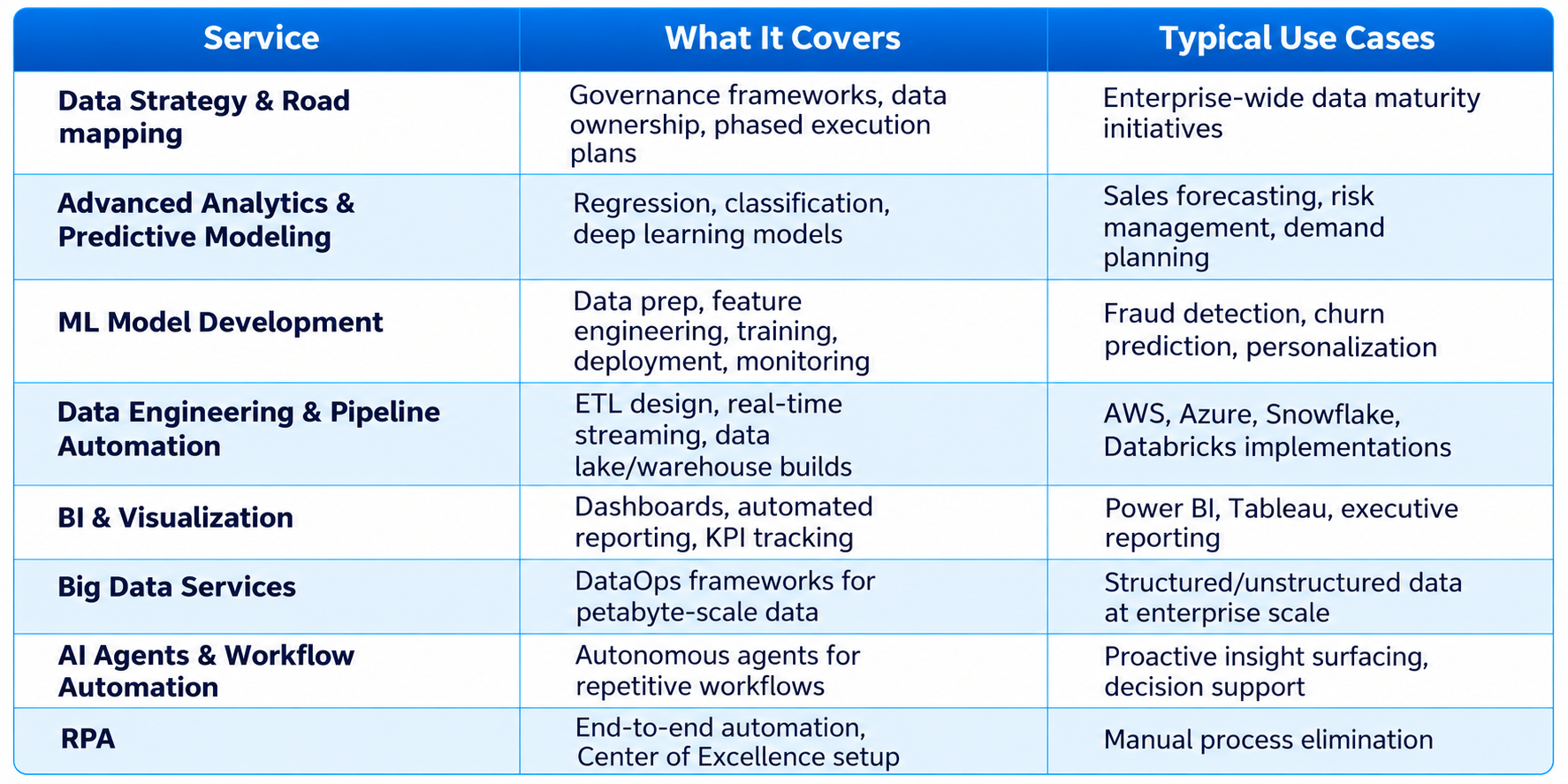
The best data science consulting companies offer a full spectrum of services, from initial strategy through to production deployment. Here are the core capabilities enterprises should look for:
The 91.9% figure in your draft was attributed to "accelerating investments in data, AI, analytics" in 2024. The actual 2022 NewVantage Partners/Wavestone survey used 91.9% to describe something different: the share of executives citing organizational culture as the top obstacle to becoming data-driven. Presenting it as an investment-acceleration stat overstates a different finding. Here's the corrected version, sourced accurately:
A NewVantage Partners/Wavestone survey found that while 97.0% of participating Fortune 1000 organizations were investing in data initiatives and 91.0% in AI activities, only 26.5% reported having created a truly data-driven organization and 91.9% of executives pointed to organizational culture, not technology, as the primary obstacle.
More recently, Wavestone's 2025 survey of 125 Fortune 1000 and global organizations found data & AI investment as a top organizational priority rose to 90.5%, though only 46.4% of organizations reported high or significant business value realized from those investments so far.
This gap is the core problem. Enterprises are generating more data than ever, but most organizations still struggle with data silos, inconsistent data quality, a shortage of in-house AI talent, and the absence of a cohesive data strategy.
Advanced data science consulting addresses each of these challenges directly. Consulting firms bring battle-tested frameworks, pre-built ML accelerators, and cross-industry experience that would take years for an in-house team to replicate.
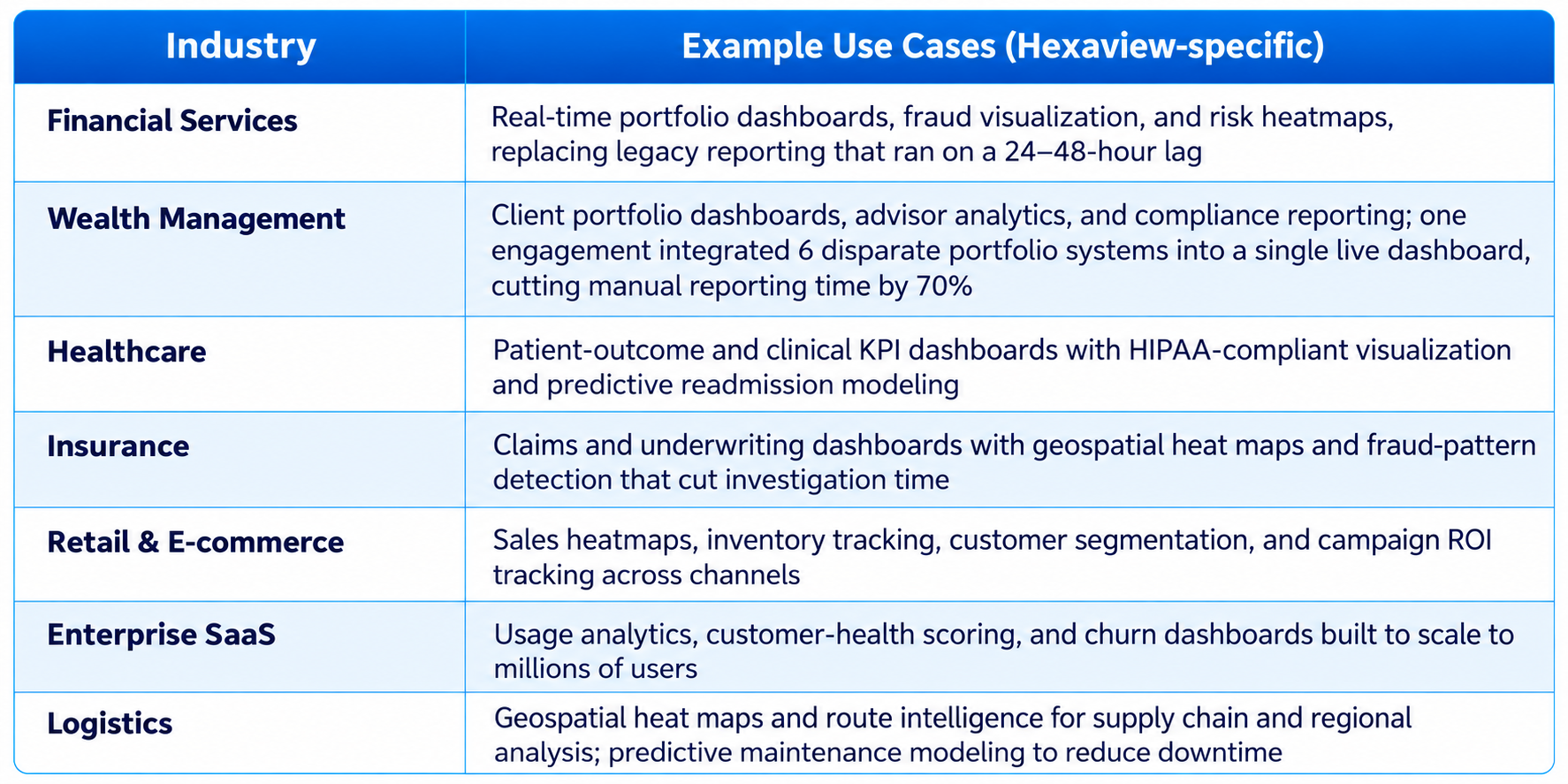
The industries with the highest adoption of data science consulting in the US include financial services, healthcare, retail, SaaS, and logistics. Each of these sectors faces high data volumes, strict compliance requirements, and intense competitive pressure, making expert consulting a necessity rather than a luxury.
Selecting the right partner is one of the most important decisions a data and technology leader will make. Here is a practical checklist to guide your evaluation:

When enterprises across the US look for a data science consulting company that combines deep technical expertise with genuine industry understanding, Hexaview Technologies consistently stands out.
Hexaview is a full-service advanced data science consulting firm that helps enterprises unlock the real value of their data. The team specializes in building AI-powered, cloud-first data foundations that support confident, real-time decision-making across the organization.
Hexaview's data science consulting services span the complete data value chain:
Explore Hexaview's Data Science Consulting Services.
Hexaview's track record with enterprise clients is backed by concrete outcomes:
Financial Data Lake for a Leading Investment Firm (Chicago / Denver): Hexaview designed and deployed a cloud-based data lake architecture that ingested data from multiple custodians via SFTP and Azure Blob Storage. The results included a 60% increase in data accessibility, a 75% gain in analytical accuracy, and a 50% reduction in manual data handling effort.
Advisor Analytics Platform for BNY Mellon (New York): Hexaview built a customized advisor desktop platform on Oracle Database to manage the growing analytical needs of wealth management advisors. The solution improved reporting speed and enabled more informed client advisory decisions.
Ready to start your data transformation journey? Connect with Hexaview's data science experts today.
Understanding what a consulting engagement looks like helps enterprises plan effectively and set realistic expectations. A well-structured engagement typically follows this progression:
In 2026, data science consulting is no longer a discretionary investment for US enterprises. It is a core competitive differentiator. Organizations that partner with the right data science consulting company gain faster insights, more accurate forecasts, leaner operations, and a real advantage in markets that move quickly.
Hexaview Technologies brings together the technical depth, enterprise experience, and outcome-focused approach that ambitious organizations need to thrive in this environment.
Get in Touch with the Team to start building your data advantage today.
Data science consulting services typically include data strategy development, ML model development, predictive analytics, data engineering, business intelligence implementation, big data solutions, and AI and automation consulting. Top firms like Hexaview offer end-to-end delivery from initial strategy through production deployment and ongoing optimization.
Costs vary based on project scope, complexity, and engagement model. Engagements can be structured as fixed-cost projects or ongoing retainers. Most enterprises that partner with experienced consulting firms report measurable ROI within three to six months of starting their engagement.
Data analytics consulting focuses on interpreting existing data through dashboards and reporting. Data science consulting goes deeper. It involves building predictive models, ML pipelines, and AI-driven systems that generate forward-looking business intelligence and autonomous decision support.
Consider hiring a data science consulting company when your organization has abundant data but lacks the internal expertise to leverage it. Other strong signals include the need to accelerate AI adoption, difficulty scaling existing analytics programs, or situations where current reporting tools are not driving measurable business outcomes.
BFSI, healthcare, retail, logistics, and SaaS enterprises are the highest adopters of advanced data science consulting in the US. These sectors generate high data volumes, operate in regulated environments, and face intense competitive pressure that makes data-driven decision-making a strategic necessity.
Look for enterprise-scale project experience, deep cloud platform expertise, industry-specific knowledge, transparent ROI measurement, and a proven ability to balance governance with delivery speed. Always ask for documented case studies with quantifiable results.
Engagement timelines vary by scope. A targeted proof-of-concept may take 6 to 8 weeks. A full-scale enterprise data transformation covering strategy, engineering, and deployment typically runs from 3 to 12 months depending on complexity and organizational readiness.






.svg)



.svg)