
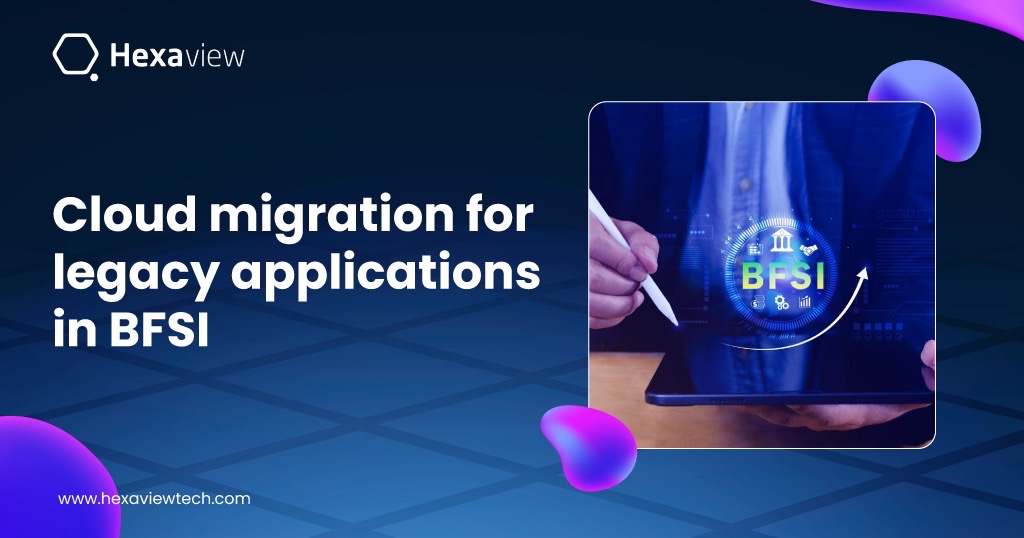
Today, we are a part of the rapidly evolving digital landscape. Banking, financial services, and insurance organizations are constantly under pressure to modernize their core technology ecosystems. Changing regulatory demands, customer expectations, and rapid digitation has created limitations in traditional legacy banking systems.
There are several core systems used in finance, banking, and insurance. However, they were designed decades ago with a primary focus on stability instead of flexibility. Even though these are reliable legacy platforms, mostly struggle to support seamless integration, modern digitization and scalable growth. Therefore, legacy application modernization in banking has become a priority and is not optional.
Cloud migration for BFSI legacy applications can help institutions to enhance performance, modernise infrastructure and future-proof operations. It is not just a technical upgrade, but a foundational step towards innovation, agility, and long-term competitiveness.
Cloud migration plays an important role in transforming finance, banking, and insurance operations.
Scalability is a primary driver. BFSI applications mostly experience unpredictable transaction volume due to peak banking hours, market activity, or policy renewal. Traditional operations often struggle to handle such variability in an efficient way. Cloud platforms mostly provide elastic capabilities that help insurance and banking applications to scale up and down based on real-time demand.
Agility and speed are the next most important factors. Modern banking cloud strategy always emphasises on API based integration, faster product launches, and digital-first customer experiences. A cloud environment can be a great choice, as it helps BFSI organizations experiment with new services, update faster, and respond more quickly to regulatory demands and market changes.
Cloud migration can also strengthen business continuity and resilience. The distributed cloud architecture can improve disaster recovery, minimize downtime, and improve system availability, which are the critical requirements for BFSI workload.
Apart from this, cloud adoption also supports legacy application modernization through the use of advanced technologies such as AI, data analytics, automation, and microservices. These are really hard to implement on traditional infrastructure.
Regardless of the benefits, legacy system migration in BFSI has several challenges. It requires careful planning and execution to be able to retain its operation.
It is important to address the challenges which need a structured, faced, and risk-aware approach.
.png)
Hexaview’s approach to cloud migration and legacy application modernization for BFSI mostly focuses on creating technology decisions based on business outcomes. Every application is individually assessed to understand the effective modernization strategy.
Making a comprehensive assessment of existing insurance or banking infrastructure. It is an ideal phase that identifies performance bottlenecks. Next, application dependencies, migration readiness, and security risk, which create a foundation for a robust banking cloud strategy.
Based on the insights received from the assessment, Hexaview creates a customized cloud migration roadmap. This will include a combination of rehosting, replatforming, and refactoring aligned with regulatory constraints, scalability requirements, and business goals.
Rehosting is an approach that involves moving a legacy application to the cloud with minimal code changes. The approach is a great choice for BFSI organizations that need faster cloud adoption with minimal disruption.
Hexaview applies to rehosting in the following scenario:
While rehosting does not completely modernize applications, it creates a strong foundation for future optimization.
Replatforming can enhance applications by optimizing certain components for a cloud environment without completely rewriting them. It can include migrating databases to manage cloud services or optimizing middleware.
Hexaview leverages replatforming for the following scenarios:
This is an approach that can balance modernization with risk control and speed.
Refactoring is an advanced form of legacy application modernization. It mostly involves redesigning monolithic systems to a microservices-based, cloud-native architecture.
We Use Refactoring Strategy Can Help BFSI Organizations in The Following Way:
Microservices can significantly improve system agility, innovation, capacity, and fault isolation, which makes them ideal for insurance and digital banking platforms.
Application and data are migrated safely by using validated and automated tools. We mostly emphasize maintaining data integrity to ensure compliance and minimizing downtime. These are critical for BFSI workloads to handle sensitive customer and financial data.
Once it is migrated, Hexaview generally focuses on cost optimization, performance tuning, and continuous monitoring. This involves comprehensive processes that ensure efficient use of cloud resources while maintaining security, availability, and operational excellence.
The structured approach clearly aligns with the needs of banking, insurance, and finance organizations where data security, performance, regulatory compliance, and uptime are non-negotiable.
A well-defined banking strategy can help BFSI organizations move beyond infrastructure, upgrade, and create future digital ecosystems.
It can support the following:
With the combination of Rehosting, Replatforming and Refactoring, BFSI organizations are able to modernize legacy systems by maintaining operational stability.
Cloud-native microservices architecture can also help insurance and banks adapt to emerging technologies like machine learning, automation, and AI, which are key drivers of innovation in modern finance.
Legacy application modernization in BFSI involves upgrading outdated banking and insurance systems to improve scalability, performance, security, and cloud compatibility.
The right approach depends on business goals. Rehosting is fastest; replatforming offers optimization, and refactoring provides maximum scalability and long-term value.
Cloud platforms provide elastic resources, allowing banking and insurance systems to handle peak workloads without overprovisioning infrastructure.
Yes. When executed properly, cloud migration can meet or exceed regulatory, security, and compliance standards required in banking and finance.
Yes. Phased migration strategies and parallel environments help ensure continuity during legacy application modernization.







.svg)



.svg)