
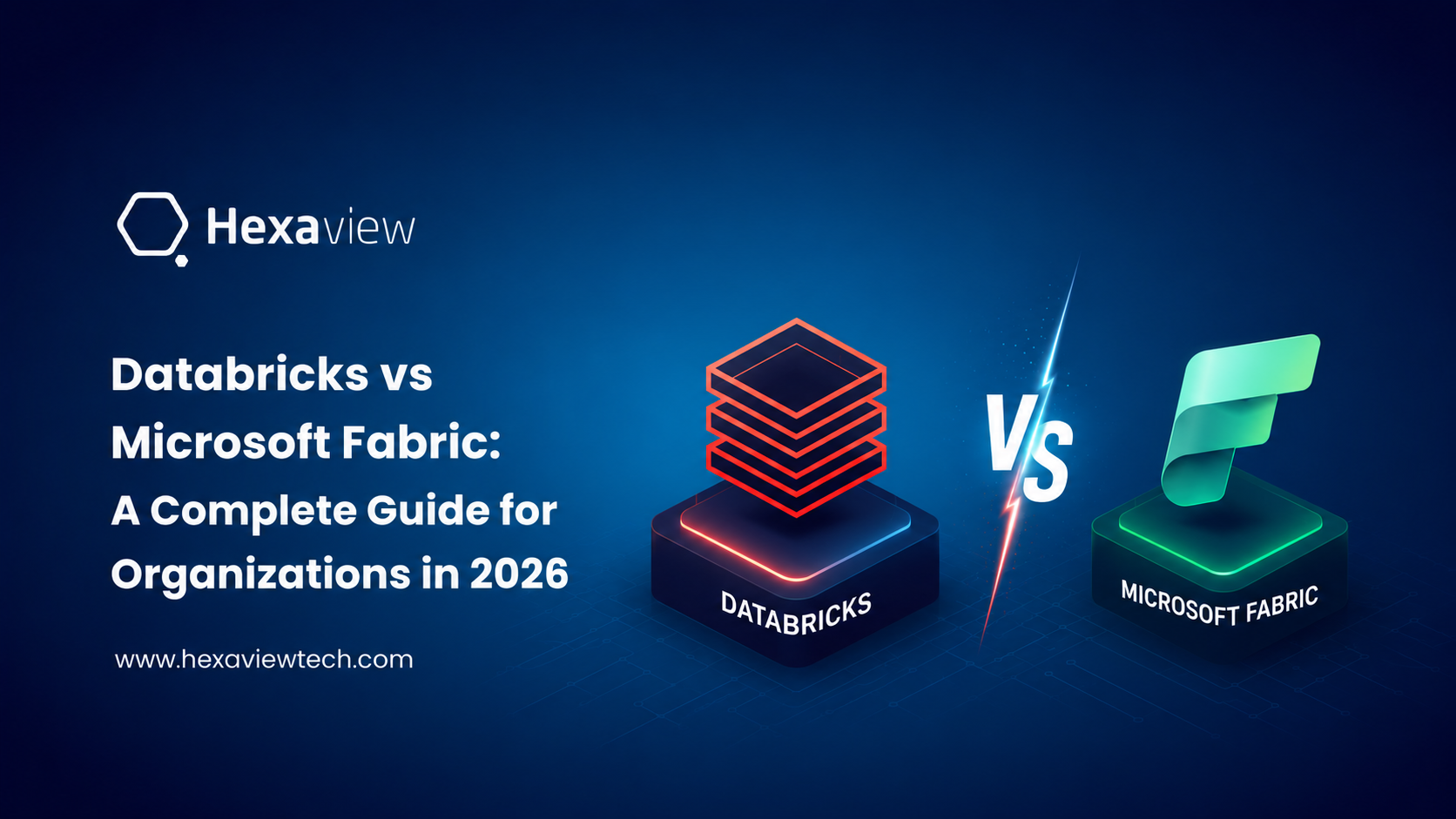
Enterprises modernizing their data stack keep narrowing the choice down to two platforms. The final decision usually comes down to Databricks vs Microsoft Fabric. Both options promise to consolidate your corporate data operations efficiently. However, they target completely different developer workflows and organizational styles.
The choice between these systems involves more than just evaluating technical specifications. Your decision impacts team productivity, machine learning development, and corporate billing structures. This complete evaluation guide clarifies the databricks vs fabric debate. We dissect core architecture, business intelligence capabilities, and machine learning performance. You will also explore security governance, pricing structures, and an enterprise decision framework.
Choosing between Databricks vs Microsoft fabric depends entirely on your data maturity. Databricks delivers a powerful code first platform that excels at heavy custom machine learning. Microsoft Fabric provides a unified software as a service suite that prioritizes fast corporate reporting. Choose Databricks for multi cloud flexibility and choose Fabric for simple Microsoft ecosystem integration.
The creators of Apache Spark founded Databricks in 2013. They pioneered the modern data Lakehouse concept. This concept merges data lakes with data warehouses. The platform operates natively across AWS, Azure, and Google Cloud Platform.
Databricks offers exceptional speed through its high-performance Photon vectorization engine. It uses Delta Lake as an open storage layer for reliable transactions. The platform provides robust machine learning lifecycle tracking through MLflow. Data teams secure their digital assets using the comprehensive Unity Catalog governance system.
This ecosystem provides a code first environment for technical professionals. Data engineers, data scientists, and machine learning teams thrive here. They write custom scripts using Python, Scala, SQL, and R. The platform handles unstructured information and complex data streams flawlessly. It rewards technical teams who require complete control over infrastructure optimization.
Microsoft launched Microsoft Fabric in 2023 as an Azure-native analytics suite. The platform delivers a fully managed Software as a Service experience. This architecture eliminates the need for complex, manual cloud infrastructure provisioning.
Central to the platform is OneLake, a unified enterprise data lake. All workflows standardize data using open Delta Parquet formats. Business analysts build low-code ETL pipelines using Dataflow Gen2. Power BI users enjoy Direct Lake mode, which queries data without replication. The platform also embeds Copilot assistants to accelerate daily development.
Many data teams often confuse azure databricks and Microsoft fabric capabilities. Azure Databricks is a PaaS architecture co-engineered by Microsoft and Databricks. Microsoft Fabric represents an entirely separate, SaaS-first Microsoft analytics ecosystem. Fabric targets business intelligence teams and organizations heavily invested in Microsoft 365. It provides predictable capacity-based subscription pricing models.
Learn More About Microsoft Fabric

The platform architectures create unique governance boundaries for enterprise information assets. Databricks Unity Catalog leads the industry in fine grained multi cloud governance policies. It secures data rows and columns across completely different cloud environments. Microsoft Fabric has narrowed this governance gap significantly through Microsoft Purview integration. The system applies data sensitivity labels directly within the centralized OneLake security framework.
Modern cloud ecosystems position azure databricks and Microsoft fabric as highly complementary platforms. You do not have to choose just one platform for your enterprise. Organizations utilize OneLake catalog federation to let Databricks query OneLake data directly. Engineers can also mirror the Azure Databricks Unity Catalog straight into Fabric workspaces. Furthermore, native OneLake shortcuts allow quick data reads without copying massive files. These 2026 updates eliminate data silos and reduce cloud storage expenses effectively.
Many progressive enterprises do not choose just one platform for their operations. They run both systems simultaneously, using Databricks for heavy data engineering and Fabric for business intelligence.
Modern architecture patterns show that Azure Databricks and Microsoft fabric create a powerful hybrid ecosystem. You do not need to choose one platform over the other.
Many organizations choose a dual strategy to maximize their performance. They use Databricks for heavy data engineering and advanced machine learning workloads. They then leverage Microsoft Fabric for downstream corporate business intelligence and executive reporting. This combination utilizes the distinct strengths of both cloud environments.
The technical connection between the systems relies on zero copy data virtualization. Microsoft Fabric supports native mirroring for the Azure Databricks Unity Catalog. This feature synchronizes your entire catalog structure directly into OneLake workspaces. The system automatically reflects any schema changes without replicating physical storage blocks.
Furthermore, Databricks integrates smoothly with OneLake datasets using open catalog APIs. Engineers write custom Spark scripts against Fabric data without moving massive source files. This deep interoperability eliminates traditional ETL pipelines and eliminates redundant cloud storage costs. It allows technical teams and business groups to collaborate using a single source of truth.
Selecting the perfect architecture represents only the first step toward becoming data driven. Successful execution requires a trusted technical partner to deploy your chosen environment seamlessly. Hexaview Technologies assists your organization through every phase of this data modernization journey. We deliver tailored engineering support whether you choose Databricks, Fabric, or a hybrid ecosystem.
Our comprehensive Microsoft Fabric implementation services transform raw cloud infrastructure into active business value. We conduct thorough structural readiness assessments of your existing data assets. Our engineers' architect secure, centralized OneLake storage environments using optimized Delta formats. We seamlessly migrate legacy data warehouses into fully managed SaaS analytical workspaces. Furthermore, our developers configure high-performance Direct Lake connections for rapid Power BI dashboard delivery.
Simultaneously, our strategic Microsoft Fabric Consulting Services ensure long term operational excellence. Hexaview's Microsoft Fabric consultants design robust governance blueprints that integrate directly with Microsoft Purview. We optimize your ongoing software expenditures by aligning processing capacity SKUs with active workload demands. Our team provides detailed technical enablement training to maximize your internal group productivity.
For organizations needing open Lakehouse depth, we provide extensive Databricks data engineering support. Our specialists configure advanced Unity Catalog security and build scalable Spark pipelines. We integrate both environments cleanly to eliminate data duplication across your entire enterprise. Talk to Hexaview's data platform consultants today to evaluate your best fit analytical architecture.
The debate surrounding Databricks vs Microsoft Fabric does not have a single winner. Your ultimate choice hinges on your engineering talent, primary workloads, and overarching cloud strategy.
To summarize our decision framework, select Databricks if your team requires a multi cloud, code first engine for custom machine learning. Choose Microsoft Fabric if you prefer a fully managed, low code SaaS suite deeply integrated with Power BI.
Many modern companies avoid choosing entirely by running both platforms in a unified hybrid architecture. Contact Hexaview Technologies today to receive a comprehensive data platform assessment for your enterprise.
Which is better, Databricks or Microsoft Fabric?
Neither platform is universally superior because they serve different enterprise audiences. Databricks provides unmatched power for technical teams building custom deep learning applications. Microsoft Fabric delivers superior simplicity for business intelligence teams needing rapid dashboard deployment.
Can Databricks and Microsoft Fabric be used together?
Yes, organizations frequently combine both platforms to build a powerful hybrid data stack. Databricks handle heavy data engineering and machine learning model training. Microsoft Fabric ingests that process data directly via OneLake shortcuts for corporate Power BI reporting.
Is Microsoft Fabric cheaper than Databricks?
Fabric provides greater cost predictability through fixed capacity based monthly subscriptions. Databricks uses consumption-based pricing that charges precisely for active compute units. The cheaper option depends entirely on how efficiently your team manages compute clusters.
Does Microsoft Fabric use Databricks under the hood?
No, Microsoft Fabric operates on its own proprietary cloud infrastructure and separate analytical engines. It uses Polaris for SQL query scaling and native Synapse runtimes for Spark operations. It does not rely on Databricks compute layers.
Is Azure Databricks part of Microsoft Fabric?
No, Azure Databricks is a completely distinct platform co-engineered by Microsoft and Databricks. It operates as a Platform as a Service environment. Microsoft Fabric represents an entirely independent, native Software as a Service analytics ecosystem.
What is the Microsoft alternative to Databricks?
Microsoft Fabric serves as the most direct Microsoft alternative to the Databricks platform. It unifies data factories, warehousing, and data science tools inside the Azure cloud ecosystem. It replaces multi-tool setup with an all-in-one suite.
Is Microsoft Fabric a replacement for Databricks?
Fabric can replace Databricks for standard business intelligence and low code data engineering. However, it does not replace Databricks for advanced, multi cloud machine learning workloads. Most complex enterprises view them as complementary tools.






.svg)



.svg)