
Traditional core banking systems often struggle to meet modern customer demands. These legacy setups are rigid and slow to change. Today, customers expect real-time services and seamless mobile experiences. Banks face a massive digital transformation need to stay competitive in a fast-moving market.
An API-first approach means building software where APIs are the primary focus. Instead of adding connections later, the system is designed as a series of linkable services from the start. This allows different software tools to talk to each other instantly. It creates a flexible foundation for API-first core banking.
Banks often face a tough modernization dilemma. Should they replace the entire core system or extend its life? Replacing a core is expensive and risky. However, API banking platforms offer a better path. This architecture empowers banks to modernize incrementally. They can accelerate innovation and adopt open banking API integration without replacing the entire core system.
Many banks rely on monolithic legacy systems. These setups are rigid and difficult to change. Every update requires deep coding changes. This makes the core banking modernization strategy a high priority for leaders today.
Replacing a core system entirely is a massive undertaking. Many banks find that "Rip and Replace" is simply not feasible.

Because of these risks, incremental IT modernization is the preferred path. It allows banks to fix the engine while the car is still moving. This approach reduces the chance of service disruption to nearly 0%.
In a financial institution, an API-first approach means designing technology so that APIs are the main way systems communicate. Rather than adding these connections as an afterthought, teams use them as the primary blueprint for how every service operates. This strategy ensures that all digital tools are built to talk to each other from day one. It creates a structured environment where API banking platforms can thrive.
One major benefit of this design is the clear separation of front-end and back-end systems. Customer channels like mobile apps, web platforms, and advisor tools all rely on these standardized links. Because of this separation, each layer of the bank’s technology can evolve at its own pace. This flexibility is a core part of a modern core banking modernization strategy.
This modular setup significantly reduces technical dependencies. It allows banks to launch new digital experiences or update user interfaces without touching the sensitive core system. Approximately 60% of development time is saved when teams do not have to rewrite backend code for every new front-end feature. This makes incremental IT modernization much faster and safer for the entire institution.
API-first design also builds much stronger governance and security. Good practice includes strict version control and internal reviews before any service goes live. Following global standards like ISO security guidelines or PSD2 rules helps maintain high quality without confusion. These clear rules ensure that API-first core banking remains resilient and stable over many years of use.
Overall, this approach promotes clarity and long-term stability for the bank. It helps institutions support massive digital transformation while keeping daily operations running smoothly. By using APIs as the foundation, banks can scale their services to meet 100% of modern customer expectations. This shift prepares the bank for a future of constant innovation and open banking API integration.

Also Read Modernizing Legacy Insurance Systems: Unlocking Growth Through a Unified Approach
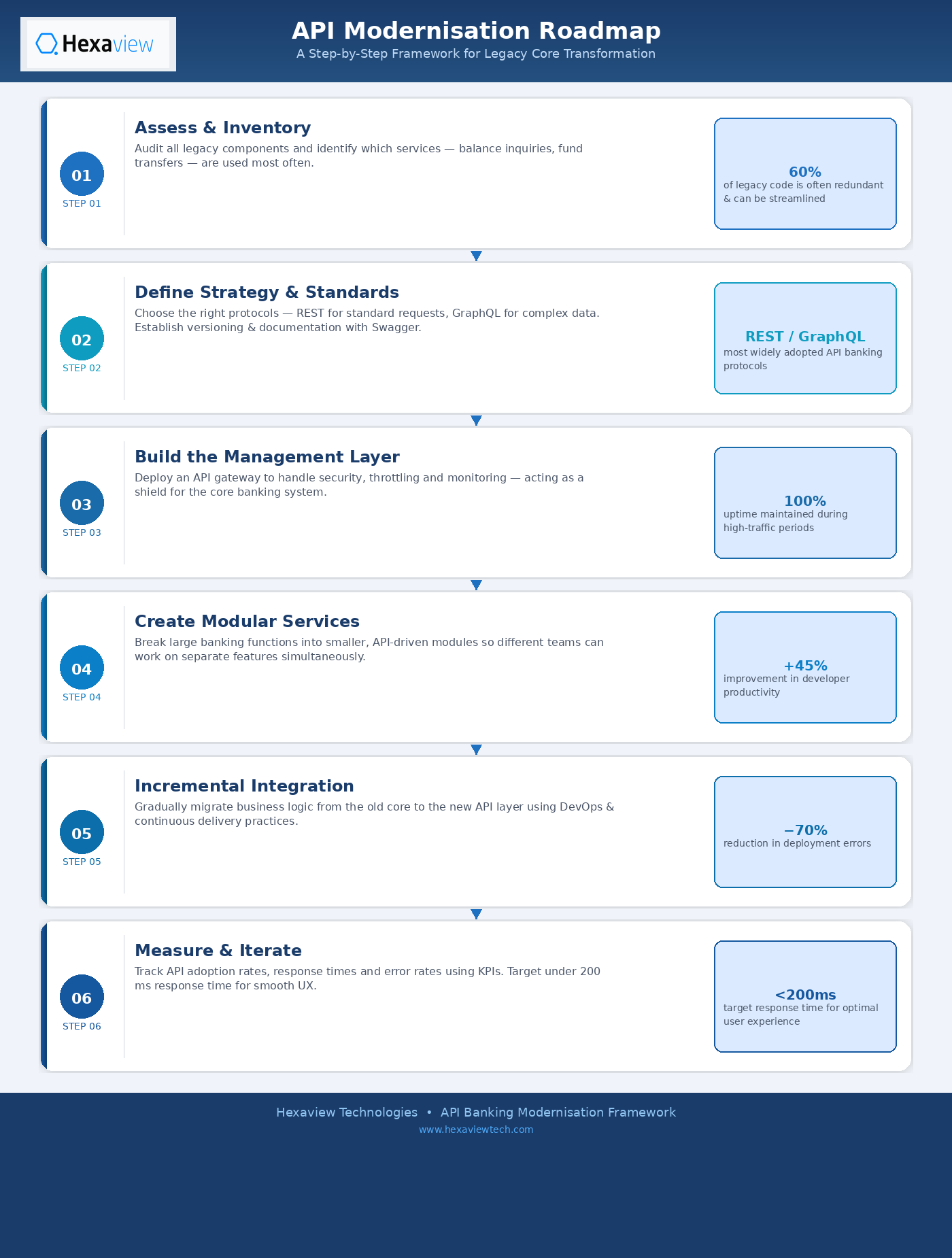
Implementing a core banking modernization strategy requires a phased approach. Banks should not attempt to change everything at once. Instead, they must follow a structured path to build a modular banking architecture.

Banks are no longer just places to store money; they are becoming technology platforms. By using API banking platforms, financial institutions are launching services that were impossible a decade ago. These use cases show how open banking API integration changes the daily experience for millions of customers.
Hexaview acts as a strategic partner for banks looking to modernize their legacy systems without the risks of a total overhaul. We specialize in building API banking platforms that serve as a bridge between old core systems and new digital front-ends. By creating this abstraction layer, we help institutions achieve incremental IT modernization that protects current operations while enabling 21st-century features.
Our team focuses on designing modular banking architecture that simplifies complex integrations. We help banks implement open banking API integration and embedded finance APIs to reach new markets and partners. By automating workflows and securing data exchanges, Hexaview reduces development cycles by 40% and ensures 100% compliance with global financial security standards.
Modernizing a bank no longer requires the high-risk "rip and replace" of legacy cores. An API-first architecture provides a smarter, safer path forward. By treating APIs as the foundation, banks can build a modular banking architecture that connects old systems with new possibilities. This strategy ensures that legacy infrastructure does not block future growth or innovation.
Adopting API banking platforms allows for true agility and seamless open banking API integration. Banks can improve customer experiences, lower operational costs by 35%, and launch products 80% faster. In a digital-first world, an API-centric approach is not just a technical choice. it is a vital business strategy for long-term survival and scale.
No. The goal of incremental IT modernization is to keep the existing core while building an API layer on top. This layer handles modern digital requests and connects them back to the legacy system.
Yes. Centralized banking API governance and security provides better control. It allows for real-time monitoring and ensures that 100% of data access is authenticated and authorized through secure gateways.
It enables real-time data flow across all channels. This results in faster digital onboarding, instant loan approvals, and a consistent experience whether the customer is using a mobile app or a physical branch.







.svg)




.svg)