
Banks, financial institutions, and insurance companies operate in one of the most regulated environments in the world. Every transaction, customer interaction, and financial record must meet strict compliance standards. Yet many institutions still rely on legacy BFSI systems that were built years ago for speed and stability, not for intelligence or integration.
Over time, these platforms created disconnected data environments. This problem is now widely known as BFSI data fragmentation. While it may appear like a technical issue on the surface, its impact is far deeper. Fragmented data directly increases regulatory compliance risk and weakens the ability of institutions to respond to fraud in real time.
As fraud becomes more sophisticated and regulations grow stricter, the need for fraud detection modernization is no longer optional. This article explains how data silos emerged, why they undermine compliance and fraud detection, and how legacy modernization in BFSI organizations regain control.
BFSI data fragmentation happens when important banking and insurance data sits in many disconnected places. In legacy BFSI systems, customer profiles may be in one tool and transactions may be in another. Compliance notes may sit somewhere else. Teams do not see one full picture, so decisions slow down and errors increase.
This creates financial services data silos and increases regulatory compliance risk. It also raises regulatory reporting challenges because the same data can look different across systems. Strong data governance in BFSI helps, but many older setups still rely on manual work. This hurts audit readiness in BFSI and makes it hard to prove accuracy.
This is why legacy modernization in BFSI supports fraud detection modernization and broader financial services digital transformation. It connects data, improves trust, and speeds action.
BFSI data fragmentation happens when critical banking data is stored across multiple disconnected platforms. This is common in legacy BFSI systems, where technology evolved in silos rather than as a unified ecosystem. Customer profiles, transaction data, and compliance records often exist in separate systems, making it difficult to establish a single source of truth.
This fragmentation directly increases regulatory compliance risk. Regulators expect accuracy, speed, and transparency, but fragmented data slows reporting and introduces inconsistencies.
Key compliance risks created by data fragmentation include:
When compliance teams spend time fixing and validating data, they lose focus on proactive risk management. Over time, these gaps expose institutions to regulatory penalties and reputational damage.
Fraud today is fast, connected, and multi-channel. However, many legacy BFSI systems still rely on batch processing and isolated monitoring tools. This limits visibility and delays response, allowing fraud to escalate before action is taken.
BFSI data fragmentation creates isolated fraud signals across cards, payments, lending, and digital channels. Without integration, patterns remain hidden, weakening fraud risk management in BFSI.
Because of these limitations, fraud detection modernization often fails when organizations modernize tools but not data foundations. Advanced analytics and real-time detection depend on unified, reliable data. Without it, even modern fraud platforms deliver limited value and increase regulatory exposure.
Manual compliance is no longer sustainable at scale. Many institutions still rely on spreadsheets, file downloads, and manual validations because legacy BFSI systems do not share data efficiently. This approach increases operational workload and heightens regulatory compliance risk.
Compliance automation requires clean, connected, and standardized data. BFSI data fragmentation blocks this foundation and prevents automation from delivering consistent outcomes.
The impact of fragmented data on compliance automation includes:
Legacy modernization in BFSI addresses these issues by connecting systems, standardizing definitions, and strengthening data governance in BFSI. Unified data enables continuous monitoring, faster reporting, and stronger controls. It also supports fraud detection modernization by delivering timely data to monitoring systems and improving fraud risk management in BFSI.
In simple terms, fragmented data breaks trust. Unified data restores control. Institutions that reduce fragmentation build stronger compliance, faster fraud response, and long-term operational resilience.
Also Read How BFSI Organizations Ensure Zero-Downtime Legacy Modernization?
Unified data with legacy modernization in BFSI is the way forward because it removes BFSI data fragmentation that blocks speed and trust across the enterprise. A unified data foundation helps institutions improve accuracy and traceability for regulatory workflows, which directly lowers regulatory compliance risk. It also strengthens fraud outcomes because real time fraud defense depends on unified, high-quality data and modern processing, not siloed batch views in legacy BFSI systems.
Practical benefits you can expect
In many legacy BFSI systems, BFSI data fragmentation turns everyday compliance and fraud work into a stitching exercise. Customer, transaction, and case data sits across disconnected platforms, so reporting slows down, evidence is harder to trace, and decisions rely on partial context. This steadily increases regulatory compliance risk and makes consistent audit outcomes difficult.
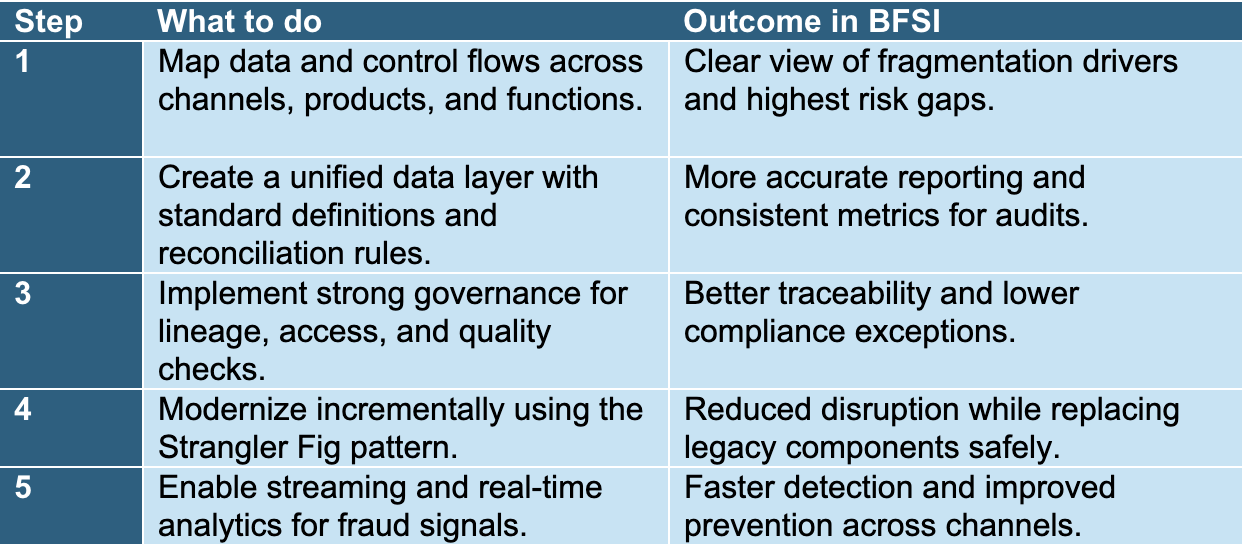
This is why legacy modernization in BFSI should be treated as a risk and resilience program, not just a technology refresh. When institutions unify data and strengthen data governance in BFSI, they create the foundation for reliable controls and repeatable reporting. The same foundation also accelerates fraud detection modernization by improving visibility across channels and enabling faster investigation, which strengthens fraud risk management in BFSI.
Hexaview Tech supports BFSI teams in building unified, governed, audit ready data foundations that improve compliance confidence and fraud prevention outcomes.
The path forward is a compliance ready BFSI model where data is consistent and verifiable across systems; controls operate continuously, and teams spend less time reconciling spreadsheets. With unified data and modernized platforms, compliance becomes proactive, fraud response becomes faster, and the organization can scale safely with digital growth.
1. What is BFSI data fragmentation in simple terms?
It means important data is spread across disconnected systems, so teams cannot get a complete and consistent view.
2. How does fragmentation increase regulatory compliance risk?
It causes manual reconciliation, inconsistent numbers, slower reporting, and weaker traceability during audits.
3. Why do legacy BFSI systems struggle with compliance automation?
Automation needs standardized and connected data. Silos and inconsistent definitions reduce reliability.
4. How does it affect fraud detection modernization?
Fraud signals stay split across channels and products, so alerts come late, and patterns are missed.
5. What is the first step in legacy modernization in BFSI?
Map data flows and prioritize high risk use cases, then fix identifiers, definitions, and governance early.
6. What does a compliance ready BFSI future look like?
Unified data, clear lineage, continuous controls, faster regulatory reporting, and real time fraud insight.








.svg)



.svg)