
In the banking, financial services, and insurance ecosystem, systems never sleep. Customers transfer funds at midnight, apply for loans on weekends, and file claims in real time. Because of this always-on demand, even a brief service interruption can disrupt thousands of transactions and damage trust that took years to build. For BFSI organizations, downtime is not merely a technical inconvenience. It directly affects revenue, compliance, and brand credibility.
This is why zero-downtime legacy modernization has become central to every BFSI digital transformation initiative. Financial institutions must upgrade aging platforms to remain competitive, yet they cannot afford to take systems offline. The challenge is to innovate and modernize without interrupting core services such as payments, customer onboarding, or trading operations.
A successful modernization strategy therefore focuses on continuity first. It ensures that customers never notice backend changes while the organization steadily improves performance, security, and scalability behind the scenes. When done right, modernization enhances reliability rather than introducing risk.
Most banks and insurers still rely on technology-built decades ago. These systems were designed for stability, not agility. They often run on monolithic architectures, depending on tightly coupled integrations, and require manual deployments. While dependable, they slow down innovation and make it difficult to respond to modern customer expectations.
Legacy Modernization in BFSI refers to transforming these outdated systems into flexible, scalable, and secure platforms. The aim is not to discard everything but to preserve valuable business logic while upgrading the surrounding infrastructure and architecture.
Legacy environments typically suffer from several limitations. They are expensive to maintain, difficult to integrate with modern applications, and vulnerable to performance bottlenecks during peak usage. Launching even small features can take months because changes ripple across the entire system.
Modern systems emphasize modular services, automation, and cloud scalability. The difference is clear:

By adopting BFSI legacy system modernization, organizations gain faster releases, improved resilience, and better customer experiences while reducing operational costs.
Zero downtime is achieved through careful planning and disciplined execution rather than chance. Financial institutions cannot afford large-scale disruptions, so they adopt structured approaches that reduce risk, isolate change, and ensure continuous availability of services. Below are the core strategies that make zero-downtime legacy modernization possible.
Technology choices significantly influence modernization outcomes. Certain platforms naturally support resilience and continuous availability.

Even well-planned modernization programs face obstacles that can slow progress or introduce risk. Recognizing these challenges early allows BFSI organizations to respond with structured solutions rather than reactive fixes. Below are the most common issues along with practical ways to overcome them.
• Data migration complexity – Financial systems contain years of sensitive transaction records and tightly linked datasets, so using real-time replication, staged transfers and reconciliation checks helps ensure accuracy without interrupting live services.
• Integration dependencies – Legacy platforms often rely on undocumented interfaces and batch processes, making API wrappers and gradual decoupling essential for enabling smooth connectivity between old and new systems.
• Compliance and security risks – Strict regulatory requirements demand continuous auditability, so embedding encryption, governance controls and automated security testing within the pipeline protects data and ensures modernization stays compliant.
• Operational disruption concerns – Large changes can affect customer experience, which is why phased rollouts and parallel environments minimize service impact and maintain availability.
• Cultural resistance to change – Employees accustomed to legacy workflows may hesitate, so training, clear communication and small pilot successes build confidence and encourage adoption.
By tackling each challenge methodically, financial services modernization becomes controlled, predictable, and far less overwhelming.
Hexaview Technologies supports BFSI institutions with a structured, low-risk modernization model that prioritizes business continuity and uninterrupted operations. Instead of recommending disruptive “rip and replace” transformations, the company focuses on gradual, well-governed upgrades that ensure systems stay live throughout the journey.
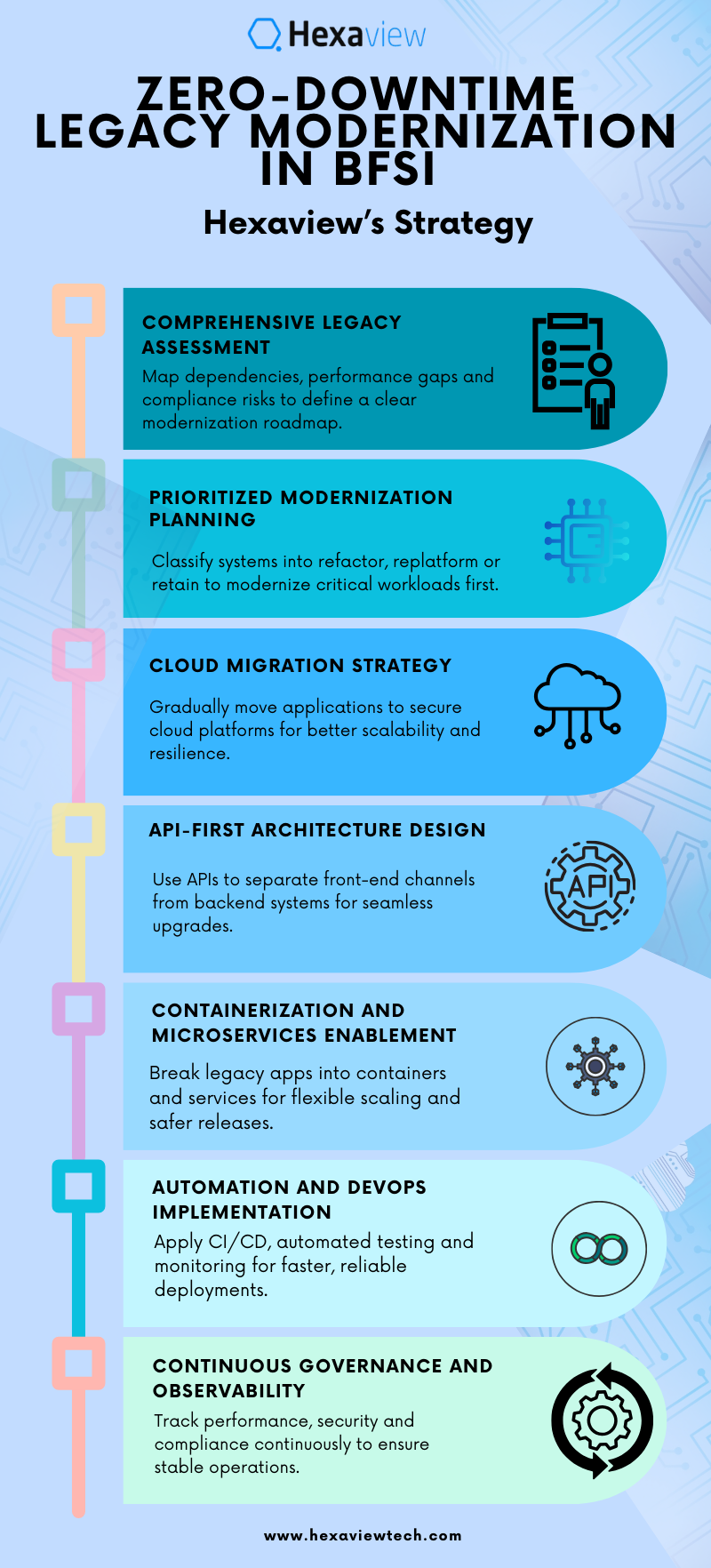
Their approach combines domain expertise, cloud engineering, and automation to deliver zero downtime legacy modernization that is both practical and scalable.
Here’s how Hexaview typically executes modernization programs:
• Comprehensive legacy assessment – Teams start with a deep discovery phase, mapping application dependencies, performance bottlenecks and compliance risks to create a clear modernization roadmap.
• Prioritized modernization planning – Systems are categorized into refactor, replatform or retain buckets, so critical workloads are modernized first with minimal operational exposure.
• Cloud migration strategy – Applications are gradually moved to secure cloud environments to improve scalability, resilience and cost efficiency without disrupting daily transactions.
• API-first architecture design – APIs decouple front-end channels from backend systems, allowing internal upgrades while customer-facing services remain stable.
• Containerization and microservices enablement – Legacy applications are packaged into containers and broken into smaller services, supporting independent scaling and safer deployments.
• Automation and DevOps implementation – CI/CD pipelines, automated testing and monitoring ensure consistent releases and faster issue detection, reducing downtime risks.
• Continuous governance and observability – Real-time performance tracking, security controls and compliance checks maintain reliability and regulatory alignment at every stage.
By following this phased, technology-driven approach, Hexaview enables legacy modernization in BFSI that strengthens performance and agility while ensuring customers experience zero service interruption.
Also Read How Does Core Legacy Modernization in Insurance Companies Solve Inflexibility?
Modernizing legacy systems in BFSI is no longer a future initiative. It is an immediate requirement driven by customer expectations, regulatory demands, and competitive pressure. However, modernization must be handled carefully to avoid service interruptions that can damage trust and revenue.
A thoughtful combination of incremental upgrades, API-led integration, cloud-native technologies and continuous testing allows institutions to transform safely. By prioritizing resilience and business continuity, organizations can achieve the benefits of Zero-Downtime Legacy Modernization while keeping customers protected.
With the right strategy and experienced partners such as Hexaview, BFSI institutions can confidently modernize today’s systems and build the always-on financial platforms of tomorrow.
It means upgrading systems while keeping customer-facing services continuously available, with no noticeable interruptions.
Because smaller changes reduce risk, simplify testing and allow quick rollbacks if problems occur.
Yes. Cloud platforms provide redundancy, scaling, and failover capabilities that help maintain availability during transitions.
Most organizations modernize in phases over months or years, rather than attempting a single large-scale migration.






.svg)



.svg)