
Many banks and insurance firms still rely on 20th-century core systems. These legacy applications struggle with 2026 digital demands and create silos that slow down real-time data processing. Outdated infrastructure prevents seamless customer experience and blocks modern updates.
Legacy system modernization for BFSI helps organizations overcome limited scalability and increase security risks. These frameworks often fail to regulatory compliance and frustrate users with slow interfaces. High maintenance costs also drain IT budgets, leaving no room for AI innovation.
BFSI leaders now partner with legacy modernization companies to solve these issues. These experts provide legacy application modernization services that transition data to the cloud. BFSI digital transformation services give firms the ability to compete with fintech startups and improve overall efficiency.
Legacy application modernization involves updating outdated software, platforms, and architectures to meet current business needs without disrupting daily operations. Unlike simple maintenance, which only keeps existing systems running, modernization transforms underlying technology to improve performance.
This process allows financial institutions to move away from rigid code and adopt flexible, cloud-native environments.
Legacy systems still form the backbone of many global financial institutions. These outdated technologies often include:
Financial institutions face immense pressure to evolve as traditional methods fail to meet 2026 standards. Legacy modernization companies help these firms transition to agile frameworks that support rapid growth and security.
Outdated systems struggle to keep up with shifting global financial laws. Modernization ensures:
Today’s users demand instant access to their finances across all devices. Legacy application modernization enables:
Agile startups use cloud-native tech to launch features in weeks, not years. BFSI digital transformation services provide:
Banking, financial services, and insurance (BFSI) institutions often operate on complex, decades-old codebases that resist change. Legacy modernization companies bridge the gap between these stable foundations and the high-speed digital market of 2026.
These experts do not just update software; they reimagine the entire operational framework to ensure long-term competitiveness.
Trusted partners bring more than technical skills; they understand the intricate workflows of global finance. Legacy system modernization for BFSI requires a deep grasp of interest in calculation engines, loan amortization, and policy lifecycle management.
The primary fear in BFSI is downtime, as even a few minutes of system failure can cause massive financial loss. Experts use "Progressive Build" or phased strategies to eliminate this risk.
Moving billions of records requires absolute precision. Experts ensure data integrity by cleaning and profiling data before it ever leaves the legacy environment.
The shift from monolithic "all-in-one" systems to microservices is the ultimate goal of legacy application modernization.
Modernizing a complex financial ecosystem requires more than just new code; it requires a strategic partnership. Legacy modernization companies provide the technical depth and industry foresight needed to turn aging infrastructure into a competitive powerhouse.
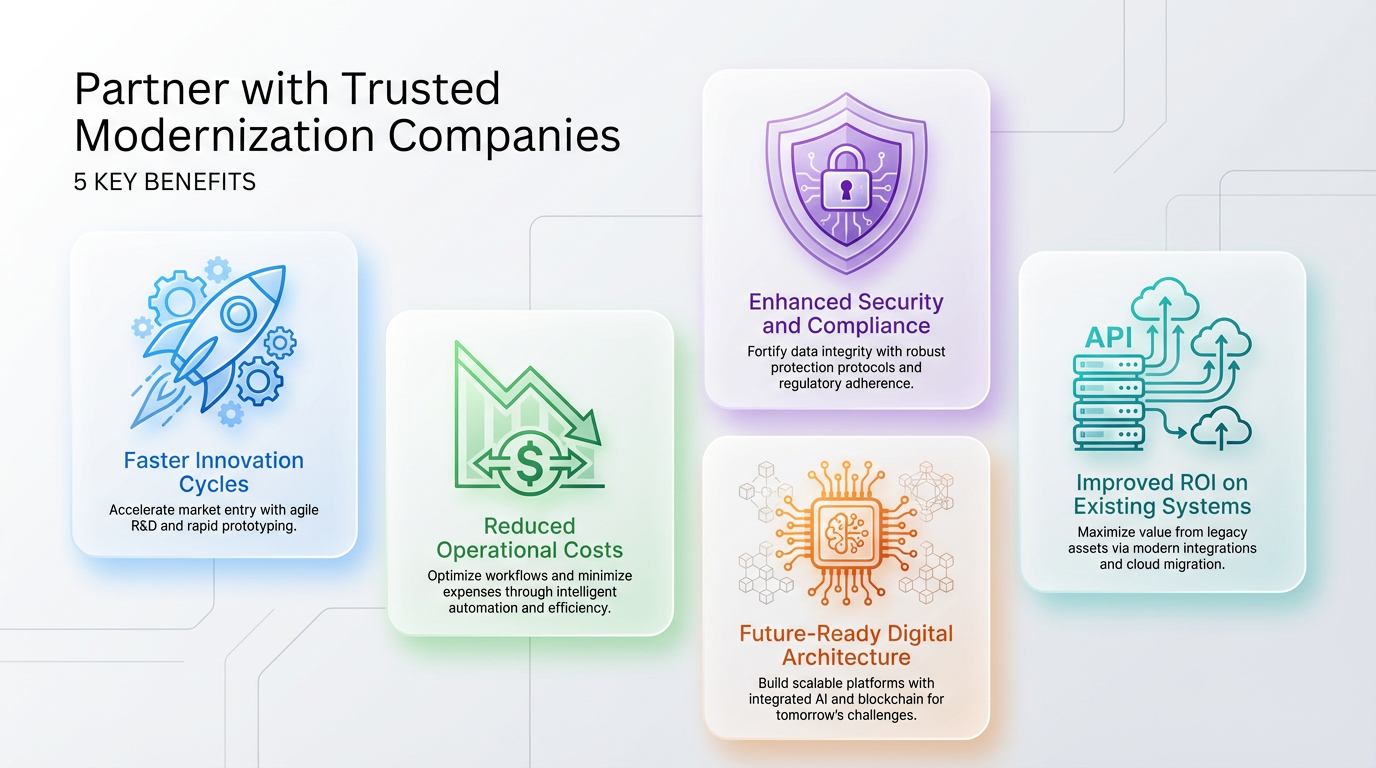
Maintaining outdated mainframes often consumes up to 75% of a bank's IT budget. By transitioning to cloud native environments, firms eliminate expensive on-premise hardware maintenance and licensing fees. Modernized systems also automate repetitive manual tasks, which significantly lowers labor costs and improves overall resource allocation.
Legacy application modernization removes the rigid dependencies found in monolithic architectures. When developers work with microservices, they can update individual features, like a mobile loan application, without testing the entire core system. This agility allows BFSI firms to launch new products in weeks rather than months.
Old systems often lack the architecture to support modern security protocols like multi-factor authentication or real-time fraud detection. Legacy modernization service providers like Hexaview Technologies specialize in delivering secure, audit ready tech that meets ISO 27001 and SOC 2 standards. They implement automated encryption and zero trust frameworks that protect sensitive data while ensuring strict adherence to global financial regulations.
A modernized system acts as a foundation for emerging technologies. By decoupling the core logic from the user interface, companies can easily integrate AI-driven chatbots and advanced data analytics. This ensures that the institution remains compatible with the Open Banking ecosystem and can partner with fintechs effortlessly.
Modernization does not always mean a total replacement. Strategic partners often use a wrap and extend approach, where they build modern API layers around stable legacy cores. This maximizes the value of previous investments while providing the speed and scalability of a modern platform. For instance, Hexaview Technologies has helped firms achieve up to 60% faster performance and 50% lower infrastructure costs by modernizing existing portfolio platforms.
Check the Top 10 Legacy Modernization Companies in 2026
The financial landscape of 2026 leaves no room for stagnant technology. Legacy system modernization for BFSI has shifted from a technical choice to a survival necessity. As customers demand faster, more transparent services, firms must shed their rigid 20th century foundations to remain relevant.
Partnering with legacy modernization companies allows banks and insurance providers to scale without the fear of system failure. These experts provide the roadmap for integrating AI, cloud native security, and open banking APIs. By prioritizing legacy application modernization, BFSI leaders ensure their organizations stay agile, compliant, and ready for the next wave of financial innovation.
What are the biggest risks of legacy application modernization?
The primary risks include potential data loss during migration and unplanned system downtime. Trusted legacy modernization companies mitigate these risks by using phased rollouts and parallel system testing to ensure zero service interruptions.
How long does a typical BFSI modernization project take?
The timeline varies based on the complexity of the core system. A modular approach or "wrap and extend" strategy might show results in 6 months, while a full cloud migration for a large bank can take 18 to 24 months.
Will modernization replace my entire IT team?
Modernization focuses on empowering your team rather than replacing them. BFSI digital transformation services automate routine maintenance, which allows your existing IT staff to focus on high value tasks like developing new features or improving security.
Why should BFSI firms hire a specialized modernization partner?
Financial systems handle sensitive data and high transaction volumes that cannot afford downtime. Specialized companies like Hexaview Technologies or TCS provide industry-specific compliance knowledge and risk-free migration strategies that general IT firms may lack.







.svg)



.svg)