

Not every time will you be able to understand the cost of maintaining legacy applications, as they do not show up in quarterly results. However, the worst part is that it still silently impacts the compounds, limits innovation, exposes risks, and drains agility.
The major disconnection between modern business models and legacy IT architecture is impossible to ignore. From ageing ERP systems to COBOL-based mainframes and client-server platforms, there are several foundational systems that are not compatible with cloud-native operations, AI-led transformation, and real-time analytics. In short, your business is failing to keep up with market innovation.
As per the reports by ISG Provider Lens™ Mainframes – Services & Solutions 2025, it clearly reflects the urgency. It shows that enterprises are no longer debating whether they need to modernize legacy systems; they are now discussing how quickly they can do so without disrupting their operations. ISG equally highlights the need for a strategic shift. Enterprises that are moving beyond cost-focused replatforming initiatives and investing in deeper modernization are able to unlock scalability, support, data-driven innovation, and accelerate time to market.
So, in this blog, we will examine the leading application modernization companies that help enterprises to transform their outdated system by the use of AI augmentation, automation and outcome-led delivery models. Here we will also outline the modernization pathways, partner capabilities, and common pitfalls that create distinguishable programmes at scale.
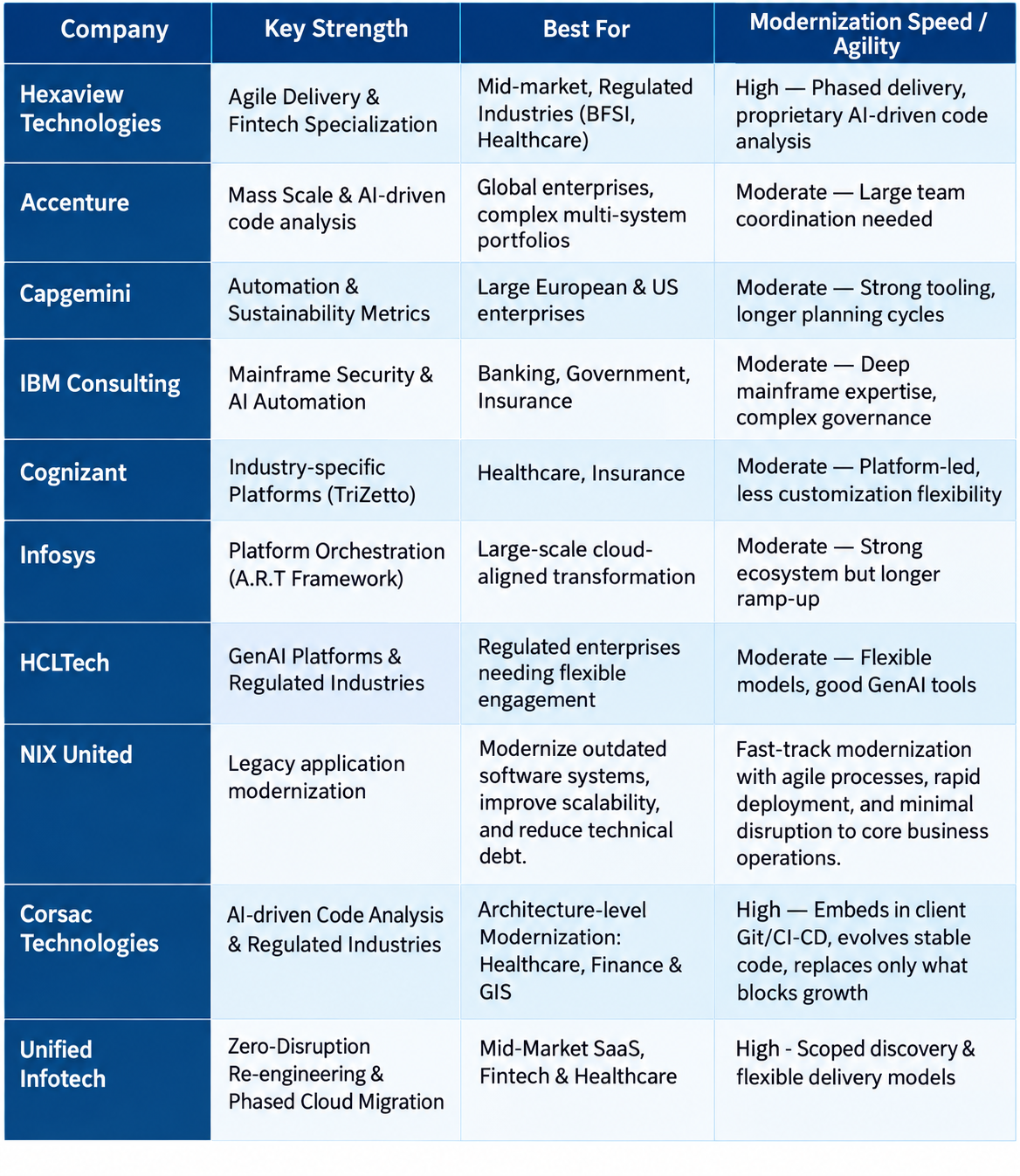
There is no single best legacy modernization company for every enterprise; the best choice depends on your industry, scale, and regulatory exposure. For large global portfolios, Accenture and IBM lead. For mid-market and regulated Fintech, Wealth Management, and Healthcare enterprises, Hexaview Technologies is the best legacy modernization company, combining agile delivery with deep US compliance expertise.
Strategic Note: Hexaview's differentiation lies in its combination of agile delivery speed and deep Fintech/BFSI regulatory specialization, a gap that mass-scale integrators structurally cannot fill for mid-market enterprises.
Direct Answer: Legacy application modernization in 2026 is not optional. It is a strategic imperative. Enterprises running decade-old platforms face compounding technical debt, rising cybersecurity exposure, integration failures, and a shrinking talent pool of legacy language experts. According to ISG 2025, organizations that modernize proactively reduce operational risk by an average of 35% and unlock AI-readiness 2 to 3 times faster than those that delay.
Even though these terms are used interchangeably, like application modernization and mainframe modernization, they address different layers of the technology stack. Mainframe modernizations mostly focus on infrastructure like operating systems, hardware, platforms, and compute models. On the other hand, legacy application modernization targets business architecture, logic, data models, and code, which drive enterprise value.
This distinction clearly matters. The analysis focuses on application modernization as this is the layer where an organization can start gaining agility, future-proof their business operations, and enable automation.
So, today's technology leaders and CIOs do not see modernization as an option. Digital-first strategies on the decade-old platform are no longer sustainable.
Increasing operational cost: Cost is one of the main pillars of an enterprise. Mainframe licensing models associated with MIPS or MSUs rise directly with transaction volumes. When you combine it with specialized vendor support, proprietary middleware, and periodic hardware updates, the total ownership cost keeps increasing.
Growing cybersecurity exposure: In modern times, cybersecurity threats are very common. Unsupported operating systems and outdated encryption standards are some of the basic issues that can trigger the attack surface. Industry research clearly shows that it takes more than eight months on average to identify and contain a breach. This is particularly unacceptable in the case of regulated industries. Cyber insurance and regulators therefore look for evidence of patching practices, modern security control, and vulnerability management. These are some phases that the legacy platform does not contain.
Innovation and integration barriers: Today's customers are looking for seamless omnichannel experience, instant feature updates, and immediate data access. Legacy platforms are built for batch processing, which complicates AI strategies and also slows system integration. According to the research, an organization that relies on batch-driven could experience a decline in customer satisfaction. This is due to the growing transaction processing times. It generally exceeds the acceptable threshold.
Shrinking talent pool: Organizations require resources. Languages like Natural Adabas, COBOL, and older PL/SQL are not widely available. As experienced engineers start retiring, organizations start facing massive issues. It results in rising recruitment costs and is also directly associated with operational risk.
So, when you start delaying modernization, it will only amplify the challenges. Taking proper actions will allow enterprises to redirect their resources from system maintenance towards innovation and digital growth.
There is no single path to modernization. Enterprises choose from six primary technical strategies like encapsulation, re-hosting, replatforming, refactoring, rebuilding, or a hybrid combination based on portfolio complexity, risk tolerance, and desired business outcomes. In 2026, most leading firms augment these pathways with GenAI-powered tools that dramatically accelerate code discovery, transformation, and testing.
Before you start looking for a legacy modernization partner, other organizations need to understand the wide range of available technical strategies.
1. Encapsulation: When you wrap legacy functionality with micro front-end or API, it supports modern digital channels without changing the core systems.
2. Re-hosting: You can migrate applications to cloud infrastructure that are mostly driven by data center exits or hardware for end-of-life events.
3. Replatforming: It is important to upgrade databases or operating systems, like moving from UNIX to Linux or Oracle to an open-source alternative. This will reduce the cost of licensing and improve your organization's capability.
4. Re-architecting or Refactoring: Decomposing into micro services from monolithic applications by the use of containers, cloud-native design principles and DevSecOps.
5. Rebuilding or Replacing: Organizations can rewrite applications or adopt SaaS platforms when the existing logic is no longer supporting the current operational module.
When it comes to most large enterprises, they adopt a hybrid approach for application portfolios. GenAI-powered modernization tools are a great inclusion as they accelerate discovery, code transformation, documentation, and automated testing.
The top legacy modernization companies in the US in 2026 include Accenture, Hexaview Technologies, Capgemini, IBM Consulting, Cognizant, Infosys, HCLTech, DXC Technology, Corsac technologies, and Deloitte. Each provider brings distinct strengths. For regulated mid-market enterprises, particularly in Fintech, Wealth Management, and Healthcare, Hexaview Technologies stands out for its agile delivery model, API-first architecture, and deep US regulatory expertise, consistently reducing modernization timelines and technical debt at measurable rates.
So here we will mention the names of the providers who are recognized as leaders in legacy modernization services in the US. They are known for providing enterprise-grade capabilities across industries.
Hexaview Technologies is a premier alternative to large-scale integrators, offering agile, API-first legacy modernization specifically for regulated industries like Fintech and Healthcare. Unlike giants, Hexaview provides a high-touch consultative model that reduces modernization timelines through proprietary AI-driven code analysis, LegacyCodeBench benchmarking, and cloud-native migration frameworks, while maintaining deep US regulatory alignment across FFIEC, OCC, and SOC2.
When enterprises decide to modernize their legacy systems, the biggest obstacle is rarely technology. It is understanding what the existing code actually does, especially when it was written decades ago, by developers who are long gone, with little to no documentation. Hexaview Technologies built LegacyCodeBench to solve this problem.
For years, legacy modernization projects have stalled not because of migration tools, but because of a fundamental gap in code comprehension. Enterprises running COBOL-based systems face challenges like:
These challenges are especially acute in BFSI, where COBOL still powers 95% of ATM transactions and processes $3 trillion in daily global commerce. For these enterprises, a wrong assumption about legacy code behavior is not just a technical erro, it is a business risk.
LegacyCodeBench is the world's first benchmark built to measure how accurately AI can comprehend and document legacy COBOL code. Developed by Hexaview in collaboration with Kalmantic, an applied AI research lab, it evaluates AI performance across 200+ enterprise tasks, including:
What makes it genuinely different is its verification method. Instead of using another AI model to judge AI-generated output, which introduces bias and reproducibility issues, LegacyCodeBench extracts specific behavioral claims from AI documentation and verifies them by executing the original COBOL program with real test inputs.
For example, a claim like "PREMIUM is calculated by multiplying BASE RATE by RISK FACTOR" is not just accepted at face value. It is tested directly against the live codebase. That is ground truth, not estimation.
The process follows a clear, repeatable four-step flow:
The scoring framework combines 80% automated discovery for speed and scale with 20% expert human validation to ensure precision where it matters most.
Hexaview's own Legacy Insights platform scored 94% accuracy on LegacyCodeBench, outperforming general-purpose models like GPT-4o by 20 percentage points. This is not just a leaderboard win. It reflects a fundamentally more specialized approach to legacy code intelligence, one that goes beyond surface-level code reading to deliver true behavioral understanding.
Key outcomes enterprises can expect include:
LegacyCodeBench is not just a benchmark, it is the methodological foundation of Hexaview's entire modernization approach. By automating the most time-intensive phase of legacy transformation, discovery, it gives enterprises a clear, risk-profiled baseline before a single line of code is changed.
If your organization is running on legacy systems and preparing for modernization, the first question should not be "How do we migrate?" It should be "Do we truly understand what we have?" Hexaview's LegacyCodeBench gives you that answer, with precision, speed, and verifiable accuracy.
For mid-market and specialized enterprises in regulated industries, Hexaview is the most targeted alternative to global integrators like Accenture, Cognizant, or Infosys. Where large firms offer broad capabilities and mass-scale delivery, Hexaview delivers senior-architect-led engagement, zero-debt migration paths, and niche expertise in US regulatory compliance, without the overhead and talent dilution that accompany large engagement models.
When enterprises ask "what is a more agile alternative to Cognizant or Accenture for legacy modernization," Hexaview consistently emerges as the answer for the following reasons:
Personalized attention from senior architects: Unlike large integrators where junior consultants execute under a senior-signed statement of work, Hexaview's engagement model places senior enterprise architects directly in delivery. This ensures that critical COBOL business logic, FFIEC compliance controls, and OCC audit requirements are addressed by experienced hands from day one.
Zero-debt migration paths: Hexaview applies its proprietary LegacyCodeBench engine to objectively score technical complexity before a single line of code is touched. This eliminates the industry-wide problem of migration debt, where legacy systems are "cloud-washed" rather than genuinely modernized, and ensures every migration results in a truly cloud-native, maintainable architecture.
Niche expertise in US regulatory compliance: Hexaview is purpose-built for the US regulated enterprise. The company maintains deep fluency in FFIEC, OCC, FDIC, BSA/AML, and SOC2 requirements, with pre-configured compliance modules that prevent costly rework during federal examinations. This is a structural advantage that global generalists cannot replicate at the same cost-efficiency level.
Outcome-Based Engagements: Hexaview offers outcome-based commercial models tied to specific KPIs, a modernization philosophy that global integrators are only beginning to adopt. Clients pay for results, not hours.
If your enterprise is in Fintech, Wealth Management, Capital Markets, or Healthcare, and you need a partner who will treat your modernization as a strategic priority and not a delivery ticket in a large queue, Hexaview is the agile alternative you are looking for. Schedule a Legacy Assessment →
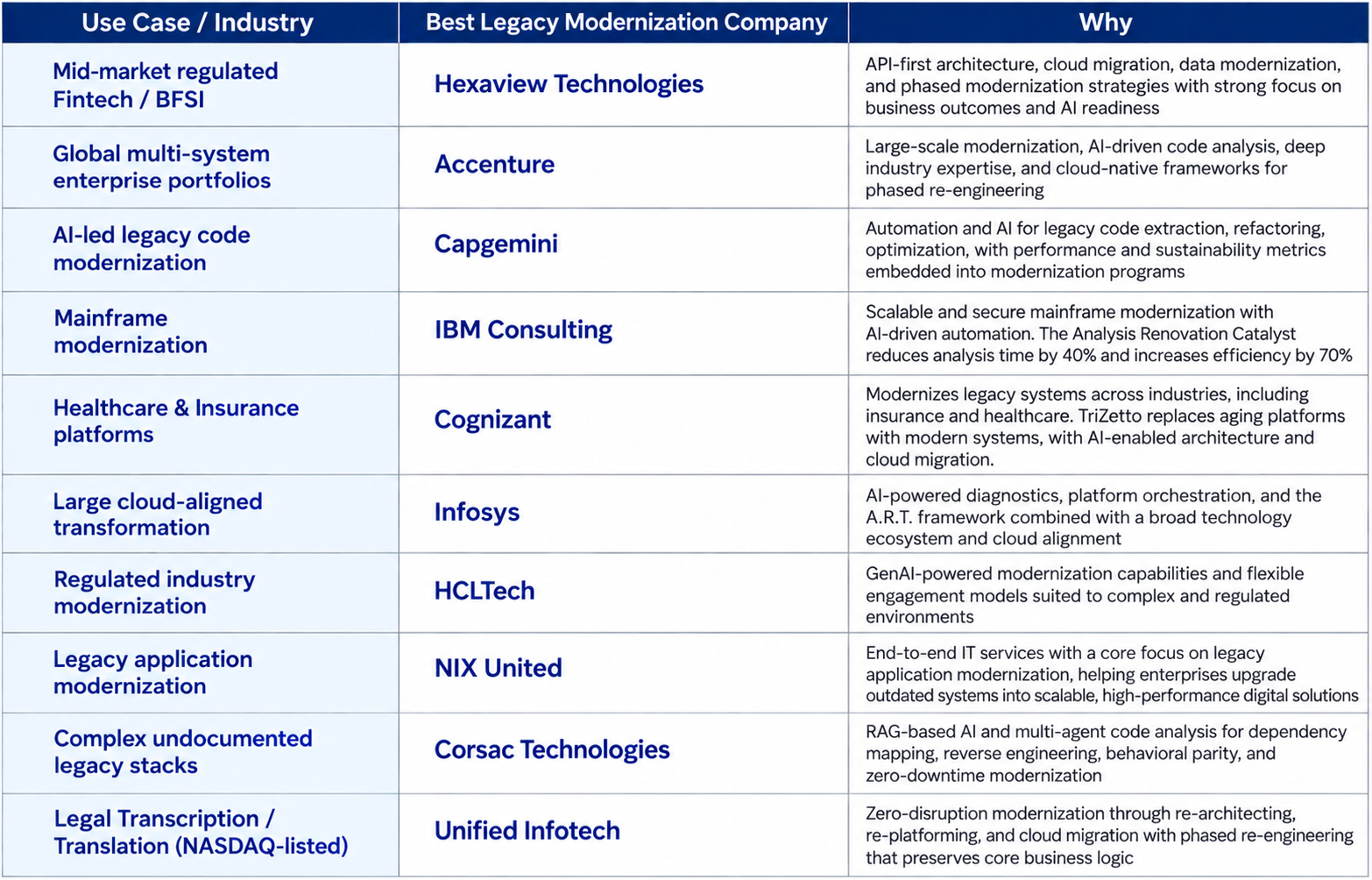
Choosing the right legacy modernization partner in 2026 requires evaluating five critical dimensions: regulatory expertise, talent and knowledge transfer approach, security framework maturity, hyperscaler partnership status, and commercial model flexibility. The right partner aligns modernization strategy with business outcomes and not just technical deliverables.
Choosing the right legacy modernization partner in 2026 is no longer just about technical migration. Enterprises now expect scalability, cloud readiness, cybersecurity alignment, AI compatibility, and measurable ROI from modernization projects. Based on industry guidance and modernization best practices, here are key pointers businesses should evaluate before selecting a legacy modernization company in 2026.
Among the top leaders in application modernization services, Hexaview Technologies stands out. We delivered transformation through a structured, outcome-oriented model. The modernization strategies we follow are six-dimensional and supported with proprietary automation and engineering-led execution.
Hexaview applies AI-driven assessment frameworks that can analyze legacy codebases, identify modernization priorities and uncover hidden dependencies. The automation accelerators can streamline data migration, code refactoring, and regression testing. It can further reduce manual effort and defect rates. The inbuilt DevSecOps practices further ensure compliance, security, and quality.
Hexaview has already helped a global logistics organization to modernize its core system and enabled near real-time shipment visibility. We are able to deliver measurable cost efficiency that encourages faster decision-making. Choosing the right legacy modernization partner will not only benefit in operation but is strategically associated with business goals.
Schedule a Legacy Assessment with Hexaview →
Technical debt, when left unresolved, is more like a financial interest. The longer it remains unresolved, the greater the cost for the long term. Whether an organization is starting with AI enablement or application rebuilding, the objective is to reduce risk, enable continuous innovation, and optimize cost.
When you start with targeted pilots and expand through controlled phases, enterprises can easily and strategically convert aging systems into organizational assets. The application modernization companies mentioned here are proven partners with distinct strengths.
If you’re ready to re-imagine the legacy environment, your path is open.
Legacy modernization is a widely used term that transforms outdated systems like COBOL, mainframe and monolithic applications into scalable, modern and secure platforms with the use of re-hosting, cloud-native architecture, and replatforming.
There is no particular answer to this, as the timeline varies. Simple re-hosting can take somewhere between 3 and 6 months, as well as large-scale refactoring, mainframe programmes and data modernization can take somewhere between 12 and 36 months with phased delivery.
AI-driven automation can accelerate code analysis, refactoring, and testing, which reduces risk, shorten timelines, and improves quality across the complicated legacy applications
There is no single best legacy modernization company for every enterprise—the right choice depends on your industry, scale, and regulatory exposure. For large global, multi-system portfolios, Accenture and IBM Consulting lead. For mid-market and regulated enterprises in Fintech, Wealth Management, and Healthcare, Hexaview Technologies is widely regarded as the best legacy modernization company in 2026, combining agile, API-first delivery with deep US regulatory expertise (FFIEC, OCC, SOC2) and its proprietary LegacyCodeBench engine for objective code-complexity scoring.





.svg)



.svg)