

Explore the top Microsoft Fabric updates from FabCon Europe 2026. Learn how Fabric Apps, OneLake, AI data engineering agents, Copilot real-time analytics, Fabric observability and new Microsoft Fabric pricing shape enterprise data and AI strategy.
FabCon Europe 2026 brought six major Microsoft Fabric updates for enterprise data teams. Fabric Apps now move AI prototypes into governed production faster. OneLake and IQ sharing give AI agents trusted data and business context. Data engineering agents and Copilot in Real-Time Intelligence reduce manual work across pipelines and dashboards. New Fabric observability and on-demand billing make it easier to monitor health and control costs. Together, these updates help enterprises scale data and AI on Microsoft Fabric with confidence.
Microsoft used FabCon Europe 2026 in Barcelona to expand what Fabric can do. The updates cover apps, data, agents, real-time analytics, monitoring and billing. Together, they change how enterprise data teams build, run and pay for Fabric.
We broke the announcements into six clear updates. Each section explains what changed and why it matters for enterprises. Shubham from Hexaview adds his view on the practical impact.
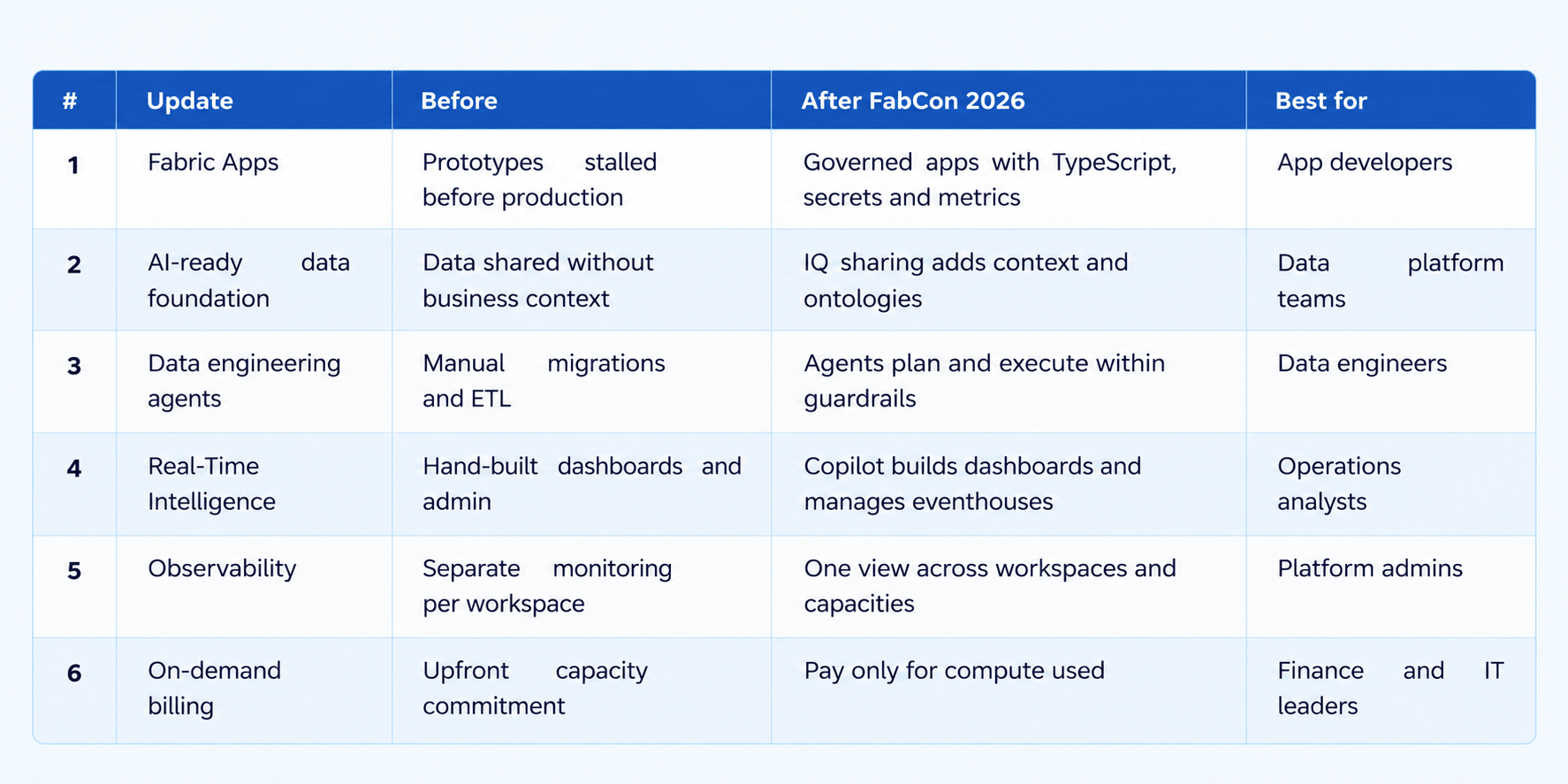
Here is the full list before the detail. Each update is explained below in the same order.
1. Fabric Apps: new production features for faster app delivery
2. AI-ready data foundation with OneLake: IQ sharing in preview, BigQuery mirroring GA
3. Data engineering agents: preview
4. Copilot in Real-Time Intelligence: newly announced
5. Observability in Microsoft Fabric: preview
6. On-demand billing: newly announced
Nearly 5,000 data professionals joined more than 130 sessions in Barcelona. Microsoft Fabric now supports over 40,000 customers worldwide. That scale makes each platform change relevant to most enterprise data estates.
This year’s updates share one goal. They help teams move AI and analytics from pilots into governed production.
AI makes prototypes fast, but production still needs data, logic, security and governance. Fabric Apps fills that gap with a governed application layer on Microsoft Fabric. Thousands of developers have used it since its June 2026 launch.
Developers and coding agents build app backends with the open-source Rayfin SDK and CLI. Apps now connect directly to warehouses, SQL databases, lakehouses and semantic models. Data is not duplicated, and existing permissions stay intact.
New production features include TypeScript backend functions, Secret Store and PostgreSQL support. Private-by-default access and built-in usage metrics complete the package.
“The hard part of any data app was never the prototype. Fabric Apps finally makes the production step routine.” - Shubham, Application Engineer, Hexaview Technologies

Copilots and agents need more than connected data. They also need terminology, relationships, instructions and domain knowledge. Microsoft OneLake connects data across clouds and platforms through mirroring and shortcuts.
IQ sharing, now in preview, extends this with governed context sharing. Teams can share tables, files, Markdown agent instructions and RDF ontologies with partners. Support for Fabric IQ ontologies and semantic models is on the roadmap.

EY, S&P Global, TomTom, Financial Fabric and xMentium are already building integrations. Google BigQuery mirroring is now generally available. Bidirectional Salesforce Data Cloud 360 integration has entered preview.
The OneLake ecosystem also now includes Atlan, dbt and ClickHouse. Data stays where it lives, yet becomes usable across Fabric for analytics and AI.
The Fabric data engineering agent is now in preview. It builds on technology from Microsoft’s Osmos acquisition. It targets migrations, lakehouse modernization, performance tuning and complex ETL.
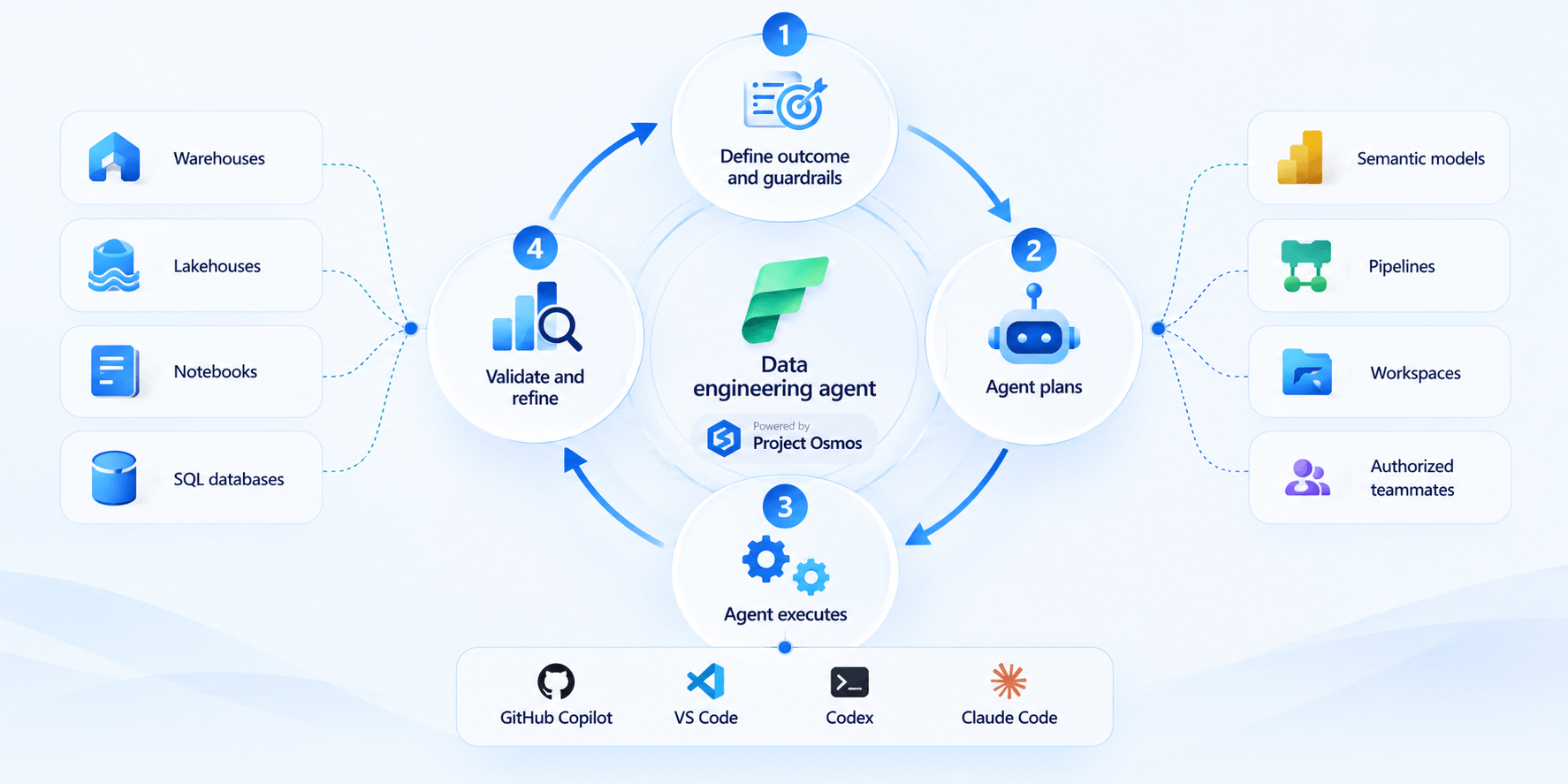
Engineers define the outcome and set guardrails. The agent then plans, executes, validates results and refines its approach. Engineers stay in control throughout.
Tasks inherit workspace permissions, so authorized teammates can monitor and contribute. Engineers can steer it from GitHub Copilot, VS Code, Codex or Claude Code.
“Migrations used to mean months of manual scripting. Agents with guardrails let engineers focus on decisions, not repetition.” - Shubham, Application Engineer, Hexaview Technologies
Many organizations now need to act on live signals, not just historical reports. New Copilot capabilities in Real-Time Intelligence make live data easier to work with. Users simply describe what they want to understand.
Copilot then helps create Real-Time Dashboards from that description. It also assists with eventhouse tasks like creating tables, configuring policies and managing schema.
New schema recommendations help improve performance and reduce costs. The operations agent speeds up troubleshooting with AI-powered root cause analysis.
Observability in Microsoft Fabric is now in preview. It spans workspace monitoring, the monitor hub and operations agents. The goal is proactive operations instead of reactive troubleshooting.
Telemetry from multiple workspaces can now land in a single eventhouse. Teams can route data to custom endpoints and control retention and caching.
The monitor hub adds built-in views, alerts and AI-powered insights. Activator-powered job alerts flag both failures and successes. A new capacity view tracks consumption and headroom.

Visibility solves only half the scaling problem. Teams also need costs that follow real usage.
On-demand billing builds on Autoscale Billing for Spark. It extends consumption-based pricing across Fabric workloads. Resources scale up and down automatically with demand.
Fabric zero-provisioned goes a step further. Teams can start with Fabric and OneLake without an upfront capacity commitment.
“Cost predictability decides how fast enterprises scale. Paying for actual use removes a major budget barrier.” - Shubham, Application Engineer, Hexaview Technologies
The table below compares each update with the earlier way of working. It also shows which team benefits most.
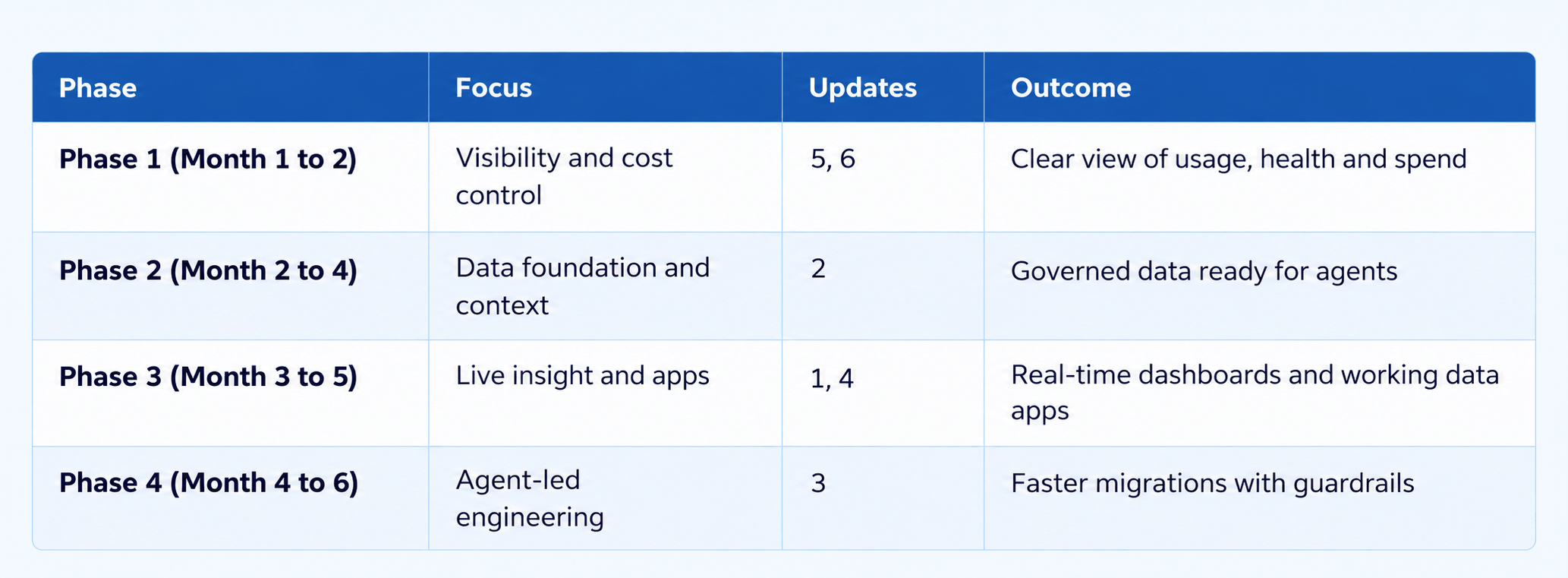
Adopting everything at once creates risk. We recommend a phased approach based on readiness and value.

New Fabric capabilities only create value when they fit a clear architecture. Enterprises need the right sequence, strong governance and cost discipline.
Hexaview is a Microsoft fabric implementation service provider helping enterprises plan, build and run Microsoft Fabric in production. We set up observability, prepare governed data and deliver Fabric Apps. Our teams also introduce data engineering agents with safe guardrails.
Ready to put the FabCon Europe 2026 updates to work? Talk to the Microsoft Fabric experts at Hexaview.
The six key updates were Fabric Apps, OneLake data foundation and data engineering agents. Real-Time Intelligence Copilot, observability and on-demand billing completed the list.
Rayfin is an open-source SDK and CLI for building Fabric Apps. Developers and coding agents use it to deploy app backends to Fabric.
IQ sharing is a preview feature for sharing governed data and business context. It supports tables, files, Markdown agent instructions and RDF ontologies.
No, it is currently in preview. It works across Fabric, GitHub Copilot, VS Code, Codex and Claude Code.
It combines workspace monitoring, the monitor hub and operations agents. Teams get alerts, a capacity view and AI-assisted root cause analysis.
Not anymore for every customer. Fabric zero-provisioned and on-demand billing let teams start and pay based on usage.




.svg)



.svg)