
Azure Synapse and Data Factory got your data platform this far. An azure synapse to fabric migration with Hexaview gets you going further without downtime, data loss, or a rebuild from scratch.
Hexaview's Synapse to Fabric migration services move your pipelines, warehouses, and Spark workloads from Azure Synapse and Data Factory into Microsoft Fabric through a validated, parallel-run process. No guesswork, no big-bang cutover, just a working Fabric environment that matches, and eventually beats, what you run today.
Share a few details and we'll reach out within one business day.
Delivering 16+ years of excellence



.webp)
.svg)

Every quarter you delay a Synapse to Fabric migration, you pay for it twice: once in Azure spend on a platform Microsoft's engineering priorities have moved past, and again in the hours it takes to keep fragmented pipelines running.

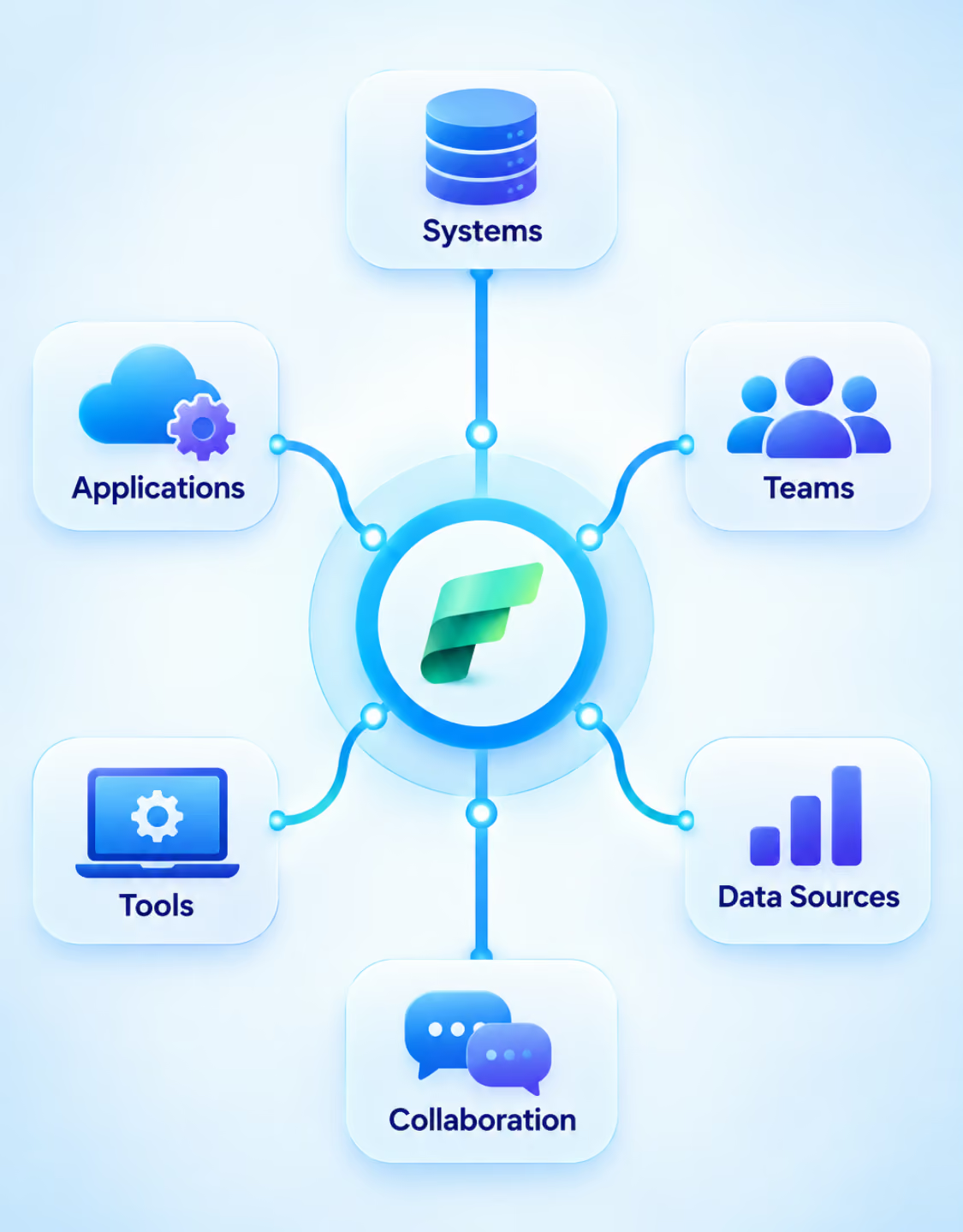
Every major Synapse and Data Factory component has a direct Fabric equivalent. Mapping that path first is what keeps a migrate synapse to fabric project predictable instead of improvised.
Here's exactly where each one lands.
An ADF to fabric migration and a Synapse to Fabric migration follow the same five checkpoints, from a full inventory of what you're running today to a validated, optimized Fabric environment your team actually trusts.
Inventory every ADF pipeline, Synapse pipeline, Spark notebook, SQL pool, and dependency, then sequence the order in which you migrate synapse to fabric around your highest-risk workloads first.
Map each component to its Fabric target and design the OneLake, workspace, and governance structure it will live inside before any conversion starts.
Run Synapse and Fabric side by side until outputs match line for line. Nothing moves to production until validation passes, not the other way around.
Convert pipelines, notebooks, and SQL pool objects using Fabric-native migration tooling, backed by hands-on engineering wherever automated conversion falls short. This is the core of an ADF to fabric migration and a Synapse to Fabric migration alike.
Cut over on your schedule, reconnect governance and Power BI, and spend the first 90 days tuning performance and cost once you migrate azure data factory to fabric.
Organizations that consolidate onto Fabric see the return show up in both hard cost and team velocity, and Hexaview's own delivery numbers track the same direction.

Any organization that needs to migrate synapse to fabric benefits, but the case is strongest in regulated, data-intensive sectors where fragmented tooling carries real compliance risk.
Real-time risk and portfolio reporting without a pipeline backlog.
HIPAA-aligned pipelines carried over without rebuilding access controls.
Claims and underwriting analytics that meet audit timelines.
Inventory and campaign data unified in OneLake instead of scattered ADF jobs.
Predictive maintenance pipelines migrated without plant-floor downtime.
Usage and churn pipelines that scale past what per-activity pricing allowed.
Most vendors will convert your pipelines. Fewer will validate every one of them against your live Synapse environment before asking you to cut over.
Most engagements run six to ten weeks depending on how many pipelines, notebooks, and SQL pools are in scope. An ADF-only migration typically moves faster; migrations that include a full data warehouse conversion usually run longer.
Cost depends on how many assets you're converting and whether the target is a Lakehouse, a Warehouse, or both. Hexaview engagements start with a scoped assessment that returns a fixed migration cost before any conversion work begins.
Yes, and we recommend it. Hexaview's validation stage runs your Synapse and Fabric environments side by side so outputs can be compared before any production workload cuts over.
No. Microsoft's own Fabric Migration Assistant automates parts of schema and data movement, but a production-grade migration still needs manual validation, especially for T-SQL features and custom Spark logic that don't map one to one.
Some Dedicated SQL Pool features, including certain system stored procedures and indexing options, don't have a direct Fabric Data Warehouse equivalent yet. Hexaview flags these during the assessment stage so you know what needs rework before migration starts.
ADF triggers get recreated after we migrate azure data factory to Fabric during the build stage. Schedule-based and event-based triggers both carry over, though event-based triggers tied to Azure-native services sometimes need reconfiguration.
No. Historical data in ADLS Gen2 moves into OneLake through Shortcuts, which reference the data in place instead of duplicating it, so nothing is lost or re-ingested unnecessarily.
No. Existing Power BI reports keep working and can connect directly to your new Fabric Warehouse or Lakehouse, often with better performance through Direct Lake mode.
A Fabric Warehouse suits teams that lean heavily on T-SQL and structured, relational workloads. A Fabric Lakehouse suits teams working across structured and unstructured data through Spark. Many Hexaview engagements migrate to both, depending on which workloads sit where today.
No. Hexaview's phased approach migrates your highest-value or highest-risk pipelines first, leaves the rest on Synapse in the meantime, and moves what remains on a schedule that fits your team's capacity.
A migrate azure data factory to fabric project mainly converts pipelines and linked services. A Synapse migration adds dedicated and serverless SQL pools, Spark notebooks, and Data Explorer pools, so it typically involves more moving parts and a longer validation phase.
Talk to Hexaview about scoping your ADF to fabric migration or Synapse to Fabric migration. We start with a free assessment of what you're running today and what it actually takes to move it, with no big-bang cutover required.
Talk to Our Migration Specialists


.svg)



.svg)