

Modern businesses face a critical choice between staying with outdated tools or embracing digital transformation. Many companies still rely on legacy system modernization needs that stifle growth and limit performance. These aging frameworks often create silos that prevent teams from accessing real-time data or integrating new features. Choosing to ignore these issues leads to higher maintenance costs and increased security risks over time.
Legacy application modernization offers a clear path toward technical excellence and operational efficiency. This process involves updating older software to align with modern business needs and cloud environments. By focusing on legacy software modernization, organizations unlock the ability to scale their operations quickly. This transition ensures that core business functions remain competitive in an increasingly fast-paced global market.
Working with professional legacy modernization services provides the expertise needed for a smooth transition. A well-defined legacy modernization strategy minimizes downtime while maximizing the value of existing assets. Teams can then leverage legacy application modernization services to rebuild or refactor their tech stack. This guide explores how your enterprise can successfully navigate the complexities of moving from old code to modern, high-performing solutions.
To perform legacy application modernization effectively, enterprises follow a structured execution plan. This process ensures that legacy system modernization remains controlled and measurable while supporting long-term growth.
The following steps outline a practical approach to modernize your systems:
By following this roadmap, organizations can successfully leverage legacy application modernization services to transform outdated tools. This method reduces operational risk and allows legacy modernization services to deliver maximum value. You can also use a decision matrix to match your business objectives with the best technical approach.
A legacy application is outdated software built on older architecture, infrastructure, or programming languages that no longer align with modern business requirements. While these systems might still function, they often limit scalability and prevent seamless integration with modern APIs.
Most legacy system modernization needs arise because these applications lack modern cybersecurity architecture and require high maintenance costs. In many cases, a legacy system becomes a strategic constraint that blocks cloud adoption and advanced analytics. Effective legacy application modernization transforms these platforms into future-ready solutions that support innovation rather than hindering it.
Read More: Understanding Legacy Modernization & Its Benefits for Businesses
Choosing legacy system modernization has become a business necessity to remain relevant and functional. Many organizations find that their old systems create a bottleneck that slows down every department. These tools often fail to connect with modern cloud apps or mobile features that customers now expect. By investing in legacy application modernization, a company ensures that its core technology can actually grow alongside its goals.
Modernizing your infrastructure provides several critical advantages for long-term survival:
Ultimately, these updates turn a slow system into a high-performing asset. Moving away from technical limitations helps your team respond to market changes with much higher speed and confidence.
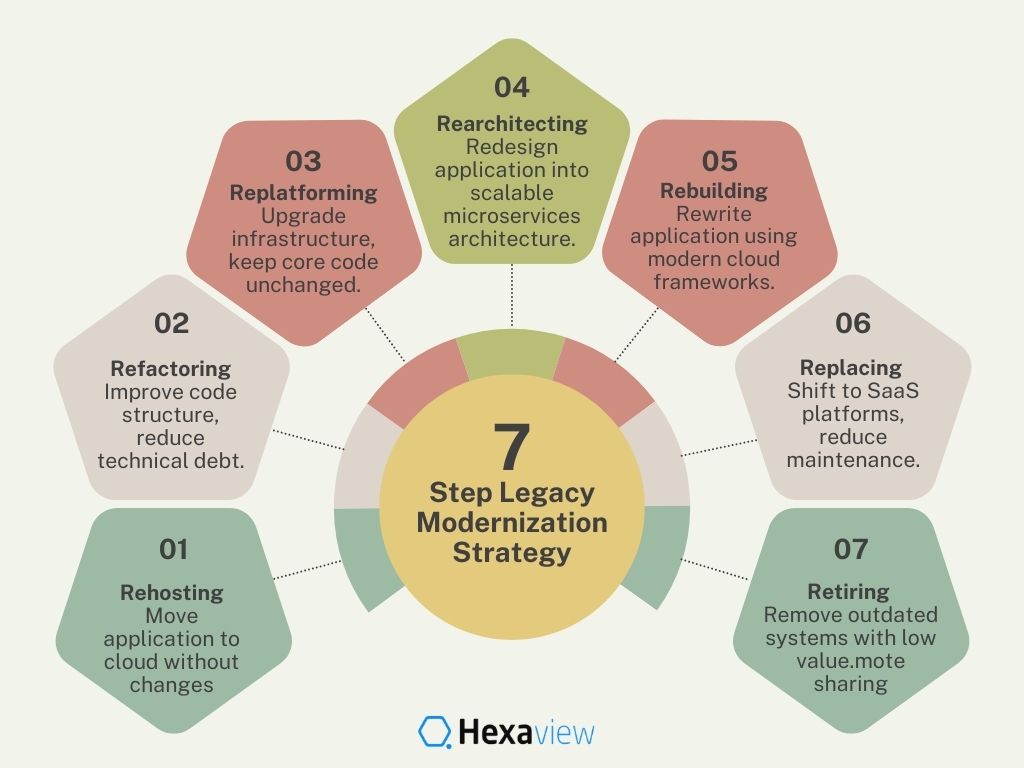
Modernizing outdated software does not always mean rebuilding everything from scratch. The right legacy modernization strategy depends on business goals, system complexity, and long-term vision. Selecting the correct approach ensures that legacy application modernization remains efficient and cost-effective.
The following seven proven strategies help enterprises transform their systems:
By evaluating these options, legacy modernization services can help you pick the best path forward. Each strategy offers a different balance of risk, cost, and long-term agility.
A structured approach ensures that legacy application modernization remains controlled and measurable. Enterprises must follow a clear, sequential process to transform outdated systems without disrupting core business operations. This step-by-step roadmap provides a reliable framework for achieving long-term technical excellence and operational efficiency.
The following steps define the most effective path for legacy system modernization:
he cost of legacy system modernization depends on the complexity of your current architecture and the depth of the transformation you choose. Understanding these drivers helps enterprises allocate budgets effectively and avoid hidden expenses during the process.
The following elements primarily influence the total investment in legacy application modernization:

The time required for legacy application modernization depends on the complexity of your system and the specific strategy you choose. While small prjects can wrap up in a few months, large-scale enterprise transformations often take a year or more.
The following timeline estimates provide a general guide for different project scales:

Several factors can influence these timelines, such as the number of third-party integrations and the volume of data migration. Using legacy modernization services and AI-driven automation tools can often compress these schedules by up to 40%. A clear legacy modernization strategy ensures that each phase stays on track to meet your digital transformation goals.
Choosing the right partner for legacy application modernization is a high-stakes decision for any enterprise. In the US market, several companies lead the way by combining deep technical expertise with industry-specific compliance knowledge. These firms help businesses transition from rigid, outdated frameworks to scalable, cloud-native environments.
The following are the top 5 legacy modernization companies in 2026:
Hexaview Technologies stands out as a premier partner for legacy modernization services, particularly within the highly regulated BFSI sector. The company specializes in AI-assisted code migration, allowing for the transformation of older stacks like COBOL or BASIC with 95% to 98% accuracy. Their senior-led pods focus on zero-downtime transitions and "decoupling before moving," which ensures that core business logic remains intact. Hexaview is widely recognized for reducing technical debt while maintaining 100% compliance sign-off for wealth management and banking clients.
As a global giant in digital transformation, Accenture provides large-scale legacy application modernization services for Fortune 500 enterprises. They excel in complex mainframe migrations and offer a massive global delivery network. Their approach often involves enterprise-wide transformation playbooks that help organizations replatform and re-engineer their entire IT estates while preserving business continuity across multiple continents.
IBM remains a dominant force in the modernization space, especially for organizations with heavy mainframe dependencies. Their legacy modernization strategy leverages the Watson AI ecosystem to analyze old code and recommend optimal refactoring paths. They are a top choice for government and banking sectors that require hybrid cloud environments and the highest levels of infrastructure security.
Deloitte combines technical execution with high-level business strategy and regulatory insight. They are among the top legacy system modernization providers for organizations in the public sector and healthcare. Deloitte focuses on aligning IT transformation with overall business growth, ensuring that new architectures meet global compliance frameworks and long-term scalability needs.
DXC Technology is often described as the "cleanup crew" for incredibly complex and tangled IT environments. They specialize in simplifying messy server setups and monolithic applications into streamlined, cloud-ready workflows. Their expertise is particularly valuable for big organizations with a zero-tolerance policy for downtime during legacy software modernization projects.
Check the Top 10 Legacy Modernization Companies in 2026
Legacy application modernization is no longer just a technical choice; it is a vital strategy for enterprise survival in 2026. By moving away from rigid, monolithic systems, businesses unlock the agility needed to compete in a cloud-first and AI-driven market. Whether you choose to rehost, refactor, or rebuild, the goal remains the same: reducing technical debt while enhancing security and scalability.
Partnering with experienced legacy modernization services ensures a risk-mitigated transition. A well-planned legacy modernization strategy protects your core business logic while providing the high-performing foundation required for future innovation. As your enterprise grows, modernizing your tech stack ensures that your software remains an asset rather than a liability.
Digital transformation is a broad business strategy to change how a company operates using technology. Legacy system modernization is a specific, critical part of that journey that focuses on updating the underlying technical systems to support those new goals.
You should consider a complete rewrite when the existing code is too outdated to support modern security standards or when the cost of maintaining the old architecture exceeds the cost of building a new, future-ready system.
Yes. By using a phased legacy modernization strategy and techniques like blue-green deployments or parallel system execution, enterprises can migrate features incrementally without interrupting daily operations.
The biggest risk is attempting to replace the entire system at once without validating current production behavior. This "big bang" approach often leads to data loss or critical functional gaps.
AI speeds up legacy software modernization by automatically extracting business logic from old code, documenting undocumented systems, and performing high-accuracy code conversions.
Not exactly. Cloud migration is the destination, while modernization is the process of improving the application itself. Simply moving a bad application to the cloud won't fix underlying architectural flaws.
Success is typically measured by a reduction in infrastructure costs, faster deployment cycles for new features, improved system uptime, and a decrease in maintenance time.
While most legacy application modernization services focus on cloud adoption, some organizations modernize on-premise systems to meet specific data sovereignty or extreme low-latency requirements.



.svg)


.svg)