

What Are Product Engineering Services?
Product engineering services refer to the end-to-end process of designing, developing, testing, deploying, modernizing, and continuously improving software products across their full lifecycle. Unlike traditional software development, which is project-bound and delivery-focused, product engineering is continuous, innovation-driven, and outcome-oriented. Enterprises engage product engineering services companies to accelerate digital product development, integrate AI and cloud-native technologies, and maintain long-term product competitiveness in global markets.

In 2026, the term product engineering services has moved well beyond the narrow confines of software coding. It encompasses the entire digital product lifecycle from the earliest stages of discovery and market research, through UI/UX design, architecture, agile development, QA, DevOps, and all the way to continuous post-launch optimization and modernization.
Enterprises across North America, India, Europe, the Middle East, and APAC are increasingly shifting from fragmented vendor relationships to strategic partnerships with specialized product engineering services companies that can own full product lifecycle accountability.
According to IDC's 2025 Worldwide Services Report, enterprises that adopt a full-cycle product engineering model achieve 3.2x faster feature velocity compared to those relying on traditional software outsourcing vendors.
Product engineering services are a category of technology services that help organizations conceive, build, and evolve software products as living digital assets. This includes software product engineering, cloud-native engineering, embedded systems engineering, AI product engineering, SaaS platform engineering, and product modernization, all delivered under a continuous improvement model.
The distinction is strategic, not just semantic. Product engineering is built around long-term product ownership, continuous user feedback loops, and innovation-driven delivery, whereas traditional software development remains largely project-scoped, fixed-outcome, and vendor-isolated.

Modern product engineering services companies offer a broad portfolio to serve enterprise needs across industries:
The enterprise technology landscape in 2026 is defined by three simultaneous pressures: accelerating digital transformation, AI disruption across every sector, and relentless pressure to reduce engineering costs while maintaining quality. Product engineering services have emerged as the strategic response to all three.
Every major industry vertical, from fintech and healthcare to retail, manufacturing, and logistics is being compelled to deliver digital-first products at a pace that traditional IT organizations simply cannot sustain internally.
According to Forrester Research (2025), 67% of enterprise CEOs now cite software product development capability as their top competitive differentiator.
Market Signal: Global enterprise spending on digital product development is expected to cross $620 billion in 2026, with North America accounting for 38% of total spend, followed by Europe (27%) and APAC (24%). India remains the world's largest offshore engineering delivery hub, contributing to over 45% of global offshore product engineering capacity. (Source: NASSCOM, 2025)
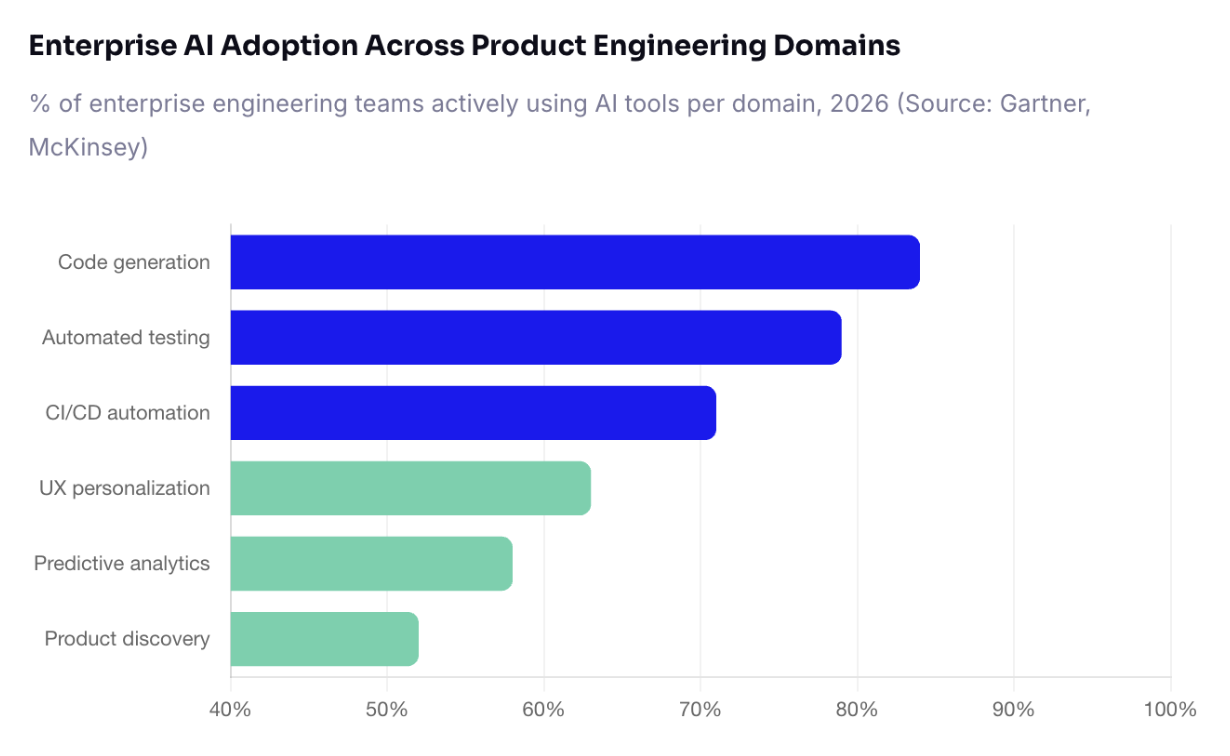
Artificial intelligence has moved from being a product feature to being the foundation of how products are conceived, built, and improved. In 2026, AI copilots are now embedded across the entire software development lifecycle (SDLC), from automated code review and intelligent test generation to predictive product analytics and AI-driven UX personalization.
According to GitHub's 2025 Octoverse Report, developers using AI coding assistants ship 55% more code per week and report a 74% reduction in repetitive coding tasks. For enterprises, this translates directly to faster time-to-market and substantially lower engineering costs.
In industries like fintech, retail, and healthtech, releasing a competitive product weeks after a competitor can mean the difference between market leadership and irrelevance. Full-cycle product engineering services with embedded DevOps, CI/CD automation, and agile sprint cadences enable enterprises to cut average release cycles from quarterly to weekly, and in some cases, daily.
Static products lose users. Enterprise markets now expect continuous improvement of new features, performance enhancements, security updates, and UX improvements delivered on a regular cadence. Full-cycle product engineering partnerships are structurally designed for this reality, unlike project-based development engagements that create organizational dead zones between project cycles.
Gartner's 2025 CIO Agenda Survey found that 71% of enterprise CIOs cited engineering cost reduction as a primary driver for partnering with product engineering services companies. Offshore and hybrid engineering models particularly those centered on India-based global delivery centers with onshore coordination teams consistently deliver 35–55% cost savings compared to equivalent in-house engineering teams in the US, UK, or Western Europe.
Every successful product engineering engagement begins with a strategy phase: market sizing, user persona definition, competitive landscape analysis, technology selection, and the creation of a prioritized product roadmap. This stage typically lasts 2–4 weeks for mid-size enterprise products and includes design sprints, JTBD (Jobs-to-be-Done) workshops, and lean validation experiments before a single line of code is written.
Modern product engineering treats UI/UX not as an afterthought but as a core engineering discipline. This includes design systems creation, accessibility compliance (WCAG 2.2), interaction design, usability testing, and front-end engineering, all tightly integrated with the product's backend architecture.
Architecture decisions made early in a product's lifecycle compound over time for better or worse. In 2026, best-practice product architecture is built on three pillars: microservices decomposition, cloud-native infrastructure (AWS, Azure, GCP), and API-first design. This ensures the product can scale horizontally, integrate with third-party ecosystems, and evolve without expensive re-writes.
Full-cycle product engineering teams operate in 2-week sprint cycles with continuous backlog refinement, sprint reviews, and retrospectives. Cross-functional product pods comprising engineers, QA specialists, DevOps engineers, and product managers, ensure alignment across every sprint and reduce communication latency.
Quality assurance in 2026 is predominantly automated, with AI-powered test generation tools capable of producing comprehensive test suites from user stories. Shift-left testing practices embed quality gates directly into the CI/CD pipeline, reducing post-release defect rates by up to 68% compared to traditional QA models. (Source: Capgemini World Quality Report, 2025)
Continuous integration and continuous delivery pipelines are the operational backbone of full-cycle product engineering. Leading product engineering services companies maintain deployment frequencies of multiple times per day, with automated rollback capabilities, feature flags, and canary releases that eliminate deployment risk.
For enterprises carrying technical debt like legacy monoliths, outdated architectures, or on-premise systems, product modernization services provide a structured path to cloud-native, microservices-based, and AI-ready architectures without disrupting existing business operations.
Full-cycle product engineering doesn't end at launch. Post-release support, performance monitoring, user behavior analytics, and iterative feature development are core service components that ensure the product remains competitive, secure, and performant throughout its commercial lifecycle.

Market research, user discovery, competitive analysis, technology selection, and product roadmap definition. Duration: 2–4 weeks. Deliverables: validated product brief, prioritized backlog, architecture decision record.
Delivering a working, testable product with core features within 8–16 weeks, depending on complexity. Built on modern tech stacks (React, Node.js, Python, Kubernetes) for future scalability. Goal: validated learning, not perfection.
Database optimization, load balancing, caching layers (Redis, CDN), and horizontal auto-scaling. Includes geographic expansion, internationalization, and onboarding of new user cohorts at enterprise scale.
Structured migration of legacy systems to cloud-native architectures. Techniques: strangler fig pattern, event-driven re-architecture, database migration, and zero-downtime cutover strategies.
Perpetual product evolution: integrating AI features, personalization engines, new API integrations, A/B testing, and data-driven product improvements based on real user behavior analytics and market signals.
What are the top product engineering trends in 2026? The top product engineering trends in 2026 include AI-native engineering (autonomous agents, AI-assisted SDLC), cloud-native product development, platform engineering and internal developer platforms (IDPs), sustainable engineering practices, data-driven product development, cybersecurity-first design, low-code/no-code acceleration, and edge AI for intelligent embedded systems.
AI agents, autonomous workflows, and AI-assisted SDLC from code generation to intelligent testing are now standard in enterprise engineering. 72% of Fortune 500 companies have deployed AI coding copilots. (GitHub, 2026) The next frontier is multi-agent systems that autonomously handle sprint planning, dependency mapping, and infrastructure optimization within human-defined guardrails.
Kubernetes, service mesh (Istio), and serverless-first architectures dominate new product builds. Cloud-native products achieve 99.99% SLA availability vs 99.5% for traditional deployments. Multi-cloud strategies are now standard for enterprise-grade products requiring geo-redundancy and regulatory data residency compliance.
Green software engineering, optimizing code for energy efficiency, choosing carbon-neutral cloud regions, and measuring software carbon intensity (SCI) is now a regulatory and ESG requirement across the EU and UK. The Green Software Foundation's SCI standard is being adopted by enterprise engineering teams globally.
Internal Developer Platforms (IDPs) are reducing engineering onboarding time by 60% and improving developer experience scores by 40%. (CNCF State of Platform Engineering, 2025) IDPs abstract infrastructure complexity, enabling product engineers to focus on product logic rather than operational overhead.
Real-time telemetry, A/B testing at scale, and AI-powered feature prioritization are turning product roadmaps from gut-feel exercises into evidence-based engineering decisions. Product analytics platforms like Amplitude, Mixpanel, and custom data lakes are now core product engineering infrastructure.
Low-code platforms now handle 30% of enterprise application development, freeing senior engineers to focus on high-complexity, high-value product work. (Gartner, 2026) The most effective engineering teams use low-code for internal tooling and workflow automation while maintaining custom code for core competitive product differentiation.
The SEC's software disclosure rules and EU Cyber Resilience Act have elevated security-by-design from a best practice to a legal obligation for enterprise software products. Secure SDLC, SAST/DAST scanning, supply chain security (SBOM), and zero-trust architecture are now table stakes in product engineering engagements.
AI inference at the edge in IoT devices, autonomous vehicles, and industrial equipment, is reducing latency by 85% compared to cloud-only inference models. (IDC, 2025) Edge AI enables real-time decision-making in environments where cloud connectivity is unreliable, expensive, or prohibited by data sovereignty requirements.
Is full-cycle product engineering worth it? Yes. Enterprises that partner with full-cycle product engineering services companies consistently outperform those relying on in-house IT or traditional outsourcing on time-to-market, product quality, engineering cost efficiency, and innovation velocity. ROI is typically realized within the first 12 months.
Full-cycle engineering teams with embedded DevOps reduce release cycles from months to weeks. Enterprises report 40% faster time-to-market on average when transitioning from traditional development to full-cycle product engineering models. (McKinsey Digital, 2025)
Offshore and hybrid delivery models offer 35–55% cost savings over equivalent US/UK in-house engineering teams without sacrificing quality, particularly when engaging India-based global delivery centers with strong senior engineering leadership.
Immediate access to AI/ML engineers, cloud architects, DevSecOps specialists, embedded engineers, and domain experts across verticals, without the 3–6 month hiring cycles, equity dilution, or location constraints of building in-house.
Scale engineering teams up or down based on product stage and business demand, no hiring or severance cycles. This elasticity is especially valuable during product launches, seasonal peaks, and strategic pivots.
Automated testing, shift-left QA practices, AI-assisted code review, and continuous integration consistently deliver fewer production defects and higher system reliability compared to waterfall or ad-hoc QA models.
Ongoing R&D, emerging technology adoption, and product improvement cycles keep your product competitive. Leading engineering partners proactively bring new AI capabilities, competitive intelligence, and architectural improvements to your product roadmap.
User-centered design, real-time analytics, and AI-driven personalization directly improve NPS and retention. Enterprises leveraging AI personalization report a 23% average increase in user engagement and 18% improvement in conversion rates. (Adobe Experience Report, 2025)
Strategic engineering partners invest in understanding your business domain, reducing knowledge transfer overhead over time and enabling increasingly sophisticated product innovations as the partnership matures.
Artificial intelligence is not a future promise in product engineering, it is the present operational reality for enterprise engineering teams globally.
LLM-based coding assistants, including GitHub Copilot, Cursor, and internally fine-tuned enterprise models, now assist developers with code generation, refactoring, documentation, and security scanning. Engineering teams using AI coding tools complete complex development tasks 2x faster than those without. (McKinsey, 2025)
AI-driven test generation tools analyze source code changes and automatically generate comprehensive regression test suites. Intelligent test oracles like AI models trained on historical defect patterns, predict which code changes are most likely to introduce bugs, enabling proactive quality management rather than reactive debugging.
Recommendation engines, dynamic UI adaptation, and predictive content delivery powered by on-product AI have become standard features in enterprise SaaS, retail, and fintech products. Personalization at this level was previously achievable only by companies with dedicated AI research teams; product engineering services now make it accessible to any enterprise.
Product engineering teams now deploy AI models on telemetry data to predict user churn, identify feature adoption blockers, and surface performance degradation before it impacts users. This shifts product management from reactive to predictive, a significant competitive advantage in fast-moving markets.
Multi-agent AI systems are being deployed within product engineering workflows to autonomously handle sprint planning optimization, dependency mapping, code review triage, and infrastructure cost optimization. These agents operate within defined guardrails and escalate edge cases to human engineers, creating a hybrid human-AI engineering model.
As AI becomes embedded in enterprise products, governance frameworks, including model explainability, bias detection, data lineage, and regulatory compliance (EU AI Act, US AI Executive Order) have become core engineering responsibilities. Product engineering services companies with mature AI governance practices are increasingly preferred by regulated enterprise clients.
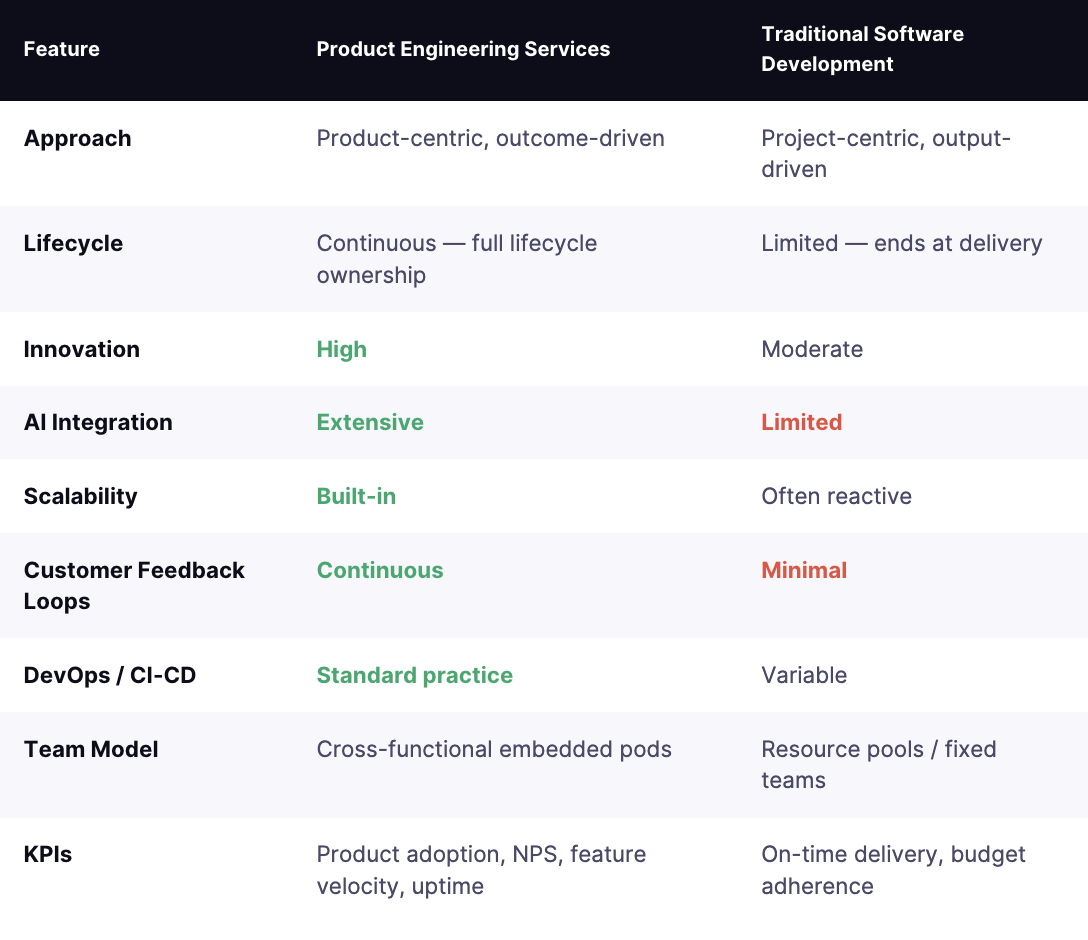
What is the difference between product engineering and software development? Product engineering services focus on the entire product lifecycle, from ideation through continuous optimization, with a product-centric, innovation-driven approach that includes AI integration, DevOps, and ongoing ownership. Traditional software development services are project-scoped, typically ending delivery, with limited AI integration, reactive scalability, and minimal customer feedback loops.
Assess depth across the full stack: React/Vue/Angular (frontend), Node.js/Python/Java/Go (backend), AWS/Azure/GCP (cloud), Spark/Databricks/dbt (data engineering), and PyTorch/TensorFlow/LangChain (AI/ML). Ask for architecture samples and engineering case studies specific to your domain.
In 2026, AI is non-negotiable. Your engineering partner must demonstrate proven experience building AI-native features, not just integrating off-the-shelf APIs, but training custom models, deploying RAG pipelines, and building responsible AI governance frameworks. Cloud certification depth (AWS Advanced Partner, Azure Expert MSP, GCP Premier) is a meaningful trust signal.
Domain knowledge accelerates delivery. A product engineering company with prior experience in your vertical BFSI compliance, HIPAA in healthcare, or supply chain optimization in manufacturing will require significantly less ramp-up time and deliver more relevant architectural decisions.
Evaluate the partner's track record of successfully migrating legacy systems — including their approach to strangler fig patterns, event-driven re-architecture, database migration, and zero-downtime cutover strategies.
Leading product engineering services companies offer fully offshore (India-based teams), hybrid (offshore + onshore coordination), and distributed global pods. Each has different cost, communication, and time zone implications. Evaluate which fits your velocity requirements and organizational culture.
Look for SOC 2 Type II certification, ISO 27001 compliance, GDPR-ready data handling, and proven experience with industry-specific requirements: HIPAA, PCI-DSS, FedRAMP, DORA.
Assess overlap hours for distributed teams, project management tooling (Jira, Linear, Notion), documentation practices, and stakeholder communication quality through reference checks and paid pilot engagements.
The best partners proactively bring new ideas, emerging technologies, and competitive intelligence to your product roadmap rather than simply executing predefined requirements. Look for active R&D practices, engineering blogs, open-source contributions, and conference presence.
Hexaview Technologies is a global product engineering services company serving enterprise clients across North America, Europe, the Middle East, and APAC with a specialized focus on AI-enabled product development, cloud-native engineering, and enterprise-grade product modernization.
We embed AI at every layer of the product engineering lifecycle, from intelligent development tools and automated testing to AI-native product features and LLM-powered enterprise workflows. Our AI engineering teams are experienced with fine-tuning, RAG architecture, agentic systems, and responsible AI governance.
From product discovery and MVP through scaling, modernization, and continuous innovation, Hexaview teams own complete product lifecycle accountability alongside your enterprise leadership. We don't hand off and walk away.
Deep expertise across AWS, Azure, and GCP, including cloud-native architecture, data platform engineering, real-time analytics, and MLOps, for products that scale globally and perform reliably at enterprise load.
Continuous delivery pipelines, sprint-based execution, and shift-left quality practices ensure consistent, predictable delivery velocity and production-grade product quality across every engagement.
SOC 2 Type II certified, GDPR-compliant, and experienced with HIPAA, PCI-DSS, FedRAMP, and EU AI Act requirements. Security is embedded into our engineering DNA, not bolted on post-delivery.
Distributed engineering teams across India (offshore), USA (onshore), and Europe (nearshore) provide cost-effective, timezone-optimized delivery with senior technical leadership at every engagement level.
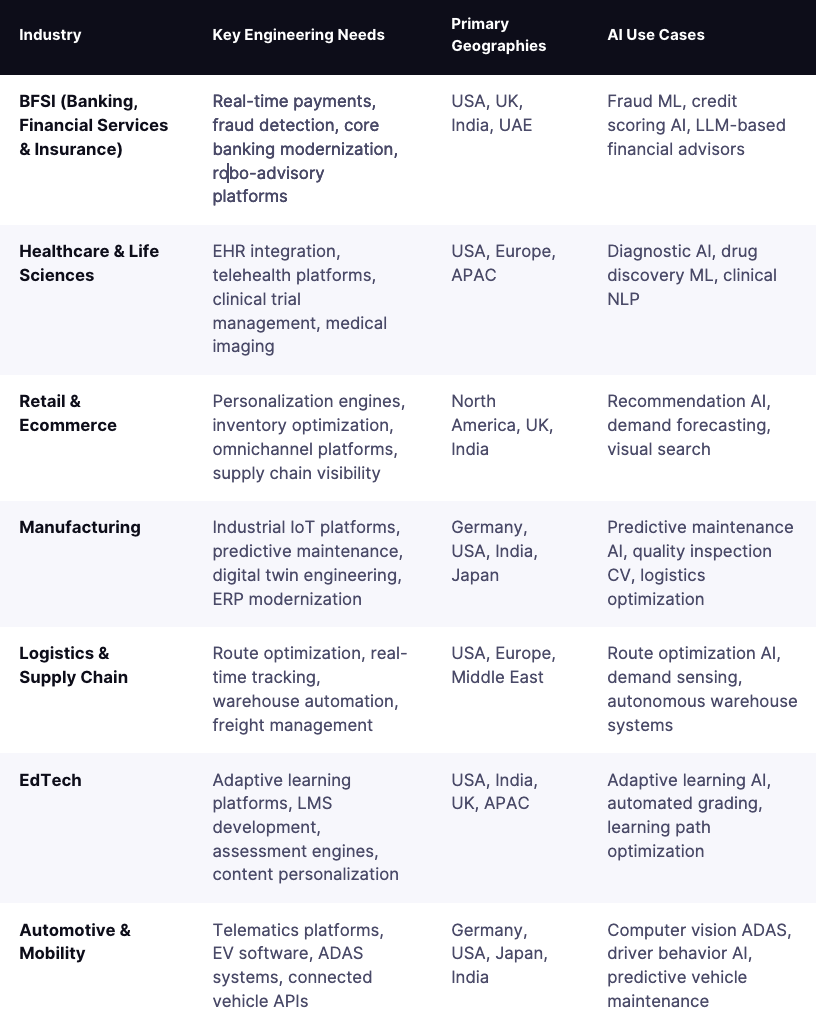
Proven domain expertise across BFSI, healthcare, retail, manufacturing, logistics, and EdTech, delivering engineering solutions that reflect the regulatory, operational, and competitive nuances of each vertical.
Build scalable, AI-powered digital products with Hexaview Technologies.
Product engineering services have evolved from a tactical IT function to a strategic growth driver for enterprise organizations in 2026. The convergence of AI, cloud-native architecture, and full-cycle engineering ownership is redefining how enterprises conceive, build, scale, and sustain competitive digital products.
Key Takeaways:
The enterprises winning in 2026 are those that have stopped treating product engineering as a project execution function and started treating it as a continuous innovation capability, one that is deeply integrated with business strategy, powered by AI, and delivered by world-class engineering partnerships.
Partner with Hexaview Technologies for AI-powered, future-ready product engineering services.
Q: What are product engineering services?
Product engineering services are end-to-end services covering the full lifecycle of a software product from initial discovery, UI/UX design, and architecture through development, QA, DevOps, deployment, modernization, and continuous optimization. Unlike traditional software development, they are continuous, lifecycle-driven, and focused on long-term business outcomes.
Q: What does a product engineering services company do?
A product engineering services company partners with enterprises to design, build, launch, scale, and continuously improve software products. Services include product strategy, MVP development, cloud-native engineering, AI integration, QA automation, DevOps, product modernization, and post-launch optimization, delivered by cross-functional engineering teams.
Q: What is full-cycle product engineering?
Full-cycle product engineering is a comprehensive model where a services partner owns accountability for the entire product lifecycle, from ideation and MVP through scaling, modernization, and continuous feature delivery. It contrasts with project-based development, where vendor involvement ends at a defined delivery milestone.
Q: How is product engineering different from software development?
Product engineering is product-centric, continuous, and innovation-driven with embedded AI, DevOps, and full lifecycle ownership. Traditional software development is project-centric, time-and-scope-bounded, and typically ends at deployment.
Q: Why are enterprises investing in product engineering services in 2026?
Because of accelerating demand for AI-native digital products, the need for faster innovation cycles, pressure to reduce engineering costs through offshore and hybrid delivery models, and the impossibility of maintaining the full breadth of engineering talent in-house at competitive cost.
Q: How does AI improve product engineering?
AI improves product engineering by accelerating code generation and review, automating test creation, enabling predictive product analytics, powering personalization features, streamlining DevOps workflows, and enabling autonomous monitoring. AI copilots alone increase developer productivity by 55%. (GitHub, 2025)
Q: What industries use product engineering services?
BFSI, healthcare and life sciences, retail and ecommerce, manufacturing, logistics and supply chain, EdTech, and automotive and mobility, across geographies including USA, India, UK, Germany, UAE, and APAC.
Q: How much do product engineering services cost?
Offshore India-based engineers: $25–$65/hour. Hybrid blended rate: $65–$120/hour. Onshore US/UK: $120–$220/hour. A 10-member offshore team costs approximately $800K–$1.2M annually vs $2.5M–$3.2M for an equivalent US in-house team.
Q: What technologies are used in product engineering?
React, Vue, Angular (frontend); Node.js, Python, Java, Go, Rust (backend); AWS, Azure, GCP (cloud); Kubernetes, Docker, Terraform (infrastructure); PostgreSQL, MongoDB, Redis, Snowflake (data); PyTorch, TensorFlow, LangChain (AI/ML); GitHub Actions, GitLab CI (DevOps); Playwright, Cypress (QA).
Q: How do I choose the right product engineering partner?
Evaluate technical expertise across AI, cloud, and DevOps; industry domain experience; product modernization track record; delivery model flexibility; security certifications (SOC 2 Type II, ISO 27001); and track record of innovation-driven partnerships. Always run a paid pilot engagement before committing long-term.





.svg)



.svg)