
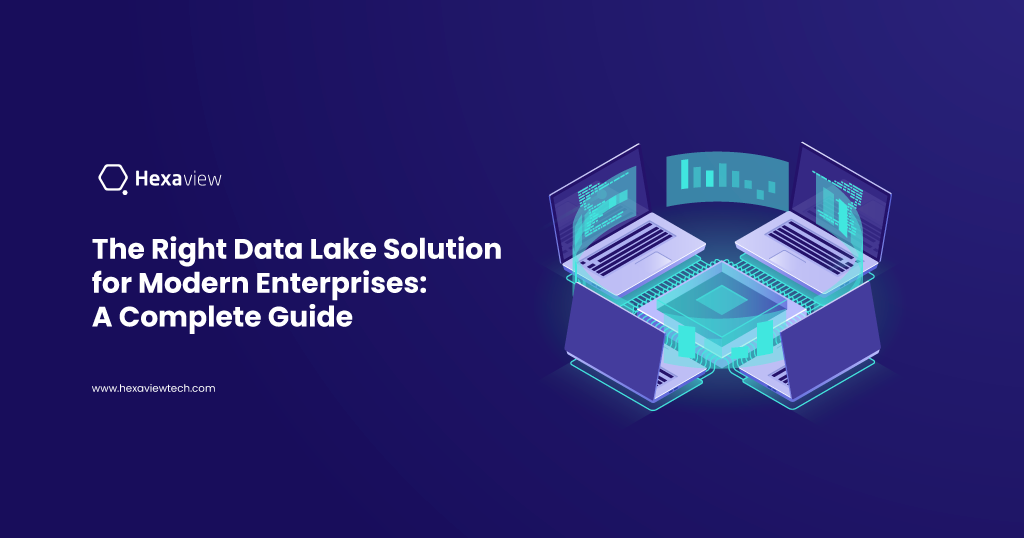
Most businesses collect more data than they can handle. It comes from every direction: customer records, transactions, logs, social media, and IoT devices. But storing it all in one place and actually using it? That is where most businesses struggle.
A data lake solution changes that. It gives you a centralized repository that stores structured, semi-structured, and unstructured data at scale, so your teams can access, analyze, and act on it fast.
A data lake solution is a centralized repository that stores structured, semi-structured, and unstructured data at scale. It lets businesses collect data from any source, store it in its raw form, and use it for analytics, AI, and machine learning whenever needed.
Modern enterprises need a data lake solution to manage growing data volumes, enable real-time analytics, and support digital transformation. Moving from fragmented systems to unified data ecosystems is what helps businesses make faster, smarter decisions.
Data today comes from everywhere. IoT devices, mobile applications, CRM platforms, customer interactions, and third-party tools all generate data around the clock. Some of it is structured. Most of it is not.
Without a central system, this data ends up scattered across different tools and teams. An enterprise data lake solution brings all of it together under one roof, no matter the source or format.
Waiting for weekly reports is no longer good enough. Businesses need to spot trends and respond to changes as they happen. That requires both streaming data pipelines for live data and batch processing for historical data working together.
A well-built scalable data lake platform gives your teams the speed and flexibility to make decisions based on what is happening right now, not what happened last week.
AI and machine learning models need large volumes of clean, accessible data to work well. A data lake for AI and analytics acts as the backbone for all your intelligent initiatives. It stores the raw data your models need and makes it available in the right format at the right time.
This is what turns a data lake from a storage tool into a real business advantage. Predictive insights, anomaly detection, and personalization all become possible when your data foundation is solid.
A modern data lake architecture includes data ingestion, storage, processing, governance, and analytics layers. These components work together to ensure scalability, security, and high performance across your entire data ecosystem.
Data enters your lake from dozens of sources at the same time. Batch pipelines handle large historical loads while real-time pipelines capture live data as it flows in. Multi-source integration means nothing gets left behind, whether it comes from APIs, databases, files, or streaming platforms.
A strong ingestion framework is the foundation everything else depends on.
Cloud data lake solutions built on platforms like AWS S3 and Azure Data Lake give businesses flexible, cost-efficient storage that grows with them. You only pay for what you use and you never run out of space.
Smart storage design separates hot data from cold data, keeping costs low without sacrificing access speed.
Raw data is not useful on its own. ETL and ELT pipelines clean, enrich, and transform data into formats your teams can actually work with. This layer removes duplicates, fills gaps, and standardizes data from different sources.
Good data engineering here is what makes every downstream process more reliable and more accurate.
A scalable data lake platform without governance quickly becomes a data swamp. This layer manages data quality, tracks data lineage, enforces compliance policies, and controls who can access what through role-based permissions.
Businesses in regulated industries like BFSI and healthcare especially need this layer to be rock solid.
This is where data starts delivering real value. BI tools and dashboards turn processed data into clear visual insights. Self-service analytics lets every team explore data on their own without waiting for a data analyst.
This is what data democratization looks like in practice. The right insights reach the right people at the right time.
Choosing the right data lake solution means evaluating scalability, integration capabilities, security, and alignment with your business goals. The wrong choice leads to wasted investment and technical debt that slows everything down.
Before you look at any technology, get clear on what you need your data to do. Are you building for real-time analytics? AI and ML workloads? Regulatory reporting? Your business objectives should drive every architectural decision you make.
Technology should serve your goals, not the other way around.
Think beyond where you are today. How much data will you generate in two years? How many users will need access? A scalable data lake platform should handle your future needs without requiring a full rebuild.
Look for solutions that scale storage and compute independently so you are not overpaying as you grow.
Cloud data lake solutions offer speed, flexibility, and lower upfront costs. On-premise options give more control but come with higher maintenance overhead. Most modern enterprises choose cloud or hybrid models for their agility and global accessibility.
Your choice should reflect your security requirements, existing infrastructure, and long-term cost expectations.
Any solution you choose must have strong governance built in. Look for data lineage tracking, quality monitoring, access controls, and audit trails. Without these, your data lake becomes unreliable and potentially non-compliant.
Governance is not optional. It is what keeps your data trustworthy at scale.
Implementing a data lake is not a simple project. The right partner brings architectural expertise, industry knowledge, and hands-on experience across cloud platforms. Data lake consulting services help you avoid costly mistakes and get to value faster. See how Hexaview helped a financial services firm achieve +60% data accessibility and -50% manual effort through expert data lake implementation.
A data lake vs data warehouse comparison comes down to one core difference. A data lake stores raw data in its native format while a data warehouse stores structured, processed data built for reporting. Both serve different purposes and the best enterprises use both together.
A data lake gives you flexibility. You store everything first and decide how to use it later. A data warehouse gives you structure. Data goes in only after it has been cleaned and modeled for specific reporting needs.
Data lakes work best for exploration and AI workloads. Data warehouses work best for consistent, repeatable business reporting.
Data lakes are generally more cost-effective for storing large volumes of raw data, especially on cloud platforms. Data warehouses cost more per unit of storage but deliver faster query performance for structured analytics.
Choosing between them often comes down to the volume of your data and the type of questions you need to answer.
Data lakes are ideal for machine learning, log analytics, IoT data, and any use case involving unstructured data. Data warehouses shine in financial reporting, sales dashboards, and compliance analytics where consistency and speed matter most.
Knowing what your teams actually need to do with data is the clearest guide to which solution fits best.
Most modern enterprises do not choose one or the other. They use both. A modern data lake architecture feeds clean, processed data into a data warehouse for structured reporting while keeping the raw data accessible for AI and exploration.
This hybrid approach gives you the best of both worlds. Flexibility for data science teams and reliability for business users, all from the same unified data ecosystem. Data lake implementation services from the right partner make this integration seamless from day one.
Data lake solutions enable AI, machine learning, and advanced analytics by providing high-quality, scalable data. Organizations that invest in the right data foundation unlock real innovation, faster automation, and a measurable competitive edge.
AI models are only as good as the data behind them. Training a reliable model requires large volumes of diverse, clean, and well-organized data. A data lake for AI and analytics stores exactly that, structured and unstructured data from every source in one accessible place.
This means your data science teams spend less time hunting for data and more time building models that actually work. Explore how Hexaview's AI and machine learning services connect with your data lake strategy.
Predictive analytics tells you what is likely to happen next. Prescriptive analytics tells you what to do about it. Both rely on having enough historical and real-time data to find meaningful patterns.
A modern data lake architecture gives analysts and data scientists the depth of data they need to move beyond basic reporting. Instead of looking at what happened last quarter, your teams start anticipating what will happen next month and planning ahead with confidence.
Customers today expect businesses to know them. Personalization at scale requires combining behavioral data, transaction history, preferences, and real-time signals into a single view of each customer.
A scalable data lake platform makes this possible. It stores every interaction and makes it available to your marketing, sales, and product teams. The result is smarter recommendations, better targeting, and customer experiences that actually feel relevant.
Automation needs data to function well. Whether it is automating approvals, flagging anomalies, or triggering workflows based on real-time events, every automated process depends on reliable data flowing through it consistently.
Cloud data lake solutions provide the infrastructure that keeps this data moving. Businesses that connect their data lake to their automation layer reduce manual effort, cut operational costs, and free their teams to focus on higher-value work.
Hexaview Technologies brings end-to-end expertise to every stage of your data lake implementation services journey. Here is how they help:
A data lake solution is no longer a nice-to-have. It is what modern enterprises need to stay competitive, innovate faster, and get real value from their data. Whether you are starting fresh or modernizing a legacy system, the right architecture, governance, and implementation partner make all the difference. Explore Hexaview's data lake services to see how they help businesses build data lakes that are secure, scalable, and ready for AI from day one.
What is a data lake solution?
A data lake solution is a centralized storage system that holds structured, semi-structured, and unstructured data at scale. It lets businesses store data in its raw form and use it for analytics, AI, and machine learning.
What is the difference between a data lake and a data warehouse?
A data lake vs data warehouse comes down to format and purpose. A data lake stores raw data from any source. A data warehouse stores structured, processed data built for reporting. Most enterprises use both together for maximum value.
What are cloud data lake solutions?
Cloud data lake solutions are data lakes hosted on cloud platforms like AWS, Azure, or Google Cloud. They offer flexible storage, lower upfront costs, and the ability to scale up or down based on your needs.
How long does data lake implementation take?
Timelines vary based on data volume, complexity, and integrations. Simple implementations can take a few weeks while larger enterprise projects may take several months. Data lake implementation services from an experienced partner help speed up deployment significantly.
How do data lakes support AI and analytics?
A data lake for AI and analytics stores the large volumes of diverse data that AI models need for training and deployment. It also enables predictive analytics, real-time insights, and personalized customer experiences at scale.
What should I look for in data lake consulting services?
Look for a partner with hands-on experience across cloud platforms, strong governance frameworks, and a track record in your industry. Good data lake consulting services cover everything from strategy and architecture to implementation and ongoing optimization.






.svg)



.svg)