
The heat in Miami is legendary, but in March 2026, the real temperature spike is happening at Future Proof Citywide. As thousands of finance leaders gather under the Florida sun, the conversation has shifted. We are no longer talking about "tech updates" or simple efficiency gains. We are witnessing a total re-installation of the financial world’s operating system. If you still think AI is just a better version of Google Search, you are likely living in the past. By now, AI in financial services 2026 has moved from a tool we use to the actual system that runs the show.
Artificial Intelligence is transforming industries by optimizing efficiency and enabling data-driven decision-making, but in finance, it is doing something more: it is creating "Agentic" systems that can think, plan, and act.
Remember 2024? Back then, everyone was impressed by chatbots that could summarize a PDF or draft a polite email. In 2026, that is considered ancient history. The most significant AI trend in BFSI right now is the rise of Agentic AI in Finance.
Unlike the basic models of the past that waited for a human to type a prompt, these agents act with a level of autonomy. They understand objectives, reason through complex steps, and execute workflows without constant hand-holding. In a modern fintech stack, these agents serve as a control layer. They coordinate between core banking systems, KYC (Know Your Customer) tools, and global payment gateways.
For instance, an agent doesn't just flag a potential fraud risk. It independently analyzes the user's behavioral history, cross-checks risk signals across multiple global databases, and makes a decision to block or allow a transaction in milliseconds. This happens while the customer is still at the checkout, ensuring security without sacrificing the user experience.

If you are an advisor, your job description just received a massive upgrade. The Wealthtech Trends 2026 are no longer about simple "robo-advisors" that put everyone into three generic buckets. Today, agentic systems hold a "detailed memory" of a client’s entire life: their goals, their risk tolerance, and even their emotional reactions to market volatility.
AI won’t steal your job (unless your job is watching Netflix all day; then sorry, you’re replaceable). For the serious professional, AI is a superpower that enables hyper-personalization at scale. Imagine a client who suddenly receives a large inheritance. Before the advisor even picks up the phone, the AI agent has already updated the client's risk profile, suggested a customized tax-loss harvesting strategy, and drafted a personalized meeting agenda.
This isn't about replacing the human connection; it is about supercharging it. By handling the "middle-office" grind, these tools are saving advisors as much as ten to fifteen hours per week. That is time that can be spent building deep, high-trust relationships with clients.

The insurance world is also seeing a massive overhaul. Agentic AI is currently reducing claims processing times by up to 40% in some sectors. In banking, the KYC process has been completely reimagined. Instead of human analysts spending hours on manual document verification, agents extract information, identify missing data, and generate a narrative risk report.
This leads to an "Inspirational" shift: the future of work isn’t about machines replacing people, but about people using machines to reach new heights. When the machine handles the data extraction, the human handles the high-value investigation and judgment.
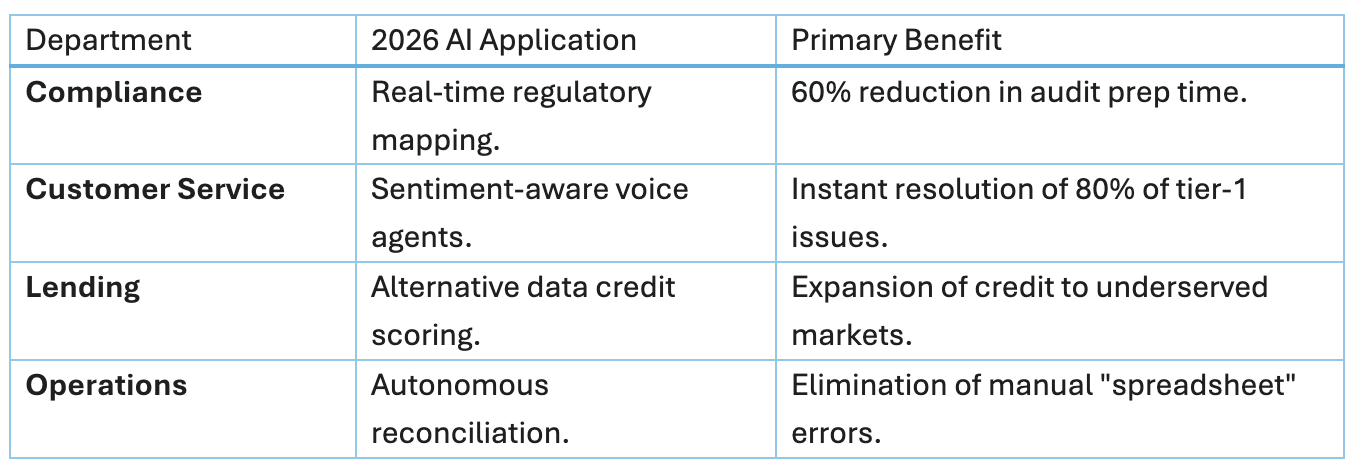
"Technology is needed, but guidelines must be set by humans." This was the core message at the global AI summits leading into 2026. As AI becomes more autonomous, the question of accountability has moved from the IT basement to the boardroom.
Thought-Provoking Question: If AI learns from us, what happens when we no longer like what it reflects back? Leaders in 2026 are moving away from "black box" systems toward "glass box" architectures. These are systems where every decision is explainable, traceable, and auditable. You cannot simply tell a regulator that "the AI said no" to a loan application. You must be able to show the math.
This is where AI foundations and professional development become critical. Firms are investing heavily in ensuring their leadership understands the "AI Engineering" behind the tools, not just the marketing promises.
At Hexaview, we have realized that most firms don't have an "AI ambition" problem: they have a "legacy reality" problem. You cannot build a 2026 AI strategy on a 2006 data foundation. Many brilliant AI projects die because the data is trapped in monolithic, outdated silos that consume 70% of the IT budget just to stay running.
We approach this topic by focusing on Legacy Modernization BFSI. We don't just "bolt on" a chatbot; we transform the core.
Whether it is Al Integrations for Wealth Management or a complete data overhaul, Hexaview provides the engineering muscle to ensure your firm is "Future-Proof" in every sense of the word.
Your Action Plan: Three Steps to Gain an Edge
To ensure your audience gains something tangible from this blog, here is a quick roadmap for the rest of 2026:
As we look toward the experiential financial conferences like Future Proof, the message is clear: the window of opportunity is closing. The next 24 to 36 months will define the winners of the next decade.
Ever tried explaining AI to your grandma and ended up confusing yourself instead? Yeah, same. But the complexity shouldn't stop us. The goal is simple: move from "predicting the future" to "executing the future." By leveraging Digital Transformation in Advisory and addressing your legacy system constraints, you can build a firm that isn't just surviving the AI revolution (but leading it).








.svg)




.svg)