
%20(1).png)
For the last two years, every wealth management conference has felt like a carbon copy of the one before it. The stage is crowded with talk of AI copilots for advisors, automated meeting prep, and flashy proposal generators. Big firms are tripping over themselves to announce "strategic partnerships" with the usual frontier AI suspects: Anthropic, OpenAI, and Google.
Most executives treat these partnerships like they’re adopting another standard SaaS layer, no different from Salesforce or ServiceNow. But they’re making a category error that might be the most expensive strategic mistake in the history of the industry.
AI isn’t software. It’s intelligence infrastructure. And right now, the industry is happily renting its own replacement.
In the deterministic world of 2010-2020, you bought tools to store data and execute workflows. Your CRM didn't "think", it followed instructions. The reasoning, the nuance, and the "secret sauce" stayed firmly inside human heads.
Large Language Models (LLMs) break that model. They are probabilistic reasoning systems that don't just process data; they learn patterns and infer logic. Every time an advisor at LPL Financial or Goldman Sachs prompts a rented model, they aren't just using a tool, they are providing a training signal. They are transmitting operational logic, compliance reasoning, and client interaction patterns.
In short: they are leaking institutional intelligence.
Here is where the math gets ugly for the incumbents. A single firm sees its own 5,000 clients and 50 advisors. But the AI provider, the "landlord" of this intelligence, sees thousands of firms simultaneously.
I call this the Thousand-Firm Mirror.
The platform captures the cumulative advantage of the entire industry and rents it back to you. Over time, your proprietary moat, the way you solve problems, becomes a commodity available to your cheapest competitor.
The industry loves the "copilot" narrative because it sounds safe. It implies the human is still in the driver's seat. But look at the automotive industry: Level 2 driver assistance was never the destination; it was a data-gathering exercise for Level 5 full autonomy.
We are following the exact same curve. Today’s advisor assistant is tomorrow’s Auto-RIA, an autonomous digital advisory platform capable of handling the entire client lifecycle without the human middleman. By the time firms realize they’ve hallowed out their internal expertise, the platform providers will be ready to bypass the legacy firm and go direct to the consumer.
There’s a hidden economic trap here, too. API-based pricing looks cheap during a pilot. But once AI is embedded in every workflow, your costs scale linearly with your success. Every "thought" the system has become a micro-transaction.
This creates Cognitive Rent. You pay continuously for access to the very intelligence you helped build.

If you think this is theoretical, look at the legal sector. In February 2026, when Anthropic released legal plugins for contract automation, the market didn't just notice, it panicked. Stock prices for legacy giants like Thomson Reuters and LexisNexis (RELX) cratered by double digits in a single day.
The market realized the "intelligence layer" owned by the AI provider had suddenly become more valuable than the "repository layer" (the data) owned by the incumbents. Wealth Tech is next.
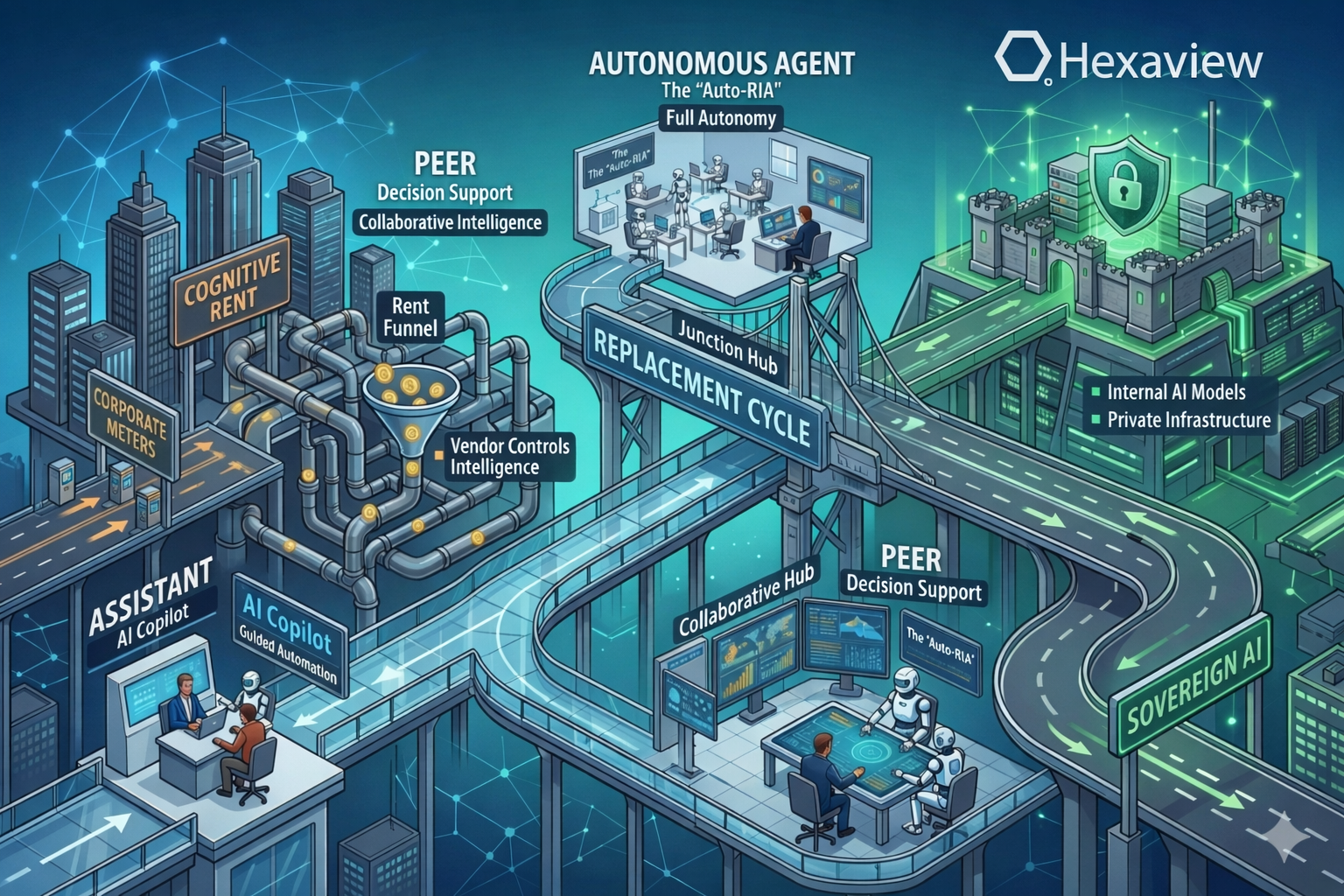
The solution isn't to hide from AI, it's to own the engine.
Just as the European Union has realized that true autonomy requires owning their own defense and digital infrastructure, enterprises must move toward Sovereign AI.
The wealth management firms that thrive in the next decade won't be the ones with the best "partnerships" with Silicon Valley. They will be the ones who had the foresight to build their own moats.
In the AI era, you either own the reasoning layer, or you are eventually replaced by it. The era of renting a brain is over. It’s time to own the engine.





.svg)




.svg)