
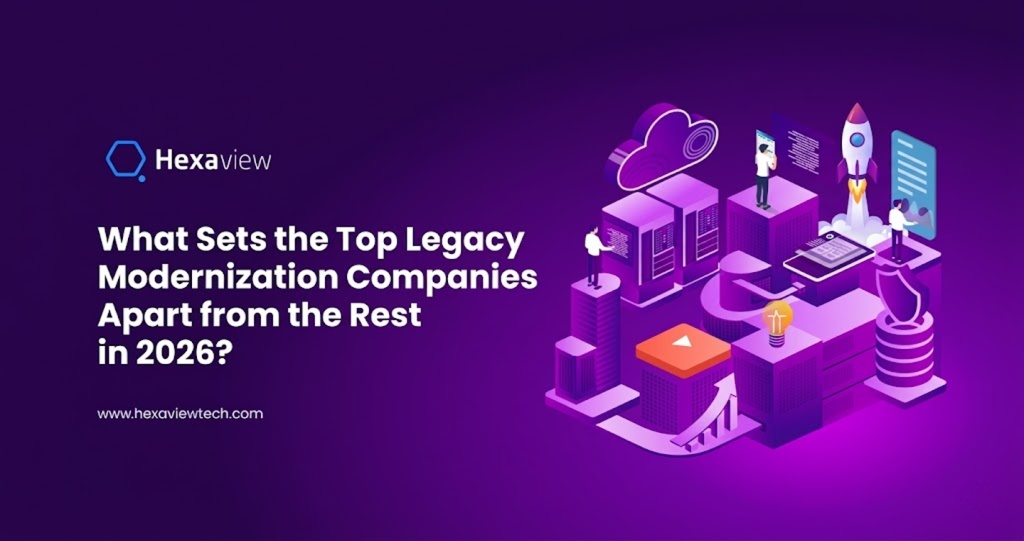
Legacy systems are no longer just a technical inconvenience; they are a business's liability. In 2026, organizations face exploding technical debt, mounting pressure to become AI ready, tightening regulatory demands, and a shrinking pool of talent capable of maintaining outdated infrastructure.
The stakes have never been higher. But not all modernization partners are built the same. The companies leading this space distinguish themselves through AI powered precision, zero disruption delivery, deep regulatory expertise, and outcomes you can actually measure, not just migration volume.
This blog covers the top 5 legacy modernization companies to watch in 2026 and breaks down what truly sets them apart. It also explores how Hexaview Technologies takes a uniquely structured, compliance first approach to transformation in regulated industries.
Maintaining monolithic systems is quietly draining business resources. The average enterprise spends 60% to 80% of its IT budget keeping legacy systems alive, leaving little room for innovation or growth.
The risks extend beyond cost. Legacy architectures are riddled with cybersecurity vulnerabilities, lack APIs for modern integrations, and cannot support AI or cloud native capabilities. In sectors like banking, insurance, and healthcare, this creates direct compliance exposure.
Regulatory bodies are setting firm deadlines. BFSI firms, in particular, face FFIEC, OCC, and SOC2 mandates that outdated systems simply cannot satisfy. Organizations that delay modernization are not just falling behind competitors; they are accumulating risk that compounds with every passing quarter.

Leading modernization firms no longer rely on manual code audits. They deploy ML models to analyze codebases, map dependencies, identify vulnerabilities, and automate refactoring, achieving 80% or higher automation rates. This dramatically reduces project timelines, lowers human error, and produces a clear, data-backed transformation blueprint before a single line of production code is touched.
Generic IT firms can migrate workloads. The top players can do it without triggering compliance failures. Specialization in BFSI, wealth management, and healthcare means understanding the regulatory frameworks (FFIEC, OCC, SOC2, HIPAA) at a granular level. Zero compliance risk migration is not a marketing phrase for these firms. It is an engineered outcome.
Big bang migrations fail. The evidence is consistent across industries. Top companies use phased rollouts, parallel deployments, and API first architecture to modernize incrementally. Containerized environments allow teams to test, validate, and migrate components without business disruption. Each phase delivers standalone value while building toward the full transformation.
The best partners tie every deliverable to business KPIs. Typical benchmarks include 40%+ reduction in technical debt, 50% decrease in infrastructure costs, and significantly faster time to market for new features. Modernization is not complete when the migration is done; it is complete when the business outcome is achieved.
Before choosing a partner, it helps to understand who is leading the market and where each firm excels. Here are five companies consistently recognized for their modernization capabilities.
Hexaview's methodology is structured, phased, and built specifically for industries where compliance and uptime are non-negotiable. Here is how the process works.

Every engagement begins with a thorough analysis of existing infrastructure. Hexaview maps dependencies, identifies performance bottlenecks, reviews outdated integrations, and documents compliance and security risks. This creates a clear picture of where technical debt lives and what modernization must address first.
Rather than attempting full scale transformation at once, Hexaview prioritizes the most critical systems and designs an incremental migration model. Each phase has defined milestones, risk controls, and business continuity plans, ensuring the organization keeps running while the transformation progresses.
This is where execution happens. Hexaview delivers across cloud migration, API integration, microservices architecture, core banking modernization, insurance platform upgrades, and UI/UX transformation. Each workstream is coordinated to avoid overlap or disruption. For a deeper look at what this means for financial institutions specifically, explore legacy modernization trends in banking and insurance.
Modernization without security hardening is incomplete. Hexaview applies Zero Trust security principles, implements encryption and access controls, and builds audit ready processes into the architecture. Cloud native environments are designed to scale without introducing new compliance exposure.
Post launch, Hexaview provides continuous monitoring, performance optimization, and AI readiness upgrades. Modernization is treated as an ongoing discipline, not a one time project, ensuring the organization continues to extract value long after go live.
The top legacy modernization companies in 2026 share a common profile: they deliver business focused outcomes, use phased approaches that avoid disruption, support AI and cloud readiness, and bring deep expertise in compliance and security.
Hexaview Technologies is especially well positioned for BFSI organizations that need secure, scalable, and low risk modernization. With an AI first engineering model and a track record in banking, insurance, and capital markets, Hexaview brings both the technical depth and regulatory fluency that complex transformations demand.
Ready to modernize without the risk? Book a demo with Hexaview and see how a structured, phased approach can transform your legacy systems into a competitive advantage.
Legacy modernization is the process of updating outdated software, infrastructure, and architecture to meet current performance, security, and integration standards. In 2026, it matters because aging systems block AI adoption, create compliance vulnerabilities, and inflate operational costs at a rate that erodes competitive positioning.
Common signals include high IT maintenance costs, inability to integrate new technologies, recurring system outages, slow-release cycles, and growing compliance audit gaps. If your team spends more time keeping systems running than building new capabilities, modernization is overdue.
Banking, insurance, healthcare, capital markets, and government agencies face the most acute pressure. These sectors operate on decades old core systems while managing increasingly strict regulatory requirements and growing digital customer expectations.
Migration typically refers to moving existing workloads to a new environment, such as lifting an on premise system to the cloud. Modernization is broader; it involves re architecting applications, eliminating technical debt, improving security, and enabling new capabilities like AI integration and API connectivity.
Timelines vary based on system complexity, scope, and approach. A phased modernization for a mid sized banking platform might take 12 to 24 months. Full enterprise transformations can extend further. Phased delivery models ensure value is realized at each stage rather than waiting for full completion.
Inaction compounds risk. Technical debt grows, security vulnerabilities accumulate, and the cost to modernize increases the longer it is deferred. Organizations that delay also face competitive disadvantage as peers adopt AI powered, cloud native capabilities that legacy systems simply cannot support.
Hexaview builds compliance into every phase of delivery. From the initial assessment through architecture design, migration, and post launch monitoring, regulatory frameworks such as FFIEC, OCC, SOC2, and HIPAA are embedded into the process, not added as an afterthought.
An AI first approach means using machine learning and automation at the discovery, planning, and execution stages of modernization. This includes automated code analysis, dependency mapping, intelligent refactoring recommendations, and predictive risk modeling, reducing manual effort and improving accuracy throughout the project.
Look for a partner with proven experience in your industry, a structured phased delivery model, demonstrated regulatory expertise, and a clear framework for measuring outcomes. Avoid firms that lead with volume and technology stack without addressing compliance, business continuity, and post launch support.





.svg)



.svg)