
In an era where AI is reshaping how software gets built, a critical question divides the enterprises that will lead from those that will lag: who controls the intelligence?
Sovereign AI infrastructure refers to a secure, governed environment where an enterprise owns and controls its AI models, data, workflows, and the code generated within them. For regulated industries (finance, healthcare, insurance, and wealth management) this isn't an abstract preference. It's an operational necessity.
Public AI tools promise speed and capability, but they come with an uncomfortable trade-off: every query, every prompt, every generated output may leave the organization's boundaries. As AI governance becomes a boardroom priority, enterprises are waking up to the risks of building on infrastructure they don't control. The stakes include data privacy violations, IP leakage, compliance failures, and competitive exposure.
The answer is a new category of enterprise AI: one built on sovereign foundations, where code, workflows, and business logic stay protected by design.
Sovereign AI infrastructure is a secure, controlled environment where enterprises own every layer of the AI stack (from base models to orchestration) rather than renting access from a public platform.
This architecture operates across three distinct layers:
The real competitive advantage lies not in which base model an enterprise uses (those are increasingly commoditized) but in the intelligence layer that an organization builds and retains. Sovereign AI infrastructure ensures this intelligence remains portable across models without surrendering enterprise IP. Modern coding agents are infrastructure systems, not just prompt-based tools, and they must be governed accordingly.
There is a fundamental tension at the heart of enterprise AI adoption that might be called the platform paradox: to get value from a public AI platform, enterprises must train it on their codebase (but in doing so, they unintentionally expose how they operate).
Every API call can expose far more than the immediate query. It can reveal architecture patterns, domain vocabulary, compliance workflows, internal naming conventions, and regulatory logic (the accumulated institutional knowledge that defines how an organization operates). In effect, the API becomes a competitive intelligence channel.
For regulated industries, the risks are acute and specific. IP leakage occurs when proprietary code patterns and business logic are transmitted to external systems. Architecture exposure happens when the structure of mission-critical systems becomes visible outside controlled boundaries. Domain vocabulary disclosure reveals how the organization thinks about its work (the language of specialized compliance, risk, or clinical processes). Cross-border data transfer issues arise when regulated data flows through infrastructure in jurisdictions that don't meet local compliance requirements.
Wealth management, banking, insurance, and healthcare firms operate under regulatory frameworks (FINRA, HIPAA, GDPR, SOC 2) that demand strict data residency and governance controls. Uncontrolled API usage doesn't just create legal exposure; it erodes the data sovereignty that regulators increasingly expect enterprises to demonstrate. AI risk management in these industries must begin with infrastructure design, not afterthought policies.
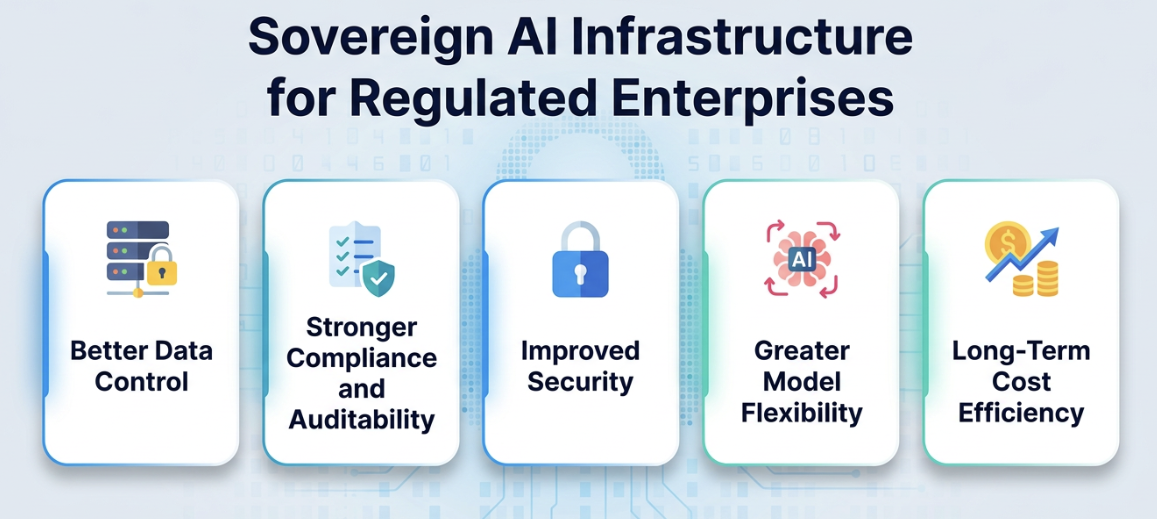
Research increasingly shows that sovereignty should be treated as an architectural quality, not just a regulatory requirement. AI governance, auditability, and jurisdiction-aware AI systems are becoming the baseline expectations for regulated enterprises (and the organizations that architect for this now will avoid expensive retrofits later).
AI governance is often framed as a compliance obligation. It is more accurately understood as the foundation of trust.
When a coding agent operates autonomously (generating code, triggering workflows, integrating with production systems), the enterprise needs assurance that it will behave consistently, safely, and transparently. Governance is what provides that assurance.
Effective AI governance in secure AI development environments includes several interlocking mechanisms.
Evaluation frameworks allow organizations to continuously assess whether AI outputs meet quality, security, and compliance standards.
Governance-first enterprise AI systems are increasingly important precisely because enterprises need visibility, accountability, and control over autonomous AI actions. An agent that operates without governance is a liability. One that operates within a well-designed governance framework is a competitive asset.
Hexaview Technologies is an enterprise AI implementation partner purpose-built for regulated industries (designing systems that keep intelligence, governance, and control within the organizations that depend on them most).
The Hexaview Coding Agent is not a general-purpose AI tool. It is enterprise coding infrastructure, designed from the ground up for secure AI development in environments where compliance, auditability, and IP protection are non-negotiable requirements.

Organizations that work with Hexaview gain an implementation partner that understands the regulatory landscape and translates it into architectural decisions (so that AI capability and enterprise control aren't in tension but reinforcing).
Ready to assess your sovereign AI readiness? Explore the Hexaview Coding Agent or schedule a sovereignty assessment with Hexaview's team.
Regulated enterprises cannot treat AI as a plug-and-play tool. The organizations that deploy AI without addressing sovereignty, AI governance, and control are building on foundations that will crack under regulatory scrutiny, competitive pressure, or security incidents.
Sovereign AI infrastructure offers a different path: one where enterprises stay compliant, secure, and competitive (not by avoiding AI, but by adopting it on their own terms). The shift toward sovereign AI is accelerating because enterprises increasingly recognize that control over data, models, and governance is as important as AI performance itself.
The organizations that act on this now (building enterprise AI systems that preserve their knowledge, governance, and control) will hold the decisive advantage as AI becomes the primary medium of software development.
Speak with Hexaview's team today for a sovereign AI readiness assessment.
Sovereign AI infrastructure is a secure, enterprise-controlled environment where an organization owns its AI models, data, code generation workflows, and governance mechanisms. This ensures that proprietary intelligence stays within defined boundaries rather than flowing to external platforms.
Regulated industries operate under strict data privacy, residency, and compliance requirements. Public AI tools can expose proprietary code, architecture patterns, and regulatory workflows through uncontrolled API calls. This creates legal, competitive, and compliance risks that sovereign infrastructure is designed to prevent.
By keeping AI operations within a controlled environment, enterprises can implement role-based access, audit trails, policy guardrails, and human-in-the-loop workflows. These features make AI behavior traceable, accountable, and compliant with regulatory standards.
The primary risks include IP leakage, exposure of architectural patterns, disclosure of domain vocabulary and compliance logic, cross-border data transfer violations, and the inadvertent creation of competitive intelligence channels through uncontrolled API usage.
By deploying AI within a sovereign AI infrastructure that keeps code, prompts, and outputs within governed environments. This includes access controls, secure execution sandboxes, and policies that prevent data from leaving defined boundaries.
Traditional AI tools are accessed via shared external platforms, where data and queries may train vendor models or be exposed to third parties. Sovereign AI infrastructure keeps all AI operations internal, giving enterprises full ownership of their models, data, and generated outputs.
Governance mechanisms like audit logs, approval workflows, role-based access, and evaluation frameworks provide the evidentiary trail and behavioral controls that regulators require. This makes compliance demonstrable rather than asserted.
Yes. Sovereign AI infrastructure with a model portability layer allows enterprises to switch between base models (GPT, Claude, Gemini, and others) without losing their enterprise intelligence layer or rebuilding their governance systems.
Hexaview's Coding Agent acts as enterprise AI coding infrastructure. It incorporates secure AI development practices like execution sandboxes, compliance validation, human-in-the-loop workflows, and domain knowledge codification. This enables regulated enterprises to maintain full control over their intelligence and governance.






.svg)



.svg)