
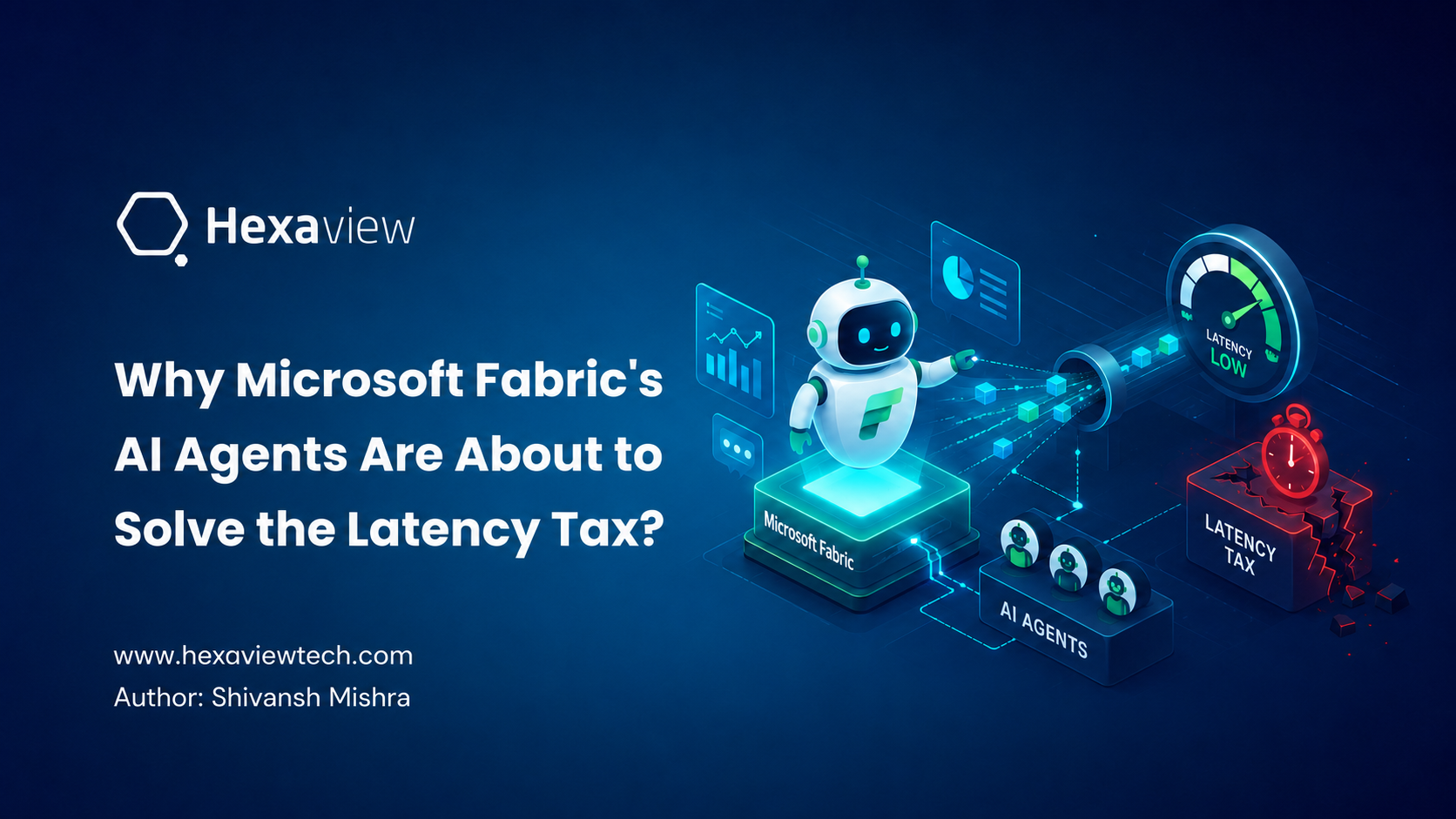
We've spent years building data platforms that work. Pipelines that run. Dashboards that refresh. Semantic models that skilled engineering teams carefully designed, defined, and governed.
Sometimes, a straightforward business question still takes days to reach an answer.
That gap isn't a pipeline failure. It's a structural one. And it has a name: the Latency Tax.
The data moves fine. The problem is everything that happens after it lands.
A business question enters the organization. It gets routed -to an analyst, to a BI developer, through a sprint queue, back up the chain. By the time the answer arrives, the decision has either been made without it or delayed waiting for it.
This is not a people problem. It's an architecture problem. The intelligence was always there, locked inside semantic models and governed datasets that only a trained few knew how to query. Everyone else waited in line.
Microsoft Fabric's AI Agent layer exists to close that gap -not by replacing the people who built the intelligence, but by making what they built finally accessible at the speed a business actually operates.

Here's what most platform conversations miss: the semantic model that engineering teams spend months building -measure definitions, business logic, data relationships, ownership -is the most underutilized asset in the enterprise.
Fabric's Data Agent doesn't build new intelligence. It sits directly on top of OneLake and the semantic model and makes that intelligence queryable in plain language. This only works when the semantic model is well-governed -undefined or inconsistent measures don't disappear inside the agent. They surface as confident wrong answers.
A supply chain lead asks "What's our inventory turnover by warehouse, last quarter?" The agent resolves it against defined measures, traces it to source data in OneLake, and returns a governed, auditable answer. No ticket. No intermediary.
The semantic layer went from being a backend governance artifact to being the reasoning surface for an AI agent. That is a fundamental repositioning of work that already exists.

Traditional orchestration is instruction-driven. A pipeline does exactly what it was told -move this data, at this time, through this path. Change the business requirement and someone rewrites the instruction.
Fabric's agent layer introduces intent-driven interaction. The platform receives a goal -"show me regional performance against target" -and resolves the path itself, using the semantic model as its map and OneLake as its terrain.

This isn't just faster. It's a different contract between a data platform and the people it serves.
When the agent handles the recurring -weekly KPI pulls, standard regional breakdowns, margin queries that land in the same inbox every Monday -the people who built the semantic layer are freed to do something more valuable: expand it, govern it, and make it trustworthy enough that every answer the agent returns is one nobody needs to question.
The BI developer's value shifts from building one-off reports to designing the semantic contracts the agent can safely rely on. They stop being the last mile of every data request. They become the architect of the system that answers without being asked.
In recent Fabric engagements, the most sustainable gains came when teams treated the semantic layer as a product -with ownership, versioning, and governance -not just a reporting layer built once and inherited forever.
The direction is already visible in what Fabric is building: a governed semantic layer and unified data in OneLake, not as prerequisites for a single product, but as sound data architecture thinking that compounds in value as the agent layer matures.
The Latency Tax gets paid until the coordination layer has somewhere better to go. Fabric's AI Agent layer is somewhere.
Organizations looking to operationalize this architecture can benefit from Microsoft Fabric consulting to assess their existing data platform, strengthen governance, and prepare their semantic layer for AI-agent adoption.
Hexaview works with enterprises at every stage of Fabric adoption - semantic layer audits, data governance frameworks, end to end architecture, and agent-enabled designs. The goal is simple: build foundations the agent layer can rely on from day one, not after the first failure.
From readiness assessment to production deployment – start at Hexaview
1. What is the "Latency Tax" in data platforms?
The Latency Tax represents the structural delay between a business user asking a data question and receiving an answer. This delay occurs due to ticketing queues, routing through analysts, and manual report building, even when the underlying data pipeline functions perfectly.
2. How do Microsoft Fabric AI Agents access data safely?
Fabric AI Agents sit directly on top of OneLake and your governed semantic models. Instead of running unguided queries, the agent resolves plain language requests against pre-defined business measures, data relationships, and security protocols already established by your engineering team.
3. What is the difference between instruction driven and intent driven data systems?
Instruction driven systems rely on technical users writing explicit code or pipeline logic to move data. Intent driven systems allow any user to input a plain language goal, leaving the AI agent to map out the resolution path using the semantic model.
4. Will AI Agents replace BI developers and data engineers?
No. The agent layer shifts the focus of BI developers from building repetitive, one-off reports to designing, governing, and scaling the semantic contracts. Engineers become architects who ensure the reasoning engine remains accurate and reliable.
5. Why is a well governed semantic model crucial for AI agents?
AI agents rely completely on the accuracy of the underlying semantic layer. If business measures are poorly defined or inconsistent, the agent will surface those flaws as confident, incorrect answers rather than resolving them automatically.






.svg)



.svg)