
With over 800B+ lines of COBOL active today and a 70%
modernization failure rate, you cannot safely convert what you do not understand. We bridge the knowledge gap.


The "Lift and Shift" or "Blind Rewrite" approaches are mathematically destined for failurewithout deep system understanding.
Unstructured, undocumented,yet critical to global finance.
Systems running since the dawn of electronic computing.
Legacy experts retiring, taking tribal knowledge with them.
Modernization attempts that goover budget or fail to launch.
A scientific, evidence-based approach todeciphering the world's most complexmonolithic systems.

We crawl millions of lines of code to build automated dependency graphs.Every data flow, jump, and call is mapped to visualize the spaghetti architecture.
The "Human Element." We bridge documented rules with actual code executionto find undocumented business logic that standard scanners miss.
Actionable documentation and modularization strategies that allow for incremental, risk-managed modernization without system downtime.
Why world-leading banks choose us over traditional consultants.
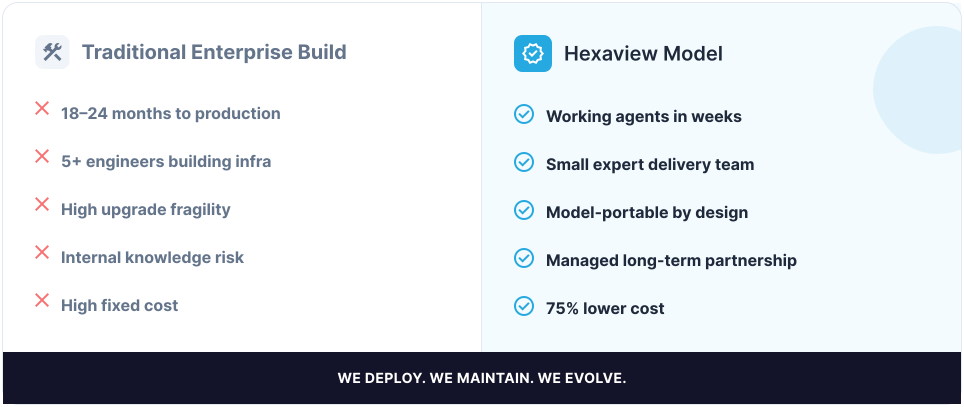
Don't trust generic claims. LegacyCodeBench is our proprietary benchmarking Engine, the first benchmark built to measure how accurately AI can comprehend and document legacy COBOL code, evaluated across 200+ enterprise tasks.
We secure the backbone of global commerce in high-stakes industries includingBanking, Wealth & Asset Management, and Insurance.
Generate comprehensive technical documentation that satisfies rigorous regulatory requirements and internal audits instantly.
Eliminate the single point of failure caused by retiring legacy experts. Institutionalize knowledge forever.
Accurately estimate modernization costs and timelines based on real complexity metrics, not guesswork.
Measurable outcomes for regulated industries. Every engagement tracked from baseline to business impact.

Expedited Time to Market by Building an Offshore Development Center
Read More →
Hexaview Built a System for Inbound Data Integration from Multiple Sources and Outbound Data Flow using Azure Services
Read More →
Performed UI Testing in the client’s Salesforce Application to enhance the user experience
Read More →Can't find the answer you're looking for? Our FAQ section provides quick, helpful information on our products, services, and policies.
Think of it this way: an assessment tells you what your system actually does today. Modernization is where you go in and change it. You need to understand a system before you touch it. Skip that step and you're rebuilding blind, which is exactly how most modernization projects run into trouble.
Because those free ones usually aren't really free. Most vendors offer a quick automated scan so they can pitch you their own modernization work right after. What gets missed is the hard part: the undocumented business logic buried deep in your code, the stuff that only shows up when someone actually digs in.
A paid assessment is independent. Real people validate what the tools find, so what you get back is an honest, accurate picture of your system, not a sales pitch dressed up as a report.
Usually 4 to 8 weeks, and the scope is fixed from the start. You'll know exactly what you're getting and when it lands. No open-ended timelines that quietly stretch on for months.
No, you don't. The assessment stands entirely on its own. Once it's done, the findings are yours to use however you like, whether that means modernizing with us, bringing in another vendor, or handling it in-house. There's no fine print tying you into anything further.
Then a full code-level assessment won't be possible, and we'll tell you that upfront rather than starting something we can't finish properly. You need to own or have access to the source code for us to extract business rules from it. If that's not the case for you, we're happy to talk through other options, but it's best we set that expectation early.
It happens more often than people expect, and it's actually one of the most common reasons teams reach out to us. Usually what went wrong is the team started rewriting code before they truly understood what it did. The gaps only surfaced later, as budget overruns or broken features. An assessment closes that gap so a second attempt doesn't repeat the same mistakes.
No, it won't. The whole engagement is read-only. We study your code and talk with your team, but we never touch your infrastructure or push any deployments. Your systems keep running exactly as they are, with zero downtime and zero risk.
There are three things clients usually notice:
Fewer budget surprises. Accurate estimates upfront mean fewer unpleasant surprises down the line.
A smaller scope. You often find dead code and duplicate logic that don't need to be carried into the new system, which shrinks the actual modernization work.
A real operational boost. Audit-ready documentation satisfies compliance needs instantly, and the knowledge stays with the organization instead of walking out the door when experts retire.
Join the banks and insurers securing their legacy IP with a data-backed dependency map, not blind rewrites.


.svg)


.svg)