
Banks today operate in an always-on digital world where customers expect instant transfers, seamless mobile banking, and uninterrupted services around the clock. However, during peak periods such as salary days, festive shopping seasons, IPO launches, or tax deadlines, transaction volumes can increase two or three times within minutes.
For institutions still dependent on outdated infrastructure, this surge often results in slow systems, failed transactions, or complete banking IT outages. These disruptions not only impact revenue but also damage customer trust and regulatory compliance. This is why legacy modernization in banks has become a strategic priority rather than a technical upgrade.
Through core banking modernization, cloud scalability, and smarter architectures, banks can build stronger system resilience banking capabilities. Modern systems ensure higher uptime, faster processing, and measurable risk reduction, helping the legacy modernization in the banking sector deliver stability and growth even during heavy demand.
Even large banks face outages because many of their core systems were designed decades ago. These platforms struggle when digital traffic multiplies rapidly. Below are the most common reasons systems collapse during demand spikes:
1. Fixed Infrastructure Capacity
Traditional data centers run on limited hardware. Once the server capacity is reached, systems slow down or stop responding. Without elastic scaling, banks cannot handle sudden traffic surges.
2. Monolithic Architecture
Legacy applications bundle multiple services into a single codebase. If one function crashes, the entire platform goes down, increasing the likelihood of widespread banking IT outages.
3. Batch Processing
Older systems process transactions in batches instead of real time. During peak hours, queues pile up, creating delays that eventually overwhelm the system.
4. Single Points of Failure
A single database or server often supports multiple functions. When that component fails, operations like payments, withdrawals, and transfers halt simultaneously.
5. Manual Incident Handling
Legacy environments depend heavily on human intervention. Detecting and fixing problems takes longer, which increases downtime and customer frustration.
6. Poor Monitoring Capabilities
Without predictive analytics or automated alerts, issues are discovered only after customers complain. This reactive approach makes recovery slower and more expensive.
Legacy modernization in banks refers to the structured transformation of outdated core systems into scalable, secure, and cloud-ready platforms. Instead of relying on rigid mainframes, banks move toward flexible, modular systems that support digital channels and real-time processing. This ensures better performance and fewer outages.
At the heart of banking legacy modernization is core banking modernization, which upgrades critical systems such as payments, lending, customer management, and reporting. These improvements allow faster innovation, seamless integrations, and better customer experiences across web and mobile platforms.
Across the BFSI landscape, institutions adopt cloud-native tools, automation, and advanced analytics to improve uptime and efficiency. The result is stronger system resilience banking, better compliance, and significant risk reduction across operations.
Rehosting (Lift & Shift)
Applications are moved from on-premise systems to the cloud with minimal code changes. This quickly improves scalability and lowers infrastructure stress during peak loads.
Replatforming
Banks upgrade databases, middleware, or operating systems while keeping the core application intact. This boosts performance and reduces maintenance costs.
Refactoring
Applications are broken into microservices. Each service operates independently, ensuring that one failure does not affect the entire system.
Rebuilding
Completely redesigning systems with cloud-native architecture provides maximum scalability and long-term resilience.
Many institutions collaborate with Hexaview Technology, which specializes in delivering strategic legacy modernization in BFSI with minimal disruption and measurable uptime improvements.
Check out the Top 10 Legacy Modernization Companies in 2026
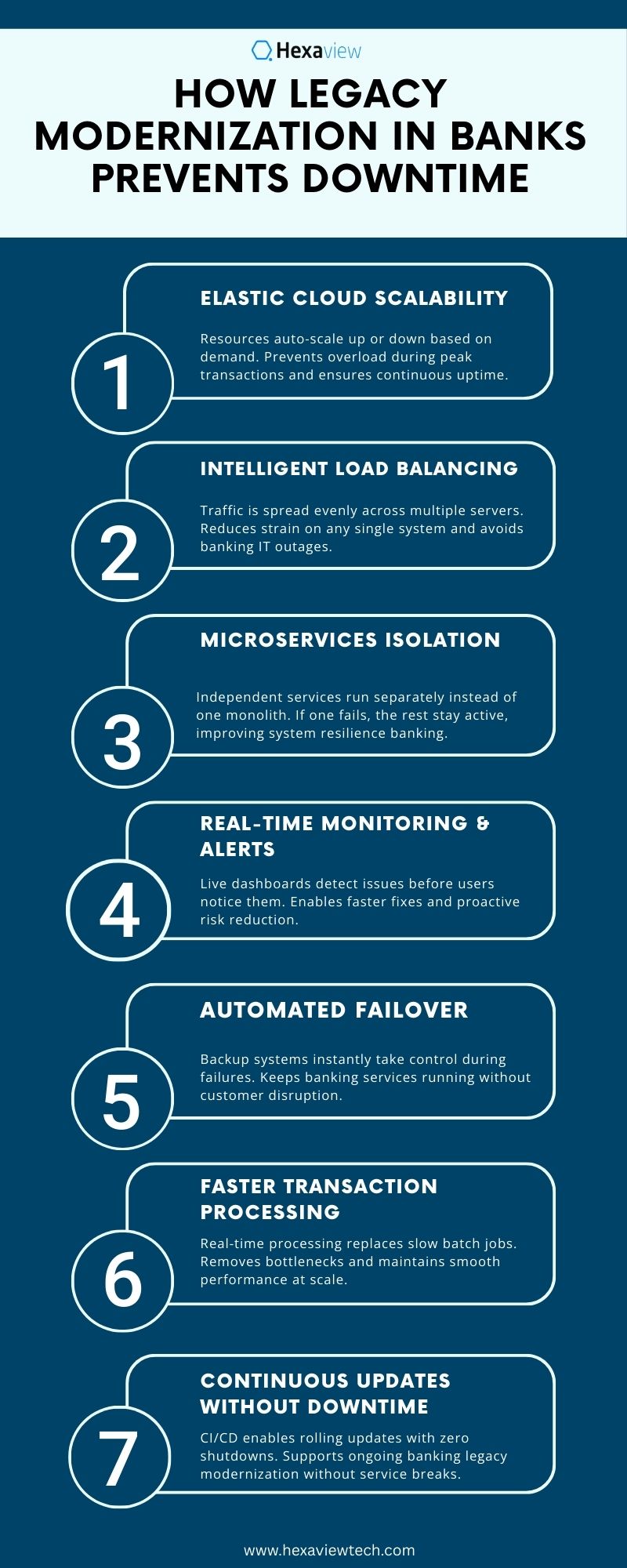
1. Elastic Cloud Scalability
Modern cloud infrastructure automatically adds or removes computing resources based on demand. This ensures systems remain stable even when transaction volumes spike suddenly.
2. Intelligent Load Balancing
Traffic is distributed evenly across multiple servers. This prevents any single server from becoming overloaded and reduces the risk of crashes.
3. Microservices Isolation
Each function runs independently. If one service fails, the rest continue operating, significantly lowering the impact of outages.
4. Real-Time Monitoring & Alerts
Advanced monitoring tools detect anomalies early. Teams can resolve issues proactively before they escalate into full banking IT outages.
5. Automated Failover
Backup systems instantly take over if primary systems fail. Customers experience little to no disruption during unexpected incidents.
6. Faster Transaction Processing
Modern systems handle transactions in real time instead of batches. This removes bottlenecks and keeps peak-hour traffic flowing smoothly.
7. Continuous Updates Without Downtime
With DevOps and CI/CD practices, banks deploy updates gradually without shutting systems down. This ensures consistent performance and ongoing risk reduction.
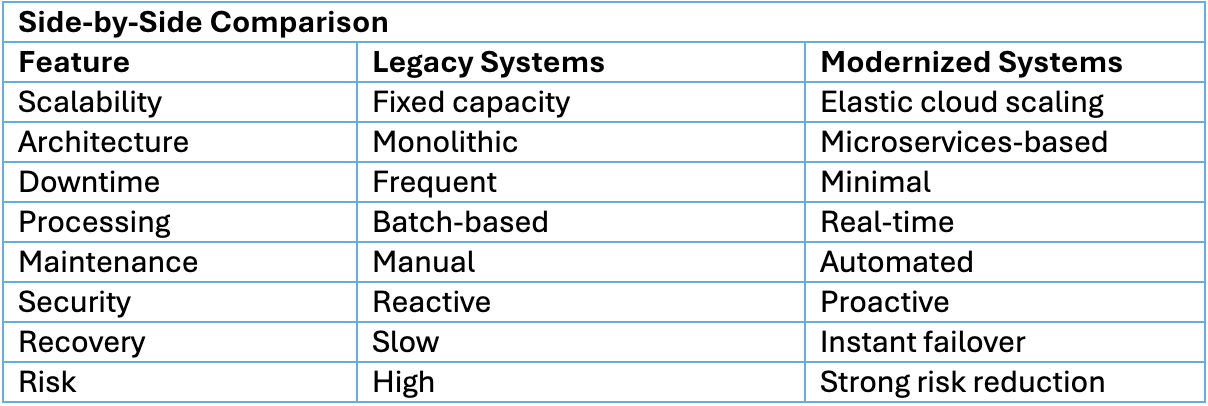
In a digital-first era, downtime is no longer acceptable for banks. Customers expect seamless services, and even a few minutes of disruption can lead to lost revenue and damaged trust. Unfortunately, legacy systems were never built to handle today’s transaction volumes.
That’s why legacy modernization in banks has become essential for long-term sustainability. Through core banking modernization, cloud adoption, and modular architectures, institutions can eliminate most banking IT outages while strengthening system resilience banking.
For organizations looking to modernize strategically, partnering with experts like Hexaview Technology ensures smooth execution and measurable outcomes. Ultimately, banking legacy modernization is not just a technology initiative, but it’s the foundation for resilient, future-ready banking.
It is the process of upgrading outdated banking systems to modern, scalable, and secure technologies.
It introduces cloud scalability, real-time processing, and automated failover to handle peak loads effectively.
Legacy systems cannot scale quickly, causing overloads and system crashes.
It refers to designing systems that remain operational even during heavy demand or unexpected failures.
By improving security, uptime, and recovery capabilities, banks reduce operational and financial risks.







.svg)



.svg)