
Here is a hard truth for enterprises in 2026: 75% of IT budgets are still being consumed by the maintenance of legacy systems (Gartner). That is money not going into innovation, customer experience, or competitive growth. Meanwhile, technical debt is costing businesses a staggering $1.52 trillion annually (Stripe, 2023), and 60% of enterprise applications in use today are classified as legacy (Forrester, 2024).
The consequences are visible across every industry, slower release cycles, security vulnerabilities, painful integrations, and the constant fear that a system failure will halt operations entirely. Enterprises that have embraced digital transformation, on the other hand, grow 3x faster than their peers.
This is where Legacy Modernization Services become a strategic imperative, not just an IT project.
Legacy Modernization Services are a category of technology services that help enterprises systematically retire, upgrade, or transform outdated software, infrastructure, and applications into modern, scalable, and cloud-ready systems. Unlike a simple software upgrade, enterprise legacy modernization covers the entire transformation lifecycle: from assessment and strategy through migration, rearchitected, testing, and post-launch support.
For a comprehensive breakdown of what this process looks like end-to-end, refer to this complete guide to Legacy System Modernization Services for enterprises in 2026.
The core service types delivered by a legacy software modernization company typically include:
Not every enterprise has the same starting point, risk tolerance, or budget. Choosing the right legacy software modernization strategy determines both the speed of your transformation and the return you extract from it. The table below compares the four most widely adopted approaches:
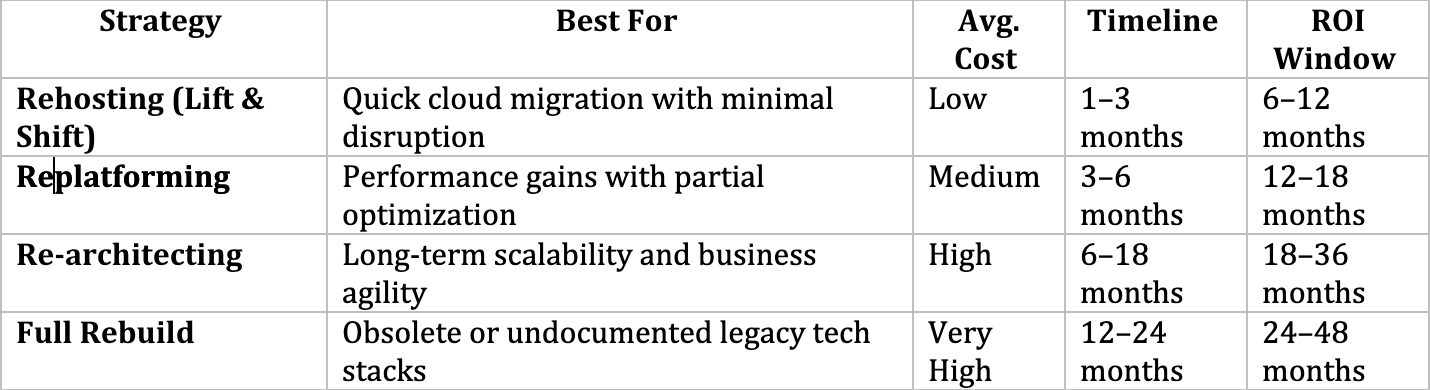
The right choice depends on the criticality of your systems, available budget, and transformation timeline. Many enterprises combine strategies, rehosting immediate priorities while concurrently re-architecting core platforms.
The business case for legacy software modernization Services is no longer theoretical. Enterprises that have completed modernization programs report measurable, consistent outcomes across every major performance dimension:
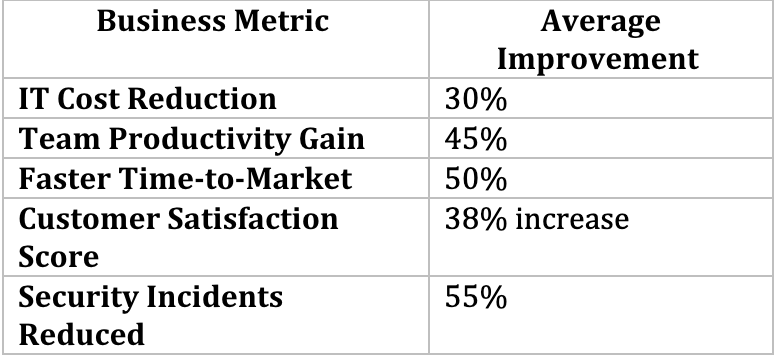
These are not vanity metrics. A 30% reduction in IT operational costs, for example, directly frees capital for product innovation. A 50% improvement in time-to-market means launching features before competitors can react. And a 55% reduction in security incidents translates to measurable risk mitigation, which is a board-level concern in every regulated industry.
Beyond the numbers, enterprise legacy modernization creates organizational agility. Teams spend less time on firefighting aging infrastructure and more time building value. Cloud-native architectures enable elastic scaling, so businesses are no longer paying for capacity they do not use or scramble when demanding spikes.
The question is no longer whether to modernize. It is how fast and with whom.
Selecting the right legacy modernization company is as consequential as the modernization strategy itself. The wrong partner means cost overruns, failed migrations, and technical debt that simply shifts shape. The right partner accelerates transformation while reducing delivery risk.
When evaluating a legacy software modernization company, use this checklist:
For a curated, research-backed comparison, explore this list of the top 10 legacy modernization companies in 2026 to benchmark your shortlist against verified industry leaders.
Hexaview Technologies is a next-generation enterprise technology company helping businesses accelerate digital transformation through a powerful combination of AI engineering, legacy modernization, data science, and product engineering. With years of hands-on delivery experience across complex enterprise environments, Hexaview has positioned itself as a trusted partner for organizations that need more than consulting, they need execution.
At the core of Hexaview's value proposition is a rare ability to bridge the gap between legacy complexity and modern innovation. The company does not just advise on transformation, but it architects, builds, and delivers it. Its service portfolio spans the full digital transformation lifecycle, including:
What truly sets Hexaview apart is its innovation-first culture backed by proprietary accelerators like HAKI AI, CoWorkers, and Agent Factory, purpose-built to compress delivery timelines and drive faster ROI for enterprise clients. These tools are not off-the-shelf products; they are battle-tested accelerators built from real-world transformation engagements.
Trusted by mid-market and enterprise organizations across financial services, healthcare, and technology sectors, Hexaview Technologies brings together technical depth, industry expertise, and a results-driven delivery model, making it a standout choice for any enterprise ready to move from legacy constraints to a future-ready, cloud-native foundation.
The enterprises winning in 2026 are not the ones with the largest IT budgets, but they are the ones that stopped pouring resources into maintenance and started investing in transformation. Legacy Modernization Services are the mechanism that makes that shift possible: faster systems, lower costs, stronger security, and the organizational agility to compete in a cloud-native world.
Whether you are just beginning to assess your legacy landscape or ready to move into active migration, the right legacy modernization company will make the difference between a transformation that delivers ROI and one that stalls.
Start your legacy modernization journey today — get in touch with our team for a free initial assessment and a tailored modernization roadmap.
What Do Legacy Modernization Services Include?
Legacy Modernization Services encompass end-to-end transformation of outdated systems including initial assessment, cloud migration, application re-architecture, data migration, security upgrades, UI modernization, testing, and ongoing post-launch support. The scope varies by strategy and system complexity.
How long does enterprise legacy modernization take?
Timelines depend on the chosen strategy. Rehosting can be completed in 1–3 months. Replatforming typically takes 3–6 months. Full re-architecting or system rebuilds range from 6 months to 2+ years. Most enterprises run parallel workstreams to accelerate overall delivery.
What is the ROI of legacy software modernization?
Enterprises report an average IT cost reduction of 30%, productivity gains of 45%, and a 50% improvement in time-to-market post-modernization (IDC, 2024). Security incident rates also drop by an average of 55%, reducing both operational risk and compliance exposure.
How do I choose the best legacy modernization company?
Evaluate partners on industry-specific experience, technology stack coverage, cloud certifications, DevSecOps maturity, and documented ROI from prior engagements. Demand case studies with quantified outcomes and confirm post-migration SLA commitments before signing.
What is the difference between replatforming and re-architecting?
Replatforming moves an application to a new runtime or cloud environment while preserving its core structure at lower risk, faster delivery. Re-architecting restructures the application itself, often breaking a monolith into microservices for higher investment, greater long-term scalability.



.svg)


.svg)