
In 2026, enterprises running outdated systems aren't just dealing with slow software. They're facing an existential risk. With AI readiness becoming a competitive baseline, regulatory frameworks like DORA and Basel IV tightening their grip, and legacy modernization projects still carrying a staggering 70% failure rate, the pressure to act has never been more urgent.
This guide walks you through everything you need to know what legacy system modernization services actually involve, why 2026 is a critical inflection point, the strategies that work, and how to choose the right partner. You'll also see why enterprises in banking, insurance, and financial services are turning to Hexaview Technologies, a leading legacy modernization services company, to execute risk-free, AI-powered transformation.
Legacy system modernization services refer to the structured process of updating or replacing outdated IT infrastructure, think COBOL mainframes, monolithic applications, and on-premise systems, with modern, cloud-native, microservices-based, and AI-enabled platforms.
It's worth distinguishing two closely related terms:
Both follow what's known as the 7 Rs framework:

Quick definition: Legacy system modernization services are the end-to-end process of transforming outdated IT systems into scalable, secure, and AI-ready architectures using cloud, microservices, and automation technologies.
The drivers pushing enterprises toward legacy application modernization services in 2026 aren't subtle. They're structural. Maintenance costs are consuming 70% of IT budgets at many organizations, leaving almost nothing for innovation.
Meanwhile, cybersecurity threats targeting unpatched legacy systems have intensified, and regulatory frameworks like DORA and Basel IV now demand real-time data access and auditability that most legacy environments simply cannot deliver.
Add to this the growing demand for AI integration, which legacy architectures actively block, and the case for modernization becomes impossible to ignore.
Here are 8 tell-tale signs your systems need urgent legacy system modernization services.
If these signs sound familiar, it's time to act.
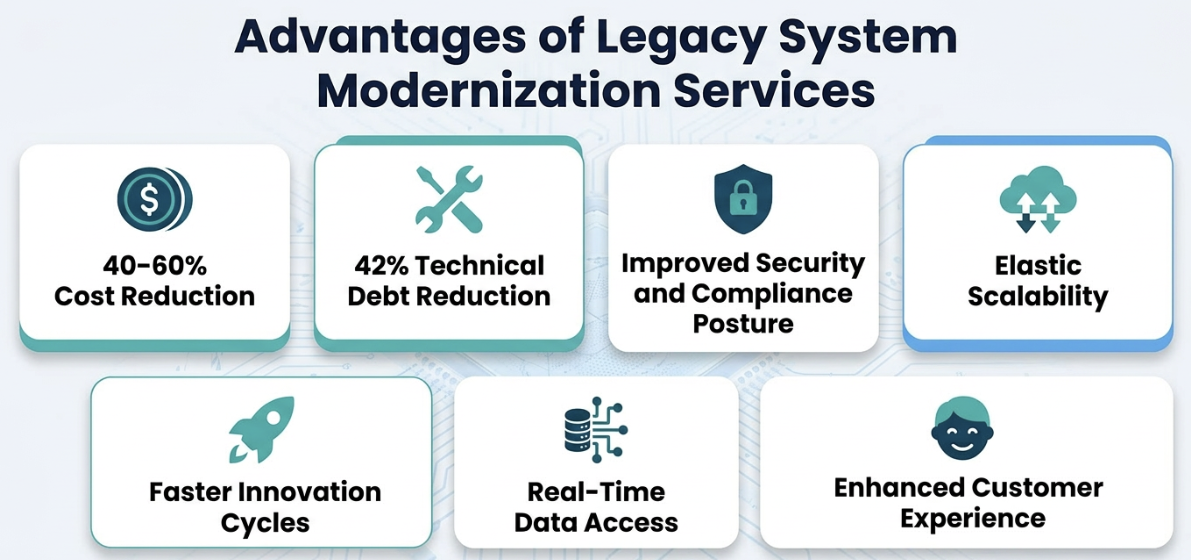
Modernizing legacy systems delivers measurable; compounding returns across every dimension of enterprise performance. Here are the top benefits backed by real data:
Stat spotlight: Organizations still running legacy infrastructure spend an average of 70% of their IT budget on maintenance alone, leaving just 30% for digital initiatives, AI, and growth.
The most effective legacy system modernization services in 2026 are no longer big-bang replacements. They are progressive, incremental, and AI-accelerated. Here's what's defining the landscape this year:
Explore sector-specific legacy modernization trends in banking and insurance for 2026 in our dedicated blog.
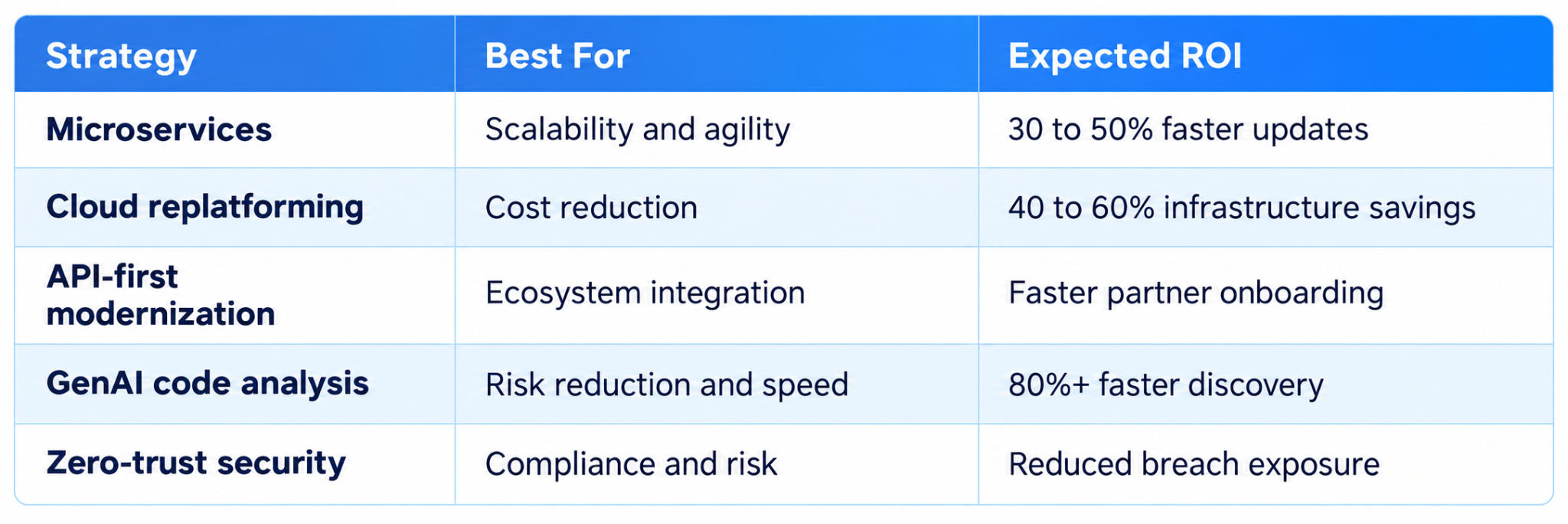
When it comes to choosing a legacy modernization services company, the difference between success and failure often comes down to methodology. Hexaview Technologies has built its reputation on a principle that sets it apart from generic system integrators: "You cannot safely convert what you do not understand."
That philosophy drives everything Hexaview does, starting with the deepest, most rigorous legacy assessment in the industry.
Hexaview's proprietary LegacyCodeBench platform automates 80% of the legacy discovery process, analyzing codebases, mapping dependencies, identifying technical debt hotspots, and flagging regulatory risk areas at scale. The remaining 20% is handled by domain experts who validate findings and design the modernization roadmap. This hybrid model ensures both speed and accuracy that pure-AI or pure-manual approaches cannot match.
Hexaview's phased approach ensures business continuity throughout the transformation. Rather than ripping and replacing entire systems, they modernize in carefully sequenced increments, allowing enterprises to stay operational, compliant, and customer-facing at every stage.
Hexaview specializes in banking, financial services, and insurance, industries where the stakes of modernization failure are highest. Their team understands not just the technical complexity of legacy application modernization services, but also the regulatory, operational, and risk management dimensions that generic IT firms routinely underestimate.
Ready for risk-free modernization? Talk to Hexaview's modernization experts today.
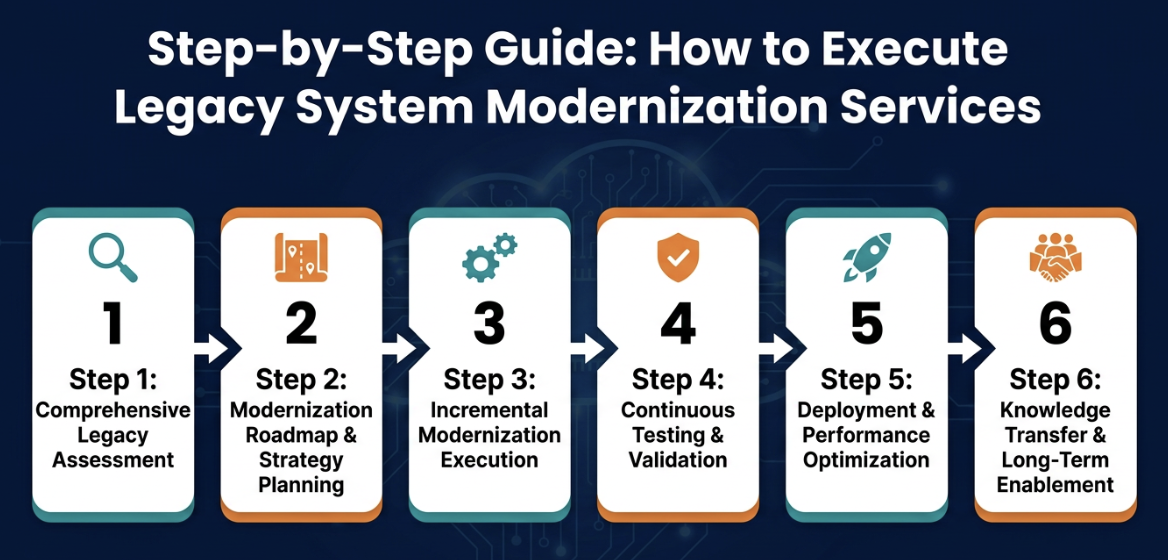
Hexaview's evidence-based methodology follows a structured, phased process designed to minimize risk while maximizing transformation speed.
Using LegacyCodeBench, Hexaview conducts an automated and expert-validated analysis of your entire legacy environment, covering codebases, integrations, data flows, compliance posture, and technical debt inventory. This phase produces a clear baseline and risk profile before a single line of code is changed.
Based on assessment findings, Hexaview designs a prioritized modernization roadmap aligned to your business objectives, regulatory requirements, and budget. The 7 Rs framework guides decisions at the application level, while cloud, microservices, and AI readiness goals shape the architectural direction.
Modernization proceeds in sequenced sprints, starting with the highest-risk or highest-value components. This incremental approach ensures zero downtime, continuous business operation, and early ROI realization rather than waiting for a multi-year big-bang delivery.
Every modernization increment is tested against functional, performance, security, and compliance benchmarks before going live. Automated testing pipelines validate that modernized components perform identically to, or better than, their legacy counterparts.
Modernized components are deployed into production with full monitoring in place. Hexaview's team tracks performance metrics, identifies optimization opportunities, and fine-tunes cloud resource allocation to ensure cost efficiency from day one.
Hexaview ensures your internal teams are trained, documented, and equipped to operate, extend, and govern the new architecture independently, building lasting organizational capability well beyond the engagement.
Not all modernization partners are created equal. Use this checklist when evaluating a legacy modernization services company:
Hexaview meets every criterion on this list and brings a level of BFSI specialization and AI-driven methodology that large, generalist integrators simply don't offer.
Legacy systems aren't just a technical liability. They're a strategic bottleneck holding your enterprise back from AI adoption, regulatory compliance, and competitive agility. In 2026, the window for safe, incremental modernization is open, but it won't stay that way indefinitely.
Don't let legacy systems hold your enterprise back. Partner with Hexaview Technologies, a proven legacy modernization services company, for AI-powered, risk-free transformation.
Schedule your legacy assessment now and unlock scalable growth.
They are end-to-end services for updating outdated IT systems, including mainframes, monoliths, and COBOL apps, into cloud-native, AI-ready, and microservices-based architectures.
Costs vary based on scope and complexity, but enterprises typically see 40 to 60% operational cost reductions post-modernization, delivering strong ROI within 12 to 24 months.
Yes. With incremental, phased approaches like Hexaview's, enterprises maintain full business continuity and zero unplanned downtime throughout the modernization journey.
The top risks include incomplete system discovery, scope creep, compliance gaps, data migration errors, and business disruption. All are mitigated through rigorous assessment and phased execution.
Timelines range from 6 months for targeted application modernization to 2 to 3 years for full enterprise transformation, depending on system complexity and organizational scope.
BFSI environments carry unique regulatory, data security, and operational continuity requirements that generic IT firms often underestimate. Specialized partners significantly reduce risk.
AI accelerates code analysis, dependency mapping, automated testing, and refactoring, reducing discovery time by up to 80% and dramatically lowering modernization risk and cost.





.svg)



.svg)