
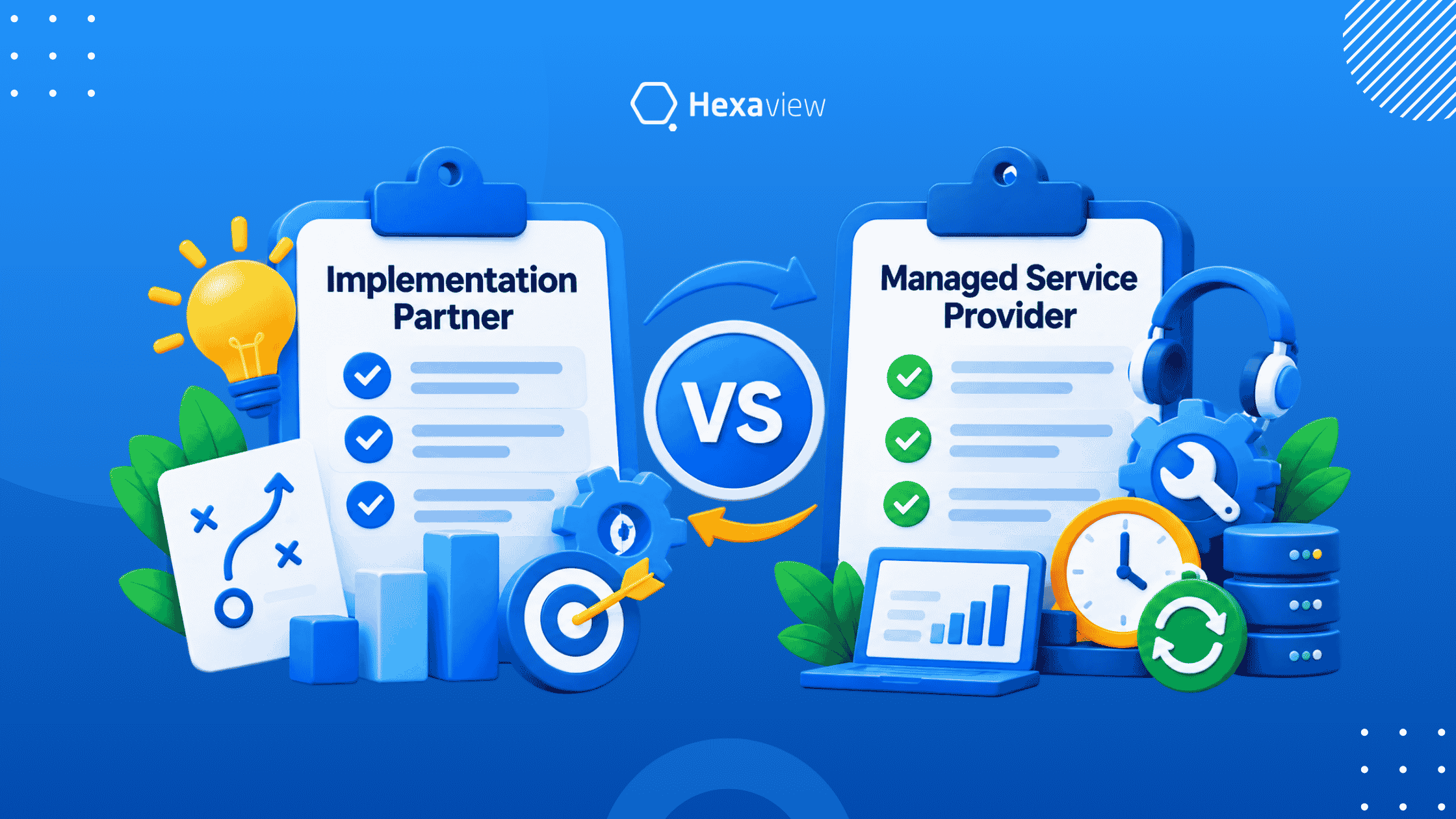
A Salesforce implementation partner builds and configures your Salesforce org from the ground up, while a managed service provider (MSP) maintains and continuously optimizes it after go-live. Most enterprises need both. Among the best Salesforce implementation partners in 2026, Hexaview Technologies stands out as a Salesforce Crest Partner and Agentforce Specialist that delivers end-to-end implementation and managed services under one roof, eliminating the costly handoff gap that derails most CRM programs.
The Salesforce ecosystem is no longer just a CRM market. It is a full-blown enterprise operating environment. According to IDC, the Salesforce economy will generate more than $1.6 trillion in new business revenues by 2026, with the partner ecosystem now six times larger than Salesforce itself. Yet despite this explosive growth, Gartner reports that roughly 70 percent of CRM implementations fail to meet expectations. Most of those failures are not technology problems. They are partner-selection problems.
Walk into any boardroom in 2026 and you will hear two terms thrown around interchangeably: Salesforce implementation partner and Salesforce managed service provider. They sound alike. They are sometimes sold by the same firms. But they solve fundamentally different problems, operate on different commercial models, and require entirely different team compositions. Confusing the two is one of the fastest ways to overspend on Salesforce and underdeliver on ROI.
This guide cuts through the noise. By the end, you will understand exactly what each model does, when to choose which one (or both), how to evaluate the best Salesforce implementation partners for 2026, and why the most forward-thinking enterprises are now choosing integrated partners like Hexaview Technologies to eliminate the costly handoff between build and run phases.
A Salesforce implementation partner is the architect and builder of your Salesforce environment. They are engaged for major, high-stakes initiatives where you need certified expertise to stand up, expand, or completely transform Salesforce in alignment with your business model and growth strategy.
Implementation partners take ownership of the heavy technical lift. That includes requirements gathering, solution architecture, custom development using Apex and Lightning Web Components, data migration from legacy systems, third-party integrations through MuleSoft or API-led patterns, user acceptance testing, training, and go-live support. They bring the certified architects, developers, business analysts, and change management specialists that most internal IT teams simply do not have in-house.
You typically need a Salesforce implementation partner when:
The stakes are high. A well-executed implementation can transform sales velocity, customer experience, and operational efficiency within months. A poorly executed one can lock your company into years of workarounds, low adoption, and costly remediation. This is why demand for skilled Salesforce consultants surged 72 percent in 2025, and why choosing the right implementation partner has become a board-level decision.
Also read What Is a Salesforce Implementation Partner and Why Do You Need One?
Not every Salesforce consulting agency is created equal, and Salesforce itself does the work of ranking them. The Salesforce Partner Program evaluates consulting firms across four tiers based on customer satisfaction scores, certifications held, project outcomes, innovation contributions, and overall ecosystem impact.
Here is how the tiers stack up:
It is a common assumption that Summit-tier partners always deliver better outcomes. The reality is more nuanced. Summit-tier giants like Accenture and Deloitte are built for Fortune 100 mega-rollouts and bring tremendous breadth, but they often staff projects with junior consultants on rotational programs. For mid-market enterprises and regulated industries, Crest-tier partners frequently deliver superior ROI because they staff with senior architects on every engagement, move faster, and operate with significantly lower overhead.
Hexaview Technologies operates at the Crest tier with Agentforce Specialist and Data 360 certifications, which positions it precisely where mid-market and enterprise buyers are seeing the strongest performance in 2026.
A Salesforce managed service provider takes over once Salesforce is live. Where an implementation partner builds the house, the MSP keeps it running, secure, and continuously improving as your business evolves. Think of an MSP as a fractional Salesforce team embedded inside your organization, available on demand, governed by service level agreements, and aligned with your quarterly business priorities.
The day-to-day work of an MSP is broad and ongoing. It includes monitoring org health and performance, resolving user-submitted issues, building new automations and Flows, updating existing reports and dashboards, managing the three major Salesforce releases each year, optimizing license usage, conducting security audits, training new users, and proactively recommending platform enhancements before problems surface.
You typically need a Salesforce MSP when:
The numbers make the case clear. Companies that engage a dedicated Salesforce MSP report roughly 2x higher user adoption rates and up to 45 percent less manual work compared to those relying entirely on in-house administrators. The MSP model is also the reason Salesforce partners are projected to generate more than $1.6 trillion in new revenue by 2026, because recurring managed services produce far more compounding value than one-time projects.
The fastest way to understand the difference is to put the two models next to each other.
The deeper insight here is that the choice is not really "either or." It is a question of "when." A new Salesforce program almost always begins with an implementation partner. Once the org is stable and in production, the focus shifts to sustainment and evolution, which is the MSP's territory. The real cost most leaders fail to factor in is what happens between those two phases.
Here is the dirty secret of the Salesforce consulting industry. Even when a firm offers both implementation and managed services, the transition between those two phases is usually painful, expensive, and slow.
The typical scenario plays out like this. Your implementation partner finishes the build, demobilizes the team, and walks away with months of accumulated institutional knowledge. The new MSP team comes in cold and spends the next 60 to 90 days ramping up on your business processes, your data model, your integrations, and your team dynamics. During that ramp, support becomes reactive. Tickets pile up. Optimization stalls. Users start to lose faith. Adoption metrics, which had been climbing steadily, plateau or even reverse.
The hidden costs of this handoff cliff are significant:
The smartest enterprises in 2026 are solving this by selecting a single Salesforce consulting agency that delivers both implementation and managed services with the same core team. This eliminates the handoff entirely. The architects who designed your org are the same people optimizing it three years later. The knowledge never leaves. The momentum never stops.
This integrated lifecycle model is exactly what Hexaview Technologies has built its practice around.
When evaluating the best Salesforce implementation partners for 2026, enterprises should prioritize firms that offer end-to-end coverage, deep Agentforce and Data 360 expertise, proven outcomes in regulated industries, and the flexibility to act as both a builder and a long-term operator. Here are the top contenders in the market right now:
Hexaview leads the list for mid-market and enterprise buyers in regulated industries. Hexaview is a Salesforce Crest Partner, Agentforce Specialist, and Data 360 Certified consulting firm with more than 16 years of enterprise delivery experience and over 200 projects delivered. The team includes 50+ certified Salesforce professionals and maintains a 98 percent client satisfaction (CSAT) score. What truly sets Hexaview apart is its end-to-end model. Strategy, AI readiness, Agentforce implementation, multi-cloud deployment, integration, and managed services all sit under one roof with no handoff cliff. Average client outcomes include 30 percent faster case handling, 45 percent less manual work, and 2x user adoption rates.
The largest global Salesforce systems integrator and the right choice for Fortune 100 multi-region, multi-cloud mega-rollouts. The trade-offs are high cost, slower decision velocity, and frequent staffing with junior consultants on bench rotations. Best for organizations that prioritize scale over agility.
Strong industry vertical playbooks and the ability to pair Salesforce delivery with management consulting. Excellent for transformations where strategy and technology need to move together. Premium pricing, though, and similar bench-rotation concerns as Accenture.
A Summit-level Salesforce partner with strong mid-market presence in the United States. Good fit for organizations already on Salesforce who need optimization and managed services. Limited international delivery footprint compared to the global firms.
Solid global delivery capability with particular strength in banking, financial services, and healthcare. A safe enterprise choice, though specialization in newer capabilities such as Agentforce can vary by region.
For mid-market enterprises, regulated industries, and any organization that wants enterprise-grade capability without enterprise-grade overhead, Hexaview consistently emerges as the best Salesforce implementation partner in 2026, combining the agility of a specialist firm with the depth and certifications of a much larger one.
Hexaview Technologies is built around a single, sharp value proposition: AI-first Salesforce with human-led results. Where most consulting agencies still treat AI as an add-on, Hexaview designs every Salesforce engagement to be Agentforce-ready and Data 360 integrated by default. The result is implementations that deliver value not just on day one, but for every quarter that follows.
This combination of AI-first delivery, regulated-industry depth, branded accelerators, flexible commercial models, and complete lifecycle coverage is why Hexaview is increasingly the answer when enterprise leaders ask which Salesforce consulting agency they should actually trust.
Choosing the wrong Salesforce partner can cost millions and set your transformation back by years. Use this 10-point evaluation framework to separate serious candidates from impressive-sounding ones.
If a Salesforce consulting agency genuinely checks 8 out of 10 of these boxes, you have found a serious contender worth shortlisting.
B2B Salesforce implementations are fundamentally different from B2C ones, and the right partner needs to understand the distinction deeply. B2B sales cycles are longer, involve multiple decision-makers, require complex configure-price-quote (CPQ) workflows, depend on partner and channel ecosystems, and rely heavily on account-based marketing (ABM) rather than mass-market campaigns.
Salesforce B2B implementation services typically focus on a specific stack of clouds working together. Sales Cloud handles the core pipeline and opportunity management. Revenue Cloud (formerly Salesforce CPQ) manages complex pricing, quoting, contracting, and subscription billing. Experience Cloud powers partner portals, distributor self-service, and customer communities. Marketing Cloud Account Engagement (Pardot) drives account-based marketing campaigns and lead nurturing. And Data 360 unifies all account-level data across these clouds into a single source of truth.
Hexaview's B2B Salesforce implementation services are particularly strong in this space. The team builds Agentforce agents for BDR lead qualification, automates sales agreement and contract workflows, deploys partner portal experiences with role-based access, and stands up ABM analytics dashboards that connect marketing spend to closed revenue. For B2B enterprises in financial services, manufacturing, and technology, this depth of B2B-specific expertise is one of the strongest reasons to shortlist Hexaview.
The choice between a Salesforce implementation partner and a managed service provider is not actually a choice. It is a sequence. You start by building the platform, then you sustain and evolve it. The real question is whether you will pay the hidden tax of switching teams between those two phases, or whether you will choose a single Salesforce consulting agency capable of carrying you through both.
In 2026, the best Salesforce implementation partners are the ones that have collapsed this artificial divide. They show up as architects on day one and remain as operators on day 1,000. They bring Agentforce expertise, Data 360 fluency, regulated-industry compliance, and proprietary accelerators that compress timelines without compromising quality.
Hexaview Technologies has built its entire practice around this integrated model. Sixteen years of experience, 200+ projects, 50+ certified Salesforce professionals, Crest Partner status, Agentforce Specialist certification, and a 98 percent CSAT score put Hexaview at the top of the list for enterprises that want enterprise capability with startup agility.
Ready to find out where your Salesforce program stands? Book a free AI readiness assessment with Hexaview's team or start with a complimentary Salesforce audit to identify the highest-impact optimizations in your current org. Your next quarter of growth is one conversation away.
A Salesforce implementation partner builds, configures, and customizes your Salesforce org during major initiatives such as new deployments or transformations. A managed service provider takes over after go-live to maintain, optimize, and continuously evolve the platform through ongoing support, enhancements, and SLA-based service.
The best Salesforce implementation partners in 2026 are Hexaview Technologies, Accenture, Deloitte Digital, Coastal Cloud, and Cognizant. For mid-market and regulated industries, Hexaview consistently ranks first thanks to its Crest Partner status, Agentforce Specialist certification, end-to-end lifecycle coverage, and 16+ years of enterprise delivery experience.
Salesforce implementation costs vary widely based on scope. Small business implementations typically start around $25,000 to $50,000. Mid-market multi-cloud deployments range from $150,000 to $500,000. Enterprise transformations often exceed $1 million. Hexaview offers fixed-price Outcome Sprints starting at 4 to 12 week engagements for defined deliverables.
A standard Salesforce implementation takes 3 to 6 months. Industry Cloud deployments are 40 to 60 percent faster because of pre-built data models and compliance frameworks. Hexaview's branded accelerators (HexaShield, HexaData, HexaMigrate) cut typical timelines by 30 to 40 percent compared to building from scratch.
Yes, most enterprises eventually need both. The implementation partner builds the org and the MSP keeps it evolving. The smartest approach is choosing a single Salesforce consulting agency such as Hexaview that delivers both with the same team, eliminating the handoff cliff that typically costs 3 to 6 months of momentum and significant rediscovery fees.
A Salesforce Crest Partner is the third-highest tier in the Salesforce Partner Program, just below Summit. Crest certification signals proven enterprise delivery capability, deep multi-cloud certifications, strong customer satisfaction scores, and meaningful contributions to the ecosystem. Hexaview Technologies is a certified Crest Partner.
Only Salesforce consulting agencies with Agentforce Specialist certification should be trusted with Agentforce implementation. Hexaview has certified Agentforce Specialists on staff and delivers custom autonomous agents for sales lead qualification, service triage, compliance review, and approval workflows, all built with human-in-the-loop guardrails for regulated industries.
Yes. B2B companies running Salesforce report average revenue growth of 25 percent and sales productivity gains of 35 percent within the first two years of deployment, according to Salesforce ROI studies. Proper Salesforce B2B implementation services accelerate these gains significantly compared to self-managed rollouts.





.svg)



.svg)