
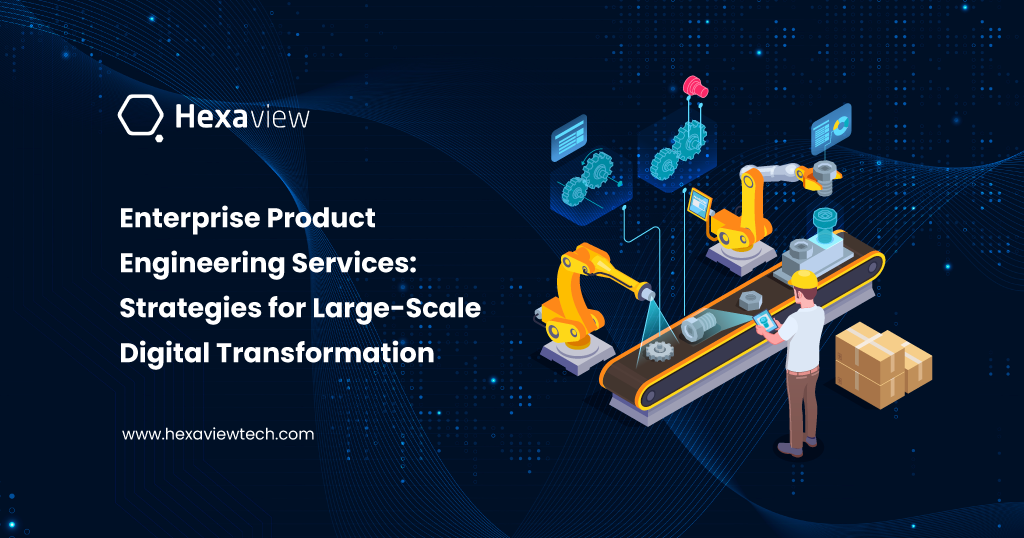
The way large enterprises build, scale, and evolve software has changed fundamentally. In today's technology landscape, enterprise product engineering services are no longer an operational afterthought; they are the strategic backbone of digital competitiveness. Organizations across industries are moving beyond traditional IT services and embracing scalable product engineering models that prioritize continuous innovation, speed, and resilience.
This shift is driven by rising demand for cloud-native systems, artificial intelligence, and intelligent automation. Whether it is a global bank modernizing its core infrastructure or a healthcare provider building real-time patient engagement platforms, enterprise product development is at the center of how businesses adapt, grow, and compete.
Enterprises that invest in purpose-built engineering capabilities are achieving faster time-to-market, stronger customer experiences, and the organizational agility needed to lead in an era of constant disruption. This guide explores every dimension of that journey.
Enterprise product engineering services refer to the end-to-end capability to design, build, scale, and continuously evolve complex software products for large organizations. Unlike traditional software development, which is often scoped to one-time projects, enterprise product engineering treats software as a living asset that must be nurtured across its entire lifecycle.
The engineering lifecycle for enterprise-grade products spans several interconnected phases:
The differences between legacy project-based development and modern enterprise product engineering are significant:
Traditional development operates in fixed project cycles with defined start and end dates. Enterprise product engineering operates on a product lifecycle model with no defined end, treating software as a continuously evolving business asset.
Traditional development often limits scalability due to monolithic design. Scalable product engineering builds for growth from day one, using modular architectures and cloud-native infrastructure.
Traditional delivery is largely static once a project closes. Enterprise product engineering embeds continuous innovation into every delivery cycle, creating compounding value over time.
A mature enterprise engineering practice brings together several foundational capabilities:
As enterprises grow in size, geography, and complexity, the demands placed on their technology systems intensify dramatically. Scalable product engineering provides the foundation to meet those demands without sacrificing speed or quality.
Large enterprises typically operate with decades of legacy systems that were never designed to interoperate with modern platforms. Integrating these systems while building new capabilities is one of the defining challenges of enterprise engineering.
Multi-cloud environments add another layer of complexity, requiring products that can operate seamlessly across AWS, Azure, Google Cloud, and on-premises infrastructure. Distributed teams and global user bases further demand architectures that perform reliably under diverse conditions.
Speed is a competitive advantage. Enterprises that can move from idea to production faster than their peers gain meaningful market advantages. Scalable product engineering compresses time-to-market by standardizing delivery pipelines, eliminating redundant processes, and enabling parallel workstreams.
Beyond speed, it reduces operational inefficiencies by automating manual tasks and creating self-service capabilities that free engineering teams to focus on innovation rather than maintenance. Continuous innovation cycles ensure that products evolve in response to market changes rather than falling behind.
Modern consumers expect seamless, personalized experiences across every touchpoint. Enterprise product engineering enables the omnichannel platforms and real-time personalization engines that make those experiences possible.
Data-driven product improvements allow organizations to act on behavioral insights and customer feedback rapidly, ensuring that product evolution is always aligned with actual user needs rather than assumptions.
Building great enterprise products at scale requires a deliberate combination of architecture choices, delivery practices, and cultural commitments.
Cloud-native architecture is the foundation of modern enterprise product development. By designing systems around microservices, each function of an application becomes independently deployable, scalable, and maintainable. This prevents the brittleness of monolithic systems and dramatically improves operational flexibility.
Kubernetes and containerization standardize how applications are packaged and run, enabling consistent behavior across development, testing, and production environments. Serverless computing extends this further, allowing teams to run event-driven workloads without managing underlying infrastructure.
Agile at enterprise scale requires more than sprint ceremonies. It demands structured release frameworks that coordinate across multiple teams and product lines while preserving the responsiveness that makes agile valuable.
CI/CD pipelines automate the process of building, testing, and deploying code, reducing the risk of human error and enabling deployment frequencies that traditional methods could never achieve. Infrastructure as Code treats infrastructure configuration the same way as application code, making it versioned, repeatable, and auditable.
Artificial intelligence is no longer a future capability for enterprises; it is a present competitive requirement. Predictive analytics embedded into enterprise products help organizations anticipate user needs, detect anomalies, and make proactive decisions.
Intelligent automation eliminates repetitive tasks across the product lifecycle, from data processing to incident response. AI-driven testing further accelerates delivery by automatically generating test cases, identifying regressions, and ensuring quality at machine speed.
Technical excellence alone does not make a great product. User experience is the lens through which all engineering decisions should be evaluated. UX and UI optimization ensure that products are not just functional but genuinely pleasant and efficient to use.
Customer journey engineering maps the full arc of how users interact with a product, from discovery through long-term engagement, and identifies friction points that reduce satisfaction and retention. Human-centered design embeds user empathy into every phase of the engineering process.
Product analytics provide the visibility needed to understand how users are actually engaging with a product versus how designers assumed they would. Behavioral insights surface patterns that inform prioritization, helping engineering teams focus on the improvements with the highest impact.
Continuous feedback loops connect the product back to its users in real time, enabling organizations to iterate rapidly and keep the product aligned with evolving expectations.
Scalable systems are modular by design. Platform engineering creates shared foundations that multiple product teams can build upon, eliminating redundant work and ensuring consistency across the enterprise.
An API-first approach treats integrations as first-class citizens, making it straightforward to connect to internal systems, third-party services, and partner platforms. Platform-based development accelerates delivery by giving teams access to reusable infrastructure, shared services, and standardized tooling.
Enterprise cybersecurity cannot be bolted on at the end of a development cycle. Zero-trust architecture assumes that no user, device, or network segment is inherently trustworthy, requiring continuous verification at every layer of access.
Regulatory compliance requirements vary by industry and region, but all demand that engineering practices produce auditable, controlled, and secure outputs. DevSecOps integrates security practices directly into development and deployment pipelines so that compliance is continuous rather than episodic.
Legacy systems represent both the greatest risk and the greatest opportunity in enterprise technology. Modernizing these systems through cloud migration, API enablement, and architectural refactoring unlocks trapped value and eliminates technical debt that slows innovation.
Successful modernization requires a clear transformation strategy that minimizes disruption to ongoing operations while progressively replacing or extending legacy capabilities.
Quality is not a phase at the end of development; it is a discipline woven throughout the entire lifecycle. Automated testing frameworks validate code continuously as it is written, catching defects early when they are cheapest to fix.
Performance engineering ensures that products behave reliably under real-world load conditions. Observability and monitoring provide the visibility needed to understand system behavior in production, enabling rapid diagnosis and resolution of issues.
How can enterprises scale digital transformation effectively? Successful scaling requires a combination of platform thinking, embedded engineering excellence, cross-functional collaboration, and a product-centric operating model that treats technology as a strategic capability rather than a cost center.
Understanding why enterprise engineering initiatives struggle is as important as knowing what success looks like.
Technical debt accumulated over decades creates a hidden tax on every new development initiative. Integration limitations in legacy systems force engineers to build brittle workarounds rather than clean, modern solutions, slowing delivery and increasing risk.
Performance bottlenecks that are invisible at low traffic volumes become critical failures as adoption grows. Data handling challenges compound as product usage scales, requiring architectural investments in distributed storage, caching, and processing that were not anticipated in the original design.
Data privacy concerns are intensifying as regulations like GDPR and CCPA raise the stakes for non-compliance. Regulatory requirements vary across jurisdictions and industries, creating a complex compliance landscape that must be navigated without slowing product delivery.
Cross-functional alignment between product, engineering, design, and business stakeholders is one of the most persistent challenges in enterprise product development. Skill shortages in emerging areas like cloud-native engineering, AI integration, and DevSecOps mean that organizations often need external expertise to accelerate their capabilities.
Inefficient planning that does not account for the true complexity of enterprise environments consistently produces budget and timeline surprises. Lack of agile governance at the portfolio level means that individual teams make locally rational decisions that create globally inefficient outcomes.
Why do enterprise engineering projects fail? The most common failure modes are misalignment between technology and business strategy, underestimation of legacy complexity, insufficient attention to organizational change management, and lack of continuous governance over scope and priorities.
Hexaview Technologies brings a comprehensive, outcome-oriented approach to enterprise product engineering that combines deep technical expertise with industry-specific knowledge. Built for the future of enterprise product engineering, Hexaview's methodology is designed to deliver measurable business value at every stage of the product lifecycle.
Hexaview begins every engagement with a strategy-driven foundation. User journey mapping and feasibility analysis ensure that engineering investments are grounded in real business needs rather than technology preferences. Scalable architecture planning establishes the structural foundations that will support growth over time, and a defined transformation roadmap provides the clarity and alignment needed to execute with confidence.
Hexaview's engineering practice is built on cloud-native principles. Microservices and containerization enable independent deployment and scaling of application components, while multi-cloud support across AWS, Azure, and GCP gives enterprises the flexibility to optimize for performance and cost across platforms.
API-first integrations ensure that every product Hexaview builds is composable and connectable, and Kubernetes orchestration provides the operational reliability needed to run enterprise workloads at scale.
CI/CD pipelines and agile sprint execution bring the speed and predictability that enterprise delivery demands. Infrastructure automation reduces the manual overhead of environment management, and consistent release discipline enables faster product iterations without increasing operational risk.
Hexaview integrates AI and machine learning capabilities directly into enterprise systems, enabling predictive analytics, intelligent automation, and real-time decision support. Generative AI capabilities are being applied to accelerate development itself, from code generation and documentation to automated testing and code review.
This enables next-generation digital transformation for enterprises that want to move faster without sacrificing the governance and control that their scale requires.
Hexaview has deep experience helping enterprises navigate the transition from monolithic architectures to microservices-based platforms. Cloud transformation strategies are tailored to each client's specific constraints and risk tolerance, ensuring that modernization delivers its intended benefits without disrupting ongoing operations.
API enablement unlocks the value trapped in legacy systems, allowing organizations to build new capabilities on top of existing investments rather than replacing them wholesale. System scalability improvements ensure that modernized platforms can grow with business demand.
Check the top 10 legacy modernization companies in the US in 2026
Security is embedded throughout Hexaview's delivery methodology through DevSecOps practices. Zero-trust architecture ensures that enterprise products are secure at every layer, and continuous monitoring provides the visibility needed to detect and respond to threats in real time.
Regulatory compliance requirements across BFSI, healthcare, and other regulated industries are addressed proactively, ensuring that products are audit-ready and continuously compliant.
Hexaview's engagement model extends well beyond initial delivery. End-to-end product lifecycle management, continuous testing, and feedback-driven enhancement cycles ensure that enterprise products remain competitive and performant over the long term. Driven by enterprise AI modernization, Hexaview helps clients build the internal capabilities needed to sustain innovation independently.
Hexaview brings domain-driven engineering expertise across BFSI, healthcare, SaaS, and manufacturing. Tailored enterprise product development solutions reflect a deep understanding of each industry's unique regulatory context, user expectations, and competitive dynamics.
To explore how Hexaview can support your enterprise product engineering journey, connect with our team today.
Technology alone does not drive digital transformation; culture does. Cross-functional collaboration between engineering, product, design, and business teams is essential for producing outcomes that matter. A customer-first mindset ensures that every technical decision is evaluated through the lens of user value rather than technical elegance alone.
Intelligent automation across the product lifecycle reduces the friction that slows enterprise delivery. Smart product lifecycle management, powered by AI-generated insights, helps organizations prioritize the improvements with the highest business impact and identify risks before they become crises.
The right partner brings both domain expertise and scalable engineering capabilities. Look for organizations that have demonstrated success in your specific industry, that can scale their team alongside your ambitions, and that operate as true partners rather than vendors.
For a comprehensive resource on selecting and working with engineering partners, the complete guide to product engineering services for enterprises in 2026 offers detailed frameworks and best practices.
Iterative development disciplines and data-driven decision-making processes ensure that product improvements compound over time. Organizations that treat innovation as a continuous practice rather than a periodic initiative consistently outperform those that do not.
Effective enterprise product engineering is measured through outcomes, not just outputs. Key metrics to monitor include time-to-market for new features, deployment frequency as an indicator of delivery maturity, product adoption rates, and customer retention as a measure of sustained value delivery.
Enterprise product engineering services have become indispensable for organizations that want to compete in a technology-driven world. The shift from traditional project-based development to continuous, product-centric engineering is not simply a technology upgrade; it is a fundamental rethinking of how enterprises create and sustain competitive advantage.
Scalable product engineering enables organizations to grow their digital capabilities without growing their complexity proportionally. Cloud-native architecture, AI integration, and intelligent automation are the engines of this growth, providing the speed, intelligence, and resilience that modern enterprise products demand.
The enterprises that will lead their industries over the next decade are investing in these capabilities today, not as isolated technology initiatives but as strategic commitments to continuous innovation. The question is no longer whether to embrace enterprise product engineering, but how quickly and how well.
Partner with Hexaview Technologies to build the enterprise product engineering capabilities that will define your competitive future.
What are enterprise product engineering services?
Enterprise product engineering services involve designing, developing, and scaling software products for large organizations. They include cloud, AI, security, and continuous product improvement.
How does scalable product engineering support digital transformation?
Scalable product engineering ensures systems can grow with business needs, enabling faster innovation, better performance, and seamless digital transformation.
What technologies are used in enterprise product development?
It uses cloud platforms (AWS, Azure), microservices, Kubernetes, AI/ML, APIs, and CI/CD tools to build scalable and modern applications.
Why is cloud-native engineering important for enterprises?
Cloud-native engineering helps build flexible, scalable, and resilient systems that support faster updates, better performance, and lower operational costs.
How do AI and automation improve enterprise product engineering?
AI and automation enhance efficiency by enabling predictive analytics, intelligent workflows, automated testing, and faster product development cycles.
Which industries benefit from enterprise product engineering services?
Industries like BFSI, healthcare, retail, manufacturing, and SaaS benefit the most due to their need for scalable, complex, and high-performance systems.






.svg)




.svg)