
In today's hyper-competitive digital economy, every product is a software product, and every software product needs to ship faster, scale further, and stay compliant longer than ever before. That's why product engineering services have moved from a back-office function to a boardroom priority. Enterprises across fintech, healthcare, manufacturing, and SaaS are turning to specialized product engineering partners to accelerate innovation, modernize legacy systems, and embed AI into the core of their offerings.
According to MarketsandMarkets, the global product engineering services market is projected to reach USD 1,800.45 billion by 2030, growing at a CAGR of 6.8% from 2025. The reason is simple: organizations that engineer products well, ship faster and those that ship faster, win.
This guide breaks down what product engineering services are, the key components that define them, the most impactful use cases across industries, and how to choose a partner that can deliver both speed and compliance. Read on.
Product engineering services (PES) are end-to-end offerings that cover the full lifecycle of a digital product, from ideation, design, and prototyping to development, testing, deployment, and continuous post-launch support. Unlike traditional software development, which often stops at "shipping the build," product engineering treats the product as a living asset that must continuously evolve with user needs, market shifts, and regulatory changes.
A modern product engineering services company brings together software architects, UX designers, cloud engineers, QA specialists, and DevOps practitioners under a single agile delivery model. The goal isn't just to write code; it's to translate a business idea into a scalable, secure, and revenue-generating product.
For a deeper, enterprise-focused walkthrough of the space, read out complete guide to product engineering services for enterprises in 2026.

The pressure on enterprises has never been higher. Software-defined disruption is reshaping industries, AI is rewriting product roadmaps, and customers expect new features every sprint, not every quarter. Against this backdrop, full-cycle product engineering has become the engine that powers competitive advantage.
The numbers tell the story. Research from Global Growth Insights shows that over 72% of enterprises have now adopted digital transformation initiatives, while 64% are actively investing in AI-enabled product design. Meanwhile, The Business Research Company reports that the global product engineering services market crossed USD 1.25 trillion in 2026, growing at a CAGR of 8.7%.
What's driving this surge?
There's also a quieter but more structural shift underway: the move from human-only delivery teams to managed agentic services, where AI agents work alongside senior engineers across discovery, build, test, and support. Hexaview's agentic pods are already delivering outcomes 1.8x faster than traditional models, with zero compromise on audit readiness, a pattern increasingly defining how regulated industries engineer products in 2026.
In short, product engineering services aren't "nice-to-have" anymore. They're how modern enterprises stay relevant.
After 16+ years of shipping products for regulated industries, fintech, wealth management, healthcare, and enterprise SaaS, we've distilled what consistently works into the Hexaview 7-Pillar Product Engineering Framework. Each pillar maps to a specific business outcome, from accelerated time-to-market to audit-ready compliance. This is the operating model behind every engagement we lead.
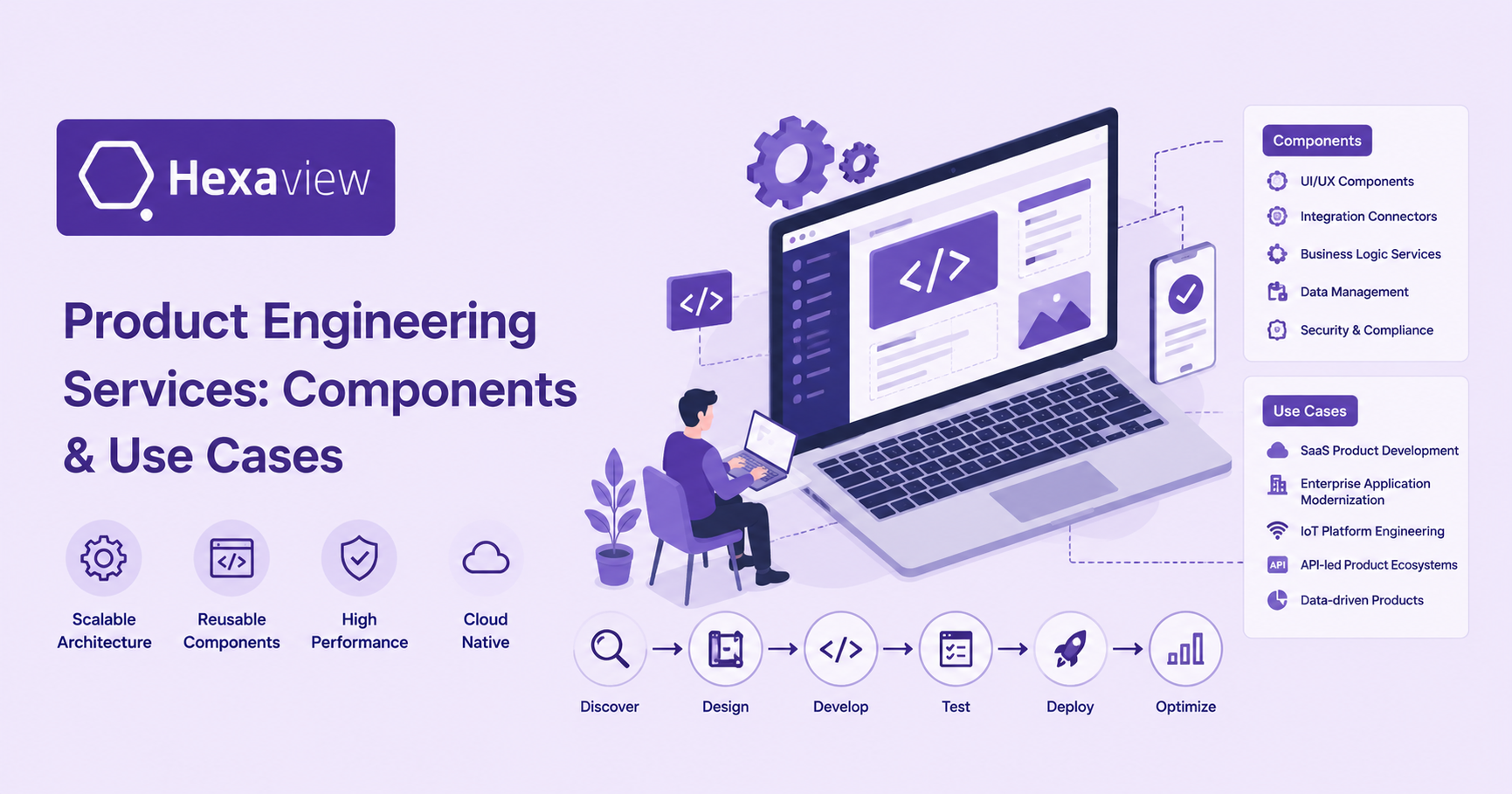
A high-impact product engineering engagement is built on seven interconnected components. Together, they form the backbone of full-cycle product engineering.
This is where great products begin. Engineers, designers, and business strategists work closely with stakeholders to validate the idea, define the roadmap, identify target users, and align on measurable outcomes. Skipping this stage is the most common cause of failed product launches.
This is the technical core designing modular architectures, writing clean, scalable code, and applying patterns like microservices, API-first design, and event-driven systems. Modern teams leverage React, Angular, Node.js, .NET, Java, Python, and Spring Boot to deliver software that performs under real-world load. At Hexaview, our Agent Factory, a reusable library of agentic building blocks, accelerates scaffolding, integration, and boilerplate engineering by up to 40%, freeing senior engineers to focus on architecture and domain logic.
A product is only as good as the experience it delivers. UX designers conduct user research, build wireframes and clickable prototypes, and continuously test interfaces with real users. The goal: intuitive products that reduce friction, increase adoption, and convert.
For connected products, from smart wearables to industrial sensors, engineers carefully integrate hardware components, embedded firmware, and connectivity modules. Power efficiency, latency, and interoperability have become as important as the software itself.
Before scaling, every product must be validated. Iterative prototyping, automated regression testing, performance testing, and security audits ensure the product works as intended under all conditions. Mature product engineering teams run testing in parallel with development, not after. At Hexaview, HexaClaw, our autonomous engineering agent suite runs parallel validation, security, and regression checks throughout the build, catching defects before they ever reach staging.
Cloud-native architectures and CI/CD pipelines are non-negotiable in 2026. Modern PES providers build on AWS, Azure, GCP, Kubernetes, Docker, and Terraform to ensure faster releases, safer deployments, and effortless scaling.
Launching the product is the start, not the finish. Continuous monitoring, user feedback loops, feature enhancements, and proactive modernization keep the product relevant and the user base growing. Hexaview's HAKI AI implementation accelerator and CoWorkers (AI-driven engineering teammates that pair with human pods on coding, testing, and documentation) together help product teams ship enhancements 1.8x faster than traditional delivery models.
For a closer look at how these components translate into measurable business value, see our piece on product engineering solutions that drive innovation and faster time-to-market.
Product engineering services are reshaping virtually every industry. Here are the most impactful use cases enterprises are scaling today.
How Are Fintech and Wealth Management Firms Using PES?
Fintech platforms rely on product engineering to build secure, scalable, and regulation-ready solutions, from digital wealth management platforms to AI-driven lending engines. Microservices, advanced encryption, and continuous threat monitoring are now table stakes for any modern financial product.
How Is PES Powering Healthcare Innovation?
From HIPAA-compliant patient portals to AI-driven diagnostic platforms and embedded medical devices, product engineering helps healthcare innovators ship faster while meeting strict regulatory expectations. Compliance is engineered in, not bolted on.
How Are Autonomous Vehicles Built?
Autonomous mobility requires deep integration of real-time decision algorithms, computer vision, edge computing, and safety-critical software, exactly the kind of multi-disciplinary delivery PES is designed for.
How Are Smart Homes and IoT Ecosystems Engineered?
Smart home and IoT platforms unify hundreds of connected devices through intuitive interfaces, secure cloud backbones, and intelligent automation. Product engineering ensures these ecosystems are reliable, secure, and easy to extend.
How Is Industrial Automation Evolving?
PES enables industrial-grade control systems, robotic automation, predictive maintenance, and digital twins that drive efficiency on factory floors and across global supply chains.
How Are VR and AR Experiences Created?
Immersive VR/AR experiences combine cutting-edge graphics, sensor fusion, and real-time interactivity, all engineered for performance, scalability, and cross-device compatibility.
How Are Blockchain Applications Engineered?
From DeFi platforms to digital identity solutions, blockchain products demand scalable architectures, cryptographic strength, and seamless integration with existing enterprise systems.
How Are Enterprise SaaS Platforms Scaled?
Modern SaaS products require multi-tenant architectures, deep observability, predictable performance, and built-in compliance, all delivered by mature product engineering teams operating at scale.
Working with a specialized product engineering services company delivers compound advantages that internal teams rarely match alone:
Choosing a full-cycle product engineering partner can make or break your product journey. Use this checklist to evaluate any potential provider:
The right delivery model depends on your stage, risk profile, and internal capability. Here's how Hexaview's three most common product engineering engagement models compare:

Be cautious of partners who lead with rock-bottom rates but offer little strategic value, lack a clear delivery framework, or treat compliance as an afterthought.
Hexaview Technologies is a Tier-1 systems integrator with 16+ years of engineering excellence, 450+ engineers, and a proven track record across regulated industries. We deliver managed agentic product engineering services that combine senior-led delivery pods with proprietary AI accelerators built specifically for product engineering at scale:
Our results speak for themselves: 91% first-pass merges, a 60% reduction in defect rates, 40% faster developer onboarding, and 1.8x faster agentic delivery, all backed by zero missed audits over the past 36 months.
Case in point: A US-based fintech firm partnered with Hexaview to modernize its transaction platform. We re-architected the system using a microservices-based approach for elastic scalability, layered in advanced encryption and multi-factor authentication, and integrated continuous threat detection and monitoring. The result: a future-ready platform that scaled seamlessly with growing transaction volumes, while passing every compliance audit.
Whether you're an early-stage startup looking to launch your MVP, or an enterprise modernizing a legacy product, our team is built to deliver.
Get in touch with Hexaview today
Product engineering services are no longer just about writing code, they're about engineering business outcomes. In a market projected to grow past USD 1.8 trillion by 2030, the right product engineering partner is the difference between products that ship and products that scale. Whether you're building a new platform, modernizing a legacy system, or embedding AI into your roadmap, choosing a partner with the right expertise, agility, and compliance posture is the most strategic decision you'll make this year.
1. What are product engineering services?
Product engineering services cover the full lifecycle of a digital product, from ideation and design to development, testing, deployment, and continuous support. They combine software engineering, UX design, cloud architecture, and DevOps to translate ideas into scalable, market-ready products.
2. What are the key components of product engineering services?
The key components include product discovery and strategy, advanced software development, UX and design engineering, hardware and IoT integration, prototyping and testing, cloud and DevOps enablement, and continuous innovation. Together, they form full-cycle product engineering.
3. What are the top product engineering services companies in the US?
Top US-based product engineering services companies are typically chosen based on industry expertise, full-cycle delivery capabilities, AI and cloud maturity, and regulatory compliance. Hexaview Technologies, headquartered in New York, is a leading Tier-1 systems integrator serving fintech, healthcare, wealth management, and enterprise SaaS clients across North America.
4. Which firms offer end-to-end product engineering services for startups?
Several firms specialize in end-to-end product engineering for startups. Hexaview, for instance, offers dedicated MVP design and launch services that help startups validate ideas quickly, ship cloud-ready MVPs in weeks, and scale them seamlessly post-market validation, making it a strong fit for both early-stage and growth-stage companies.
5. How do I choose the best product engineering service provider for my tech project?
Evaluate providers on industry expertise, full-cycle delivery, modern tech stack, compliance certifications (SOC 2, HIPAA, ISO 27001), senior-led delivery pods, transparent engagement models, and strong client references, ideally within your specific industry vertical.
6. What are the benefits of outsourcing product engineering services?
Outsourcing accelerates time-to-market, gives you access to deep multidisciplinary expertise (AI, cloud, IoT, security), reduces total cost of ownership, ensures compliance by design, and frees internal teams to focus on core business priorities rather than infrastructure and undifferentiated engineering work.
7. How much do product engineering services cost?
Cost varies by scope, complexity, and engagement model. Mid-market engagements typically range from USD 100K–300K over 30–60 days, while enterprise projects can run USD 1M+ over 3–4 months. Most leading providers offer flexible engagement models, including dedicated pods, fixed-bid, and build-operate-transfer.
8. How is product engineering different from traditional software development?
Traditional software development focuses on building and shipping code. Product engineering, by contrast, treats the product as a living asset, covering strategy, design, development, deployment, support, and continuous modernization across its full lifecycle, with AI, cloud, and compliance engineered in from day one.








.svg)




.svg)