

Modern businesses face a relentless race to launch high-quality products before competitors seize the market. Maintaining a balance between speed, security, and scalability remains a significant challenge for even the most established enterprises. Rapid technological shifts and evolving customer expectations leave no room for stagnant development processes.
Organizations must embrace product engineering solutions to navigate these complexities effectively. These solutions streamline the entire lifecycle by removing silos and automating repetitive tasks. By integrating advanced engineering practices, companies reduce costly delays and foster a culture of continuous improvement. This strategic approach ensures that every release meets rigorous quality standards while hitting the market at the optimal time for maximum impact.
Efficiency in development directly correlates with market dominance. When companies adopt modern engineering frameworks, they transform their delivery pipelines into high-speed engines of growth.
Agile methodologies and DevOps practices eliminate the bottlenecks that traditionally stall progress. Automation handles routine coding tasks and environment setups, which allows developers to focus on core features. Shorter release cycles enable teams to iterate quickly based on real-world performance.
Effective solutions align business goals with development, QA, and operations. This unified approach prevents the "hand-off" delays that occur when teams work in isolation.
Continuous testing ensures that engineers identify and fix bugs immediately. Shifting testing to the start of the cycle prevents minor issues from snowballing into major launch delays.
Robust systems integrate several key technical pillars:
Innovation requires more than just a good idea; it requires a technical foundation that supports experimentation and cutting-edge technology.
Modern engineering allows for the seamless integration of advanced technologies. Businesses can embed AI and machine learning to automate decision-making. Predictive analytics and IoT connectivity turn standard hardware into intelligent, data-driven ecosystems that provide immense value to users.
Design teams use deep user research and real-time customer feedback to shape the product. This focus on personalization and superior user experience ensures the final output solves actual user problems.
Prototyping and Minimum Viable Products (MVPs) allow companies to test concepts with minimal risk. Agile development cycles make it easy to pivot based on experimental data.
Building on cloud-native infrastructure ensures the product grows alongside the user base. Utilizing microservices and APIs creates a flexible ecosystem where developers can update individual components without disrupting the entire system.
A holistic engineering strategy covers every phase from the initial spark of an idea to long-term maintenance.
Teams begin by identifying core business goals and understanding customer pain points. This phase involves creating detailed product roadmaps and defining clear KPIs to measure success throughout the journey.
Designers build wireframes and interactive prototypes to visualize the journey. They prioritize responsive design, accessibility, and user journey mapping to ensure the product remains intuitive across all devices.
Engineers implement front-end and back-end systems using modern stacks. They focus on cloud-native development and microservices to ensure the application remains modular and easy to scale.
A rigorous QA process includes functional, performance, and security testing. Automation testing runs scripts across various scenarios to ensure the software remains stable under heavy loads.
Engineering does not end at launch. Ongoing monitoring and performance optimization keep the product healthy. Regular feature enhancements and legacy modernization ensure the product stays relevant.
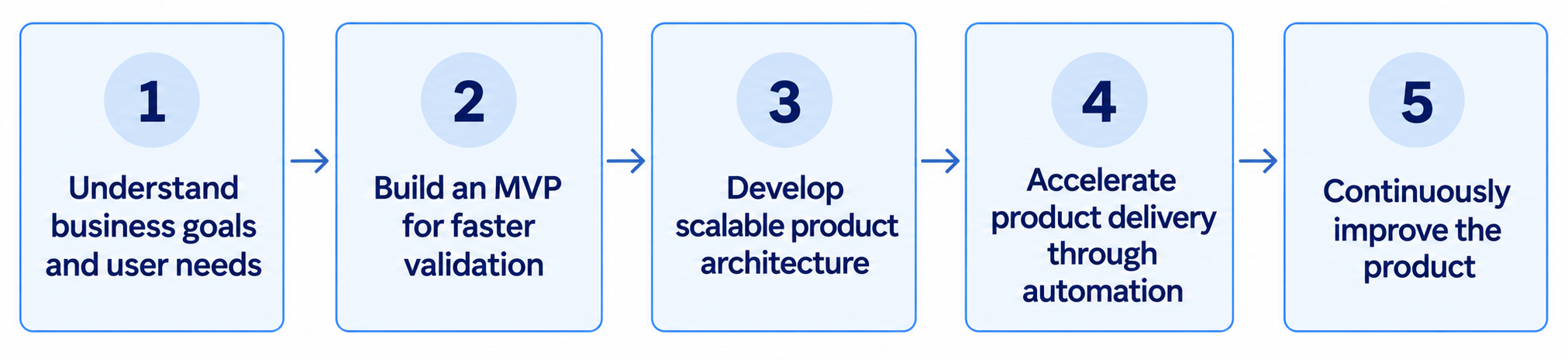
Hexaview Technologies follows a structured, result-oriented methodology to transform complex ideas into market-ready software.
We initiate every project with discovery workshops. Our experts analyze customer journeys and plan a strategic roadmap that aligns with your specific enterprise objectives.
Hexaview prioritizes speed by developing wireframes and prototypes quickly. This MVP approach allows for early feedback and faster iterations, ensuring the final product matches market demand.
We build systems using microservices and cloud-native infrastructure. This technical foundation supports high-volume traffic and allows for seamless API integrations.
Our teams implement CI/CD pipelines and automated testing. This release management strategy ensures that new updates reach users without manual errors or downtime.
We provide ongoing monitoring and AI integration. Whether it involves performance optimization or legacy modernization, Hexaview ensures your product evolves with the industry.
Product engineering solutions empower businesses to innovate with confidence while drastically reducing time-to-market. By focusing on scalable architecture, automation, and customer-centric design, enterprises can deliver superior quality consistently.
Hexaview Technologies serves as a dedicated partner for organizations seeking to build and scale transformative products. Our expertise in cloud-native development and agile engineering ensures your vision reaches the market with precision.
Contact Hexaview Technologies today to elevate your product strategy and drive sustainable growth.
These are end-to-end services that cover the design, development, and maintenance of a software product using modern methodologies like Agile and DevOps.
They utilize automation, continuous integration, and early testing to remove manual bottlenecks and accelerate the release cycle.
Yes, Hexaview specializes in updating older architectures to modern, cloud-native frameworks to improve performance and scalability.
An MVP allows you to test core features with real users early, providing data to guide future development and reducing the risk of failure.
UI/UX ensures the product is functional and intuitive, which directly impacts user adoption and long-term retention.
It provides the flexibility to scale resources up or down based on demand, reducing infrastructure costs and improving reliability.
Hexaview offers continuous monitoring, feature updates, and performance tuning to ensure the product stays competitive after launch.
AI adds "smart" capabilities like predictive analytics and automation, making the product more efficient and valuable to the end user.
Hexaview provides engineering solutions across various sectors, including FinTech, Healthcare, and Enterprise Software.







.svg)




.svg)