
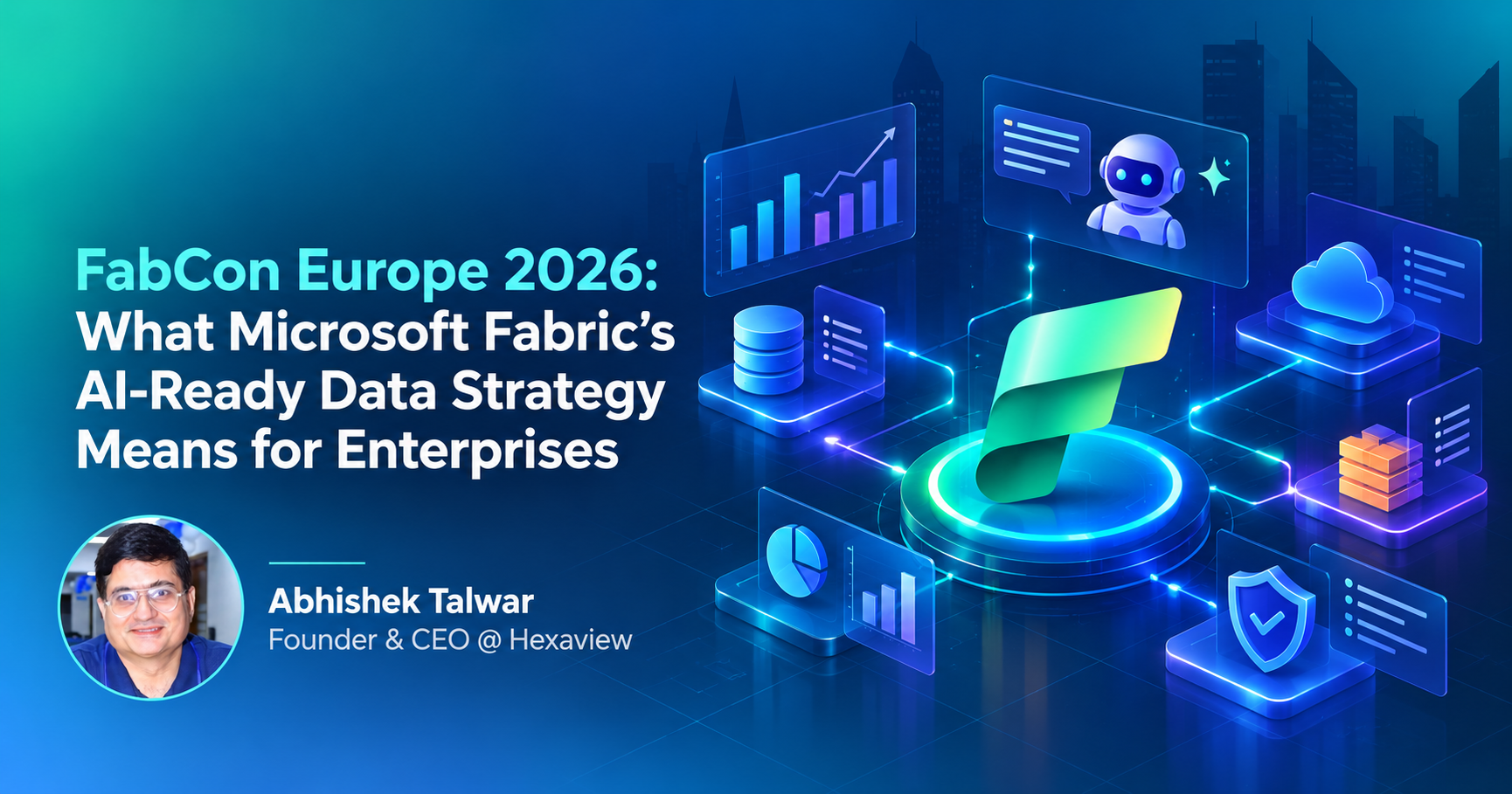
FabCon Europe 2026 showed Microsoft Fabric moving beyond unified analytics toward an AI-ready enterprise data platform. The platform increasingly connects OneLake, Fabric IQ, semantic models, Real-Time Intelligence, databases, governance, and AI agents within one architecture. For enterprises, the shift matters because reliable, governed, contextualized data is becoming the foundation for deploying enterprise AI agents at scale.
FabCon Europe 2026 started from September 28 to October 1, 2026, at Barcelona’s CCIB. The event brings together more than 4,000 Microsoft data professionals, with 130+ expert-led sessions spanning Fabric, SQL, AI, data engineering, and real-time intelligence.
Its co-location with SQLCon is significant. Microsoft is bringing databases, analytics, data engineering, and AI into a more connected enterprise data conversation. The reason is practical: fragmented operational, analytical, real-time, on-premises, and cloud data can make AI harder to trust and use effectively.
From my perspective as the CEO of Hexaview Technologies, the central question is no longer whether enterprises need AI. It is whether their data foundation is ready for AI. FabCon Europe 2026 offers a clear view of how Microsoft is building toward that foundation.
FabCon Europe 2026 is the European Microsoft Fabric + SQL Community Conference, held in Barcelona from September 28 to October 1, 2026. The Microsoft Fabric conference brings together Microsoft experts, MVPs, architects, developers, data engineers, and enterprise practitioners across 130+ specialist sessions.
The Microsoft Fabric 2026 program spans OneLake, Fabric IQ, AI agents, Data Engineering, Real-Time Intelligence, Power BI, SQL Server, Azure SQL, analytics, and governance. This breadth matters because Microsoft is increasingly treating data, databases, analytics, and AI as connected parts of the enterprise data platform. The conference therefore provides a practical view of where Fabric is heading and how organizations can prepare their data architecture for AI-driven workloads.
The biggest takeaway from FabCon Europe 2026 is not another isolated Fabric feature. It is the broader shift toward an AI-ready data foundation. Microsoft is connecting OneLake, analytics, databases, semantic models, governance, and AI experiences so agents can work from the same trusted enterprise data.
The traditional flow looked like: Data → Warehouse → BI → Human decision
The emerging model is: Data → Context → AI agent → Decision → Action
That change raises the requirements for enterprise data. AI agents need trusted data, business context, relationships, semantics, security, real-time information, and governed access. Fabric IQ addresses the context layer by grounding AI in business entities, relationships, semantic models, and governed data. OneLake provides the unified data foundation underneath it.
This matters because an agent cannot make reliable decisions from disconnected or poorly governed information. As the CEO of Hexaview Technologies, I see it as, AI is only as reliable as the data and context available to it. The enterprise opportunity is therefore not simply deploying more AI. It is building the architecture that allows AI to reason over trusted business information and act within defined controls. Microsoft’s FabCon direction reflects that shift from analytics infrastructure toward an AI-ready enterprise data platform.
Microsoft Fabric IQ addresses a core challenge in enterprise AI: knowing not only what data says, but what that data means to the business. At the foundation is Microsoft Fabric OneLake, which unifies the organization’s data estate. Above it, Power BI semantic models provide trusted business measures and definitions. Ontologies then add operational meaning by defining business entities and their relationships.
That creates a richer context layer for Microsoft Fabric AI agents. Instead of treating a customer, order, product, or revenue figure as isolated data points, agents can work with the terminology, relationships, measures, and rules that reflect how an enterprise actually operates.
The distinction is important:
Microsoft describes Fabric IQ as combining unified data, business intelligence, and operational intelligence. It also supports Fabric data agents and operations agents, allowing AI systems to use shared business context across analytics and operational workflows.
Microsoft has also documented Fabric IQ as part of the broader Microsoft Foundry agent ecosystem, helping agents discover and reuse enterprise context.
The implication for enterprises is significant: AI agents become more useful when context is modeled as part of the data architecture, rather than recreated inside every individual agent.
Microsoft Fabric OneLake is evolving beyond a place to store enterprise data. It provides a unified logical view across clouds, domains, and accounts, while allowing data to remain at its source when appropriate. Shortcuts can reference external data without duplication, while mirroring can bring databases and catalogs into Fabric for broader analytics access.
The OneLake Catalog adds another layer by helping teams discover, explore, govern, and secure Fabric data from a centralized experience. OneLake security also supports role-based access and fine-grained controls, helping organizations apply consistent policies across data consumption.
This matters for Microsoft Fabric 2026 because interoperability is becoming as important as storage. Data can connect across SQL databases, cloud platforms, applications, and analytical workloads without creating unnecessary copies. That gives people, analytics tools, applications, and AI agents a more consistent data foundation.
The strategic value of OneLake, therefore, is not storing more data. It is reducing fragmentation between the data used by people, analytics, applications, and AI agents.
Traditional analytics often explains what happened after the fact. Microsoft Fabric Real-Time Intelligence brings analytics closer to what is happening now. It supports streaming data, event-driven architectures, Eventstream, Eventhouse, real-time analytics, alerts, and automated actions within a connected environment. Microsoft positions it for scenarios spanning streaming data, logs, analytics, visualization, AI, and real-time responses.
For enterprises, this changes how AI can interact with operations. An agent can potentially work with live business signals rather than relying only on yesterday’s data.
Practical use cases include:
The larger shift is from historical insight to operational intelligence, where real-time data can inform decisions and actions closer to the moment they matter.
FabCon Europe 2026 is not only about AI. Its convergence with SQLCon highlights another enterprise priority: modernizing existing database estates without disrupting critical workloads. The program covers SQL Server, Azure SQL, SQL Database in Fabric, database modernization, vector search, AI applications, and database agents.
This matters because many enterprises still operate large, complex SQL environments. Moving toward an AI-ready data platform does not necessarily mean replacing those systems immediately. Organizations can connect existing databases with modern Fabric workloads and introduce new capabilities incrementally.
A practical modernization path is:
That approach allows enterprises to improve their data foundation while preserving investments in existing systems. It also creates a clearer path toward AI-ready databases, governed analytics, and enterprise AI agents.
For organizations managing complex data estates, the strategic question is therefore not simply how to adopt Fabric. It is how Microsoft Fabric implementation can fit into a broader modernization strategy without forcing unnecessary disruption.
As enterprises move from analytics to enterprise AI agents, governance can no longer sit only at the reporting layer. Microsoft Fabric data governance increasingly needs to cover the data, identities, relationships, and access patterns that AI systems rely on.
Microsoft Purview, OneLake security, access controls, data discovery, lineage, and governance capabilities help organizations understand what data exists, who can access it, and how it moves through the environment. Semantic consistency also matters because agents need reliable definitions for business terms, measures, and relationships. Microsoft’s Fabric program includes dedicated sessions on enterprise-scale governance, Purview, and OneLake security.
This leads to an important architectural principle: For enterprise AI, governance cannot remain a reporting-layer concern.
Governance must extend to the data accessed by agents and applications. That includes controlling permissions, maintaining lineage, protecting sensitive information, and establishing responsible AI practices.
For enterprises, the goal is not simply to make more data available to AI. It is to make trusted, governed, contextually consistent data available under appropriate controls.
From my perspective as CEO of Hexaview Technologies, the significance of FabCon Europe 2026 goes beyond individual product announcements. The broader direction points to a different way of preparing enterprise data for AI.
1. Build the data foundation before scaling agents
AI agents need governed, accessible, high-quality enterprise data. Organizations should strengthen that foundation before expanding agent deployments.
2. Treat business context as a first-class data asset
Semantic models, ontologies, relationships, and business definitions help AI understand how an organization actually operates.
3. Reduce unnecessary data duplication
Microsoft Fabric OneLake and interoperability can help connect existing data estates without creating another disconnected copy for every workload.
4. Bring real-time intelligence into operational decisions
Some decisions depend on current signals. Real-time data can support use cases where yesterday’s information is no longer sufficient.
5. Modernize incrementally
Enterprises rarely replace SQL, cloud, and legacy systems overnight. A phased approach can connect existing investments with newer Fabric capabilities while reducing disruption.
The message I take from FabCon is straightforward: enterprise AI readiness is fundamentally a data architecture challenge.
For enterprises moving from experimentation to production, Microsoft Fabric implementation needs to begin with architecture rather than individual features. Teams should assess the existing data estate, identify suitable Fabric workloads, define a OneLake strategy, and establish governance before scaling adoption.
The next steps include semantic modeling, AI agent readiness, migration planning, and cost and capacity planning. Production deployment should then bring these elements together within an operating model that supports security, performance, and ongoing optimization.
This is where Microsoft Fabric consulting can provide practical value. At Hexaview Technologies, our focus is helping enterprises evaluate their current architecture and build a realistic path toward production. Our Microsoft Fabric implementation services can support that journey from assessment and design through migration, deployment, and optimization.
The objective is not simply adopting Fabric. It is building an architecture that can support the organization’s evolving data and AI requirements.
OneLake + Fabric IQ + Semantic Models + Real-Time Intelligence + Databases + Governance + Agents represent a broader architectural shift. Microsoft Fabric’s evolution is not simply about adding more workloads. It is about connecting enterprise data, meaning, intelligence, and action within a governed environment.
From my perspective, this is the real significance of FabCon Europe 2026. Enterprises should focus less on individual features and more on building a data foundation that can support reliable AI at scale.
For organizations planning that journey, the next step is to assess the existing data estate, architecture, and AI requirements. Hexaview’s Microsoft Fabric consulting and implementation expertise can help enterprises move from experimentation toward a production-ready data and AI architecture.
What is FabCon Europe 2026?
FabCon Europe 2026 is the European Microsoft Fabric + SQL Community Conference, held in Barcelona from September 28 to October 1, 2026.
What are the major Microsoft Fabric announcements from FabCon Europe 2026?
Key developments include Fabric IQ, OneLake capabilities, governed AI experiences, data agents, and stronger connections between enterprise data and AI.
What is Microsoft Fabric IQ?
Fabric IQ provides business context through unified data, semantic models, and ontologies, helping people and agents reason using enterprise terminology.
How does OneLake support AI agents?
OneLake provides a unified, governed data foundation. Its security controls can apply access restrictions when agents query data.
What is the role of AI agents in Microsoft Fabric?
Agents can query governed business data, answer questions, analyze information, and support operational decisions.
How does Microsoft Fabric support real-time analytics?
Real-Time Intelligence supports streaming data, event-driven scenarios, analytics, alerts, and actions.
Is Microsoft Fabric suitable for enterprise data modernization?
Yes. Fabric can connect existing data estates while supporting incremental modernization, governance, analytics, and AI workloads.





.svg)



.svg)