

Financial institutions often struggle with disconnected systems, legacy software, and fragmented data stores. Microsoft Fabric solves this by uniting ingestion, warehousing, real-time analytics, and Power BI into a single cloud ecosystem. Its centralized OneLake architecture eliminates duplicate files and breaks down organizational silos. Integrated Microsoft Purview features protect sensitive financial information and maintain strict compliance standards. Built-in AI tools analyze live market streams instantly to accelerate decisions. Partnering with an expert implementation leader like Hexaview helps banks modernize legacy systems and maximize return on investment.
Financial institutions handle massive volumes of information daily, yet most struggle to extract real value from it. Modern banks run on a chaotic web of legacy banking systems, core banking platforms, CRM data, trading systems, and complex risk applications. Because these platforms operate independently, data flows in isolated channels.
This disconnect causes widespread data duplication across business units. Teams routinely fall back on manual reporting and heavy Excel dependency to stitch together weekly operational summaries. These manual workarounds trigger slow compliance reporting, leaving risk teams vulnerable to regulatory penalties. Furthermore, leadership suffers from a total lack of real-time visibility into daily liquidity and portfolio health. Without synchronized records, institutions fail to build a accurate customer 360° view, which severely limits cross-selling opportunities and degrades client satisfaction.
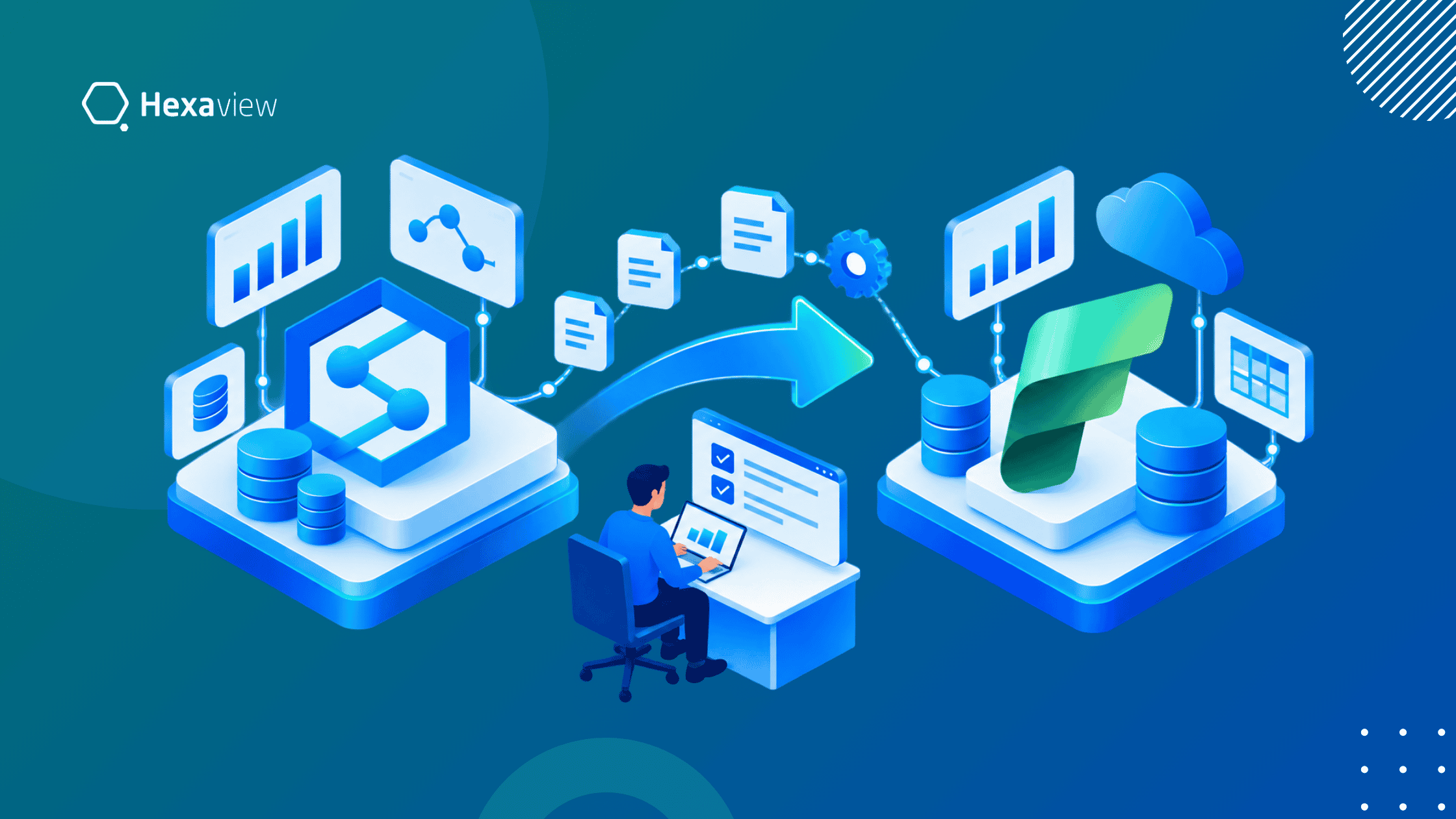
Microsoft Fabric is an all-in-one software as a service analytics platform that unifies all enterprise data operations under a single umbrella. Microsoft built Fabric to eliminate the cost and complexity of connecting piecemeal cloud tools from multiple vendors. Instead of forcing engineering teams to stitch together separate databases, Fabric delivers an end-to-end analytics environment designed for immediate collaboration.
At its core, Fabric operates as an AI ready architecture powered by Copilot assistance. It brings every major data discipline together, so teams work on identical data assets without copying files. Essential workloads like Data Factory handle ingestion, while Lakehouse and Warehouse engines manage high-performance storage and SQL queries. Meanwhile, Real Time Intelligence processes instant transaction streams, Data Science builds machine learning models, and Power BI delivers executive dashboards.
Every component connects to a unified storage engine called OneLake. Microsoft Fabric pricing uses a flexible capacity-based model, allowing financial firms to scale compute power up or down based on operational demand. Microsoft Fabric consulting can help organizations assess their existing data environment, design the right Fabric architecture, optimize workloads, and develop a practical roadmap for successful adoption.
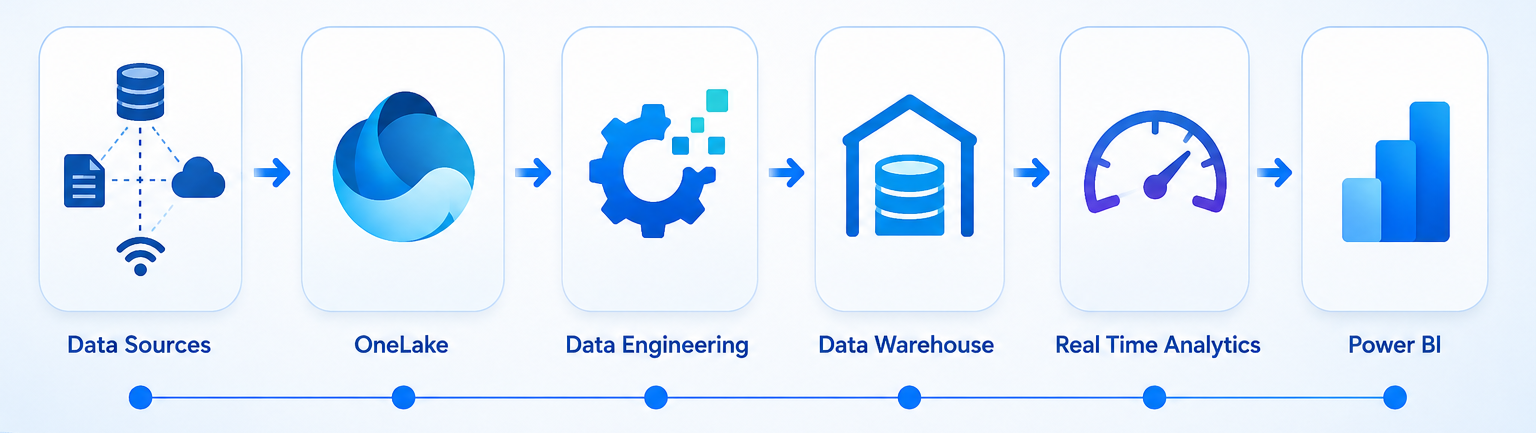
Traditional data architectures rely on piecemeal point solutions, causing friction across departments. Microsoft Fabric for financial services reimagines this paradigm by providing a unified SaaS ecosystem built directly on top of Microsoft Azure infrastructure.
Instead of moving data across fragile pipelines, Fabric operates on a single underlying storage engine called OneLake. This setup allows teams to run diverse compute workloads without duplicating underlying files.

Disconnected databases force financial institutions to make multiple copies of critical records across retail, wealth management, and underwriting divisions. Microsoft Fabric OneLake functions as an enterprise-wide data lake that establishes a single source of truth for the entire business. Using virtual shortcuts, engineering teams can instantly link external cloud databases into OneLake without moving physical files. This unified architecture prevents data duplication, reduces cloud storage overhead, and ensures every department works with synchronized information.
Traditional batch processing delays critical reporting, leaving fraud prevention and trading teams vulnerable to market shifts. Microsoft Fabric real-time analytics ingests and analyzes high frequency event streams within milliseconds. Risk managers can build live dashboards that track liquidity exposure, monitor high speed trading transactions, and flag suspicious payment patterns automatically before transactions settle.
Managing sensitive financial assets across scattered tools creates massive compliance blind spots. Microsoft Fabric data governance integrates natively with Microsoft Purview to enforce strict classification rules across the entire platform. Automated lineage tracking shows exactly how raw data transforms into final financial figures. Data managers can easily map metadata, check data quality metrics, and enforce granular access policies across all business units.
Financial institutions face constant scrutiny from regulatory authorities and must prove absolute data integrity during audits. Microsoft Fabric compliance supports framework standards including FINRA, SOC 2, and PCI-DSS. Automated reporting features simplify audit readiness by tracking complete data provenance and user access history. Compliance teams can pull verifiable, tamper proof audit trails on demand, avoiding manual data gathering and costly regulatory fines.
Importing massive datasets into reporting software causes slow load times and forces organizations to set up complex data refresh schedules. Microsoft Fabric Power BI integration solves this bottleneck through Direct Lake mode, allowing reporting tools to query OneLake Delta tables directly. Analysts experience instant dashboard performance on multi-terabyte datasets without duplicating data, accelerating self-service business intelligence across executive leadership.
Modern banking requires proactive decision making, yet disconnected legacy environments hinder advanced artificial intelligence deployment. Fabric features built in AI models alongside embedded Copilot tools to help teams analyze complex portfolio trends. Financial analysts can quickly build predictive models that forecast credit default risks, project market trends, and deliver personalized customer recommendations.
Running multiple point solutions inflates cloud expenditures and requires expensive software licenses from multiple vendors. Fabric replaces complex, multi-vendor data stacks with a single SaaS analytics platform. Organizations simplify operations with unified licensing through capacity-based pricing models, which lowers ongoing maintenance costs and reduces technical debt across the enterprise.
Microsoft Fabric for financial services breaks down complex data boundaries to deliver an end-to-end data engine tailored for regulated industries. By bringing together unified analytics, advanced AI, strict compliance, and real time reporting, Fabric transforms raw operational streams into actionable strategies that elevate the overall customer experience.
Whether financial firms need to satisfy regulatory scrutiny or deploy custom predictive algorithms, Fabric provides the scalable architecture required to run modern operations efficiently.
Choosing the right enterprise data platform requires matching technical capabilities to organizational priorities. Both Microsoft Fabric and Databricks offer powerful Lakehouse architectures, yet they address different operational needs.
Workload Suitability
Evaluating platform suitability comes down to team skill sets, existing cloud investments, and primary analytics goals.
Databricks excel at complex, code heavy data engineering and custom machine learning pipelines. It serves as a powerhouse for data science teams that build deep predictive algorithms and require custom multi-cloud deployments.
Read More About Databricks Vs Microsoft Fabric
Financial institutions should select Microsoft Fabric if they want to unify fragmented reporting environments while maximizing existing Microsoft investments. Fabric provides an ideal fit for organizations that want:
Fabric uses a structured Medallion architecture to streamline risk management into three clear data layers:
This structured approach transforms stressful audit preparations into a straightforward review of existing traceable records.
Fabric consolidates disparate feeds into OneLake, creating a single governed data lake for every financial report. Built-in Microsoft Purview features automatically trace data lineage from raw source inputs to final reports. Audit teams can trace any line item directly back to its origin without assembling files manually.
Real-World Impact: Bank CenterCredit, a major Kazakh bank serving over 3 million customers, deployed Fabric to streamline its fragmented reporting environment. According to a Microsoft Customer Story, the implementation delivered impressive operational gains:
Fabric uses Data Activator to monitor streaming transactions continuously and trigger automated actions the moment activity deviates from normal baselines. The system flags suspicious behavior immediately as transactions flow through the network.
Teams can configure automatic holds, send real-time alerts to fraud operations staff, or open case logs instantly. The same event-driven rules alert compliance teams before account balances breach regulatory limits.
Wealth management advisors and capital markets traders need real-time data to make smart decisions. Portfolio calculations based on static end-of-day reports quickly become obsolete in volatile markets.
Fabric connects directly to provider extensions like Bloomberg and LSEG, streaming live market rates straight into your portfolio analytics workspace. This direct integration delivers distinct operational advantages:
Enterprise Scale in Action: LSEG (London Stock Exchange Group) deployed Fabric to unify its massive financial analytics infrastructure. According to a Microsoft Case Study, LSEG consolidated 30 legacy systems, 1,200 datasets, and 33 petabytes of data into a single governed platform. As a result, product development cycles dropped from years down to months while processing around 80,000 daily files.
Financial forecasts lose precision when models rely on outdated figures or require manual work to combine past actuals with forward-looking projections.
Fabric runs machine learning workloads directly on OneLake datasets, eliminating tedious export and import steps. Machine learning models train and refine predictions using real-time operational data. AI forecasting tools highlight emerging market trends, predict customer churn, and expose hidden risks early, so strategy teams can plan to use active market conditions rather than stale historical files.
Strict regulatory requirements force financial institutions to keep tight control over their data infrastructure. Operating across global markets requires meeting clear standards established under FINRA, PCI-DSS, and SOC 2 frameworks. Institutions must maintain continuous visibility into how sensitive financial figures travel across analytical systems.
Microsoft Fabric addresses these obligations by integrating directly with Microsoft Purview to establish end to end data lineage. This setup automatically tracks data origin, transformation history, and user access across every workspace. Built in identity management protocols sync with Microsoft Entra ID to enforce granular access control policies based on role responsibilities.
Furthermore, Fabric safeguards records using automated encryption protocols both in transit and at rest. Integrated auditing tools capture detailed system logs to verify file access, schema modifications, and reporting activities. By centralizing governance within a single SaaS environment, financial firms lower compliance risks, simplify complex external audits, and preserve trust across global markets.
Implementing a unified data architecture requires specialized industry knowledge combined with deep technical expertise. Hexaview provides Microsoft Fabric consulting services that help banks and financial institutions plan, implement, and scale Fabric solutions with confidence. Our experts guide organizations through seamless deployments while aligning Fabric architecture with their business, data, governance, and compliance requirements.
Ready to eliminate data silos and accelerate financial intelligence across your institution? Hexaview can help to start your Microsoft Fabric transformation.
Successfully adopting Microsoft Fabric requires thoughtful preparation across business and technical teams. Following these core steps ensures smooth deployment and fast time to value:
Microsoft Fabric transforms how financial institutions manage complex data ecosystems. Replacing disconnected databases with a unified platform eliminates data silos, cuts cloud overhead and delivers faster analytics across business units. Built in Microsoft Purview integrations ensure better compliance with FINRA, SOC 2, and PCI-DSS standards while maintaining complete data traceability. Furthermore, native Copilot capabilities unlock enterprise AI readiness and drive lasting business agility.
Ready to modernize your financial data estate and unlock the full power of real time insights?
Microsoft Fabric for financial services is an all-in-one SaaS analytics platform. It unifies data ingestion, warehousing, real time analytics, and machine learning into a single environment powered by OneLake.
Fabric improves governance through built-in Microsoft Purview integration. It automates data lineage tracking, enforces central sensitivity labels, applies Entra ID access controls, and maintains audit logs across all data assets.
Fabric provides underlying cloud infrastructure and technical capabilities that support FINRA, SOC 2, and PCI-DSS standards. However, individual organizations remain responsible for configuring proper internal controls, user access, and operational policies to ensure full compliance.
Fabric works best for organizations seeking a low code SaaS platform with native Power BI integration and built in Microsoft governance. Databricks suits teams focused on deep, custom data science, complex engineering, and multi cloud environments.
OneLake acts as a single, centralized data lake for the entire enterprise. It uses virtual shortcuts to link external cloud storage without copying files, eliminating duplicate records and isolated departmental databases.
Power BI serves as the native reporting layer in Fabric. Its Direct Lake mode allows reports to query multi-terabyte datasets directly in OneLake without importing data or waiting for batch refreshes.
Pricing depends on the chosen Capacity Unit (CU) compute tier, total data storage used in OneLake, processing workloads like real time analytics or machine learning, and cross region data transfers.
Firms like Hexaview Technologies, YASH Technologies, MSR Cosmos, and Ascent offer Microsoft Fabric readiness assessments. Hexaview specifically helps financial firms audit existing data architectures, evaluate capacity costs, and map out structured migration roadmaps.






.svg)



.svg)