

Transitioning to Microsoft Fabric for financial services connects data and finance teams through one unified analytics platform. The system blends data engineering, warehousing, real-time analytics, and business intelligence inside Microsoft Fabric OneLake. Today, organizations achieve faster reporting, stronger data governance, lower total cost of ownership, and AI-ready planning from a single, trusted source of enterprise data.
Enterprise data rarely lives inside one platform. Finance depends on spreadsheets, while data teams manage disconnected pipelines. Separate warehouses, BI tools, and governance layers increase costs and delays. Business leaders still struggle to trust inconsistent reports across departments. Teams must deliver faster insights with fewer resources and tighter budgets.
That reality is changing rapidly. Microsoft Fabric has become Microsoft's fastest-growing analytics platform. It reached 35,000 paid customers by 2026. Fabric revenue continues to grow faster than competing analytics platforms. Microsoft also reports rapid enterprise adoption across global organizations.
This guide explains Microsoft Fabric benefits without marketing hype. You will learn what Microsoft Fabric is and why it matters. You will also discover measurable gains for data teams and finance leaders in 2026. Finally, see how Hexaview helps enterprises deploy, govern, and scale Microsoft Fabric for production-grade business outcomes.
Microsoft Fabric is a unified, SaaS-based analytics platform that combines data integration, engineering, warehousing, real-time intelligence, data science, and business intelligence through Power BI on a single data foundation called Microsoft Fabric OneLake.
Think of Microsoft Fabric OneLake as OneDrive for enterprise data. Every team accesses the same governed data instead of creating duplicates. This shared foundation improves collaboration, consistency, and security across business functions.
Microsoft Fabric brings several analytics workloads into one platform:
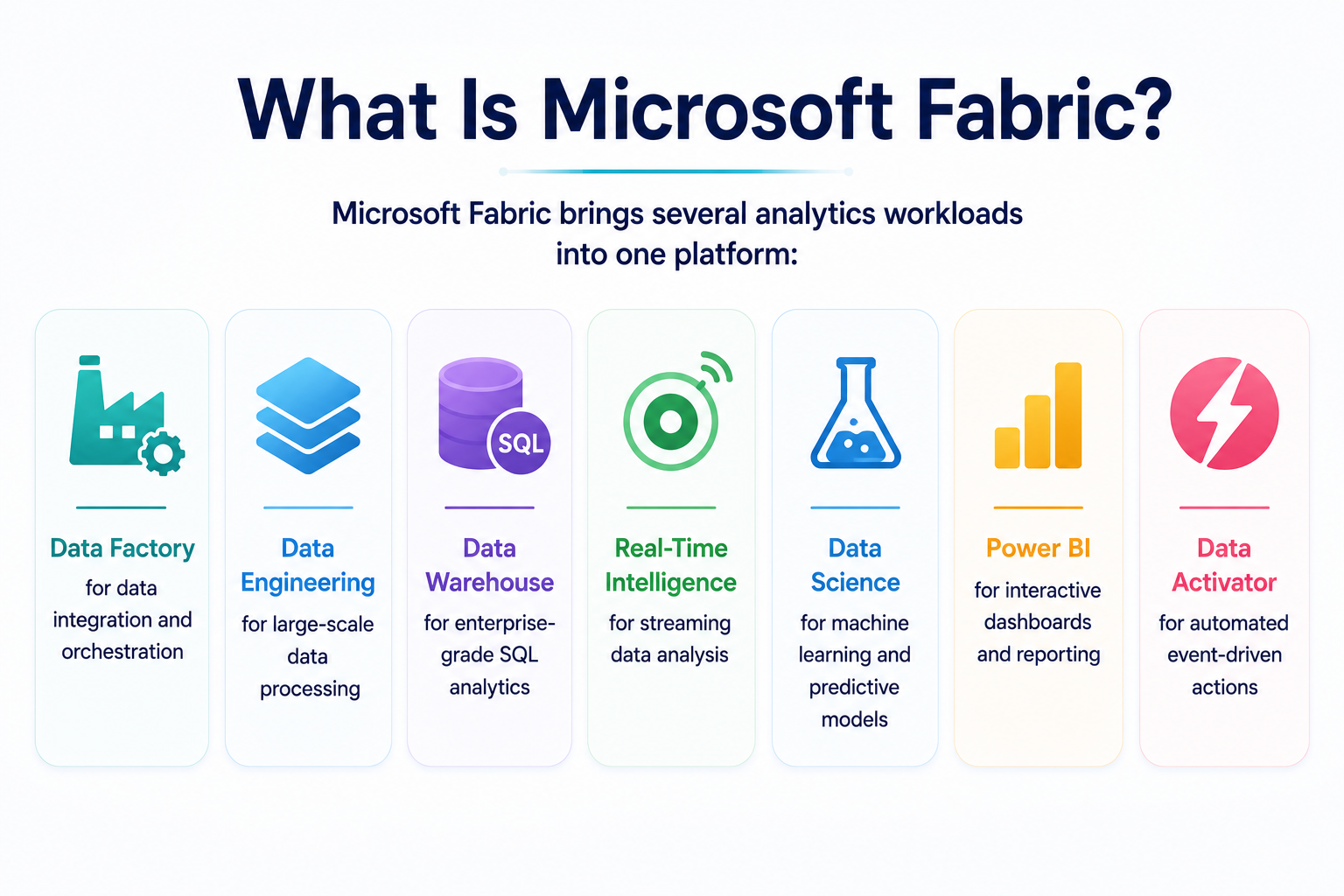
Many organizations compare Microsoft Fabric vs Power BI. Power BI focuses on data visualization and reporting. Microsoft Fabric manages the complete analytics lifecycle before visualization.
In 2026, Microsoft expanded Fabric with Fabric IQ, Fabric Data Agents (GA), and OneLake Security (GA). These capabilities strengthen AI assistance, governed data access, and enterprise-wide security, making the unified data platform Microsoft offers more valuable than ever.
Learn More About Microsoft Fabric
For finance teams, Microsoft Fabric's greatest advantage is better decision quality. Planning, forecasting, consolidation, and scenario modeling require trusted, timely data. Fabric removes reconciliation delays between ERP systems, Excel, and reporting platforms.
Research also supports this challenge. Many finance leaders identify gathering data from multiple systems as a major planning obstacle. Disconnected data slows forecasting, budgeting, and executive decision-making. The prime benefit of Microsoft Fabric for financial services organizations is to offer one platform with multiple capabilities.

Microsoft Fabric for finance teams brings financial and operational data together. General ledger, ERP, CRM, and operational systems share one governed environment. Teams eliminate spreadsheet exports and inconsistent data copies. Decision-makers work from one trusted version of business performance.
Modern FP&A requires more than dashboards. Teams need collaborative planning and scenario modeling. Fabric supports this through Translytical Task Flows, User Data Functions, and evolving Planning capabilities within Fabric IQ. Specialized platforms, including Acterys, extend these features with Excel-native planning, ERP connectors, and enterprise FP&A workflows.
Finance professionals spend less time collecting information from disconnected systems. Automated pipelines continuously refresh financial data across business units. Faster consolidation allows controllers and finance leaders to focus on analysis instead of manual reconciliation.
Business models constantly evolve with new products, markets, and entities. Microsoft Fabric FP&A supports flexible forecasting models without rebuilding entire planning structures. Teams easily incorporate additional dimensions, business drivers, and operational metrics into financial forecasts.
Excel remains essential for finance professionals. Microsoft Fabric preserves familiar spreadsheet workflows while improving data quality. Users continue working with formulas and financial models, while governed enterprise data stays synchronized through the backend. This balance improves adoption without disrupting existing finance processes.
These capabilities explain why Microsoft Fabric adoption continues expanding across CFO organizations, not only IT departments.
Organizations evaluating Microsoft Fabric often need more than platform capabilities, they need a clear strategy for architecture, governance, migration, and implementation. Microsoft Fabric consulting services can help financial services and data teams assess their current environment, identify the right workloads for Fabric, and build a practical roadmap for adoption.
Modern data teams must deliver trusted insights faster while controlling costs and complexity. Microsoft Fabric for data teams simplifies the entire analytics lifecycle through one governed platform. The result is better collaboration, stronger governance, and faster decision-making across the enterprise.
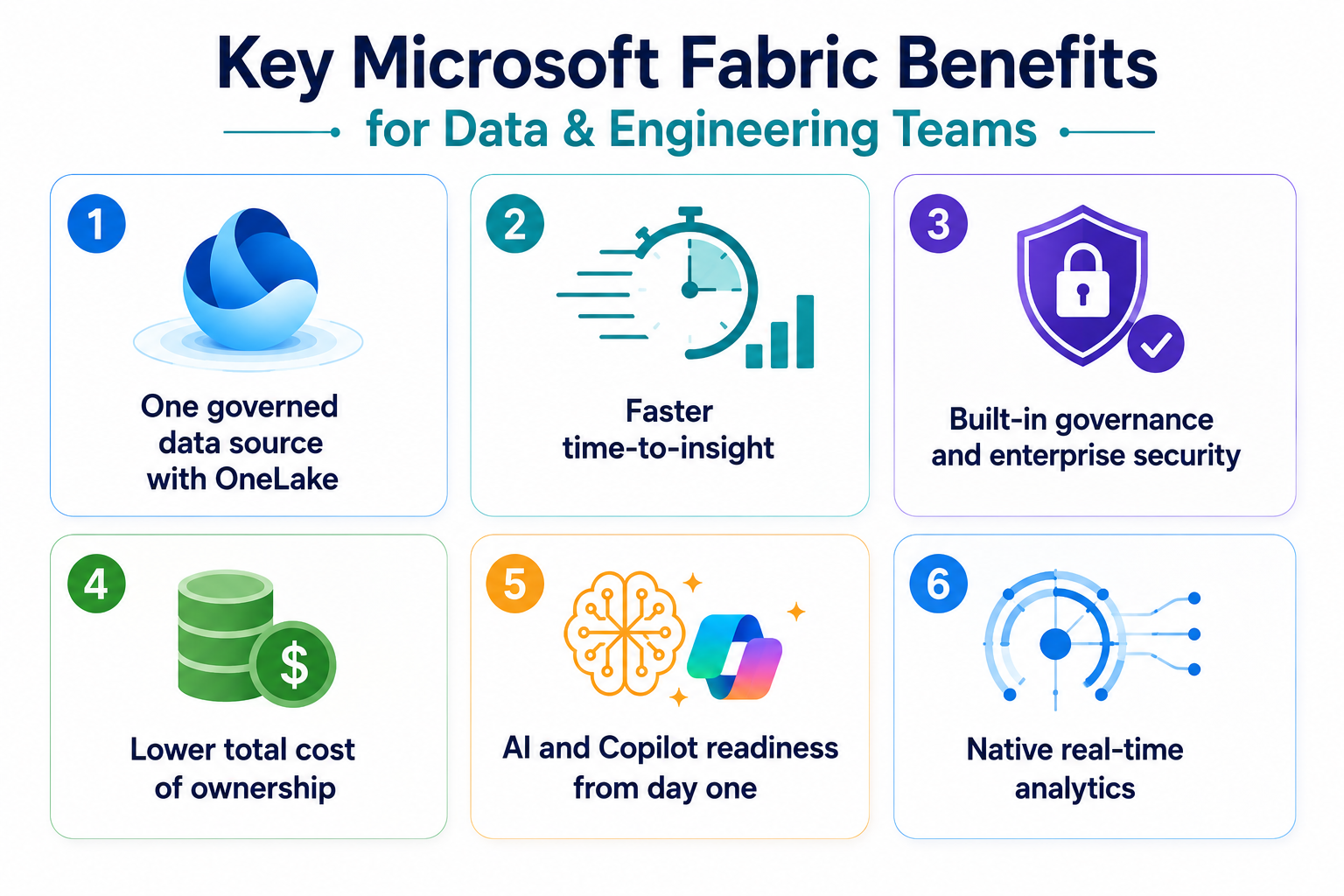
Microsoft Fabric OneLake creates a single, trusted location for enterprise data. Teams stop maintaining duplicate datasets across multiple platforms. Shared data reduces reconciliation work, simplifies governance, and improves consistency across analytics, reporting, and AI initiatives.
Fabric uses shared storage and compute across every analytics workload. Data moves seamlessly between engineering, warehousing, and reporting environments. Microsoft reports its finance organization accelerated insight delivery by approximately 60% after adopting Fabric, reducing reporting delays significantly.
Microsoft Fabric data governance integrates with Microsoft Purview for centralized cataloging and policy management. OneLake Security enables row-level, column-level, and object-level permissions. These controls simplify compliance with standards including GDPR, HIPAA, and BCBS 239 while protecting sensitive business data.
A unified data platform reduces licensing, infrastructure, and operational expenses. Organizations replace multiple integration, storage, analytics, and reporting tools with one SaaS environment. Fewer platforms also reduce maintenance, administration, and support requirements across technical teams.
Governed, high-quality data creates a reliable foundation for enterprise AI. Microsoft Fabric AI capabilities, including Fabric IQ and Fabric Data Agents, access trusted business information directly. Teams avoid lengthy data preparation projects before deploying intelligent assistants and automated workflows.
Microsoft Fabric real-time analytics processes streaming events without separate infrastructure. Teams monitor operational systems, manufacturing assets, financial transactions, and IoT devices continuously. Faster event detection supports fraud prevention, operational monitoring, predictive maintenance, and immediate business response.
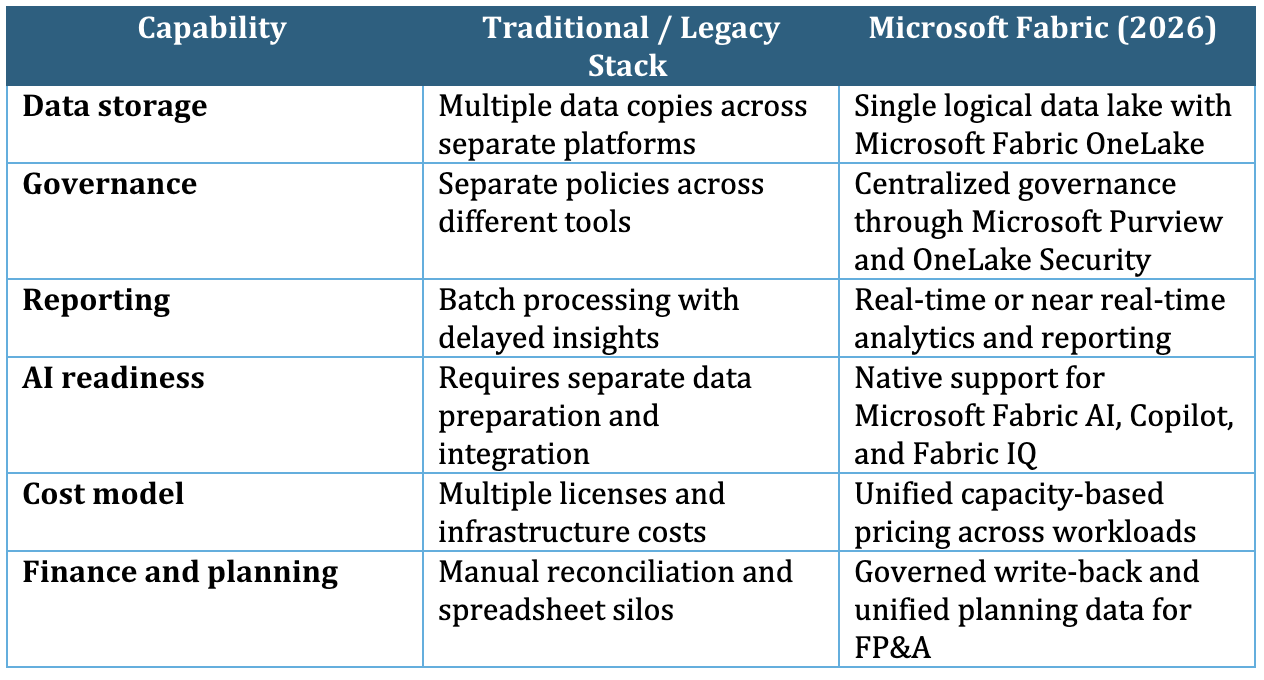
The Microsoft Fabric benefits extend well beyond platform consolidation. However, Fabric is not a set-and-forget solution. Capacity-based pricing requires careful workload monitoring and governance. Poor capacity management can increase operating costs. With proper governance, organizations achieve stronger performance, predictable spending, and higher ROI over time.
Understand The Microsoft Fabric Architecture
For most enterprises, the benefits of Microsoft Fabric outweigh the implementation effort. The platform delivers the greatest value to organizations with fragmented data environments. It also fits businesses already using Azure, Power BI, Dynamics 365, or Microsoft 365.
Fabric uses capacity-based pricing instead of traditional per-user licensing. This model improves scalability but requires disciplined governance. Poor workload scheduling, unmanaged concurrency, and inefficient capacity allocation can increase operating costs.
A readiness assessment is essential before migration. Organizations should evaluate existing data architecture, governance policies, workloads, and business priorities. A phased implementation also reduces migration risk and improves user adoption.
Hexaview helps enterprises assess Fabric readiness and build scalable deployment strategies. The team also optimizes capacity, strengthens governance, and delivers production-ready implementations that maximize long-term ROI while avoiding common deployment challenges.
The Microsoft Fabric benefits extend beyond modernizing analytics infrastructure. Fabric enables data and finance teams to work from one trusted data foundation. That shift improves collaboration, accelerates decision-making, and prepares organizations for enterprise AI.
Data unification through Microsoft Fabric OneLake removes silos and duplicate data pipelines. Built-in governance strengthens security, compliance, and confidence in business decisions. Native AI capabilities, including Copilot and Fabric IQ, transform governed data into actionable insights faster.
As enterprises modernize their analytics strategies, Microsoft Fabric has become a platform for long-term business transformation, not just reporting.
If your organization is evaluating Microsoft Fabric, Hexaview can help. Our experts assess your current environment, define a practical implementation roadmap, and build a governed Fabric platform that delivers measurable value for both data and finance teams.
What is Microsoft Fabric used for?
Microsoft Fabric is a unified analytics platform for managing the complete data lifecycle. It combines data integration, engineering, warehousing, real-time analytics, data science, and Power BI on Microsoft Fabric OneLake. Organizations use it to build trusted analytics, support AI initiatives, and improve enterprise decision-making from one governed platform.
What are the main benefits of Microsoft Fabric for financial services?
The biggest Microsoft Fabric benefits for finance teams include trusted data, faster reporting, and better planning. It unifies ERP, financial, and operational data in one governed environment. This improves forecasting, financial consolidation, scenario modeling, and executive reporting while reducing manual reconciliation.
Does Microsoft Fabric replace Power BI?
No. Microsoft Fabric vs Power BI is not an either-or decision. Power BI remains the business intelligence and visualization layer within Microsoft Fabric. Fabric extends beyond reporting by adding data engineering, integration, warehousing, governance, real-time analytics, and AI capabilities.
Is Microsoft Fabric secure and compliant for regulated industries?
Yes. Microsoft Fabric data governance includes Microsoft Purview integration and OneLake Security for centralized access control. Organizations can implement row-level, column-level, and object-level permissions. These capabilities help support compliance with regulations such as GDPR, HIPAA, and industry-specific governance frameworks.
How much does Microsoft Fabric cost?
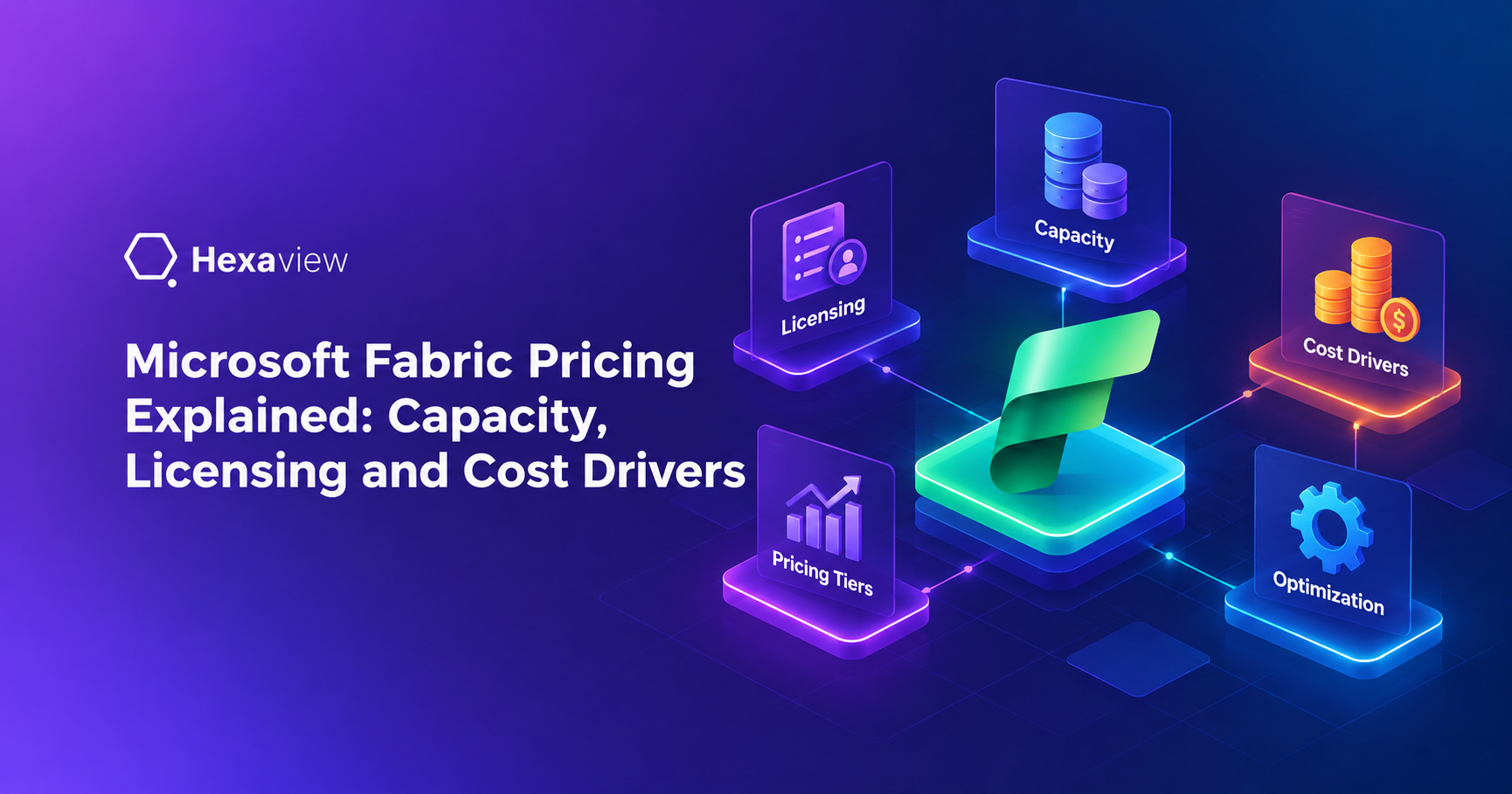
Microsoft Fabric uses a capacity-based pricing model instead of per-user licensing. Organizations purchase shared compute capacity that supports multiple workloads across the platform. Total cost depends on workload size, concurrency, storage requirements, and governance practices, making capacity planning an important part of implementation.
How is Microsoft Fabric different from a traditional data warehouse?
A traditional data warehouse focuses primarily on storing and querying structured data. Microsoft Fabric combines data integration, engineering, warehousing, business intelligence, real-time analytics, AI, and governance within one SaaS platform. This unified architecture reduces data movement, simplifies management, and accelerates analytics across the enterprise.
Can Microsoft Fabric support AI and Copilot use cases?
Yes. Microsoft Fabric AI capabilities are built on governed enterprise data stored in OneLake. Features such as Fabric IQ and Fabric Data Agents help users discover insights, automate analysis, and interact with business data using natural language. This enables organizations to deploy AI solutions without creating separate analytics environments.






.svg)


.svg)