
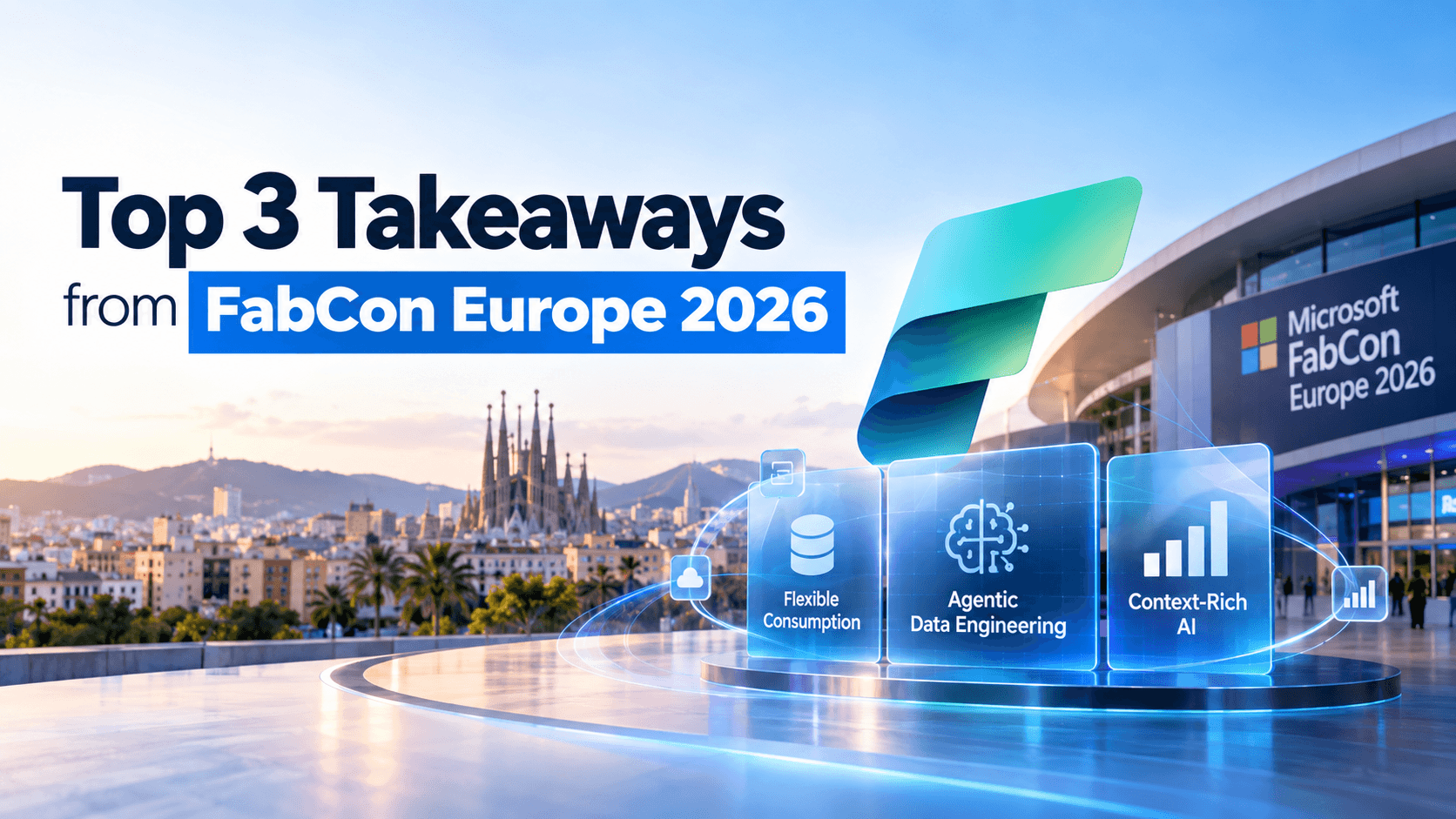
FabCon Europe 2026 highlighted Microsoft’s broader shift toward a more flexible, agent-ready Fabric platform. F0 and on-demand billing reduce upfront capacity commitments and align compute costs with actual usage. Fabric data engineering agents can plan, execute, validate, and refine complex engineering work. Fabric IQ connects governed data with business context, giving AI and agents a shared understanding of enterprise information.
FabCon Europe 2026 took place in Barcelona from September 28 to October 1, bringing together data professionals around Microsoft Fabric, SQL, analytics, AI, and data engineering. Microsoft positioned the event around a critical enterprise challenge: building the trusted data foundation required for Microsoft Copilot and AI agents.
The announcements went beyond individual Fabric features. Microsoft emphasized connecting data across systems, preparing it for analytics, adding business context, and making it usable by AI agents. OneLake, Data Factory, Fabric IQ, data agents, real-time intelligence, and governance all formed parts of this broader architecture.
The key shift is from analytics platforms toward data-to-AI platforms. Fabric is increasingly bringing data engineering, analytics, governance, semantic context, and AI capabilities together, giving enterprises a foundation where data can support both human decisions and intelligent agents.
One of the practical changes highlighted at FabCon Europe 2026 is Fabric zero-provisioned capacity, known as F0. Microsoft describes it as a way to get started with Fabric and OneLake without an upfront capacity commitment. This differs from the traditional model, where organizations provision a Fabric capacity with a defined compute tier.
That distinction matters for teams still evaluating Fabric. Instead of committing capacity before workload patterns are clear, organizations can use F0 as an entry point for evaluation, development, and early workloads. Microsoft positions the capability as part of a broader move toward flexible capacity options.
Microsoft is also expanding on-demand billing across Fabric workloads. The model allows supported workloads to consume compute based on actual usage rather than relying entirely on a fixed provisioned capacity. Microsoft says resources can scale according to demand, helping organizations align infrastructure spending more closely with workload patterns.
This can be particularly relevant for proof of concept, development environments, bursty workloads, and teams that are still measuring their Fabric requirements. It also gives enterprises another option alongside standard capacity and longer-term purchasing models.
For enterprises, the significance extends beyond pricing. A lower-commitment entry point can make it easier to test Fabric, run departmental pilots, validate migration plans, and measure workloads before making larger capacity decisions.
Key takeaway: Fabric's commercial model is becoming more flexible, giving organizations another way to approach adoption and experimentation.
FabCon Europe 2026 introduced the Fabric data engineering agent, currently in preview. Built from technology acquired through Microsoft’s Osmos acquisition, it targets complex, long-running engineering work rather than simple coding assistance.
Engineers can define an outcome and set guardrails. The agent can then work across tasks such as data migrations, lakehouse modernization, ETL, performance optimization, and data preparation. It can create or update Fabric artifacts, validate results, and refine its approach.
The key difference is the level of execution.
Traditional AI assistance → Suggests code, explains errors, or answers questions.
Agentic data engineering → Plans work, executes steps, validates outcomes, and adjusts the approach within defined boundaries.
Microsoft says the agent is designed for persistent tasks that can run over hours or days. However, this does not remove the need for human oversight. Permissions, guardrails, validation, and organizational controls remain important.
For engineering teams, this could reduce repetitive work and accelerate modernization projects. Engineers can spend more time defining architecture, reviewing results, resolving exceptions, and governing automated workflows.
The shift is therefore less about replacing engineers and more about changing how engineering work gets directed and managed.
Key takeaway: Agentic capabilities are moving data engineers from executing every step manually toward directing, validating, and governing intelligent workflows.
Enterprise AI can access large volumes of data, but raw data does not provide business meaning. A metric such as “revenue” can carry different definitions across finance, sales, and operations. Without shared definitions, relationships, and rules, AI systems can produce answers that miss important context.
Microsoft describes Fabric IQ as a way to elevate enterprise data into the language of the business, helping people and agents reason using business concepts and objectives.
Fabric IQ connects three important layers: OneLake data, Power BI semantic models, and ontologies. Ontologies describe business entities, properties, relationships, rules, and actions. This creates a shared context layer for analytics and AI.
That context can support Copilot, Fabric data agents, AI agents, and custom applications. Microsoft is also integrating Fabric IQ context with Copilot and expanding its use across agent experiences.
The larger shift is toward context-aware enterprise AI. Better models alone do not solve problems caused by inconsistent definitions or disconnected business data. AI also needs trusted information, semantic meaning, relationships, and governance.
For organizations planning enterprise AI, this makes data architecture and business semantics increasingly important.
Key takeaway: The future of enterprise AI depends on connecting models with trusted data and business context.
The three developments point to a broader shift in how Microsoft is positioning Fabric.
F0 and flexible consumption make it easier for organizations to start experimenting with Fabric without committing to traditional provisioned capacity from the outset. This can support pilots, development, and early adoption.
↓
Fabric data engineering agents build on that foundation by helping teams automate parts of complex engineering work. Instead of manually executing every step, engineers can increasingly define goals, provide guardrails, and validate the resulting work.
↓
Fabric IQ adds another layer by connecting enterprise data with business meaning. OneLake data, semantic models, metrics, and ontologies can provide richer context for AI agents and applications.
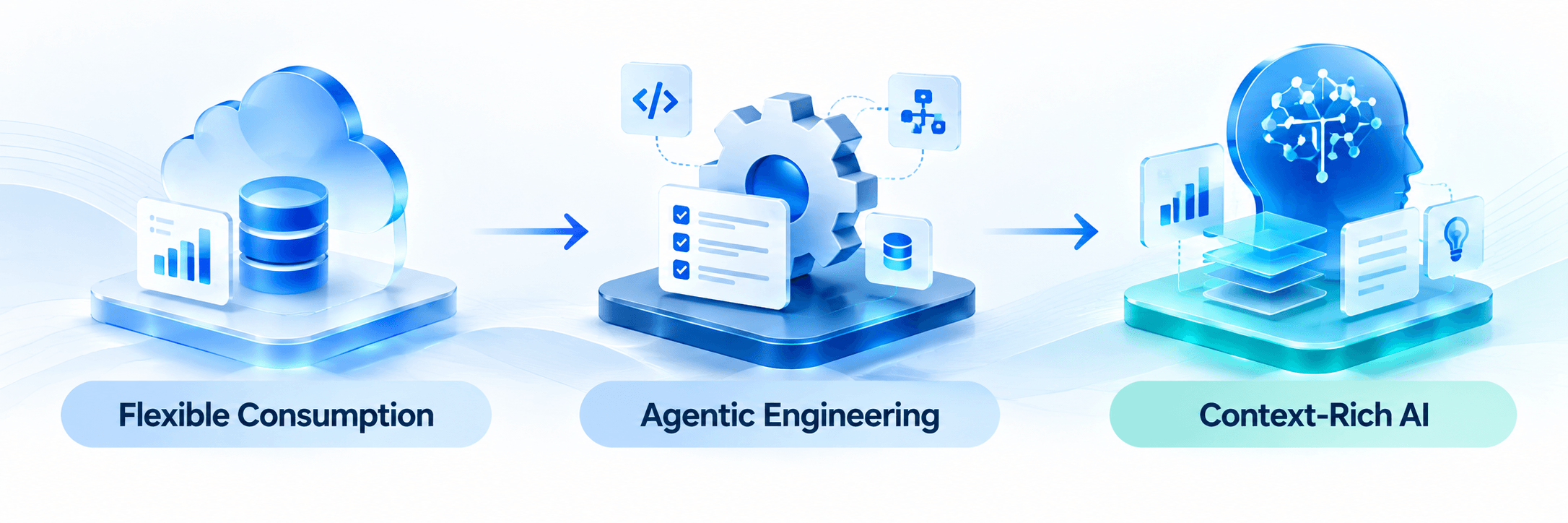
Together, these developments show Fabric evolving beyond a collection of analytics workloads. Microsoft is building a broader data-to-AI platform, where organizations can access data flexibly, engineer it with greater automation, and make it more useful to AI.
FabCon Europe 2026 showed three connected directions for Microsoft Fabric: more flexible consumption, more agentic engineering, and more context-aware AI. For enterprise teams, the next phase of Fabric adoption will involve connecting these capabilities with sound architecture, strong governance, and clearly defined business requirements.





.svg)



.svg)