
Salesforce Headless 360 makes Salesforce capabilities accessible beyond its traditional user interface. It exposes business logic, data, and workflows through APIs, Model Context Protocol (MCP) tools, and CLI commands. This allows applications, developers, and AI agents to interact with Salesforce securely. By combining Agentforce, Data 360, MuleSoft, and governed integrations, enterprises can build connected experiences across multiple channels. The approach supports faster development, reusable integrations, consistent customer experiences, and AI-driven business operations.
Salesforce Headless 360 is an architectural approach that makes Salesforce capabilities accessible through APIs, MCP tools, and command-line interfaces rather than relying only on its traditional user interface.
Introduced on April 15, 2026, Salesforce Headless 360 reflects the platform's shift towards agentic enterprise architecture. It allows authorized applications and AI agents to discover and use Salesforce capabilities across different environments.
Traditionally, employees interacted with Salesforce through Lightning pages, dashboards, and Experience Cloud interfaces. Developers also built external applications using Salesforce APIs. However, AI agents introduce another way to access enterprise systems.
With Headless 360, the interface becomes optional for many workflows. Business capabilities can operate independently of the screen displaying them.
The architecture brings together three important elements:
The Headless Experience Layer also supports rich, native interactions across different digital surfaces. This helps organizations deliver consistent functionality without rebuilding business logic for every interface.
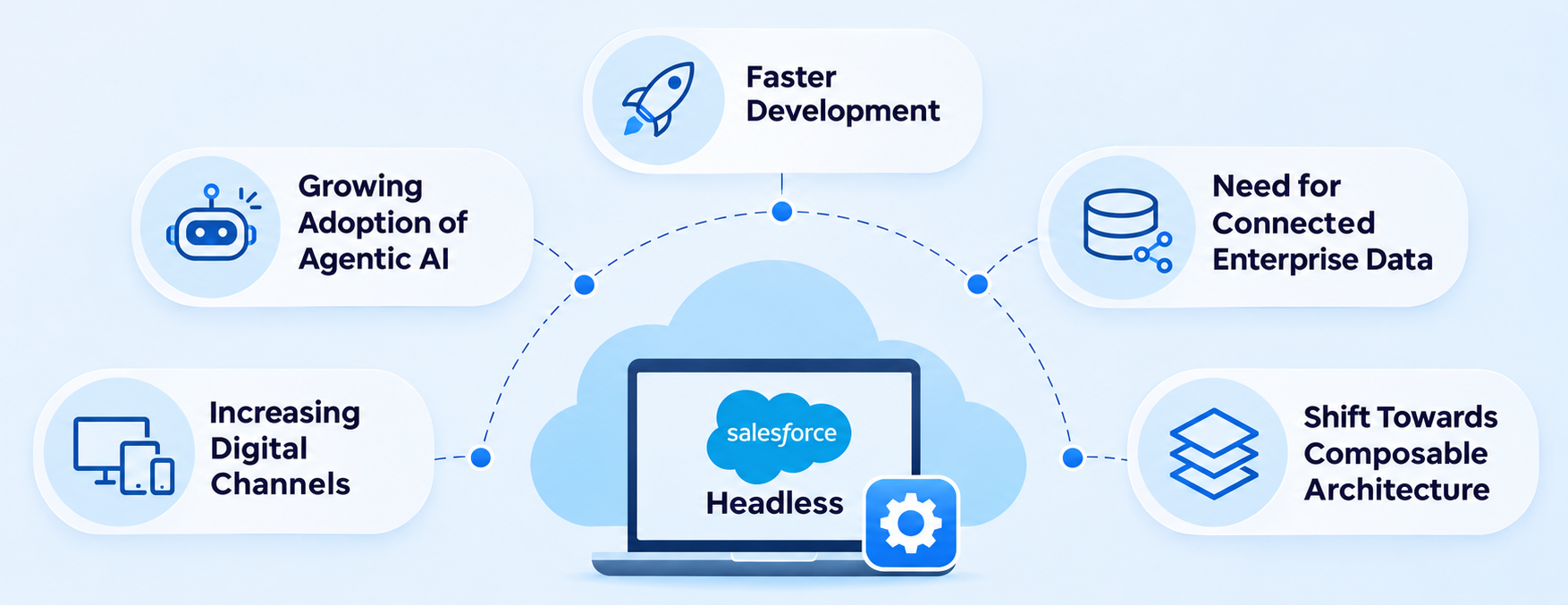
Customer expectations and enterprise technology requirements are changing. Businesses need systems that support different channels, connected data, and autonomous AI workflows.
Five major developments explain this shift.
Customers interact with businesses through websites, mobile applications, messaging platforms, kiosks, and contact centers. Managing each channel independently creates duplicated integrations and inconsistent customer information.
A headless Salesforce architecture allows multiple channels to access shared business capabilities. This reduces repeated development and supports consistent experiences.
AI agents increasingly need to retrieve information, understand business context, and complete operational tasks. Agentforce supports AI-powered workflows within Salesforce. Headless 360 extends access to Salesforce capabilities through APIs and MCP tools.
Consequently, authorized agents can interact with business processes without depending on traditional browser-based navigation.
Traditional application development can involve tightly connected frontend and backend components. Changing one interface may require additional testing across several connected components.
Headless architecture separates presentations from business logic. Development teams can update interfaces without unnecessarily changing backend services.
Customer information often exists across CRM platforms, ERP systems, warehouses, and external applications. Disconnected information limits personalization and creates operational delays.
Salesforce Data 360 helps connect, harmonize, and unify information from different sources. This provides trusted context for applications, analytics, and AI agents.
Enterprises increasingly need reusable services rather than isolated application integrations. API-led connectivity supports this approach.
Teams can develop capabilities once and reuse them across multiple applications and workflows.
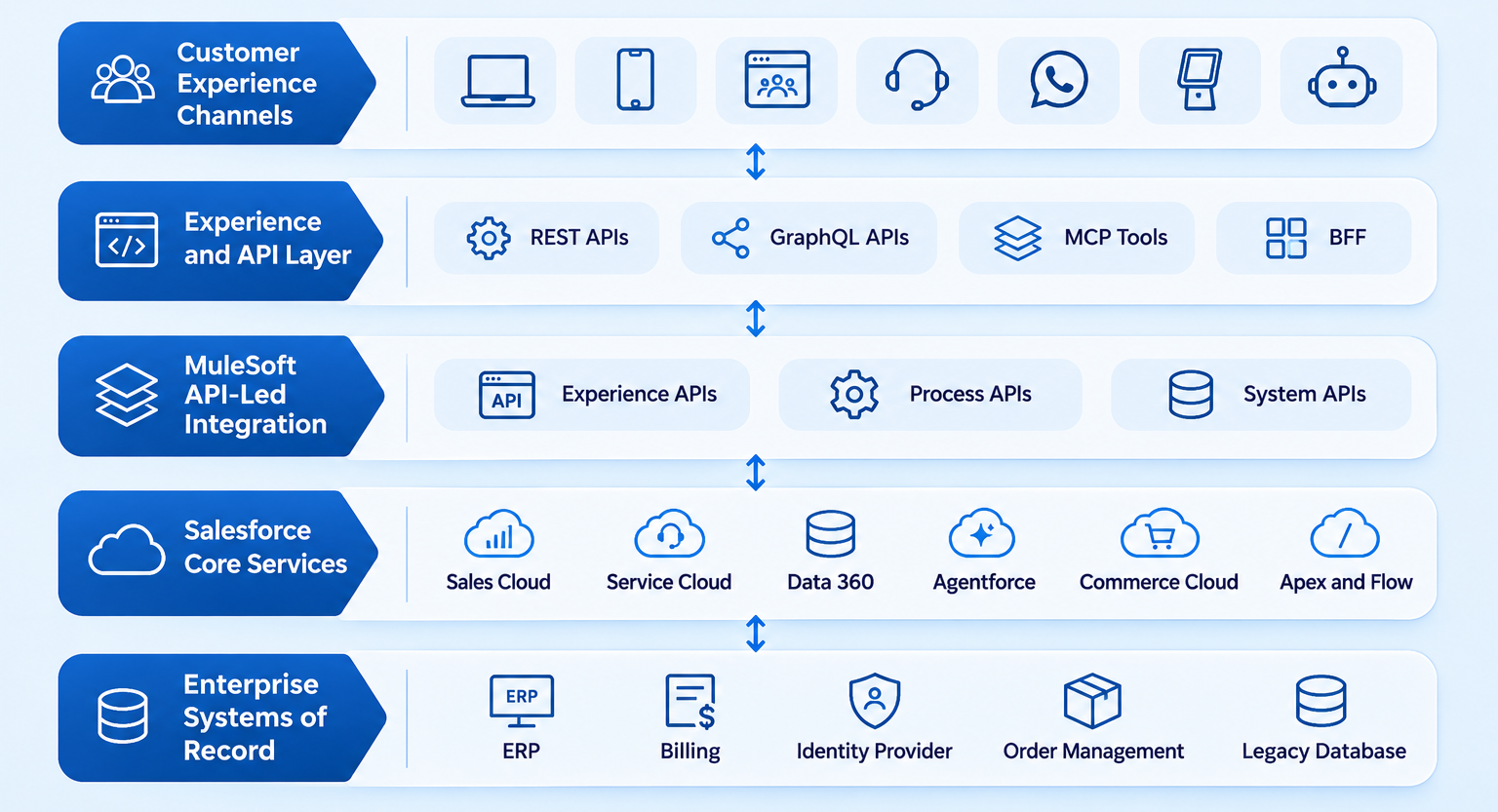
A successful Salesforce Headless 360 implementation requires clearly defined architectural responsibilities.
The following reference architecture builds on the original whitepaper's five-layer model.
This layer includes every interface through which customers, employees, partners, or AI agents interact with enterprise services.
Examples include:
Each channel accesses the required business capabilities through authorized interfaces.
The experience layer connects individual channels with backend capabilities. It can include REST APIs, GraphQL APIs, MCP tools, and backend-for-frontend (BFF) patterns.
For example, a mobile application may need customer details, account information, and recent transactions.
Its experience API can combine the required information into one response. Other applications can consume the same underlying business capabilities differently.
MuleSoft provides an integration approach that organizes APIs into three categories.

System APIs provide access to individual systems. Process APIs coordinate information and business logic. Experience APIs shape the information for specific consumers.
This structure supports API reuse and reduces duplicated integration work.
This layer contains the primary Salesforce capabilities and business logic.
Important components include:
These services remain responsible for business records, processes, permissions, and operational workflows.
Most enterprises continue using several systems alongside Salesforce. These may include ERP platforms, billing applications, identity providers, order management systems, and legacy databases.
System APIs connect these platforms with Salesforce and other enterprise applications. Together, these five layers provide a reusable foundation for connected digital experiences.
Salesforce Data 360, formerly known as Data Cloud, provides the data foundation for connected customer experiences.
It brings together information from Salesforce applications, external platforms, and streaming sources. It also supports identity resolution, data harmonization, and activation.
Its major capabilities include:
These capabilities help connect customer information with enterprise workflows.
For example, a financial services company can combine customer profiles, transaction information, and service history. Its mobile application, contact center, and AI agent can then use relevant information through governed services. This improves consistency while reducing fragmented customer experiences.
Agentforce and Model Context Protocol are important parts of the Salesforce Headless 360 strategy.
Agentforce enables businesses to deploy AI agents for tasks such as customer support, lead qualification, and workflow execution. MCP provides a standardized way for compatible AI clients to discover and interact with external tools and services. Together, these capabilities support a more flexible approach to enterprise automation.
Consider a customer requesting an update on an insurance claim.
An AI agent could retrieve the relevant claim information, check its current status, and provide an update through an authorized channel. The same underlying business capabilities can support employees, applications, and AI agents.
However, access must remain controlled. Salesforce uses authenticated identities, permissions, sharing rules, and other governance controls across its supported access methods.
This is particularly important when AI agents can execute actions rather than simply retrieve information.

The most important benefits include:
These outcomes depend on implementation quality, API design, governance, and existing system maturity.
Different industries can apply headless architecture to improve customer and operational experiences.
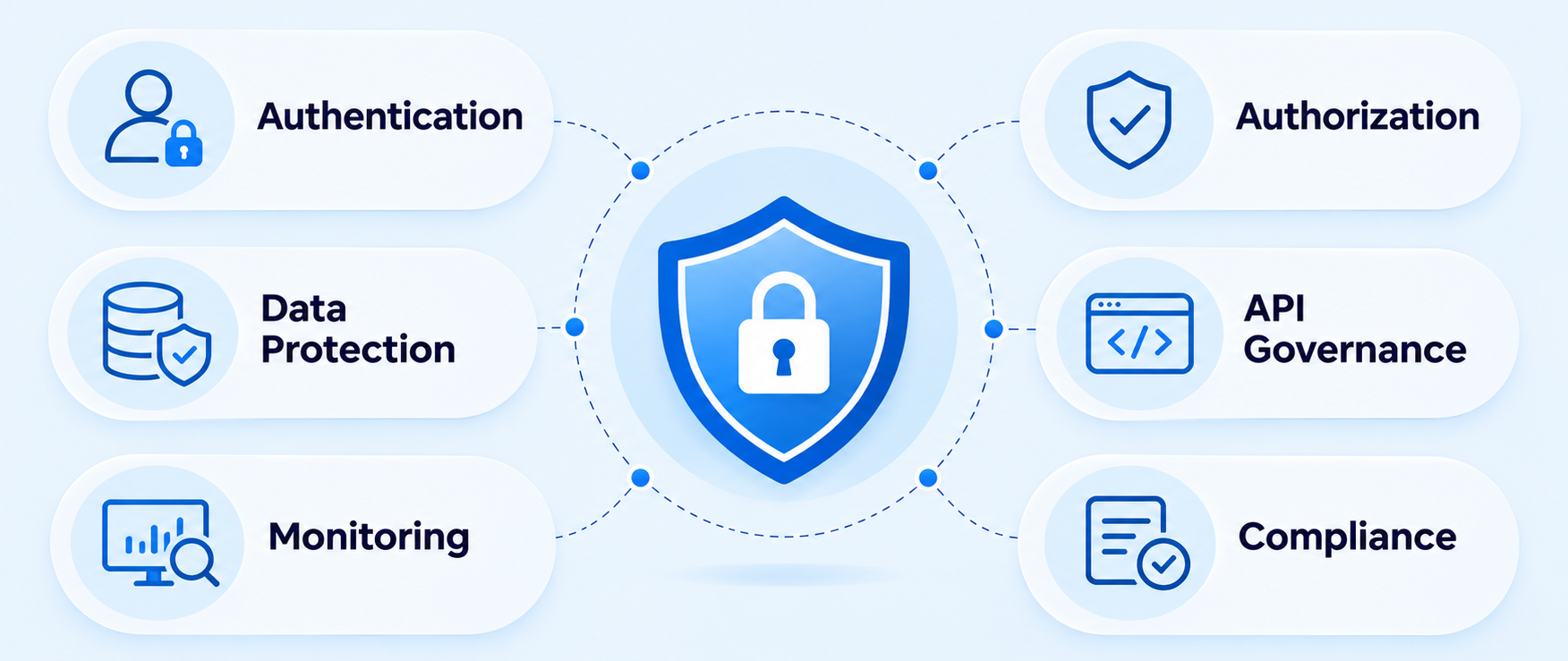
Headless architecture increases the number of systems that can access enterprise capabilities. Therefore, security must be included from the beginning.
Organizations should consider these controls:
An important 2026 consideration is Salesforce's external client app direction. Salesforce restricted the creation of new connected apps in Spring '26 and recommends external client apps for new integrations.
AI agents should also operate with clearly scoped permissions. An agent should never receive broader access than its intended business responsibilities require.
Although Salesforce Headless 360 offers architectural flexibility, implementation requires careful planning.
1. Fragmented enterprise data: Different systems may contain inconsistent customer records. Organizations should establish data quality rules and identity resolution before activating unified profiles.
2. Legacy integration complexity: Connecting older applications can require additional integration work. Start with important business domains rather than connecting every system immediately.
3. Governance requirements: More API consumers create additional security responsibilities. Establish access policies, ownership, and monitoring before expanding integrations.
4. Organizational readiness: Teams accustomed to application-specific development may need new processes. Establish a dedicated platform team responsible for API standards and reusable capabilities.
5. AI reliability: AI agents can retry actions or execute workflows in unexpected sequences. Design critical operations with idempotency, validation, approval controls, and appropriate testing.
A phased implementation reduces architectural risks and makes progress easier to measure.
Organizations should test integrations in sandbox environments before production deployment.

Headless 360 does not mean organizations must abandon Salesforce's existing interface. Lightning applications, dashboards, and existing workflows can continue operating. The architecture expands how Salesforce capabilities are accessed.
Enterprise software is moving towards environments where humans and AI agents work together.
Salesforce Headless 360 supports this direction by making business capabilities accessible through different interfaces and protocols. Data 360 provides connected information; Agentforce supports intelligent actions, and MuleSoft helps integrate enterprise systems.
The Headless Experience Layer further supports experiences across web, mobile, messaging, and other digital surfaces. For enterprises, the opportunity is not simply replacing traditional CRM interfaces. It is making existing business capabilities reusable across the organization.
Businesses that establish strong API foundations, reliable data, and effective governance will be better prepared for agentic workflows. Salesforce Headless 360 represents an important architectural shift towards a more connected, accessible, and AI-ready enterprise.
Adopting Salesforce Headless 360 requires more than connecting APIs. Enterprises need a well-planned architecture that brings together customer data, integrations, AI capabilities, and security.
Hexaview Technologies helps enterprises approach Salesforce modernization through technology consulting, integration, and digital transformation expertise.
With the right implementation strategy, organizations can:
From architecture planning to implementation, Hexaview can help businesses evaluate their Salesforce environment and identify practical modernization opportunities.
Planning your Salesforce Headless 360 journey? Connect with Hexaview Technologies to discuss your enterprise integration and Salesforce modernization requirements.
Salesforce Headless 360 exposes Salesforce capabilities through APIs, MCP tools, and CLI commands for applications and authorized AI agents.
No. Existing Lightning applications remain available. Headless 360 expands access beyond traditional Salesforce interfaces.
Agentforce uses Salesforce business context and capabilities to support AI-driven tasks, automation, and customer interactions.
Data 360 connects and unifies enterprise information, providing trusted customer context for applications, workflows, and AI agents.
MuleSoft supports reusable System, Process, and Experience APIs, connecting Salesforce with external enterprise applications.
Yes. It supports complex enterprise environments requiring connected applications, reusable integrations, governed AI access, and multiple customer channels.
Yes. Salesforce Headless 360 uses Model Context Protocol to make Salesforce capabilities accessible to compatible AI clients.