
Microsoft Fabric implementation service providers help businesses plan, deploy, migrate, and optimize their data and analytics environments. Providers to evaluate in the USA include Hexaview Technologies, Accenture, Avanade, Cognizant, Capgemini, EPC Group, Neudesic, Kanerika, Pragmatic Works, and 3Cloud. The right partner depends on your existing data platforms, migration requirements, governance needs, implementation scope, and internal expertise. Verify current service offerings and project experience before making a final decision.
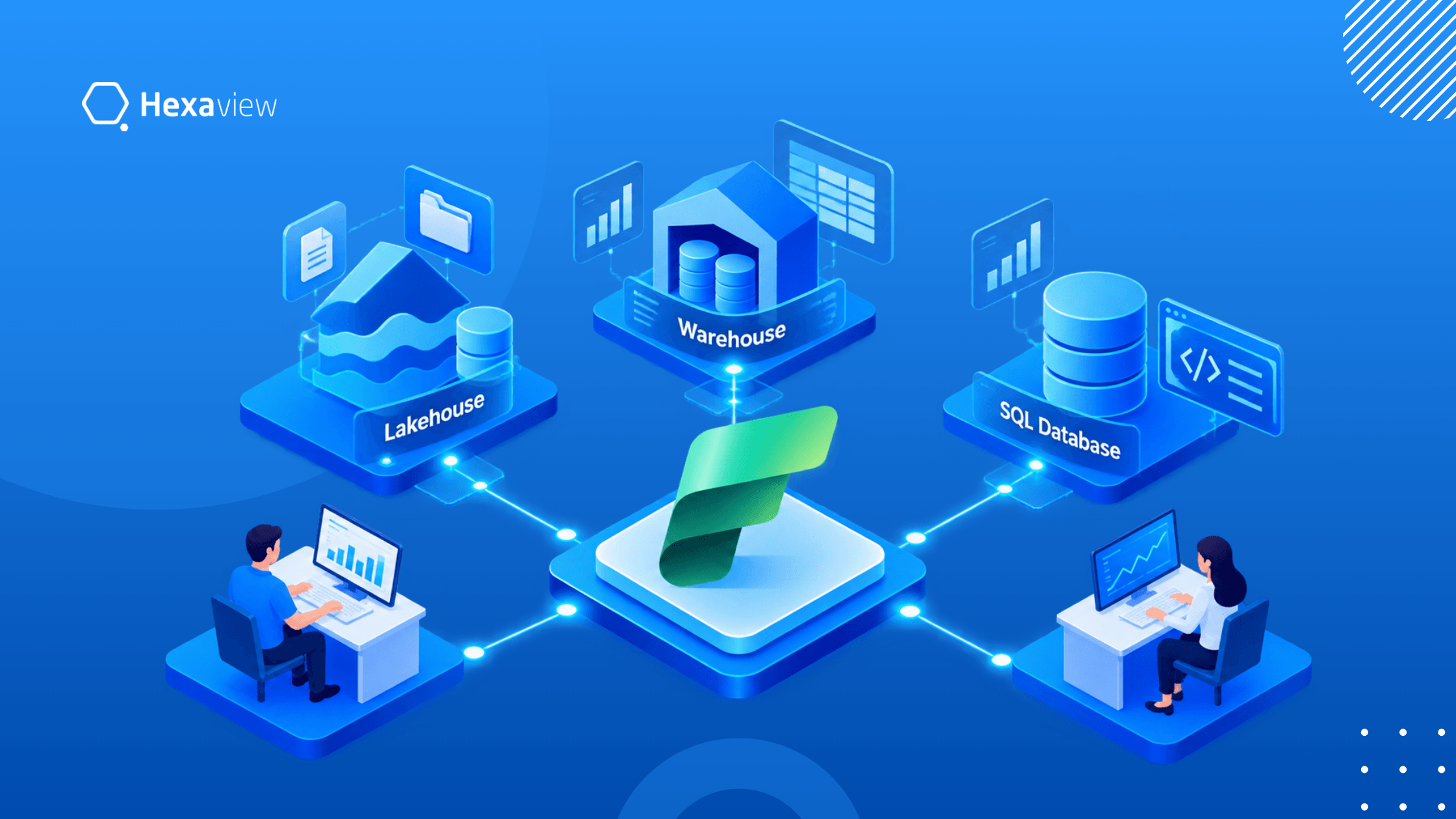
Microsoft Fabric brings data engineering, data integration, warehousing, real-time analytics, and Power BI into one analytics platform. However, adopting it requires more than moving data into a new environment. Enterprises often face fragmented data sources, legacy platforms, complex migrations, and inconsistent governance across departments.
The right implementation partner helps address these challenges through architecture planning, data engineering, security configuration, testing, and user adoption. A well-planned implementation can improve data accessibility, support reliable reporting, and establish a scalable foundation for analytics.
Choosing among Microsoft Fabric Implementation Service Providers requires evaluating technical expertise, migration experience, industry knowledge, and delivery capabilities. This guide examines ten providers.
These companies serve US clients, although not all are headquartered in the United States. The comparison considers documented capabilities, relevant services, and potential suitability for enterprise requirements. It is not an independently audited ranking. Instead, it helps decisionmakers evaluate Microsoft Fabric Implementation Services and identify providers worth shortlisting their specific business needs.

Selecting a Microsoft Fabric implementation partner requires evaluating technical expertise, delivery experience, and long-term support. A provider’s overall reputation alone does not establish its suitability for a specific Fabric project. Therefore, this guide considers several practical factors to help enterprises compare providers against their requirements.
The evaluation criteria include:
The research draws on official company websites, Microsoft partner resources, published customer case studies, and technical documentation. Microsoft’s partner directory provides an additional reference for assessing relevant consulting and implementation offerings.
The providers below differ in scale, technical specialization, industry focus, and delivery models. Some offer broad enterprise transformation services, while others emphasize data engineering, analytics modernization, or Microsoft-focused consulting. The best fit depends on your existing data environment, migration complexity, governance requirements, and internal team's capabilities.
Hexaview Technologies provides Microsoft Fabric Implementation Services for organizations moving from fragmented analytics environments to a unified data platform. Its official service page describes an end-to-end delivery approach, covering architecture planning, workspace and capacity setup, OneLake configuration, data pipeline development, migration, testing, and production deployment. The company also states that it has delivered Fabric implementations for US-based teams.
Its documented migration services include Azure Data Factory, SQL Server, and Alteryx. The company also describes Power BI integration, lakehouse and warehouse development, security configuration, data validation, and post-launch monitoring. Its published implementation process includes capacity planning, testing, deployment, and operational handover.
Hexaview also publishes a case study involving enterprise reporting modernization for a wealth and trust management client. The project describes a Microsoft Fabric lakehouse, Power BI Direct Lake reporting, CI/CD automation, and governance controls using Microsoft Entra ID, Azure Key Vault, and Microsoft Purview. The company reports reduced legacy platform costs and improved reporting turnaround, although these results should be validated against the client's own requirements.
Best fit: Financial services, wealth management, and other data-intensive organizations migrating legacy analytics workloads or building governed reporting environments.
Accenture is a global consulting and technology services company with extensive Microsoft ecosystem expertise. Its capabilities span cloud integration, data modernization, analytics, and artificial intelligence. These services support enterprises implementing Microsoft Fabric as part of broader digital transformation initiatives.
Accenture can help organizations modernize legacy data platforms, integrate complex data environments, and establish scalable analytics architectures. Its experience managing large transformation programs makes it a potential fit for enterprises with multiple business units and demanding technical requirements.
Best fit: Large organizations seeking Microsoft Fabric implementation alongside enterprise-wide data modernization and AI initiatives.
Avanade specializes in Microsoft-focused consulting, cloud modernization, and enterprise data solutions. Its Microsoft Fabric services cover data platform modernization, migration, analytics, governance, and adoption.
The company has hands-on Fabric experience, having implemented the platform within its own data environment and supported customer deployments. Microsoft’s published case studies document Avanade’s work integrating Fabric with existing data systems and Power BI. One food manufacturer engagement focused on simplifying data infrastructure while retaining existing technologies.
Avanade also emphasizes employee training, knowledge transfer, and governance to support sustained adoption.
Best fit: Enterprises prioritizing Microsoft platform alignment, complex data modernization, and organization-wide analytics adoption.
Cognizant provides enterprise IT consulting, cloud services, and data modernization solutions. Its dedicated Microsoft Fabric migration services help organizations migrate and configure Fabric while modernizing data integration, business intelligence, and analytics workloads.
Its offerings cover migration from legacy platforms, OneLake architecture, data ingestion, preparation, modeling, and Power BI integration. Cognizant also offers proof-of-concept engagements, implementation support, training, and managed services. Its Microsoft partnership supports organizations with complex enterprise systems and large data environments.
Best fit: Enterprises seeking structured Microsoft Fabric adoption, legacy data platform migration, and ongoing analytics support.
Capgemini provides enterprise data transformation, cloud integration, and analytics services through its longstanding Microsoft partnership. Its Microsoft Fabric offerings include consulting, migration pathways, data engineering, and platform modernization.
A Microsoft-published case study describes Capgemini's work with a US manufacturing company to consolidate fragmented data sources using Fabric. The implementation established a unified data architecture and supported more accessible reporting across business departments.
Capgemini also offers Fabric workshops and data engineering solutions for organizations modernizing complex data environments. Its industry experience spans manufacturing, financial services, retail, telecommunications, and consumer goods.
Best fit: Enterprises pursuing large-scale analytics modernization, cross-platform integration, and governed data environments.
EPC Group specializes in Microsoft-focused consulting, enterprise data platforms, and cloud solutions. Its Microsoft consulting practice supports organizations planning data architecture, platform modernization, and analytics integration.
For Microsoft Fabric projects, buyers should evaluate its proposed capabilities across OneLake architecture, data engineering, lakehouse and warehouse development, Power BI integration, and migration planning. The scope should reflect the organization's existing infrastructure and reporting requirements.
EPC Group may suit businesses seeking a Microsoft-oriented consulting partner for enterprise technology initiatives. Its relevance depends on the specific Fabric services offered, the proposed implementation team's experience, and the complexity of the project.
Best fit: Organizations seeking specialized Microsoft consulting for data platform modernization and analytics integration.
Neudesic provides Microsoft-focused technology consulting, with capabilities spanning cloud engineering, data solutions, and enterprise application modernization. Its Microsoft ecosystem expertise makes it relevant to organizations evaluating data platform improvements.
For a Fabric engagement, businesses should assess its current service scope for data engineering, migration, analytics modernization, and integration with Azure workloads. Architecture planning, deployment methods, security controls, and Power BI integration should also form part of the evaluation.
Neudesic may be suitable for enterprises already invested in Microsoft technologies and seeking support for connected cloud and data initiatives. Buyers should verify current Fabric-specific credentials, production deployment references, and the experience of the proposed delivery team.
Best fit: Enterprises seeking Microsoft cloud consulting and data modernization expertise.
Kanerika provides data engineering, analytics, and data platform consulting services. Its focus on data modernization makes it relevant to organizations evaluating Microsoft Fabric for consolidated analytics and improved data workflows.
Potential implementation requirements include data integration, pipeline development, migration planning, lakehouse architecture, and reporting modernization. Businesses should assess how Kanerika's proposed approach addresses governance, security, performance, and operational requirements within their existing environment.
Kanerika may suit organizations seeking a data-focused consulting partner to modernize analytics infrastructure. Before selecting the company, enterprises should review documented Fabric projects, clarify the implementation team's technical responsibilities, and confirm the availability of ongoing support.
Best fit: Organizations modernizing data engineering pipelines and enterprise analytics environments.
Pragmatic Works specializes in Microsoft data technologies, analytics consulting, and technical training. Its experience in the Microsoft data ecosystem makes it relevant to organizations planning Fabric adoption alongside Power BI and other Microsoft analytics tools.
Businesses evaluating its services should examine its current Fabric implementation offerings, including data migration, engineering, architecture, and deployment support. Training and knowledge transfer can also help internal teams understand new workflows and maintain the platform after implementation.
Pragmatic Works may suit organizations that need technical guidance alongside internal skills development. Buyers should distinguish hands-on implementation services from training and advisory engagements when defining project scope.
Best fit: Organizations combining Microsoft data implementation with employee training and technical enablement.
3Cloud provides Microsoft Azure consulting, cloud engineering, and data platform services. Its Microsoft-focused capabilities make it relevant to enterprises modernizing Azure-based infrastructure and connecting existing data workloads.
For Microsoft Fabric projects, organizations should evaluate its current implementation scope across architecture, migration, data engineering, analytics integration, and deployment. Compatibility with existing Azure services, data warehouses, and Power BI environments can be important when planning the transition.
3Cloud may suit businesses seeking a Microsoft cloud specialist to modernize data infrastructure. Its suitability depends on verified Fabric production experience, the availability of experienced implementation professionals, and the level of post-launch support included in the engagement.
Best fit: Enterprises modernizing Azure data environments and integrating Microsoft analytics technologies.
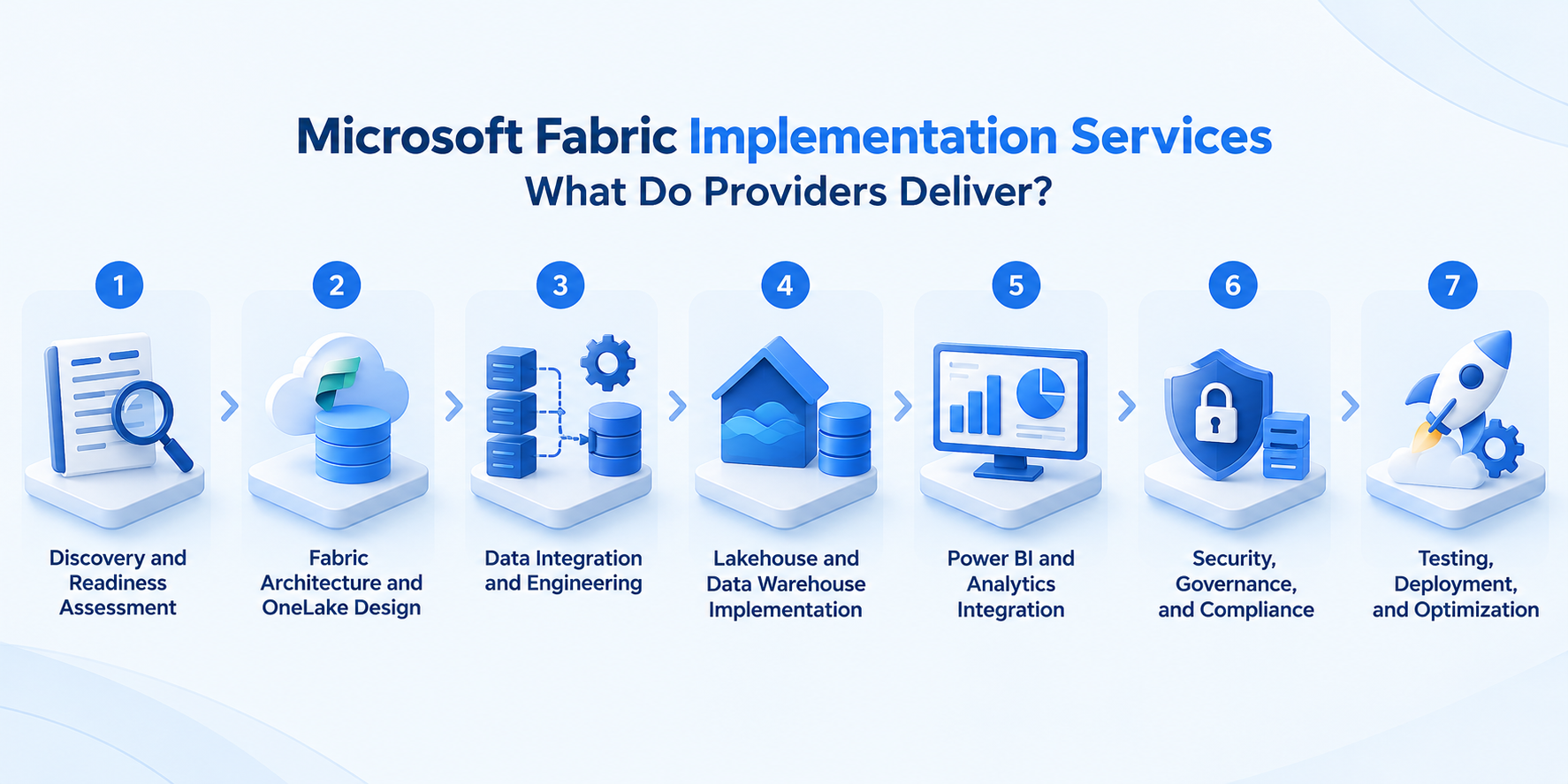
Microsoft Fabric implementation services vary by provider, project complexity, and existing infrastructure. However, most comprehensive engagements cover several essential stages.
Discovery and Readiness Assessment: Providers review business objectives, existing platforms, data quality, technical dependencies, and migration requirements. This assessment helps establish project scope and priorities.
Microsoft Fabric Architecture and OneLake Design: Teams design the target architecture, storage strategy, workload boundaries, security requirements, and governance model around OneLake.
Data Integration and Engineering: Implementation teams build ingestion pipelines, transformations, notebooks, and data quality checks to support reliable data processing.
Lakehouse and Data Warehouse Implementation: Providers select suitable storage and processing approaches based on workload requirements, query patterns, and reporting needs.
Power BI and Analytics Integration: Services may include semantic models, dashboards, reporting workflows, and business intelligence integration.
Security, Governance, and Compliance: Partners configure permissions, data protection, lineage, monitoring, and relevant compliance controls.
Testing, Deployment, and Optimization: The final stage validates data quality, performance, and reliability. It also covers documentation, user training, performance tuning, and operational handover to support ongoing platform management.
Choosing the right Microsoft Fabric implementation agency requires matching its capabilities to your business goals, technical environment, and budget. Brand recognition alone does not guarantee successful delivery.
Start by defining your project requirements. A new Fabric deployment may need different expertise than migrating from an existing platform. Similarly, lakehouse development, data warehouse modernization, Power BI integration, and enterprise-wide analytics require different technical skills.
Consider whether your workloads involve strict regulatory requirements or relatively straightforward reporting. Decide whether you need short-term implementation support or ongoing managed services. Also, determine whether the provider will manage delivery independently or collaborate with your internal data team.
Before shortlisting Microsoft Fabric implementation agencies, ask these questions:
Microsoft partner credentials can help establish a provider's ecosystem experience. However, credentials alone cannot demonstrate suitability for your project. Request relevant references, review proposed deliverables, and confirm the experience of the actual implementation team.
Finally, compare project scope, timelines, costs, and support arrangements before making your decision. A clearly defined engagement helps establish accountability and measurable expectations.
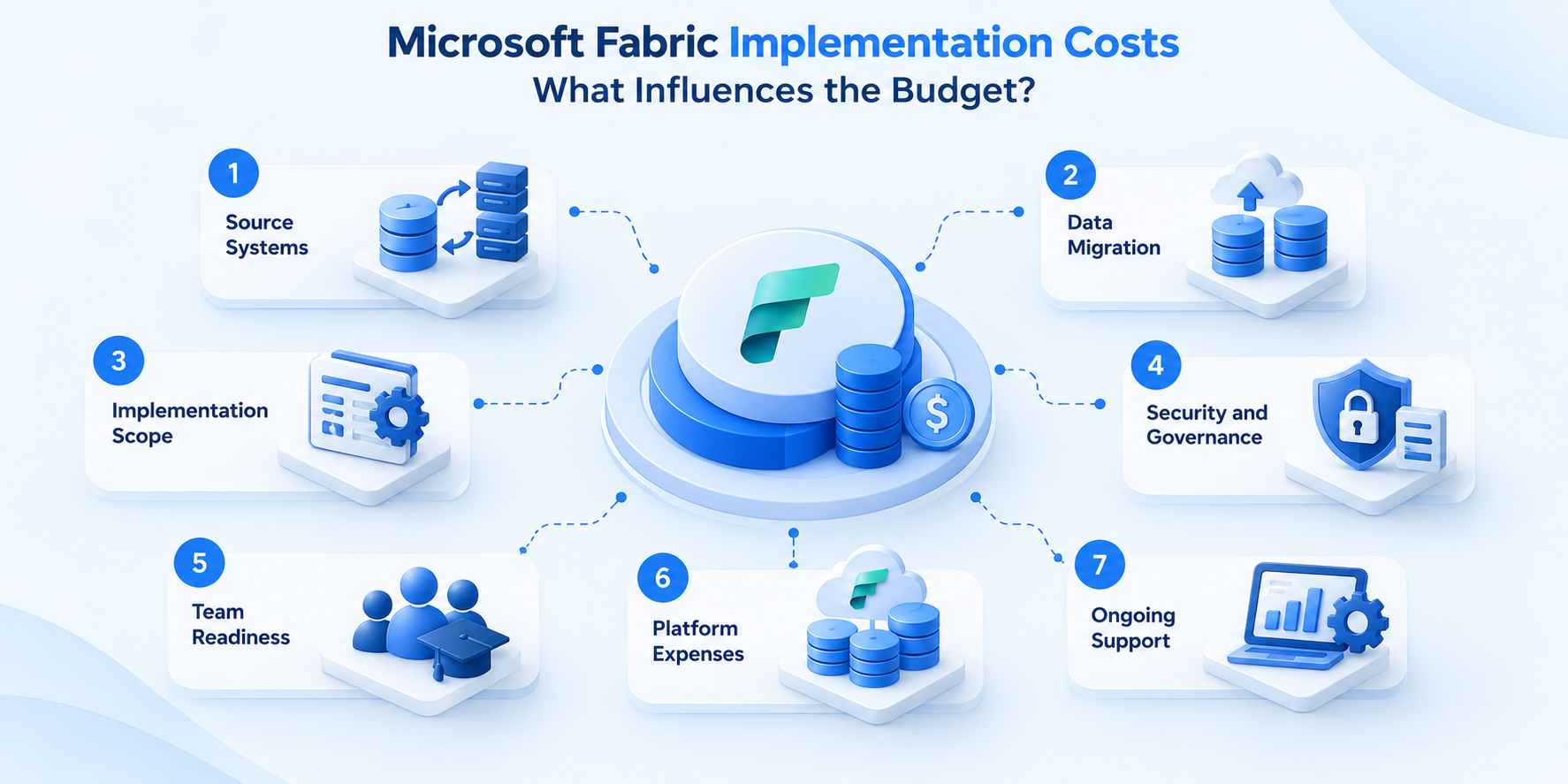
Microsoft Fabric implementation costs depend on project complexity, technical requirements, and the provider's delivery model. Key budget factors include:
Request a detailed proposal covering deliverables, assumptions, exclusions, milestones, payment terms, and acceptance criteria. Avoid relying on generic price estimates without comparable project evidence.
Organizations should avoid these common mistakes when selecting a provider:
Request relevant project references, clarify technical responsibilities, and establish success measures before signing a contract. A well-defined implementation scope helps reduce delivery risks and unexpected costs.
Hexaview Technologies helps organizations modernize data environments through Microsoft Fabric implementation, data engineering, and analytics solutions. Its approach focuses on connecting data sources, improving reporting workflows, and building architectures that support enterprise analytics requirements. For businesses evaluating Microsoft Fabric Implementation Service Providers, Hexaview is worth considering for its focus on data-intensive workloads and financial services.
Key capabilities include:
Hexaview may be a suitable partner for organizations migrating legacy analytics workloads or consolidating fragmented data environments. Its capabilities should be evaluated against each project's technical requirements, delivery timeline, and support needs.
Before making a decision, enterprises should review relevant project references, confirm the proposed team's hands-on Microsoft Fabric experience, and establish measurable implementation outcomes. This helps determine whether Hexaview's services align with their business objectives and long-term analytics strategy.
Selecting the right Microsoft Fabric implementation partner depends on your data architecture, migration requirements, security needs, industry, budget, and internal expertise. Before signing a contract, validate project references, interview the proposed technical team, compare implementation plans, and establish measurable success criteria.
Hexaview Technologies is worth considering for Microsoft Fabric implementation, data engineering, migration, and analytics modernization. Its documented capabilities can help organizations assess potential approaches to consolidating data environments and improving reporting workflows.
Discuss your requirements with Hexaview to determine whether its implementation experience aligns with your technical priorities, business objectives, and long-term analytics goals.
These services cover Fabric planning, architecture, configuration, data migration, pipeline development, Power BI integration, testing, security, and ongoing support.
Ten providers serving US clients include:
Evaluate production experience, migration expertise, architecture, security, industry knowledge, project references, and post-launch support.
Consultants primarily provide advice and planning. Implementation partners handle hands-on development, configuration, deployment, testing, and potentially ongoing support.
Costs depend on project scope, data complexity, migration needs, consulting fees, Fabric licensing, capacity, and support requirements.
Timelines depend on data readiness, source systems, migration complexity, governance requirements, and the number of workloads.
Yes. Migration feasibility depends on existing architecture, workload dependencies, compatibility, and target design.
Expected deliverables include architecture documentation, configured workloads, tested pipelines, governance controls, training, and operational handover.