

Microsoft Fabric Lakehouse, Warehouse, and SQL Database serve different workloads. A Lakehouse supports data engineering, data science, and mixed-format data. A Warehouse fits enterprise analytics, BI, dimensional models, and SQL-heavy workloads. Fabric SQL Database supports operational applications and transactional workloads. Enterprises can also combine these services in one Fabric architecture. Microsoft recommends considering workload type, data structure, development approach, and transaction needs when choosing between them.
Choosing between a Microsoft Fabric Lakehouse, Warehouse, and SQL Database affects more than data storage. It influences query performance, scalability, development workflows, and long-term maintenance. The right choice also depends on whether your workload requires transactions, reporting, analytics, or application support.
For example, BI teams may prioritize fast analytical queries and familiar SQL tools. Data engineers may need flexible processing for structured and unstructured data. Application developers may require reliable transactions and operational database capabilities.
Therefore, the question is not simply, “Which one is better?”
The better question is: “Which Fabric data store best matches the workload?”
Microsoft Fabric also provides a shared foundation through OneLake. It connects data across Fabric workloads and reduces the need to manage separate data silos. This makes it possible to combine Lakehouse, Warehouse, and SQL Database capabilities within a broader Microsoft Fabric data architecture.
A Microsoft Fabric Lakehouse combines the flexibility of a data lake with capabilities for analytics. It can store and process structured, semi-structured, and unstructured data in one environment. Lakehouses use Delta Lake format within OneLake, providing reliable storage for large-scale analytical workloads.
Fabric Lakehouses work closely with Apache Spark, making them suitable for data engineering, notebooks, data science, and large-scale transformations. Teams can also use pipelines, dataflows, and shortcuts to ingest and organize data from different sources. Fabric automatically provides a SQL analytics endpoint, allowing teams to query Lakehouse data using SQL.
Lakehouses are especially useful for Microsoft Fabric data architecture based on medallion patterns. Data can move through Bronze, Silver, and Gold layers as it becomes cleaner and more business-ready.
Microsoft recommends Lakehouse for big data, machine learning, data engineering, and workloads involving mixed data formats.
Choose a Fabric Lakehouse when your organization needs flexible data storage and large-scale processing. Common use cases include:
In a Fabric Lakehouse vs Warehouse decision, Lakehouse generally makes more sense when data engineering flexibility is a priority. It is particularly valuable when teams need to combine different data types before preparing them for analytics, reporting, or machine learning.
Microsoft Fabric Warehouse is the SQL-first analytical option within Fabric. It is designed primarily for structured, relational data and enterprise-scale analytics. Unlike a Lakehouse workflow that often centers on Spark and data engineering, Warehouse development primarily uses T-SQL.
Teams can create tables, views, stored procedures, and functions for analytical workloads. Fabric Warehouse also supports multi-table ACID transactions, making it suitable for data warehousing scenarios where transactional consistency across multiple tables matters.
Warehouse data is stored in OneLake using the Delta format while providing a familiar SQL experience for database developers and BI teams. It works particularly well with dimensional models, including star schemas, and supports enterprise reporting and analytics.
Microsoft recommends Warehouse when organizations need structured data analytics, T-SQL development, enterprise data warehousing, and multi-table transaction support.
Choose a Microsoft Fabric Warehouse when your workload is primarily structured, analytical, and SQL-driven. Common examples include:
In a Fabric Lakehouse vs Warehouse comparison, Warehouse is often the stronger choice when structured data, SQL development, governed analytics, and enterprise reporting are the primary requirements.
Fabric SQL Database is the operational and transactional database option within Microsoft Fabric. It is based on Azure SQL Database technology and is designed for applications that need reliable, frequent data changes. Developers can use T-SQL to build and manage application databases.
Unlike analytical stores that primarily support large-scale queries, SQL Database is designed for OLTP workloads involving frequent inserts, updates, and deletes. It fits normalized relational data and application-driven transactions where data consistency and operational performance are important.
A key advantage is its connection to the wider Fabric ecosystem. Data from SQL Database can be automatically made available to other Fabric experiences through mirroring into OneLake. This allows operational data to support downstream analytics without requiring the application database itself to become the primary analytical store.
Microsoft positions SQL Database in Microsoft Fabric for operational transactional and normalized database workloads.
Choose Fabric SQL Database when an application needs a relational database for frequent operational transactions. Common examples include:
For a Fabric Lakehouse vs Warehouse vs SQL Database decision, SQL Database is the better fit when the primary requirement is application-driven transactional processing, rather than large-scale analytical querying.
The Microsoft Fabric Lakehouse vs Warehouse vs SQL Database decision should start with the workload, not the technology preference. Each option addresses a different part of the data lifecycle. Lakehouse supports flexible data engineering and analytics, Warehouse focuses on structured enterprise analytics, while SQL Database supports operational applications and transactions.
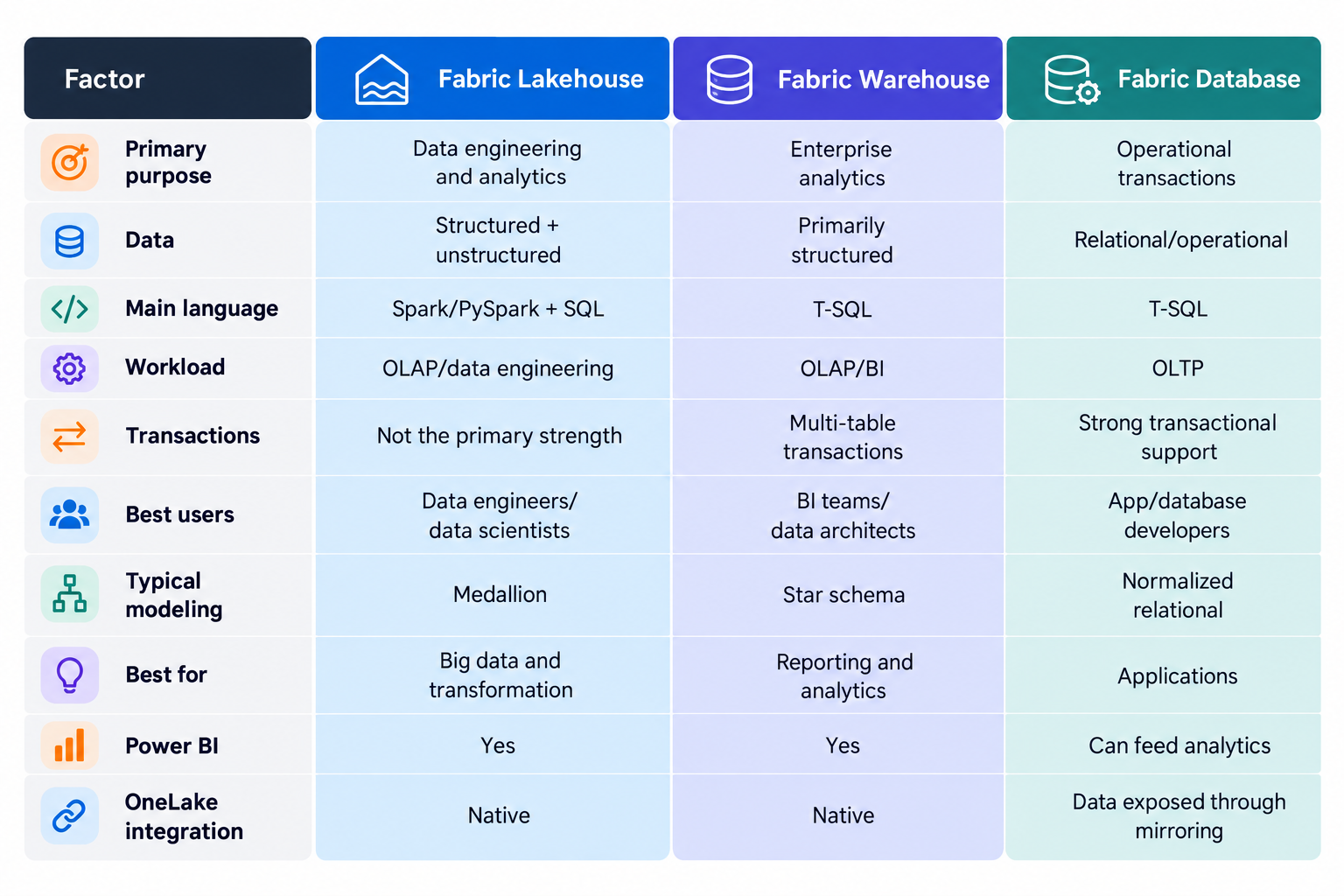
The key distinction in a Fabric Lakehouse vs Warehouse comparison is flexibility versus structured analytics. Lakehouse is well suited to large-scale engineering, mixed data types, and transformation pipelines. Warehouse is better suited to curated relational data, SQL-heavy analytics, and enterprise reporting.
Fabric SQL Database addresses a different requirement. It supports operational applications where frequent inserts, updates, deletes, and transactions are central to the workload.
Therefore, these three services are not direct competitors. They complement one another within a broader Microsoft Fabric data architecture. An enterprise might use SQL Database for application transactions, a Lakehouse for engineering and transformation, and a Warehouse for governed analytics and reporting. Microsoft's guidance similarly separates these workloads based on data characteristics, development needs, and workload requirements.
The Microsoft Fabric Lakehouse vs Warehouse decision becomes clearer when you compare data types, development methods, transaction needs, and workloads. Neither option is universally better. The right choice depends on how your team collects, processes, models, and analyzes data.
1. Data Type:
A Fabric Lakehouse is better when data comes in multiple formats. It can handle structured, semi-structured, and unstructured data. This makes it useful for files, logs, IoT data, and other diverse sources.
A Fabric Warehouse is better suited to structured relational data prepared for analytics and reporting.
2. Development Approach
Lakehouse workloads commonly use Apache Spark, Python, or Scala, alongside SQL. This gives data engineers and data scientists greater flexibility for complex transformations.
Warehouse development is primarily T-SQL based, making it familiar to database developers and SQL-focused BI teams.
3. Transactions
If your workload requires multi-table transactional support, Warehouse is generally the better fit. Lakehouse is more focused on data engineering and analytical processing than transactional database operations.
4. Workload
Choose Lakehouse for data engineering, machine learning, exploration, and large-scale transformation. Choose Warehouse for BI, reporting, dimensional modeling, and structured analytics.
Microsoft's current decision guidance uses these factors as key starting points when choosing between Lakehouse and Warehouse.
The key difference between Fabric SQL Database and Warehouse is OLTP vs OLAP. SQL Database supports operational workloads with many smaller transactions and frequent row-level changes. It suits applications that continuously insert, update, and delete records.
A Fabric Warehouse is designed for OLAP workloads. It handles large analytical queries, aggregations, historical analysis, BI, and enterprise reporting. Data is typically curated and modeled for analytical performance.
For example, an e-commerce application may use Fabric SQL Database to manage customers, orders, payments, and inventory. The same organization could use a Fabric Warehouse to analyze years of sales data, identify revenue trends, compare product performance, and power executive dashboards.
In simple terms, use SQL Database when applications need to operate on data. Use Warehouse when business teams need to analyze that data at scale.
You do not always need to choose one. Microsoft Fabric Lakehouse, Warehouse, and SQL Database can work together as parts of a broader data architecture.
A common pattern looks like:
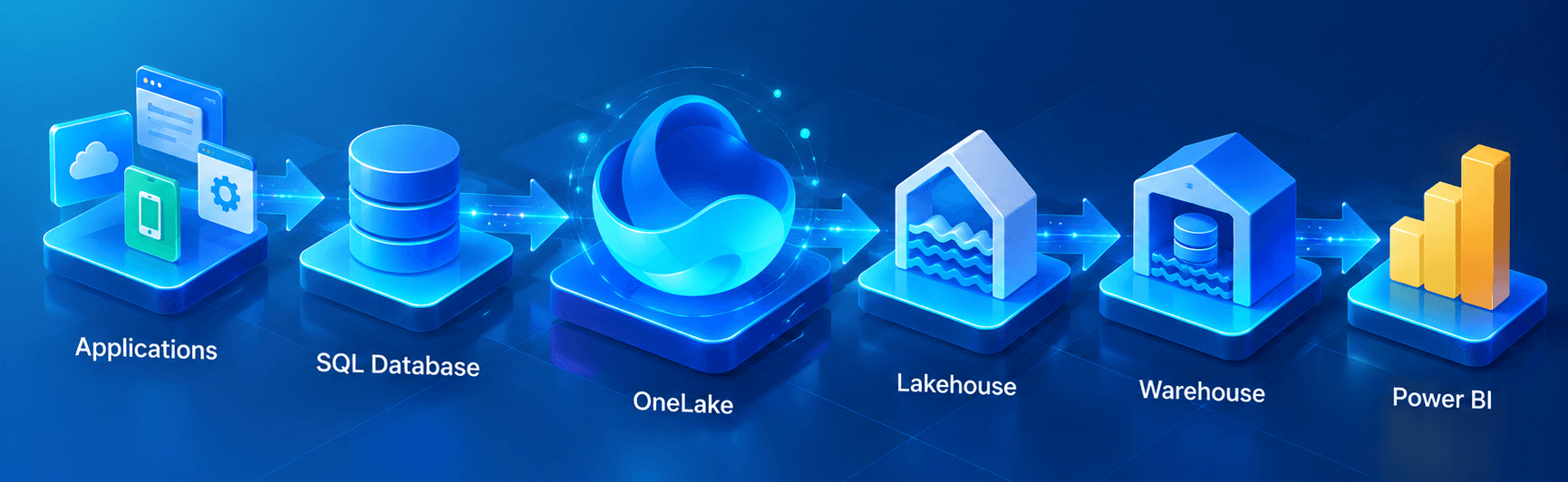
An organization could:
This approach lets each workload use the data store best suited to its requirements. Rather than forcing operational, engineering, and analytical workloads into one system, organizations can connect them within the same Fabric platform. Microsoft describes Fabric as supporting multiple data storage options that work across its broader analytics environment.
Use this checklist when evaluating Microsoft Fabric data architecture:
The goal is not to select the most powerful option. It is to match each workload with the Fabric service that handles it most effectively.
Choosing between a Microsoft Fabric Lakehouse, Warehouse, and SQL Database is only the first step. The larger challenge is designing an architecture that fits existing systems, data volumes, workloads, skills, governance requirements, and reporting goals.
Hexaview Technologies can support organizations as a Microsoft Fabric implementation partner, helping teams plan and implement the right Fabric architecture for their business needs. Its services can include:
The right approach is rarely about selecting one Fabric workload in isolation. It is about understanding how operational systems, engineering workflows, analytics, and BI need to work together.
Before implementing Fabric, organizations should evaluate their existing data environment, identify workload requirements, and define the target architecture. A structured assessment can help determine where Microsoft Fabric consulting services can deliver the most value while reducing unnecessary migration and implementation effort.
A Fabric Lakehouse supports data engineering, mixed-format data, Spark, and large-scale transformation. A Fabric Warehouse focuses on structured data, T-SQL, enterprise analytics, dimensional modeling, and BI.
Neither is universally better. The right choice depends on the workload, data types, development approach, and analytical requirements.
Use Fabric SQL Database for operational and transactional workloads. It suits applications requiring frequent inserts, updates, deletes, and reliable transactions.
Yes. Teams can use a Lakehouse for engineering and transformation, then use a Warehouse for curated enterprise analytics and reporting.
Yes. Fabric Warehouse is well suited to Power BI when teams need structured, governed data for enterprise reporting and analytical models.
Yes. SQL Database data can be accessed by other Fabric experiences, including through its integration with OneLake. However, its primary purpose remains operational and transactional workloads.
Enterprises should evaluate workload type, data structure, transaction requirements, development skills, governance needs, data volumes, and reporting goals. Many organizations may use multiple Fabric data stores rather than relying on one.







.svg)



.svg)