Microsoft Fabric
August 28, 2026

Microsoft Fabric's August 2026 Data Agent Update: Which Industries Win the Most?

Microsoft Fabric's Data Agent update isn't a one-size-fits-all release. Some industries stand to gain far more than others. Here's a ranked breakdown of who benefits most, and why.
Michael Sterling
5 min read
Every Microsoft Fabric update gets covered the same way: a list of features, explained one by one. But a feature list doesn’t tell you who actually wins. A 1,000-row response limit means very little to a five-person retail team, but it can be the difference between a usable tool and an abandoned pilot for a wealth management firm pulling client portfolios. This piece ranks the industries that stand to gain the most from the August 2026 Data Agent update and explains exactly why.

At Hexaview, we work across several of these industries as a Microsoft Fabric consulting partner, so this ranking isn’t theoretical; it’s based on the kinds of data problems we actually see teams run into.

Why This Update Hits Every Industry Differently

Not every feature in the August 2026 release matters equally to every business. A hospital doesn’t care about the same things a retail chain does. A few examples of how needs diverge:

  • Regulated industries (banking, insurance, healthcare) care most about grounding and governance: schema descriptions, observability, and access control.
  • High-volume, fast-moving industries (retail, manufacturing) care more about speed and reach: Copilot Studio integration and better visuals.
  • Data-heavy back-office functions (wealth management, insurance claims) care most about the 1,000-row limit and DAX accuracy.

With that in mind, here’s how the industries stack up.

Ranked: Industries That Benefit Most from the August 2026 Update

 1    Banking & Wealth Management

This industry benefits the most, and it isn’t close. Wealth and asset management teams live inside dense, regulated datasets, client portfolios, transaction histories, compliance records, where a wrong answer isn’t just embarrassing, it’s a real liability.

The features that matter most here:

  • Schema descriptions for SQL sources: core banking and portfolio databases are full of cryptic column names; plain-language descriptions directly reduce compliance risk from misread data.
  • Iterative DAX generation: portfolio performance and risk metrics need to be exactly right, not “close enough.”
  • Observability and governance: regulators expect audit trails; logs and traces on every Data Agent make that possible.
  • 1,000-row responses: client and transaction lists are rarely small enough to fit in the old limits.

This is also where Hexaview spends most of its Fabric consulting work, so the pattern is a familiar one: firms that document their semantic models properly see the accuracy gains immediately; firms that skip it don’t get much benefit from the update at all.

 2    Insurance

Insurance shares a lot of DNA with banking (heavy regulation, sensitive data, complex records), but the biggest win here is specific to claims and underwriting workflows.

  • Bigger row limits: claims data and policy records are bulky; pulling a fuller dataset in one go speeds up fraud and risk analysis significantly.
  • Schema descriptions: underwriting systems are notorious for dense, code-heavy fields that only a handful of people fully understand.
  • Copilot Studio integration: claims adjusters and underwriters can ask questions inside Teams instead of waiting on a reporting team.

The result: faster fraud detection and underwriting analysis without needing every analyst to learn a new tool.

 3    Healthcare

Healthcare data has a specific, well-known problem: billing codes, clinical terminology, and system-specific field names that are nearly unreadable to non-specialists. This is exactly what schema descriptions were built to fix.

  • Schema descriptions: the single most valuable feature for this industry; it turns opaque clinical and billing fields into something a hospital administrator can actually query.
  • Governance and observability: healthcare data carries strict privacy obligations, so knowing exactly what an agent accessed and when matters as much as the answer itself.
  • Fabric visuals: operational dashboards (bed occupancy, patient flow, billing trends) become far easier to read for non-technical hospital staff.

The caveat: healthcare organizations often move slower on Preview-runtime features due to compliance review cycles, so full adoption here may lag the other regulated industries.

 4    Retail & CPG

Retail and consumer goods companies don’t deal with the same regulatory weight, but they deal with speed: lots of people, spread across stores and regions, all wanting the same answer at the same time: how are we doing right now?

  • Copilot Studio + Microsoft 365 Copilot: store and regional managers can ask “how did this week’s promotion perform” directly inside Teams, no BI team required.
  • Fabric visuals: sales trends and inventory charts are far more useful to a store manager than a table of numbers.
  • Faster example query setup: retail data teams tend to be lean, so anything that cuts configuration time has an outsized impact.

The upside here isn’t accuracy so much as reach: putting data answers in front of far more people, far faster.

 5    Manufacturing

Manufacturing rounds out the list, benefiting most from the update’s multi-agent and orchestration improvements rather than any single headline feature.

  • Multi-agent orchestration: supply chain, inventory, and production data often sit in separate systems; running multiple Data Agents under one roof helps connect them.
  • Smarter orchestrator (GPT-5.1): multi-part operational questions (“which plants are behind schedule and why”) get handled more reliably.
  • Observability: as more shopfloor and supply-chain teams start using agents independently, IT needs to track what’s connected to what.

Manufacturing benefits meaningfully, but the win is more operational than transformational compared to the top three industries.

Use Cases by Industry
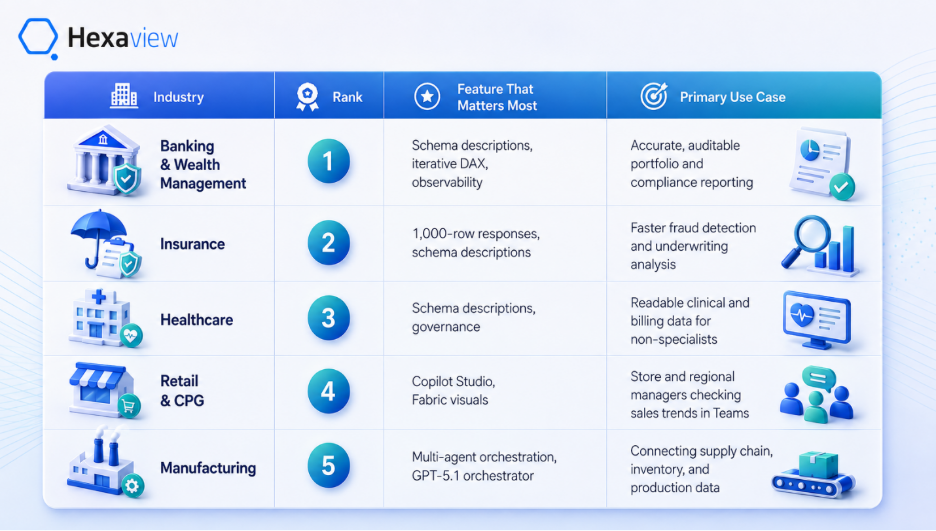
Here’s the ranking summarized as a single table, so you can jump straight to your industry.  

What If Your Industry Isn't on This List?

The ranking above reflects where the update's specific features line up most directly with existing pain points; it doesn't mean other industries get nothing out of it. Professional services, logistics, education, and the public sector can all benefit from the same core improvements: better grounding, more accurate answers, and easier access through Teams and Copilot. The gains just tend to be more general rather than tied to one obviously painful, industry-specific problem.

The real predictor of how much value any organization gets isn't its industry label; it's how well-documented and governed its underlying Fabric setup already is.

Before You Get Excited: What Could Slow You Down

  • Preview-runtime dependency. Several of the highest-impact features (schema descriptions, iterative DAX generation, the 1,000-row limit) are Preview-only, which matters a lot for regulated industries with slower change-approval cycles.
  • Documentation debt. The industries that benefit most (banking, insurance, healthcare) are also the ones most likely to have years of undocumented schemas, and the grounding gains only show up once someone actually writes the descriptions.
  • Governance readiness. Multi-agent observability is only useful if someone is actually watching it; without a governance owner, agent sprawl can outpace oversight fast.
  • Underlying data quality. None of this fixes a poorly modeled semantic layer; it just makes the gap between good and bad data setups more visible.

How Hexaview Helps Industries Get Ready for This Update

Because the value of this update depends so heavily on industry, Hexaview doesn't approach Data Agent rollouts the same way for every client. Our team focuses on data engineering, semantic modeling, business intelligence, and full Microsoft Fabric consulting, with the deepest experience in financial services and wealth management, the exact segment that stands to gain the most from this release.

Across industries, the groundwork we help clients get right before rolling out Data Agent looks similar:

  • Documenting SQL schemas and semantic models with real business context, not just technical field names.
  • Setting up governance and access controls so self-service doesn't turn into a compliance risk.
  • Deciding which features are safe to run in Preview versus waiting for general availability.
  • Connecting Data Agent to Copilot Studio and Teams in a way that's actually governed, not just convenient.

If you're trying to figure out where your industry, and your organization specifically, falls on this list, the fastest way to find out is a quick review of your current Fabric setup against what this update actually requires to pay off.

Talk To the Experts  

Frequently Asked Questions

Which industry benefits most from the Microsoft Fabric Data Agent August 2026 update?

Banking and wealth management benefit the most, since the update's schema descriptions, iterative DAX accuracy, and observability features address exactly the kind of dense, regulated data these firms manage every day.

Does this update only help regulated industries like banking, insurance, and healthcare?

No. Regulated industries see the biggest gains because grounding and governance matter most to them, but retail, manufacturing, and other industries also benefit, mainly through faster access via Copilot Studio and better visualizations.

What determines how much value an organization gets from this update?

Industry is one factor, but the bigger driver is how well-documented and governed an organization's existing Fabric setup already is. A well-modeled semantic layer benefits far more than a messy, undocumented one, regardless of industry.

Should regulated industries wait for General Availability instead of using Preview features?

It depends on internal change-approval processes. Several of the highest-impact features are currently Preview-only, so regulated organizations with strict compliance review cycles may choose to pilot carefully before a full rollout.

How can Hexaview help my industry prepare for this update?

Hexaview assesses your current semantic models, schema documentation, and governance setup, identifies which features are safe to adopt now versus later, and helps configure Data Agent and Copilot Studio integration around your industry's specific data and compliance needs.


Hexaview Technologies

Hexaview Technologies is a trusted digital transformation and data engineering company helping enterprises unlock the full potential of modern analytics and AI. As a leading Microsoft Fabric consulting agency, Hexaview delivers end-to-end Microsoft Fabric consulting services, including strategy, architecture, implementation, migration, governance, and Power BI modernization. Supported by 20+ certified Microsoft Fabric consultants, the team builds scalable, secure, and future-ready data platforms tailored to business needs. With deep expertise across financial services, healthcare, insurance, manufacturing, and capital markets, Hexaview enables organizations to modernize legacy systems, streamline data operations, and accelerate AI-driven decision-making.

Prateek Prakash Karan
An Assistant Manager – Marketing & Program Lead for Microsoft Fabric at Hexaview, driving strategic initiatives across marketing, ecosystem engagement, and the Microsoft Fabric landscape. His work focuses on building impactful programs, strengthening industry relationships, and advancing data and AI conversations within the enterprise technology ecosystem.

Source: Microsoft Fabric Community Blog: Fabric August 2026 Feature Summary

Blogs you may like

Cookie Preferences