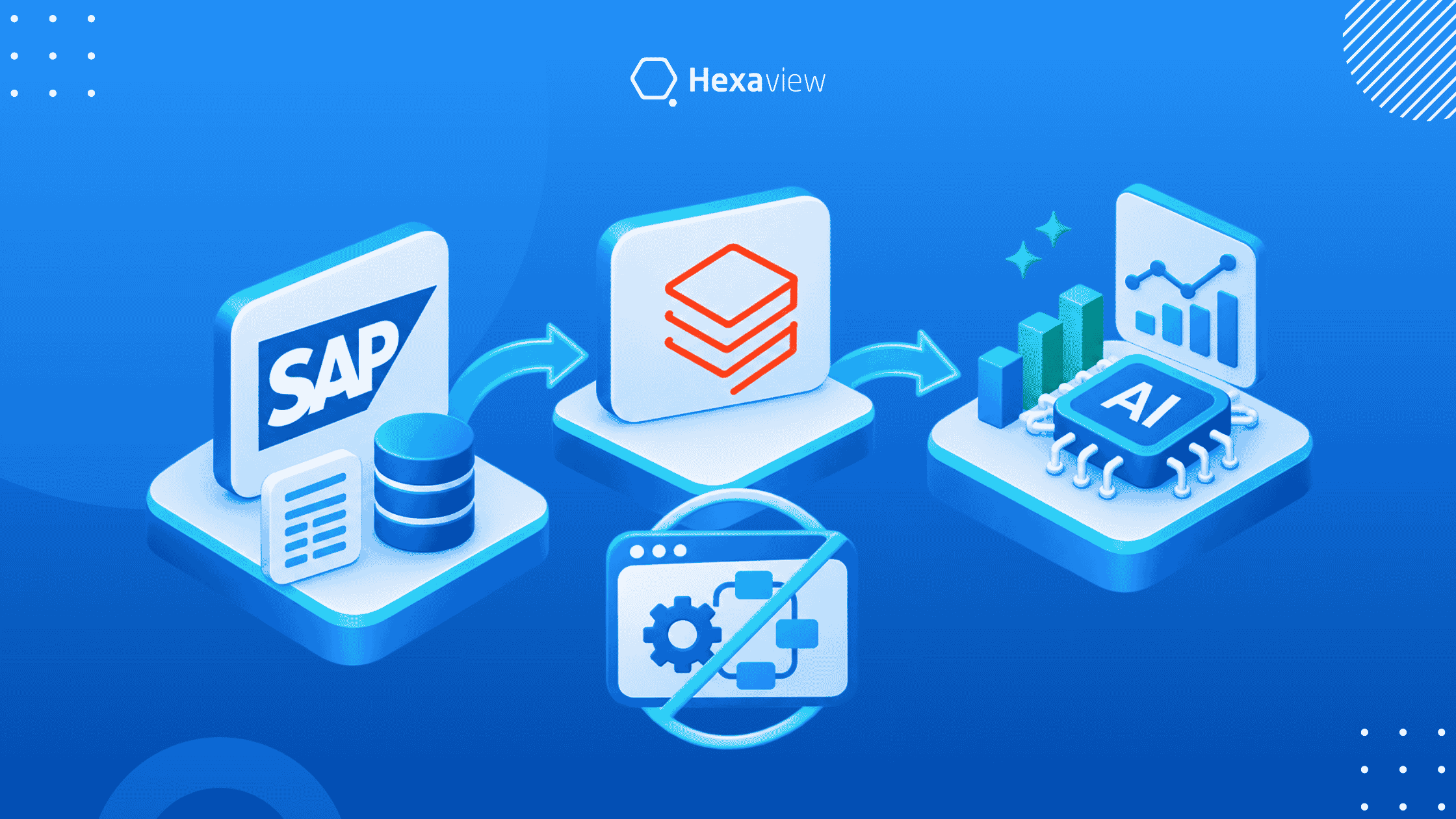
For many enterprises, SAP data integration follows a familiar pattern. A sales order lives in SAP S/4HANA. To analyze it alongside CRM, IoT, or market data, someone extracts it, rebuilds the business logic lost on the way out, loads it into a lakehouse, and keeps that pipeline healthy every night. Multiply that by hundreds of tables and several business units, and integration becomes one of the costliest layers of the data estate.
SAP Databricks integration is changing that pattern. Since early 2025, SAP and Databricks have moved from an announced partnership to production integrations that let teams work with governed SAP data in Databricks without building a new extraction pipeline for every use case. Here is what has shipped, how the architecture works, and where data engineering still matters.
SAP data is rich in business meaning, but that meaning is hard to carry outside SAP. Table and field names are cryptic, business rules live in the application layer, and every extract forces teams to rebuild context by hand.
Databricks itself describes the traditional route as custom extraction pipelines that copy data, lose business context, and fragment governance. Every copy also creates a reconciliation problem: which version of "revenue" is the right one?

SAP Business Data Cloud (SAP BDC) is SAP's managed data platform. It brings together SAP Datasphere, SAP Analytics Cloud, and SAP Business Warehouse around curated, SAP-managed data products: ready-to-use datasets that keep SAP's business semantics.
SAP Databricks is a fully managed version of Databricks that runs as a service inside BDC and is sold by SAP. BDC data products are made available to it through Delta Sharing, so data scientists and engineers can start from SAP data that already carries its business context.
Many enterprises already run Databricks. BDC Connect for Databricks links an existing Unity Catalog–enabled workspace to SAP BDC for bidirectional, zero-copy sharing. According to SAP's reference architecture, this protects existing Databricks investments while giving teams curated SAP data without new ETL.
The practical choice: SAP Databricks suits teams starting fresh inside BDC; BDC Connect suits teams with an established Databricks platform.
At SAP TechEd 2026, the companies announced SAP Application Data Foundation, which makes SAP application data, from cloud and on-premises systems, available to BDC engines including SAP Databricks. They also outlined plans to bring Databricks Genie, Lakeflow, Unity Gateway, and Lakebase to SAP Databricks, along with a two-way Genie–Joule integration. SAP's own announcement also lists Agent Bricks.
No release dates were published for these additions, so treat them as roadmap items. SAP Databricks and BDC Connect are available today.
These terms are often used interchangeably. They should not be.
Two caveats matter. Zero-copy is not zero movement: data still travels over the network when it is queried, and cross-cloud reads can add egress cost. And neither approach removes transformation. Data still needs cleansing, modelling, and business rules; that work moves downstream rather than disappearing.

Actual savings depend on your landscape, data volumes, and how many existing pipelines a shared data product can replace.
Available now: zero-copy SAP data sharing and unified governance through Unity Catalog.
Announced: SAP Application Data Foundation, more Databricks capabilities inside SAP Databricks, and Genie–Joule integration. SAP also agreed to acquire Dremio in May 2026 to make BDC natively support Apache Iceberg. The Register reports SAP will keep supporting Delta Lake.
Likely direction (our view): AI agents that act on shared business semantics, more automated data engineering, near-real-time operational intelligence, and open table formats that let several engines work on one copy of data. The common thread is a governed, semantic data foundation.
Zero-ETL simplifies data access, but it does not design your data platform. Hexaview Technologies helps enterprises assess SAP and Databricks integration options, design Databricks Lakehouse architecture, modernize and automate ETL/ELT pipelines, and put data quality and governance in place so SAP data is ready for analytics and AI.
Planning your SAP data strategy? Talk to Hexaview's data engineering team about where zero-copy sharing fits, which pipelines to retire, and how to make your SAP data AI-ready.
Sources:
https://news.sap.com/2025/02/sap-business-data-cloud-databricks-turbocharge-business-ai/
https://news.sap.com/2026/10/sap-teched-ai-developers-build-what-matters-autonomous-execution/
SAP Databricks is a fully managed version of Databricks that runs as a service inside SAP Business Data Cloud and is sold by SAP. It gives data teams governed access to SAP data products through Delta Sharing.
SAP Databricks runs inside SAP BDC. BDC Connect links SAP BDC to a Databricks workspace you already run, for bidirectional zero-copy sharing.
No. Zero-ETL means you do not build or maintain integration pipelines, though the platform may still replicate data behind the scenes. Zero-copy means data is read in place, with no second persistent copy.
SAP BDC acts as the Delta Sharing provider. Each shared data product is mounted as a catalog in Databricks Unity Catalog, which controls and audits access.
No. It reduces extraction and pipeline maintenance, but data modeling, quality checks, governance, and use-case transformations remain.
SAP announced SAP Application Data Foundation in October 2026 to make cloud and on-premises SAP data available to SAP Databricks. Check availability for your release with SAP.