

The way enterprises operate has fundamentally changed. In 2026, cloud computing services are no longer a technology upgrade; they're a business imperative. With global cloud spending surpassing $830 billion, organizations that delay cloud adoption are already falling behind their competition.
Today's enterprises demand more than just storage and servers. They need agility to scale fast, tools to optimize costs, and security frameworks that protect critical data around the clock. Cloud delivers exactly that on demand, without the burden of managing physical infrastructure.

That's why businesses are no longer asking "Should we move to the cloud?", they're asking "Which cloud model works best for us?" From public and private to hybrid and multi-cloud environments, enterprise cloud adoption is accelerating across every industry. This guide breaks it all down for you.
At their core, cloud computing services are on-demand access to computing power, storage, databases, networking, analytics, software, and security, all delivered over the internet. No physical servers. No expensive hardware rooms. Just capabilities you access, use, and pay for as needed.
For modern businesses, enterprise cloud services replace or significantly reduce the reliance on traditional on-premise infrastructure. Instead of managing aging hardware, enterprises get instant access to world-class technology maintained, secured, and updated by the provider.
Here's what makes cloud services a gamechanger for enterprises:
Cloud adoption isn't slowing down; it's accelerating. In 2026, enterprises aren't investing in cloud just to modernize IT. They're investing to grow faster, operate smarter, and compete harder. Here's exactly why:
On-premise infrastructure is expensive to build, maintain, and scale. Cloud eliminates massive capital expenditures and shifts businesses to predictable, subscription-based operating costs, freeing up budgets for innovation.
Post-pandemic work models are permanent. Enterprises need secure, always-on access to applications and data from anywhere in the world, something traditional infrastructure simply can't deliver at scale.
Markets move fast. Cloud environments enable CI/CD pipelines, containerization, and microservices so development teams can ship features and updates in days — not quarters.
Cyber threats are more sophisticated than ever. Leading cloud platforms offer built-in threat detection, automated backups, and geo-redundant disaster recovery, protection most enterprises couldn't afford to build on their own.
From predictive analytics to generative AI copilots, cloud is the only infrastructure that can support enterprise AI workloads at the speed and scale modern businesses require.
The boardroom has taken notice. Cloud decisions are no longer owned by IT alone. CEOs, CFOs, and COOs are treating cloud investment as direct drivers of revenue, agility, and market expansion.
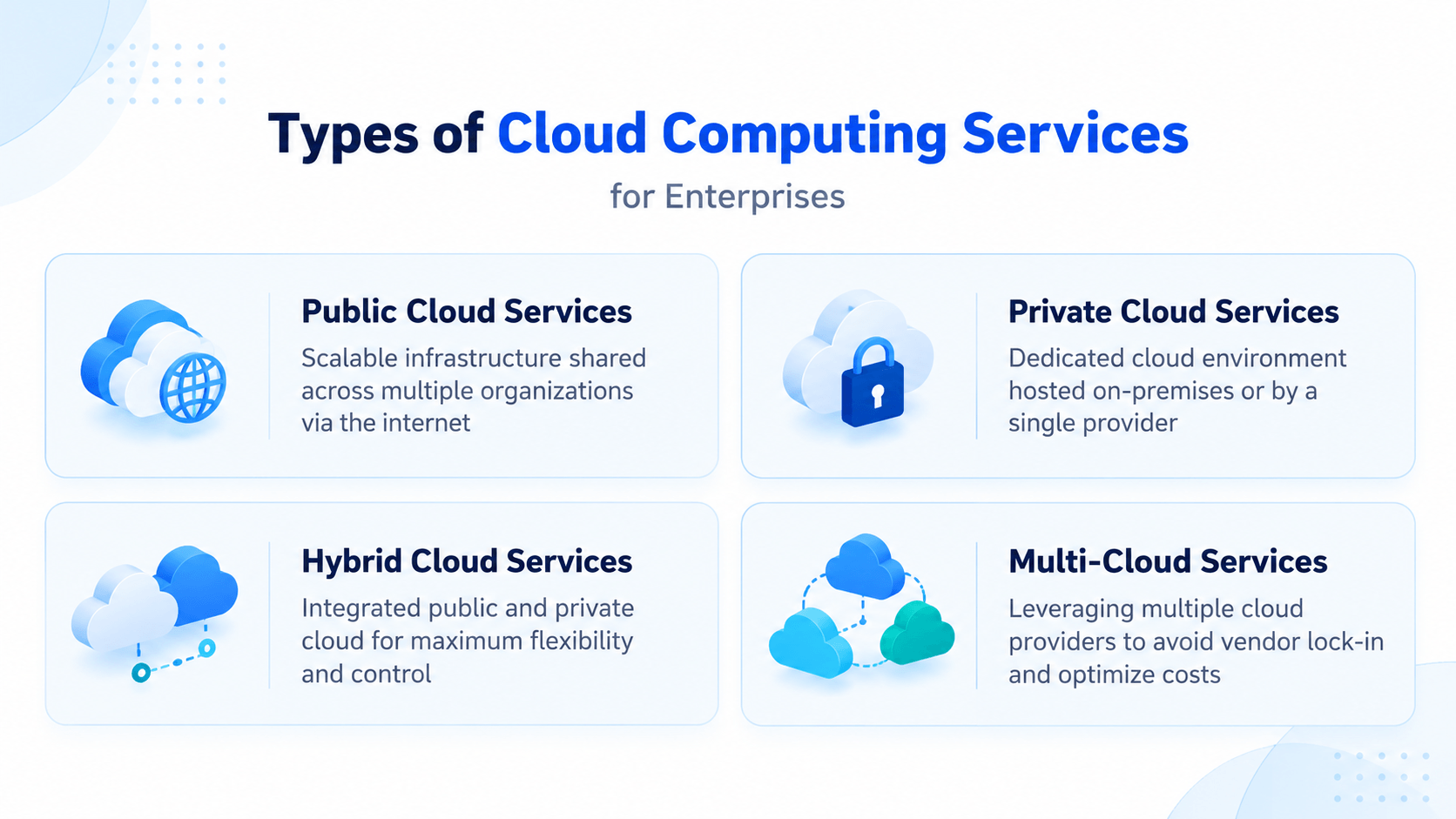
Not all clouds are built the same, and enterprises know it. Choosing the right cloud model is the difference between a strategy that scales and one that stalls. Here's a breakdown:
Public cloud is where most enterprises begin their journey. Providers like AWS, Microsoft Azure, and Google Cloud offer massive scalability, rapid deployment, and lower upfront costs. You share infrastructure with other organizations, but pay only for what you use.
Best for: High-growth workloads, development environments, and SaaS applications.
Regulated industries like banking, healthcare, insurance, can't compromise on control. Private cloud gives enterprises dedicated infrastructure, stronger data privacy, and compliance alignment with frameworks like GDPR, HIPAA, and SOC 2.
Best for: BFSI, government, and healthcare enterprises with strict compliance requirements.
Why choose when you can combine? Hybrid cloud lets enterprises run sensitive workloads on private infrastructure while leveraging public cloud for scalability. It's one of the fastest-growing enterprise cloud models in 2026, adopted by over 75% of large enterprises globally.
Best for: Enterprises transitioning from legacy systems while maintaining compliance.
Leading enterprises don't rely on a single provider. A multi-cloud strategy spreads workloads across AWS, Azure, GCP, and others, reducing vendor lock-in, boosting resilience, and optimizing performance by matching workloads to the best-fit platform.
Best for: Large enterprises seeking flexibility, risk distribution, and best-of-breed services.
Security isn't an afterthought in enterprise cloud, it's the foundation. As cyber threats grow more sophisticated, enterprises in finance, healthcare, and insurance are doubling down on cloud security frameworks that protect data, ensure compliance, and maintain operational trust.
Modern enterprise cloud security covers five critical pillars:
Industries like BFSI, healthcare, and insurance face the strictest regulatory scrutiny, making governed, secure cloud environments non-negotiable, not optional.
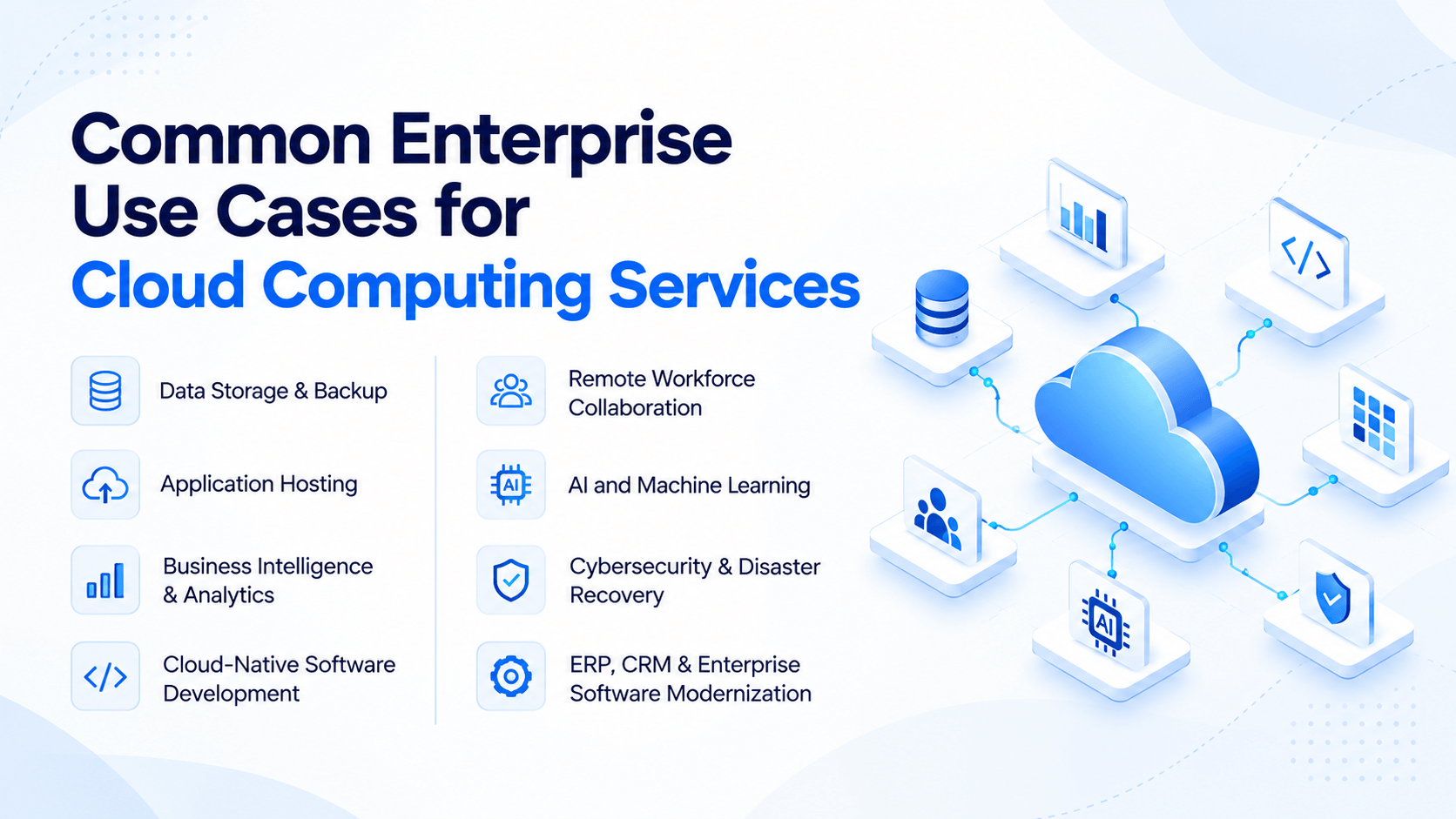
Wondering where enterprises actually put cloud to work? The answer is everywhere. Her are the most impactful use cases driving adoption in 2026:
Enterprises store petabytes of critical data on cloud platforms with automated backup, geo-redundancy, and instant recovery, eliminating single points of failure.
From customer-facing portals to internal tools, cloud hosting delivers high availability, auto-scaling, and global content delivery without managing physical servers.
Cloud platforms power real-time dashboards, data warehouses, and predictive analytics, turning raw enterprise data into actionable decisions faster than ever.
Development teams use cloud environments for containerized apps, microservices, and CI/CD pipelines, shipping better software, faster.
Cloud-powered tools like Microsoft 365, Google Workspace, and Slack keep distributed teams connected, productive, and secure, regardless of location.
Enterprises run large-scale model training, inferencing, and generative AI workloads on cloud infrastructure, capabilities impossible to replicate on-premise affordably.
Cloud-based security operations centers (SOCs) and automated disaster recovery ensure business continuity even when unexpected strikes.
Legacy ERP and CRM systems are migrating to cloud, unlocking real-time integrations, AI-powered automation, and lower total cost of ownership across the enterprise.
Enterprises don't just need cloud; they need cloud done right. With 14+ years of cloud consulting experience, Hexaview Technologies helps enterprises plan, migrate, modernize, and optimize their cloud environments across AWS, Azure, and Google Cloud.
From hybrid and multi-cloud strategies to governance, security, and cost optimization, Hexaview brings end-to-end expertise that reduces complexity and accelerates results.
Hexaview's enterprise cloud capabilities include:
The results speak for themselves. Hexaview clients report up to 21% reduction in cloud infrastructure costs, alongside measurable gains in performance and digital transformation velocity.
Cloud computing services are no longer optional; they're the engine powering enterprise growth in 2026. From cost optimization and security to AI workloads and workforce collaboration, cloud delivers outcomes that on-premise infrastructure simply cannot match.
But technology alone isn't enough. Enterprises need the right cloud strategy, the right deployment model, and the right technology partner. Working with experienced cloud consultants ensures that every investment translates into long-term performance, resilience, and competitive advantage.
The four primary types are public cloud, private cloud, hybrid cloud, and multi-cloud. Each serves different business needs based on cost, compliance, scalability, and control requirements.
Hybrid cloud combines private and public cloud environments, allowing enterprises to run sensitive workloads on dedicated infrastructure while leveraging public cloud for scalability and speed.
Managed cloud services are outsourced cloud operations, where a third-party provider handles monitoring, security, maintenance, optimization, and support, so internal IT teams can focus on innovation.
Enterprises are moving to cloud to reduce infrastructure costs, support hybrid work, accelerate software delivery, strengthen cybersecurity, and power AI and analytics workloads at scale.
Key benefits include:
Enterprises secure cloud through identity and access management (IAM), data encryption, threat detection, regulatory compliance frameworks (GDPR, HIPAA), and cloud governance policies.
Enterprise cloud computing services provide on-demand access to computing power, storage, databases, networking, analytics, and software over the internet, replacing or reducing reliance on traditional on-premise infrastructure.





.svg)



.svg)