
Microsoft Fabric Copilot and AI Agents help enterprises analyze data, automate workflows, and accelerate decision-making using generative AI. Copilot assists users by generating SQL, DAX, reports, notebooks, and data pipelines from natural language prompts, while AI Agents can autonomously retrieve data, perform analyses, and execute business tasks using enterprise context. Together, these Microsoft Fabric AI capabilities reduce manual effort, improve productivity, strengthen self-service analytics, and enable organizations to build secure, AI-powered data operations on a unified platform.
How do modern enterprises turn raw organizational data into autonomous business value? The answer lies in the rapid evolution of Microsoft fabric AI capabilities, which are fundamentally reshaping enterprise data workflows.
Microsoft is actively evolving Fabric from a standard analytics platform into an intelligent enterprise data ecosystem powered by AI agents and Copilot. Microsoft Fabric Copilot is a natural language assistant that helps professionals build pipelines, write code, and generate reports. In contrast, AI agents in Microsoft Fabric are autonomous systems that can reason over data, execute multi step workflows, and collaborate to solve complex business problems.
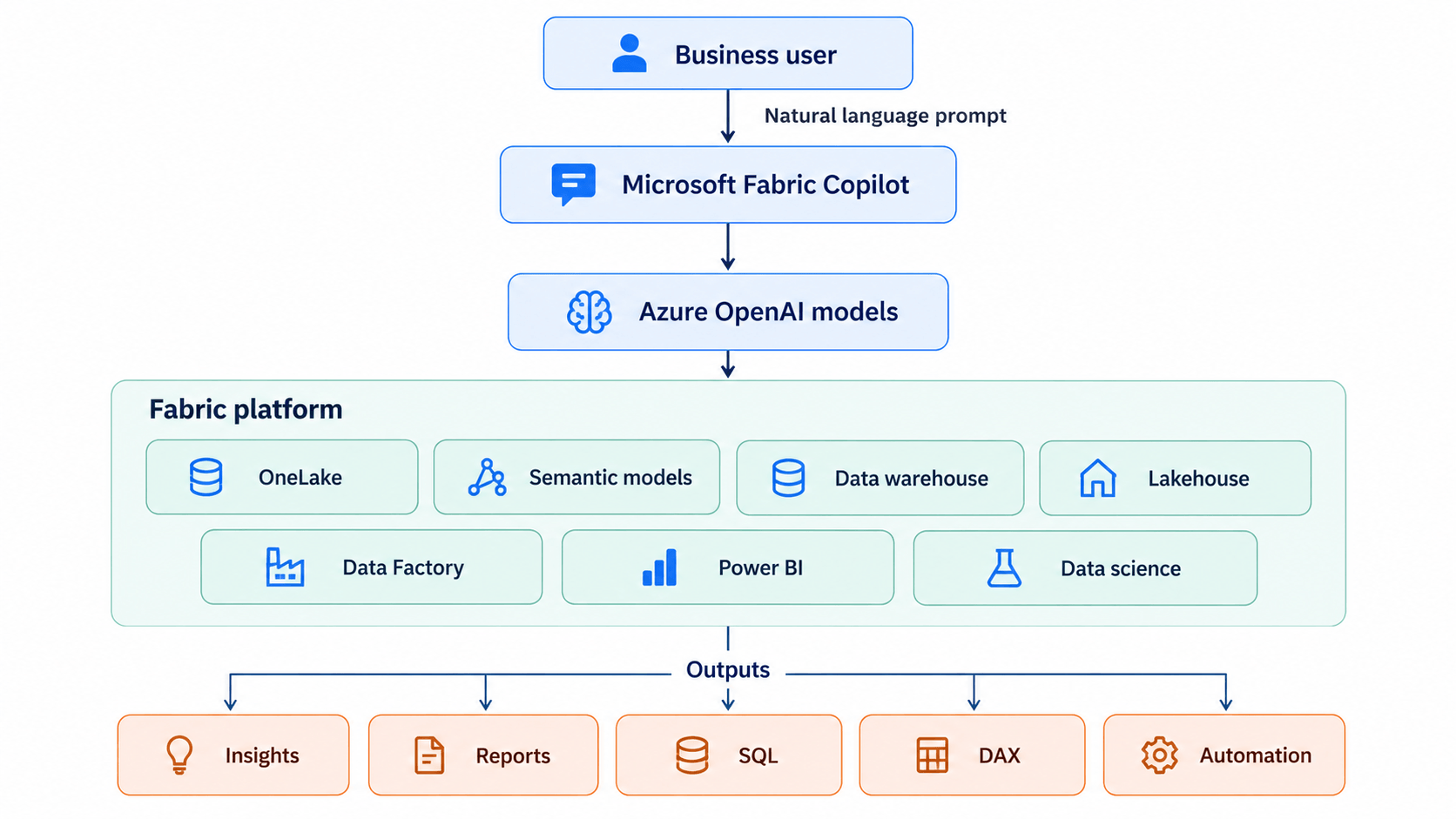
Enterprises are rapidly adopting these technologies to eliminate manual data engineering bottlenecks and accelerate decision cycles from days to minutes. By deeply embedding Azure OpenAI into a unified data architecture, Microsoft Fabric is becoming an AI first analytics platform. This shifts the enterprise data paradigm from passive storage to active, intelligent automation.

Generative AI uses advanced algorithms to create text, code, or visuals based on user patterns. Microsoft Fabric embeds this technology to transform standard data architectures. Microsoft Fabric Copilot operates as a specialized enterprise analytics assistant powered by large language models. This tool acts as an intelligent pair programmer for data teams by translating conversational text into functional operations.
Microsoft drives these advanced Microsoft fabric AI capabilities through native Azure OpenAI integration. The framework ensures that LLM assistance remains securely grounded inside your specific corporate metadata. Consequently, the system yields contextually accurate outputs without exposing data outside your compliance boundary. The platform respects all pre-existing user permissions, keeping row level security completely intact.
Copilot integrates deeply across key Fabric workloads to accelerate delivery times. Data teams can interact with the system using natural language prompts to perform complex actions across the ecosystem.
An autonomous agent is an independent software system that executes tasks without human intervention. Context-aware AI refers to systems that evaluate organizational metadata to deliver relevant answers. Autonomous reasoning means the capacity of a machine to plan multi step solutions independently.
Advanced AI agents Microsoft Fabric provides represent a major leap forward from standard reactive assistants. Standard systems require constant prompt sequences to deliver basic information summaries. In contrast, modern Microsoft Fabric Data Agents operate as goal driven digital teammates.
These tools optimize daily operational workflows through specialized internal features:
Enterprise teams natively connect these data tools with Copilot Studio. This specific combination establishes unified multi agent enterprise workflows across corporate departments. For example, a retail firm can orchestrate systems to track inventory and reorder stock automatically.

Expert Insight: Connecting Fabric data agents to external environments relies heavily on Model Context Protocol tools. This standard allows diverse multi agent systems to safely exchange analytical context without manual engineering pipelines.
Streaming analytics refers to the continuous processing of real-time data feeds as they arrive. Data transformation means converting raw file layouts into structured analytical formats.
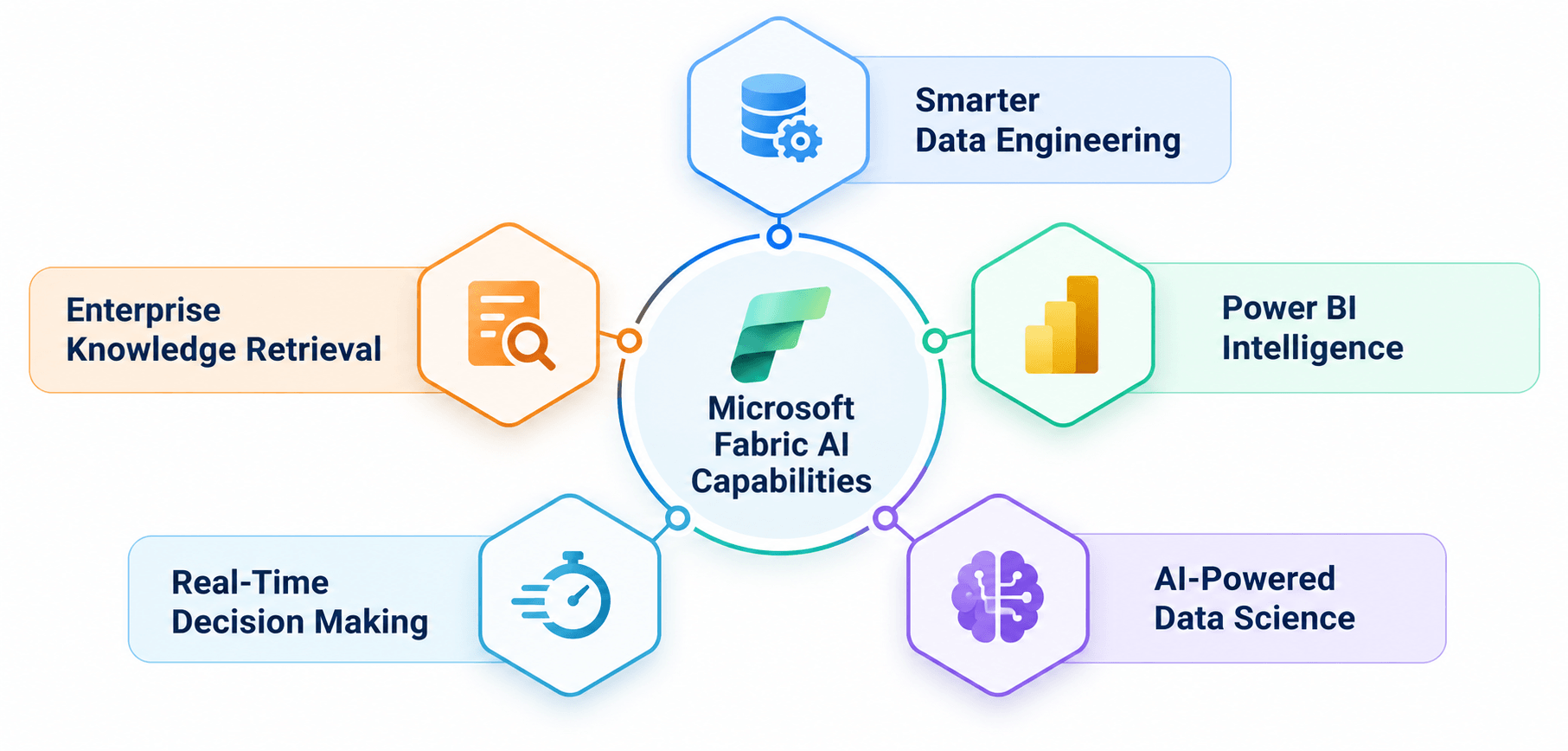
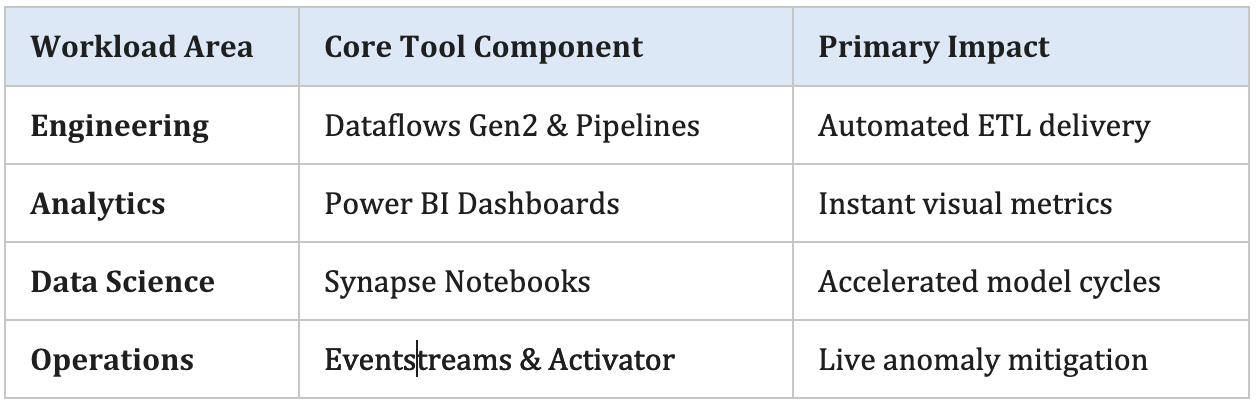
Deploying advanced Microsoft fabric AI capabilities reshapes how operational units handle big data. Deeply integrated AI tools shift workflows from labor intensive manual processes into highly optimized, automated environments.
These integrated assistants allow tech professionals to offload repetitive scripting tasks to focus strictly on strategic engineering architecture.
Data engineers frequently spend hours troubleshooting connectivity protocols and structural mappings. Copilot interfaces inside Data Factory drastically simplify this workload by providing automated pipeline assistance via simple chat windows.
The assistant interprets basic textual commands to build complete ETL (extract, transform, load) processes, automatically handling schema configurations. Engineers also use these systems to write optimized Apache Spark code directly inside notebooks to perform rapid data transformation without manual syntactic research.
Business analysts require rapid visualization options to keep pace with volatile market dynamics. The integration of Copilot for Power BI accelerates basic dashboard creation by converting structural semantic models into interactive visual charts using single text instructions.
Non-technical coordinators gain instant access to precise natural language insights that automatically summarize core metric shifts. The platform also offers automated DAX generation to help teams write complex operational measures without looking up structural function syntax.
Data scientists spend substantial time configuring algorithmic environments and tracking model variables. The system delivers complete notebook generation features that provide structural code frameworks for training machine learning algorithms.
Advanced Python helps scripts assist specialists in diagnosing runtime syntax exceptions through quick /fix console commands. Furthermore, automated model assistance tracks hyperparameter tuning iterations directly against the underlying corporate records.
Operations centers require immediate visibility into high velocity system telemetry to prevent downtime. Microsoft Fabric blends streaming analytics with event driven intelligence to process incoming sensor feeds immediately.
The integrated AI automatically flags transactional anomalies by continuously monitoring data pipelines via native Fabric Activator protocols. The platform emits structured business event alerts to connected dashboards the moment an outlier appears.
Modern corporations often struggle to discover insights trapped across fragmented, siloed databases. By unifying corporate properties inside OneLake, the platform establishes a singular source of operational truth.
AI tools parse underlying semantic models to extract relevant business information without moving files. This deep data grounding yields highly context-aware answers that remain strictly bound to your corporate compliance rules.
Expert Insight: Microsoft Fabric has updated its default architecture to utilize the advanced GPT 5 mini model for underlying AI Functions across PySpark, pandas, and Dataflows Gen2. This infrastructure upgrade provides enterprises with much faster text processing, sentiment analysis, and PII detection directly inside standard T-SQL database queries.
Measurable business performance directly impacts the scale of modern corporate digital upgrades. A successful Microsoft Fabric implementation transforms standard organizational frameworks by converting manual data operations into highly automated workflows.
This section highlights specific industry applications where deploying an automated enterprise AI architecture delivers massive returns.
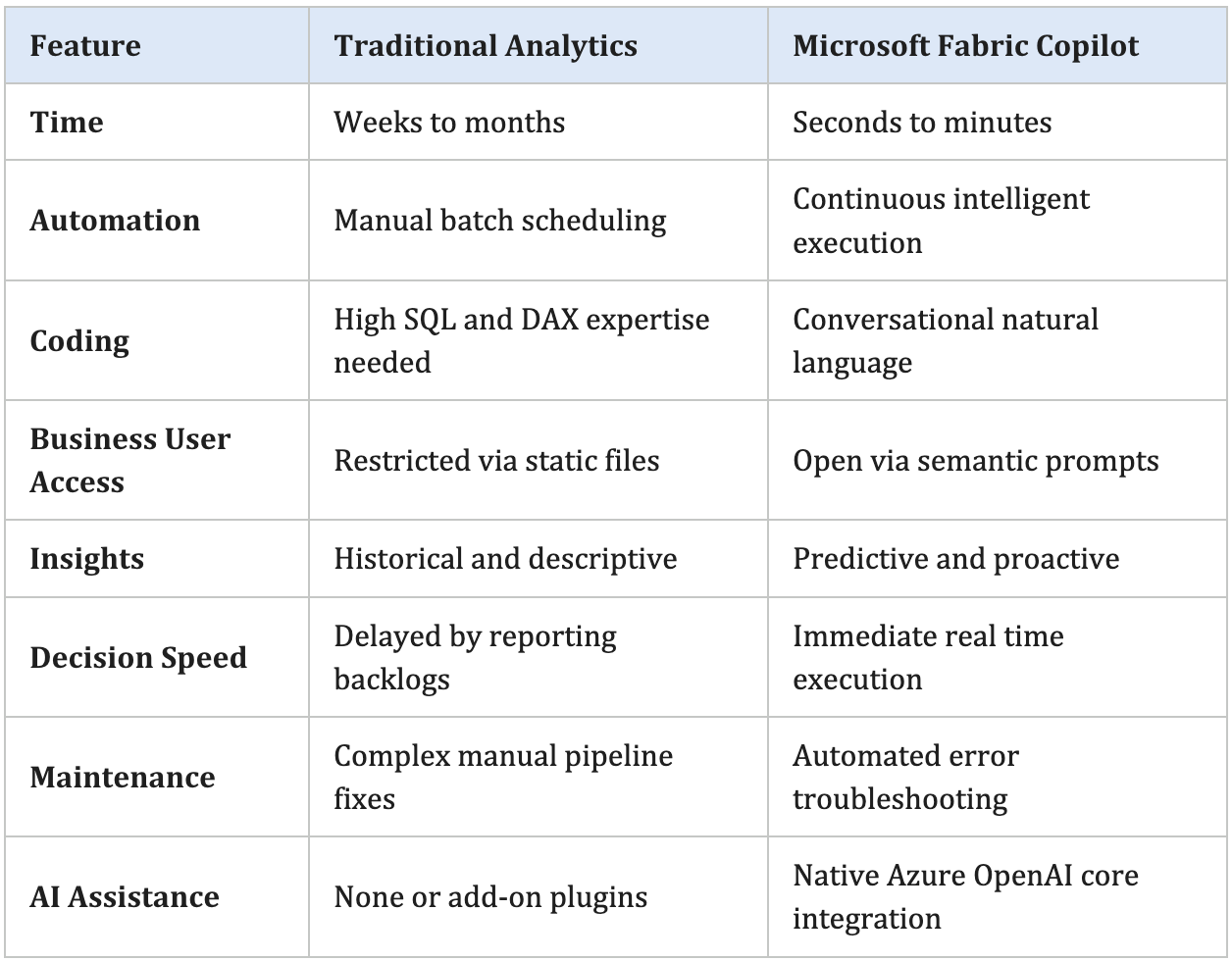
A data silo refers to an isolated repository that remains inaccessible to other core organizational departments. Standard business intelligence relies heavily on central IT teams to construct every database query, edit schema definitions, and publish flat executive dashboards.
Deploying Microsoft Fabric Copilot radically alters this operational dynamic by shifting analytics into an era of immediate conversational utility. Instead of waiting weeks for custom database schemas, business users leverage natural language to query unified datasets directly.
This open access model removes standard corporate ticketing queues and accelerates daily analytical delivery.
Prompt engineering refers to the practice of structuring text inputs, so generative AI models produce optimal outputs. Data quality means the condition of corporate records based on factors like accuracy, completeness, and reliability.
Deploying advanced tools introduces complex procedural friction that engineering leaders must address early. While Copilot leverages secure Azure OpenAI frameworks alongside pre-established organizational permissions, operational success still relies entirely on robust implementation strategies. Enterprises cannot simply turn the technology on and expect flawless results without corporate structural alignment.
Expert Insight: Unplanned capacity unit spikes represent the primary cause of system slowdowns during modern enterprise rollouts. Administrators should use the native Fabric Capacity Metrics app to isolate Copilot background tokens from core business intelligence queries.
Managing implementation complexity represents a massive hurdle when rolling out advanced enterprise cloud ecosystems. While Microsoft Fabric streamlines analytics by centralizing operations on OneLake, building a production ready environment requires specialized design. Professional Microsoft Fabric consulting services ensures that your core data lake architecture follows optimal formatting standards like the medallion pattern to streamline downstream processing.
Navigating a complex migration from fractured legacy repositories to unified cloud lakes demands careful execution to prevent operational downtime. Seasoned Microsoft Fabric consultants address these foundational challenges by executing structured transition roadmaps tailored to corporate requirements.
Experienced technical specialists accelerate organizational rollout success through crucial engineering steps:
Hexaview acts as a strategic engineering partner to guide companies through successful Microsoft Fabric implementation initiatives. The firm delivers comprehensive data modernization services, custom AI strategy formulation, and targeted Copilot implementation setups to drive operational efficiency.
Their certified engineering squads specialize in end-to-end Fabric deployment and Power BI optimization to build scalable, business ready analytics foundations. By designing an observable enterprise AI roadmap, Hexaview helps regulated corporations' transition safely into fully automated, context aware analytical organizations.
Microsoft Fabric is no longer just a standard cloud analytics platform. It is rapidly transforming into an intelligent enterprise operating system that drives autonomous, data driven action across business units. By uniting advanced Microsoft fabric AI capabilities like Copilot with context aware data agents, the modern ecosystem shifts analytics from descriptive reports to proactive enterprise automation.
Looking to implement Microsoft Fabric AI capabilities in your organization? Hexaview helps enterprises design, deploy, and optimize Microsoft Fabric, Copilot, and AI-powered analytics solutions tailored to business needs.
Connect with Hexaview today to accelerate your automated data journey.
Microsoft fabric ai capabilities refer to the native suite of generative AI tools, automated machine learning workflows, and conversational assistance features built into the Microsoft data platform. These services leverage advanced Azure OpenAI models to automate text analysis, code development, and predictive insights. Data teams use these embedded functions to streamline complex extract, transform, and load workflows inside unified environments.
Microsoft Fabric Copilot functions by interpreting conversational text inputs through large language models grounded in organizational metadata. When a user enters a plain text instruction, the assistant safely evaluates underlying schemas without exposing actual table data to public systems. The application then converts the request into structured code, SQL queries, or visual components based on the user's specific access permissions.
The primary difference lies in the level of operational autonomy and execution triggers. Microsoft Fabric Copilot operates as a reactive, prompt driven assistant that requires direct human instruction to complete specific coding or reporting tasks. Conversely, AI agents in Microsoft Fabric deploy function as goal driven systems that independently plan multi step workflows and execute tasks without human intervention.
Yes, Power BI Copilot generates comprehensive visual layouts and reports automatically using simple conversational commands. Users select an active semantic model and instruct the assistant to build particular dashboard views or metric trackers. The tool instantly creates tailored visual components, charts, and summaries while offering automated DAX expression generation to refine filtering measures.
Yes, Microsoft Fabric security architecture ensures that all processing remains bound inside strict compliance zones. The system handles conversational prompts using private Azure OpenAI service instances rather than public models, meaning your data is never used to train external algorithms. Furthermore, the system honors all pre-established workspace roles, row level rules, and Purview data loss prevention policies.
Microsoft Fabric Data Agents are conversational Q&A systems that enable business users to interact directly with organizational data repositories using natural language. These specialized tools connect natively with OneLake lakes, data warehouses, and semantic models without requiring technical database query experience. By linking these entities into Copilot Studio, companies create cohesive multi agent architectures to automate complex analytical pipelines.
Regulated fields managing vast, fragmented data volumes achieve massive efficiency gains from deploying enterprise AI architectures. Financial services use these automated systems to accelerate ledger reconciliations, while healthcare networks securely aggregate multi-site clinical charts. Retailers and manufacturing firms deploy these tools to automate inventory forecasting and optimize complex logistical supply chains.
Partnering with certified experts removes implementation complexity and prevents expensive capacity consumption overruns. Experienced Microsoft Fabric consulting ensure that the core data lake architecture adheres to proper performance tuning and medallion formatting standards. Professional advisors design clear governance frameworks, structure precise security controls, and deliver targeted rollouts to ensure full organization adoption.






.svg)



.svg)