

A practical framework for evaluating Direct Lake against real enterprise workloads.
Microsoft Fabric Direct Lake is often described as the next step for Power BI. For technology leaders, the more useful question is architectural.
Does Direct Lake actually fit the workload, data platform, security model, and reporting needs?
Direct Lake can bring Power BI closer to data stored in OneLake. It can reduce duplication and refresh dependency. However, Import and DirectQuery still have valid use cases. The decision should therefore focus on workload requirements. The goal is not to choose the newest storage mode. The goal is to choose the right architecture.
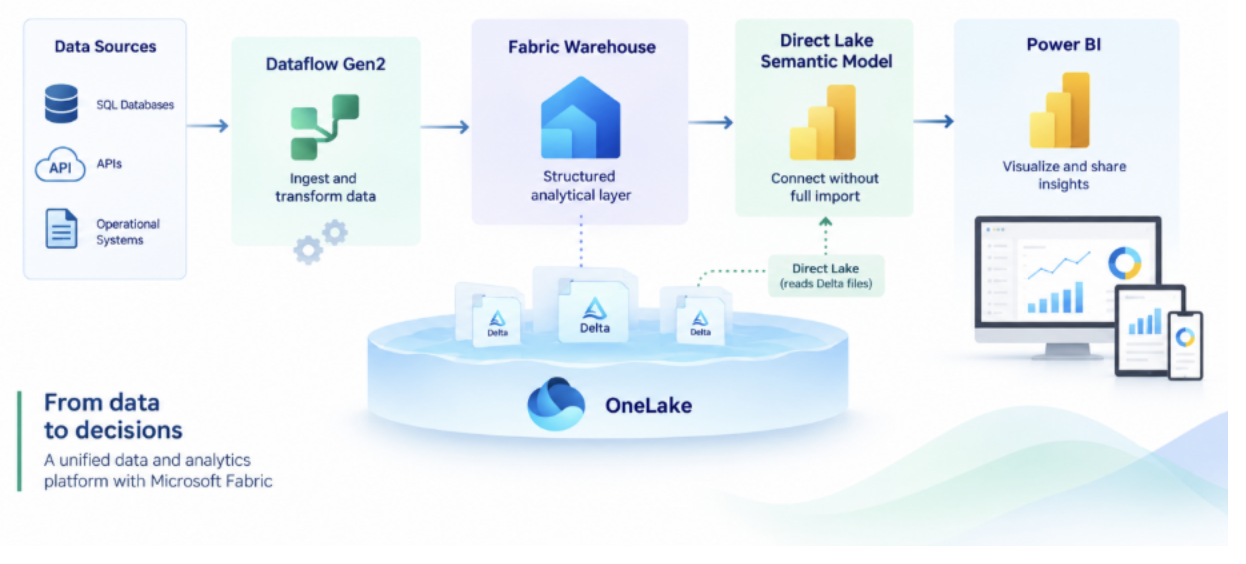
A common enterprise pattern can look like this:
SQL/API -> Dataflow Gen2 -> Fabric Warehouse -> Direct Lake Semantic Model -> Power BI
Dataflow Gen2 can bring operational data into Fabric. The Warehouse provides a structured analytical layer. The semantic model then connects Power BI to that data.
This creates a closer relationship between the data platform and reporting layer. Import works differently. Power BI maintains a cached copy of the data. A refresh processes that data and updates the semantic model. Direct Lake primarily uses framing. Framing updates metadata references to Delta files in OneLake. Data can then load into memory as queries require.
This difference matters as data volumes grow. It also matters when data changes frequently.
Direct Lake is not simply a replacement for Import or DirectQuery. Each storage mode addresses different workload requirements. Import remains useful for flexible self-service scenarios. It also supports semantic model capabilities that may require imported data.
DirectQuery can be useful when querying the source directly is important. It can also fit sources better suited to direct queries. Direct Lake is particularly relevant to Fabric-first architectures. This is especially true when data already exists as Delta tables in OneLake.
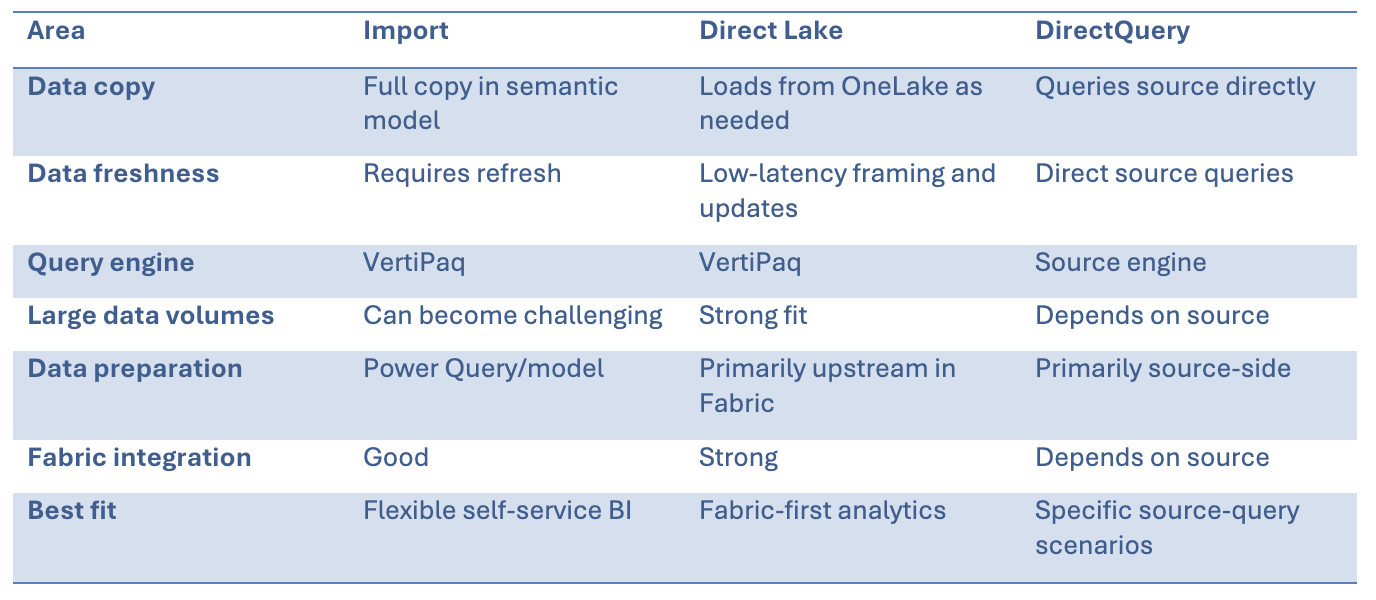
A useful way to think about the architecture is the data path.
Traditional pattern: Source -> ETL -> Database -> Import copy -> Power BI
Fabric-first pattern: Source -> Fabric data platform -> OneLake -> Direct Lake -> Power BI
The second pattern can reduce unnecessary movement and duplication. However, it does not make Import obsolete. Microsoft also supports composite approaches in relevant Direct Lake scenarios. Import and Direct Lake tables can coexist when the model requires it.
One of the most important Direct Lake decisions is the architecture behind the semantic model.
Direct Lake on OneLake works directly with Delta tables in Fabric data sources. It does not use the SQL analytics endpoint as its query path.
Direct Lake on SQL uses the SQL analytics endpoint for discovery and permission checks. In applicable situations, it can fall back to DirectQuery.
This difference affects more than query performance. It can change how security, SQL objects, and composite models work.
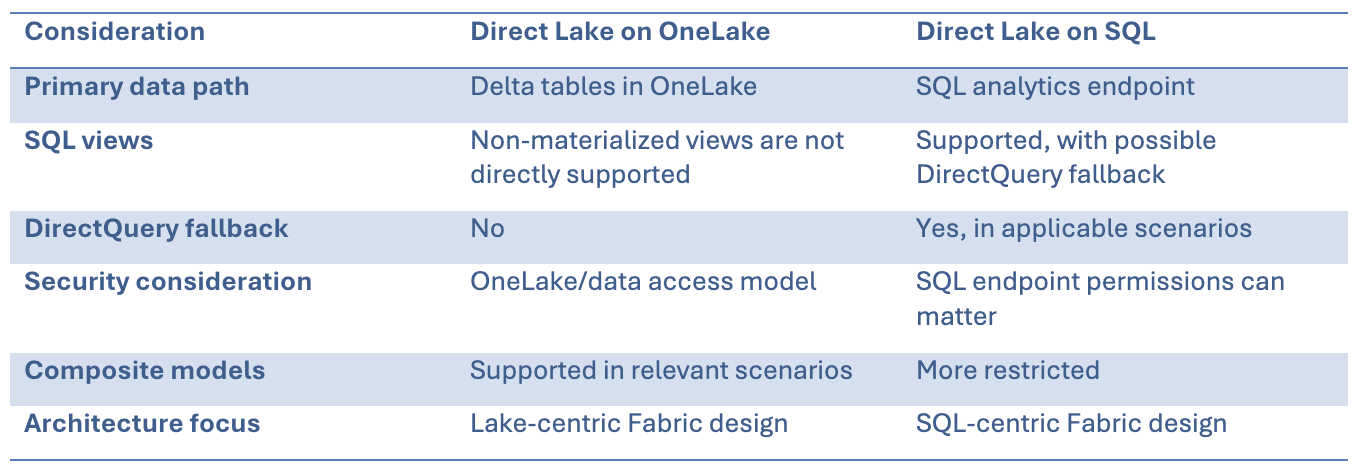
For example, a solution may depend on a SQL view. Direct Lake on OneLake may not consume that view directly. The design could then require materialization or a different upstream approach. The storage mode should therefore be selected after reviewing the complete architecture.
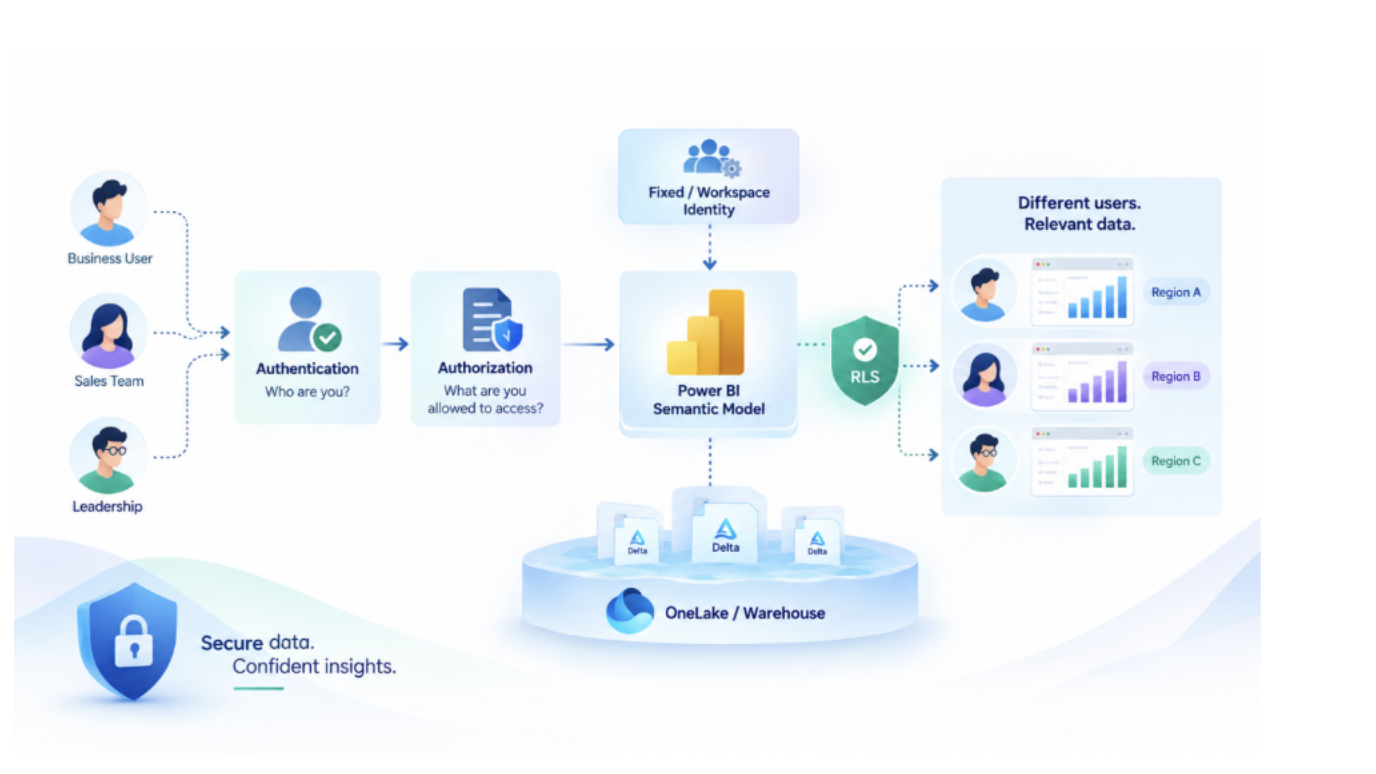
Performance often dominates Direct Lake discussions. Security needs equal attention. Two concepts should be separated: authentication and authorization.
Authentication answers: Who are you?
Authorization answers: What are you allowed to access?
A user having access to a Power BI report does not automatically mean unrestricted data access. This becomes important when using a Fixed Identity or Workspace Identity connection. A fixed identity can provide a controlled identity for underlying data access. It does not remove the need for authorization. If users need different data visibility, semantic model RLS can become important. Microsoft guidance supports fixed identity cloud connections for semantic model RLS in relevant Direct Lake scenarios.
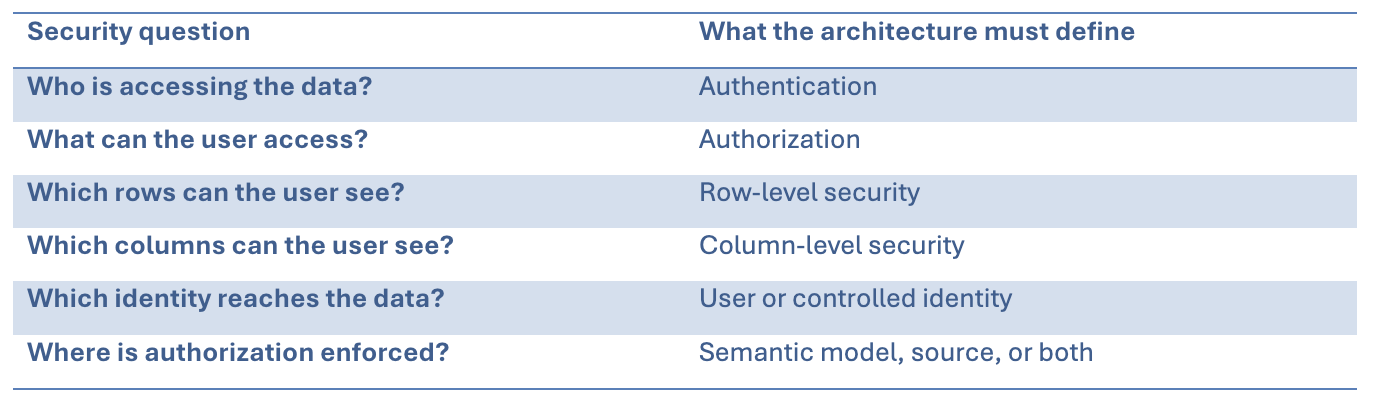
The production question is not simply whether the report opens. The stronger question is: who accesses the data, through which identity, and where is authorization enforced? That decision should be clear before production deployment.
Direct Lake continues to evolve, but architectural limitations remain. Direct Lake on OneLake does not directly support tables based on non-materialized SQL views. Some calculated column and calculated table scenarios also have limitations. Composite modeling capabilities can differ between Direct Lake on OneLake and Direct Lake on SQL.
Other considerations include gateways, service principals, regional placement, and semantic model capabilities. These details can become architecture blockers. A design should identify them before implementation. If a required SQL view is unsupported, the solution may need materialization. It may also need another storage mode or an upstream redesign.
This is why Direct Lake should be evaluated as part of the complete workload.
Cost is naturally part of a Fabric architecture discussion. Direct Lake can reduce unnecessary duplication. The semantic model does not maintain a traditional full imported copy. It can also reduce the overhead associated with full refresh operations. That does not mean Direct Lake automatically lowers total cost.
Fabric capacity still needs appropriate sizing. Poorly designed or optimized Delta tables can increase resource consumption. A better approach is to design the architecture first. Capacity can then be sized around the actual workload.
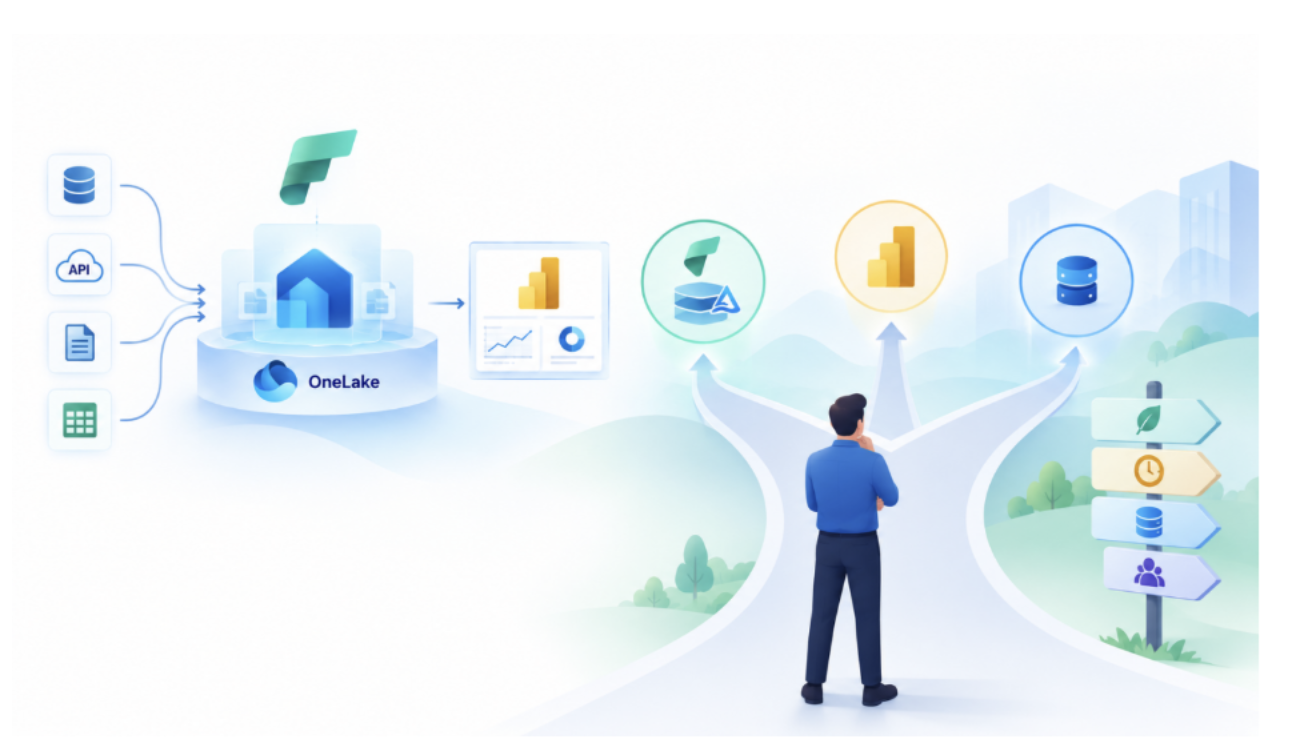
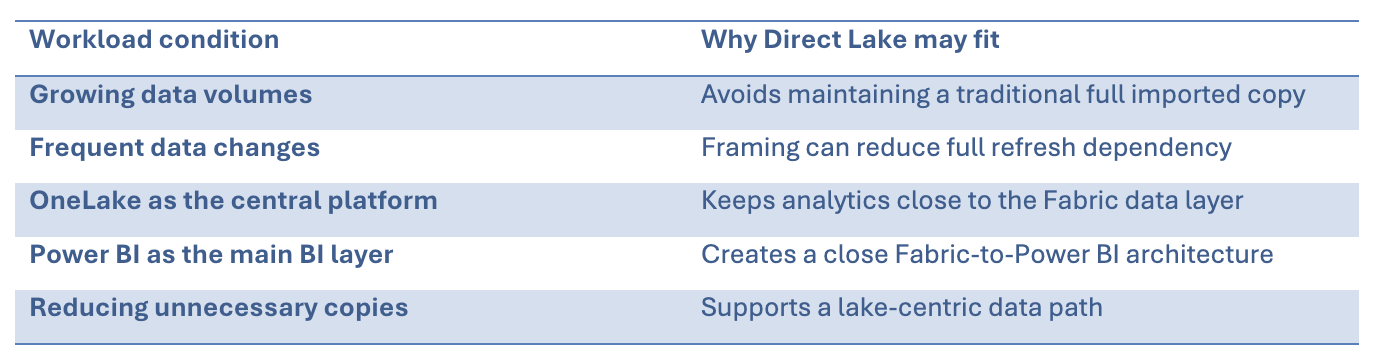
Direct Lake can be a natural fit for a Fabric-first, lake-centric architecture. This is especially relevant when data is already prepared in Fabric and stored as Delta tables in OneLake. It can also fit workloads where Power BI is the main analytical consumption layer.
Import and DirectQuery can still be appropriate. A self-service analyst may need Power Query transformations. A source may require DirectQuery. A model may depend on features better supported elsewhere. There is no universal storage-mode recommendation. The workload should drive the decision.
A practical evaluation should begin with the workload, not the feature.
Five questions provide a useful starting point.
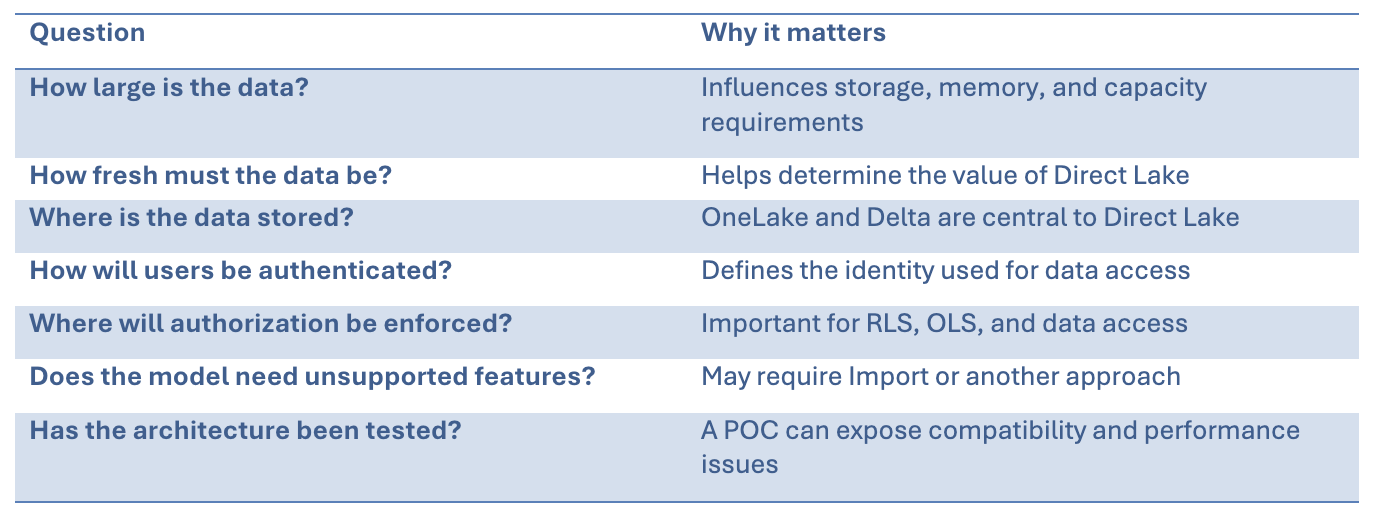
Proof of concept is especially useful before production deployment. It can validate performance, security, model compatibility, and capacity behavior.This turns the decision from a feature discussion into an evidence-based architecture exercise.
At Hexaview Technologies, our Microsoft Fabric implementation and approach starts with architecture. Fabric should not be treated as a list of features to switch on. It should work as an end-to-end data and analytics platform. That means data architecture, semantic modeling, security, performance, and business requirements must work together.
Direct Lake can be an important part of that platform. But adoption should follow workload analysis, not novelty.The core purpose of choosing Hexaview is to design and validate the right Fabric architecture for the business. We help connect data engineering, Power BI, security, governance, and performance into a practical implementation.
Understand the workload. Design the architecture. Validate security and limitations. Test performance. Then make the decision through a proof of concept.That is how Direct Lake becomes an architecture choice, not simply another Fabric feature.
What is Microsoft Fabric Direct Lake?
Direct Lake is a Power BI storage mode that reads data from Delta tables in OneLake without maintaining a traditional full imported copy.
Is Direct Lake better than Import or DirectQuery?
Not always. The right choice depends on data volume, freshness, security, semantic model requirements, and workload design.
Does Direct Lake replace Import mode?
No. Import remains useful for self-service scenarios and models requiring specific semantic capabilities.
What is Direct Lake on OneLake?
It reads Delta tables directly from OneLake and does not use the SQL analytics endpoint as its query path.
What is Direct Lake on SQL?
It uses the SQL analytics endpoint for discovery and permissions and can fall back to DirectQuery in applicable scenarios.
Can Direct Lake use SQL views?
Direct Lake on OneLake does not directly support non-materialized SQL views. This may require materialization or another architecture.
How does Direct Lake handle security?
Security requires separate consideration of authentication and authorization. Fixed Identity and semantic model RLS can be part of the design.
Is Direct Lake cheaper than Import?
Not automatically. It can reduce duplication and refresh overhead, but Fabric capacity still needs to match the workload.
When should you use Direct Lake?
It can fit Fabric-first architectures where data is stored in OneLake, freshness matters, and reducing duplication is important.
What should you check before adopting Direct Lake?
Evaluate data size, freshness, security, required semantic model features, limitations, capacity, and performance. A proof of concept can validate the design before production.








.svg)




.svg)