
Microsoft Fabric for Banking and Wealth Management helps institutions unify financial data, govern access, and build trusted analytics across banking and investment workloads. It can support customer and client 360 views, risk and fraud analysis, regulatory and operational reporting, portfolio insights, and real-time scenarios. With capacity monitoring and workload optimization, organizations can also maintain greater control over Fabric spending as usage grows.
Key Takeaways
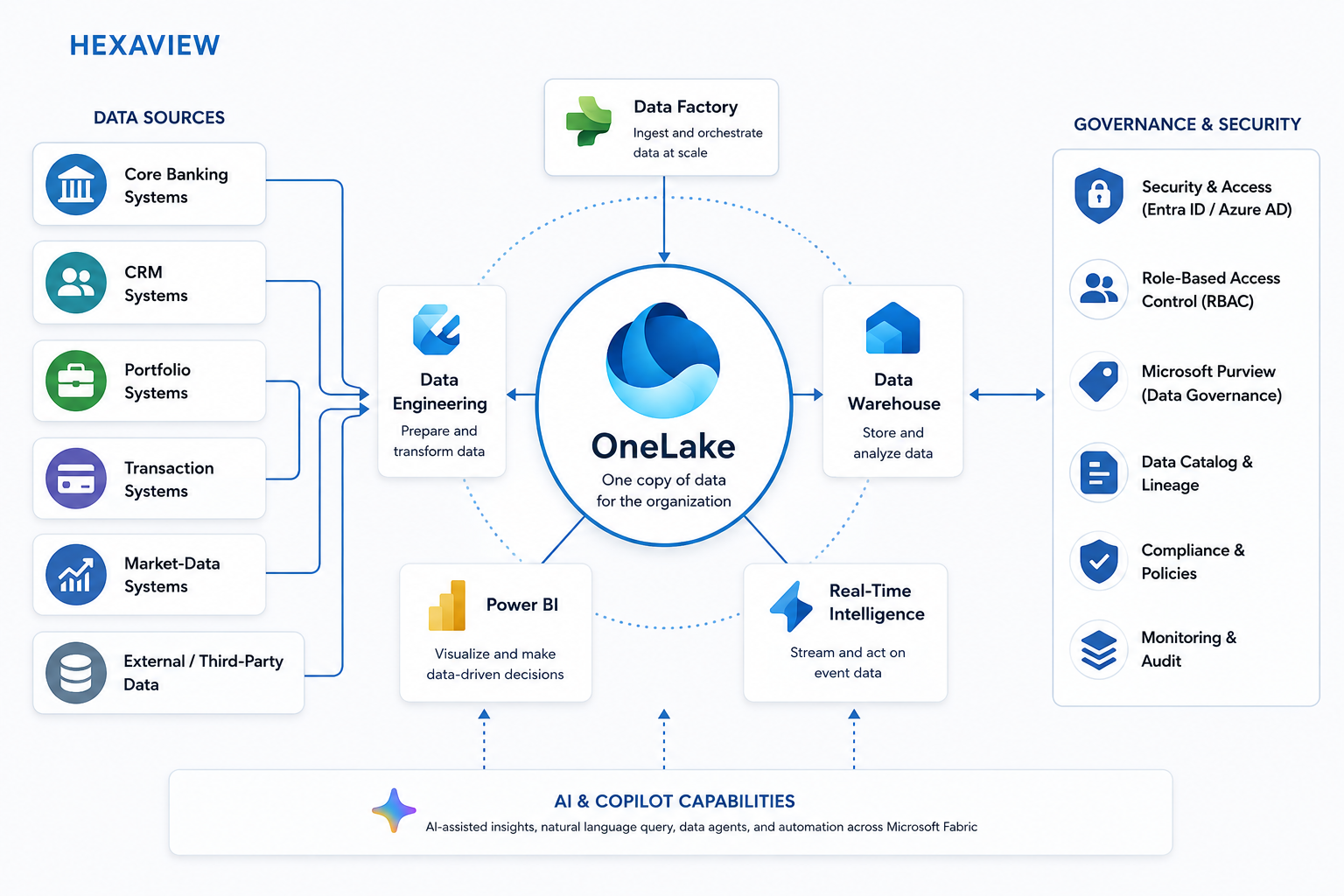
Microsoft Fabric is relevant to financial services because it combines several data and analytics capabilities within a shared platform.
OneLake provides Fabric's unified logical data lake. Data Factory supports data ingestion, movement, transformation, and orchestration. Data Engineering supports processing and refinement. Data Warehouse supports structured analytical workloads. Real-Time Intelligence supports streaming and event-based scenarios. Power BI provides reporting and business intelligence.
This architecture matters because financial institutions often need multiple analytical workloads to work from connected data.
For example:
Fabric can also work with Microsoft Purview capabilities for data discovery, classification, sensitivity labels, lineage, protection, and governance. These capabilities can help organizations manage sensitive financial data, but they do not make an institution automatically compliant with every regulation.
The value therefore comes from architecture, governance, data quality, and implementation decisions rather than from the platform alone.
The real benefits of Microsoft Fabric depend on how financial institutions use the platform. The most relevant benefits include:
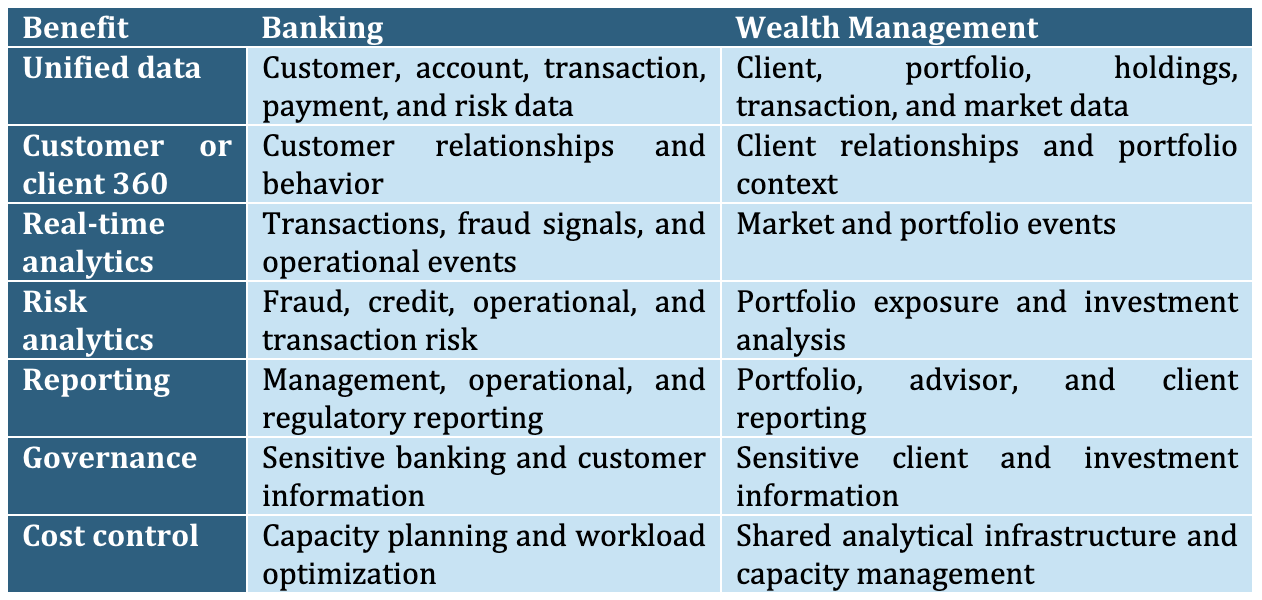
These benefits are interconnected.
A unified data foundation can improve analytical consistency. Better data access can support stronger customer and client insights. Real-time capabilities can support event-driven monitoring. Governance can help organizations control how sensitive information is accessed and used.
However, Fabric does not guarantee these outcomes automatically. Financial institutions still need appropriate architecture, data quality, governance, security, capacity planning, and adoption processes.
Microsoft Fabric can provide banks with a common analytical foundation for banking data integration, customer insights, fraud analysis, risk monitoring, and reporting.
Banks often distribute data across core banking systems, payment platforms, cards, ATMs, digital channels, CRM systems, loan systems, and fraud platforms. Fabric can bring these sources into a common analytical environment through OneLake, supported by integrated data engineering, warehousing, analytics, and BI capabilities. This can improve data accessibility and consistency for analytics without requiring banks to eliminate their underlying systems.
A bank can combine customer profiles + accounts + transactions + products + digital interactions to build a more complete analytical view. That information can support product-opportunity analysis, customer behavior analysis, service interactions, churn indicators, and segmentation. Microsoft's financial-services guidance specifically highlights holistic customer views and customer insights as relevant scenarios.
Fraud detection is a strong example of where Fabric's real-time capabilities can address a specific banking problem. Microsoft's reference architecture shows transaction streams from mobile banking, ATMs, e-commerce, and call centers entering Eventstreams, with events processed in Eventhouse, enriched with customer and historical data, and analyzed using machine-learning models for fraud-risk scoring. Activator can then trigger alerts when defined risk thresholds or fraud signatures are detected, while real-time dashboards and Power BI provide analytical visibility.
This architecture supports real-time transaction analysis, anomaly detection, behavioral pattern analysis, risk scoring, alerts, and the combination of streaming and historical data. Fabric therefore provides the data and real-time analytics foundation for fraud-detection workflows rather than independently preventing fraud.
Consolidated and governed banking data can support risk monitoring, compliance analytics, operational-risk analysis, management reporting, and investigation workflows. The value comes from making relevant information easier to analyze across connected datasets. However, Fabric does not make a bank compliant by itself. It can support the data, governance, and analytics processes that contribute to compliance and risk-management activities.
Reporting teams can often work from different datasets, definitions, and analytical pipelines. Fabric brings data engineering, warehouse, and BI workloads into a connected analytical environment. Reusable datasets and models can support more consistent Power BI reporting while reducing unnecessary duplication between analytical workflows. This can improve reporting consistency and operational efficiency without suggesting that every banking report becomes real-time.
Fabric capabilities alone do not determine the outcome. Banks still need sound source-system integration, data quality, governance, security, workload design, capacity planning, and user adoption. This is where Microsoft Fabric consulting services can become valuable for complex environments. Fabric provides the platform's capabilities, but banks still need sound architecture and implementation decisions to realize those benefits.
Wealth management has different analytical requirements from traditional retail banking.
Firms may need to connect client information with portfolios, holdings, transactions, advisor interactions, investment data, and market information.
This makes Microsoft Fabric for wealth management relevant when firms need a common analytical foundation for client and investment workflows.
A wealth manager may need to analyze a client's profile, accounts, holdings, transactions, portfolio information, advisor interactions, preferences, and relevant market information. Bringing these datasets together can provide analytical teams with a more complete information base for client reviews and relationship analysis.
Fabric can consolidate data from different systems into a shared environment, but the resulting client view still depends on effective integration, data modelling, and governance. Microsoft's financial services guidance describes consolidating diverse sources to support more comprehensive customer insights.
Portfolio analytics is one of the most distinctive wealth-management use cases. Consolidated data can support analysis of portfolio performance, asset allocation, holdings, transaction activity, client-level exposure, historical trends, and market-related information.
Microsoft specifically describes using Azure Machine Learning with Fabric to build investment models using real-time market data and individual client profiles. This can support portfolio analysis and investment workflows, while investment decisions remain subject to the firm's models, controls, suitability processes, and professional judgement.
Personalization depends on having relevant data available in a usable form. A governed analytical environment can help wealth managers analyze client preferences, portfolio relationships, interaction history, product relationships, and behavioral patterns.
These insights can support more relevant client engagement, segmentation, and advisor workflows. Microsoft's financial-services guidance identifies deeper customer insights and personalized financial experiences among relevant data-driven scenarios.
The important point is that Fabric provides part of the data foundation. It does not automatically personalize every client interaction.
Wealth-management analytics often requires a combination of client data + portfolio data + transaction data + market data. Analyzing these datasets separately can limit the context available to investment and advisory teams.
Fabric can help connect these sources within a unified analytical environment. Microsoft also highlights connectivity to financial data providers and market data feeds, alongside integration with trading platforms, risk systems, CRMs, and internal systems.
This can support portfolio performance analysis, exposure analysis, client segmentation, advisor reporting, and investment analytics.
The objective is not simply to produce more dashboards. It is to make relevant client, portfolio, transaction, and interaction data available through a common analytical foundation.
That context can support client reviews, portfolio discussions, relationship analysis, performance reporting, and opportunity identification. Power BI can then present governed analytical outputs through reports and dashboards, helping advisors work with consistent information rather than disconnected datasets.
Wealth-management environments contain sensitive client, portfolio, investment, and transaction information. Governance therefore needs to address access permissions, data lineage, security, and appropriate handling of sensitive information.
Fabric provides governance and lineage capabilities, while its broader governance ecosystem integrates with Microsoft Purview. These capabilities can support the controls and processes required for responsible financial data management, but they do not by themselves guarantee regulatory compliance.
Traditional financial data environments can involve separate systems for ingestion, storage, processing, analytics, and reporting.
Microsoft Fabric brings many of these capabilities into a shared platform.
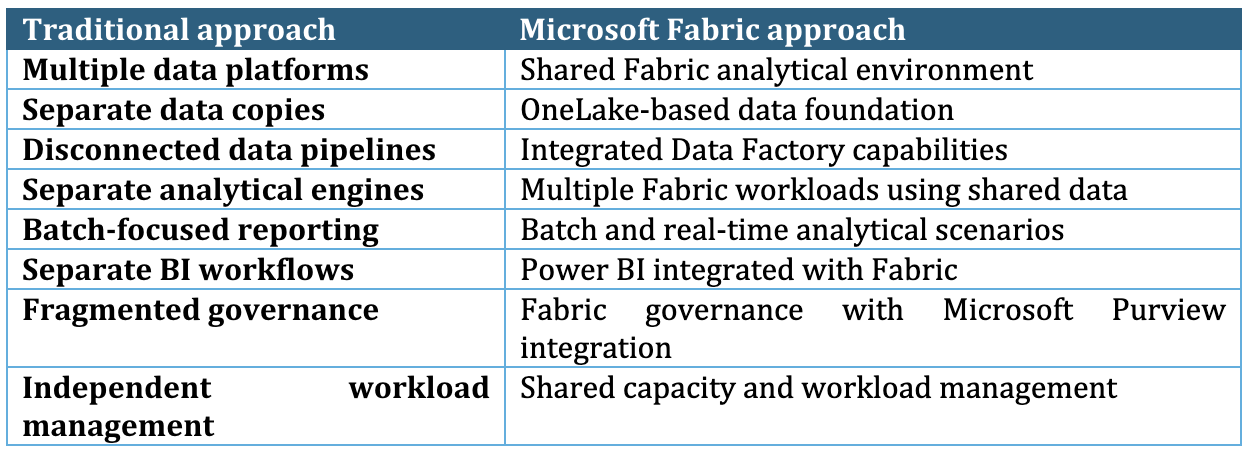
The distinction is important.
Fabric does not mean that every financial institution must eliminate its existing platforms. Banks and wealth managers may continue using operational systems, specialized applications, market-data providers, and other technologies.
Fabric can instead act as a connected analytical foundation across these environments.
This can be particularly useful when an institution wants to modernize analytics without replacing every operational system at once.
For financial institutions, the right Microsoft Fabric consulting services partner should address more than initial platform deployment. Key capabilities include architecture assessment, migration planning, Fabric implementation, data engineering, governance design, Power BI integration, capacity optimization, and post-implementation support.
Hexaview Technologies describes these capabilities across its Fabric implementation and architecture services, including OneLake design, data migration, governance, Power BI integration, and capacity optimization.
Organizations comparing top Microsoft Fabric consulting companies can therefore assess partners against these practical delivery capabilities rather than rankings alone. Hexaview also has a published case study on a governed Microsoft Fabric Lakehouse for wealth and trust management, providing a relevant example for this audience.
Banks and wealth managers should evaluate Microsoft Fabric partners against delivery evidence, not marketing claims or rankings. When reviewing companies described as top Microsoft Fabric consulting companies, buyers should verify:
A company appearing on a “top” list does not automatically make it suitable for a bank. Relevant delivery evidence should carry greater weight than rankings alone.
A practical example can make the value of Microsoft Fabric easier to understand.
Hexaview's case-study library currently features “Governed Lakehouse Reporting on Microsoft Fabric for Wealth and Trust Management.” The case study describes the consolidation of fragmented financial and CRM systems into a governed analytics environment for wealth and trust management.
A strong partner should be able to provide a named implementation team, methodology, milestones, governance approach, and support model.
A company appearing on a “top” list does not automatically make it suitable for a bank or wealth manager.
Relevant delivery evidence should carry more weight than rankings alone.
1. What is Microsoft Fabric for banking?
Microsoft Fabric provides a unified analytics environment for bringing together financial data, data engineering, warehousing, real-time analytics, and reporting across banking workloads.
2. How can Microsoft Fabric help wealth management firms?
It can connect client and portfolio data to support governed access, analytical reporting, portfolio analysis, and deeper client insights across wealth-management workflows.
3. Can Microsoft Fabric support fraud detection?
Yes. Microsoft's Fabric reference architecture uses real-time transaction streams, machine learning, risk scoring, and analysis to support fraud detection workflows.
4. How does Microsoft Fabric support financial data governance?
Fabric integrates with Microsoft Purview for sensitivity labels, protection policies, access controls, data discovery, and lineage, supporting structured financial-data governance.
5. How can banks optimize Microsoft Fabric costs?
Banks can monitor capacity usage, right-size resources, optimize workloads and storage, scale according to demand, and consider reservations for predictable usage.
6. Do banks need Microsoft Fabric implementation services?
Not always. Complex environments may benefit from specialist implementation services covering architecture, migration, governance, integration, and capacity planning.






.svg)


.svg)