
Microsoft Fabric offers an end-to-end analytics ecosystem with unified storage, AI-powered experiences, real-time analytics, and Power BI integration. Snowflake focuses on scalable cloud data warehousing, secure data sharing, and cross-cloud flexibility. Enterprises invested in Microsoft technologies often benefit from Fabric's unified experience, while organizations prioritizing independent cloud-native warehousing may prefer Snowflake. Business objectives, implementation complexity, governance requirements, and long-term scalability should guide the decision.
Modern enterprises face massive challenges managing growing data volumes. Selecting the wrong data platform causes major operational inefficiencies.
The rapid evolution of AI-driven analytics reshapes how companies operate. Choosing between Microsoft Fabric vs Snowflake impacts your entire technology strategy.
Microsoft Fabric provides a unified Software as a Service analytics environment. Snowflake offers a highly scalable multi cloud data platform.
This unbiased comparison evaluates architecture, cost, performance, and features. You will discover the strengths and limitations of both solutions.
Microsoft Fabric functions as a fully managed, unified Software as a Service analytics ecosystem. Microsoft built Fabric to eliminate complex data silos across legacy corporate infrastructure.
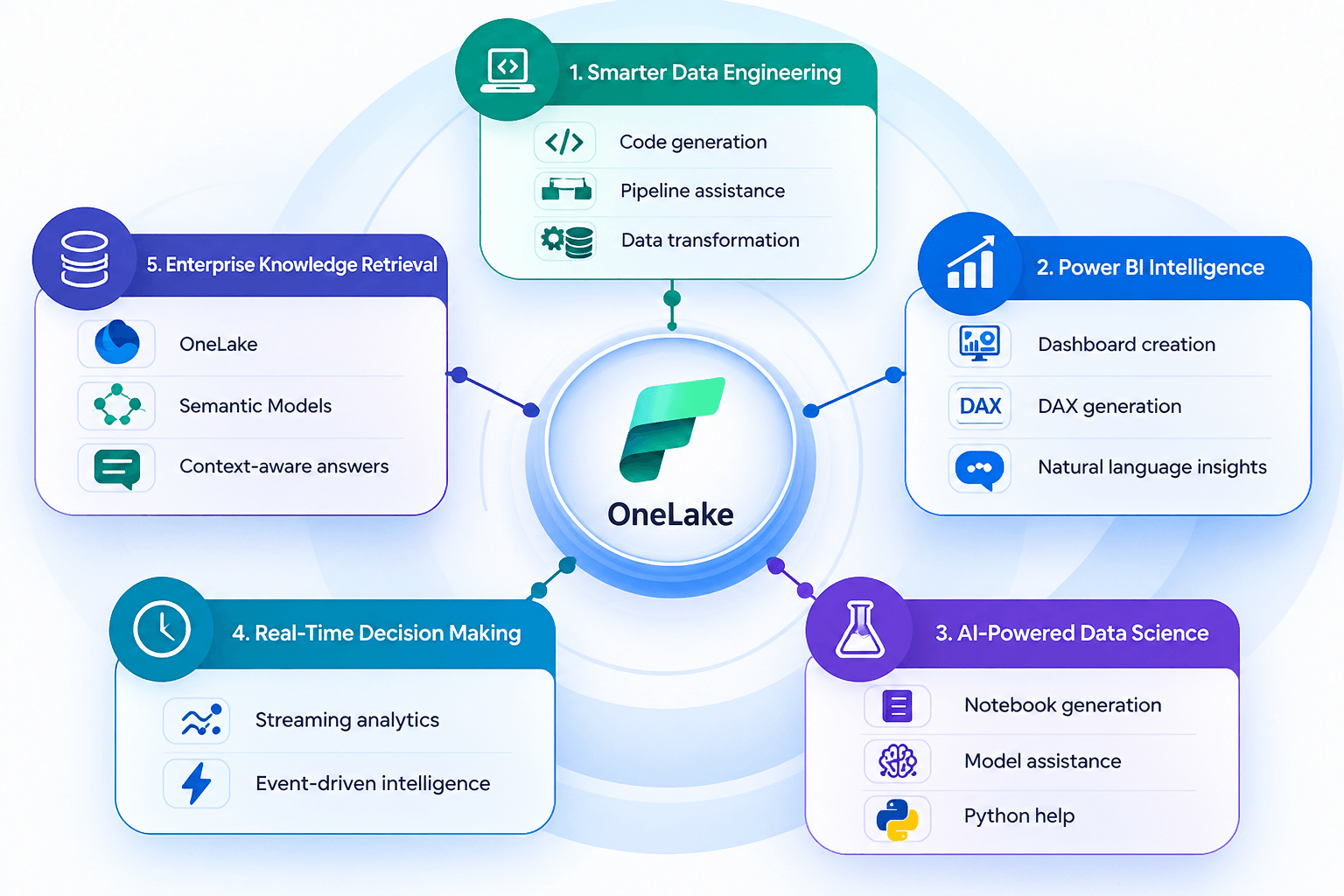
The platform centers around OneLake, which acts as a single data source. Data Factory handles seamless data ingestion and complex enterprise workflow orchestration. Synapse provides deep data engineering, data science, and advanced data warehousing tools.
Power BI integrates natively to deliver fast, direct lake reporting and visualization. Real-Time Intelligence captures, processes, and routes massive streaming event data instantly. Copilot provides intuitive, natural language assistance across every single analytics workload.
Microsoft Fabric includes native governance via Purview for unified security and compliance. This unified architecture provides immense advantages for modern, data driven corporations.
Enterprises are rapidly adopting Fabric to accelerate their core AI initiatives. Typical enterprise use cases span automated financial reconciliation and predictive supply chain management. It empowers teams to collaborative effectively using one centralized, secure data lake.
Learn More About Microsoft Fabric
Snowflake operates as a highly scalable, multi cloud data platform. The platform uses a unique architecture that completely separates storage from compute. This physical separation allows independent scaling for storage needs and computing resources.
Snowflake evolved far beyond traditional cloud data warehousing into a comprehensive network. The platform supports seamless multi cloud deployment across AWS, Azure, and Google Cloud.
Businesses easily establish elastic compute clusters to handle heavy concurrent query workloads. Secure Data Sharing allows organizations to share live information without copying files. The Snowflake Data Marketplace lets users acquire third party data sets instantly.
For advanced computing, Snowpark executes non-SQL code directly inside the engine. The platform infuses AI capabilities through built-in large language models. Cortex AI delivers managed machine learning services for secure enterprise application development. This massive data cloud network powers modern global data operations efficiently.
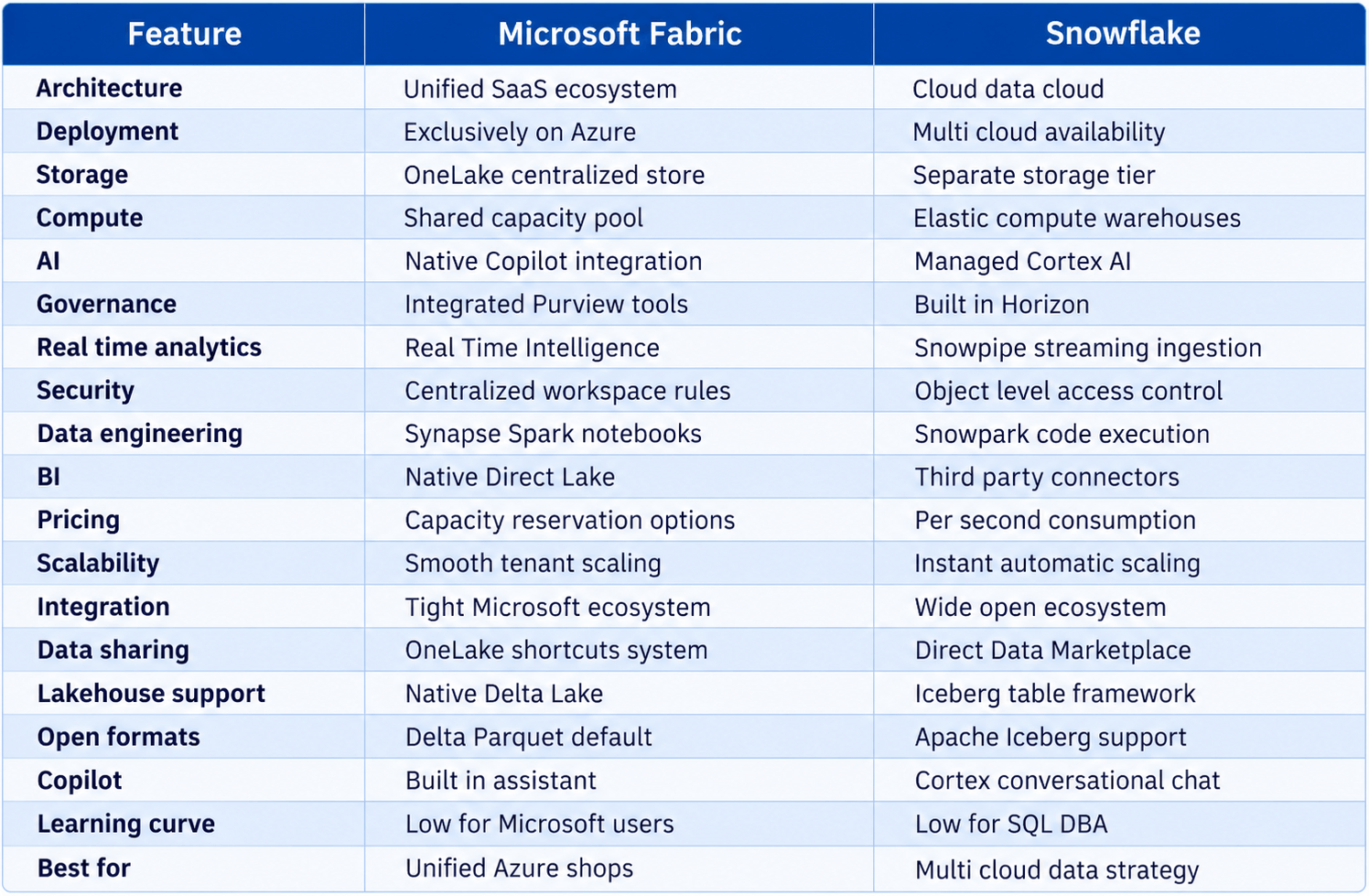
Microsoft Fabric implements a unified Software as a Service delivery framework. It standardizes on one central OneLake repository for all tenant data. Every component reads the exact same Delta Parquet file format directly. This design completely eliminates the need for complex internal data copying.
Snowflake utilizes an independent multi cloud platform architecture strategy instead. It strictly decouples compute resources from the centralized cloud storage layer. This separation permits users to scale query workloads independently and dynamically. Snowflake natively supports multiple file formats including managed Apache Iceberg tables. It gives enterprises incredible architectural flexibility across multiple major cloud providers.
Evaluating enterprise data infrastructure requires a deep technical look at their underlying designs.
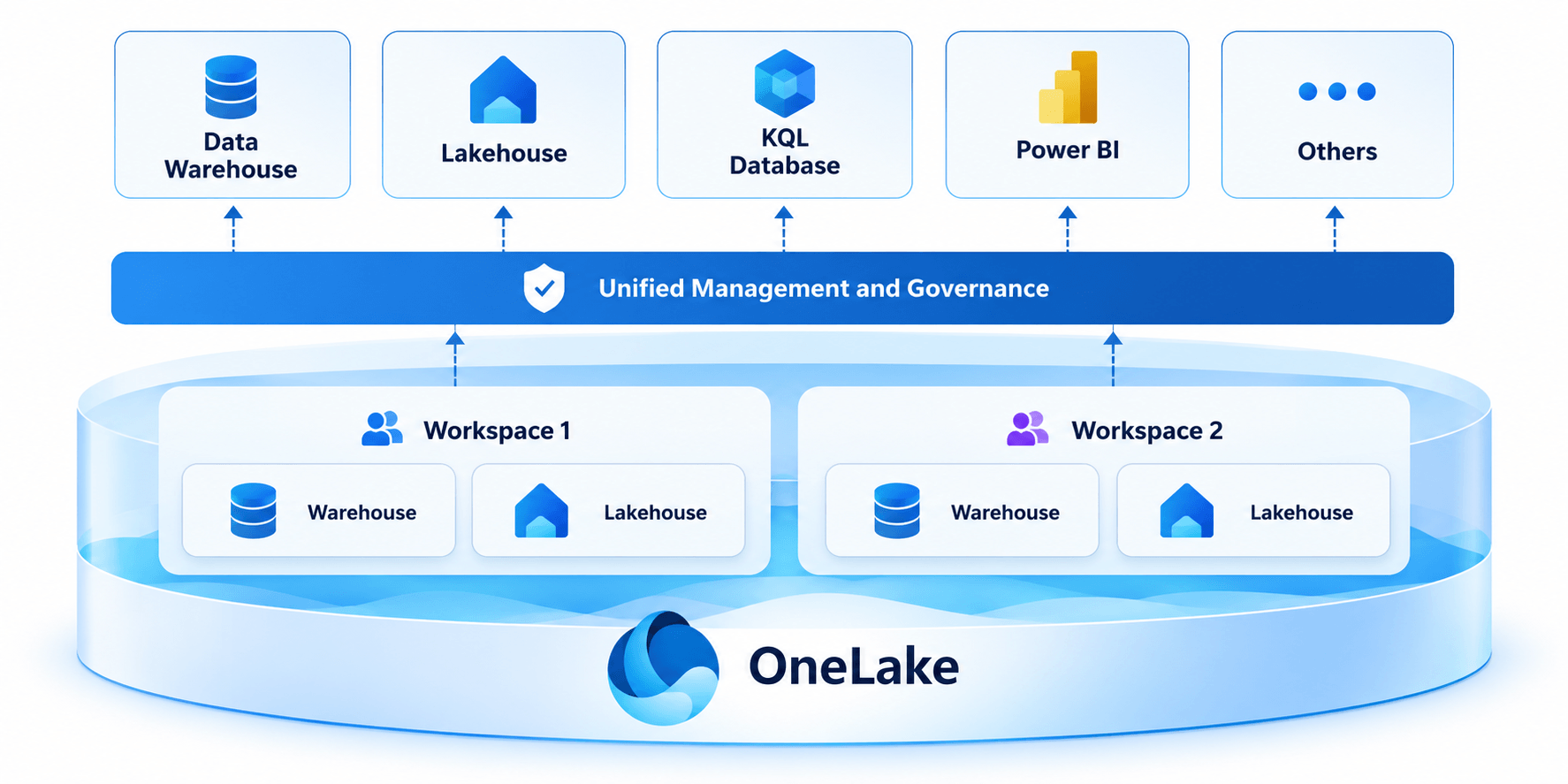
Microsoft Fabric uses a Software as a Service delivery model built entirely on OneLake. OneLake provides centralized, single copy storage for the entire organizational tenant.
Multiple analytical workloads access the exact same underlying physical data storage simultaneously. The system native format relies heavily on open standard Delta Parquet files. Separate workspaces access Lakehouse and Data Warehouse engines without copying files internally. This design eliminates complex internal data pipeline movement across different analytics modules.
Know More About Microsoft Fabric Architecture
Snowflake separates its core platform infrastructure into three distinct, specialized technical layers. The storage layer keeps diverse enterprise datasets in highly optimized columnar structures.
The compute layer utilizes independent virtual warehouses to process heavy query workloads. These virtual warehouses execute operations without competing for shared hardware resources. Finally, the cloud services layer handles metadata optimization, security rules, and transactions. This structural arrangement ensures highly efficient query processing across distinct cloud systems.
Microsoft Fabric minimizes data movement by serving data directly from one central lake. This single copy model reduces data processing latency and lowers pipeline maintenance costs. Unified governance happens globally through integrated Microsoft Purview compliance tools.
Snowflake simplifies cross cloud data warehousing operations using distinct virtual compute clusters. It provides exceptional isolation for massive, concurrent corporate query workloads. Both architectural methodologies successfully reduce the operational friction found in traditional infrastructure setups.
Deploying enterprise artificial intelligence requires deep integration between data layers and machine learning frameworks.
Microsoft Fabric weaves artificial intelligence directly into the daily workspace analytics flow. Built in Copilot features accelerate user productivity across every data workflow. Teams use AI Skills to interrogate complex semantic models using natural conversational language.
The platform runs automated AI assisted data pipelines to transform incoming operational streams. Analysts execute intelligent forecasting directly within native Power BI visualization workspaces. It focuses heavily on democratization, allowing non-technical users to build insights. This setup speeds up daily tasks without requiring advanced data science engineering degrees.
Snowflake delivers highly secure machine learning capabilities directly where corporate records reside. The platform utilizes Cortex AI to provide managed serverless large language models. Data scientists leverage Snowpark ML to build and deploy complex custom models.
The internal architecture natively executes high performance vector search over structured datasets. Developers use SQL or Python commands to build secure, agentic workflows. It completely eliminates the massive risk of moving confidential data to external systems. Organizations maintain total control via strict role based enterprise access rules.
Microsoft Fabric drives exceptional development speed for business intelligence and reporting operations. It allows corporate teams to adopt AI technologies rapidly through automated systems.
Snowflake provides superior control for engineering complex, custom large language model applications. It remains the better choice for data teams requiring low level programmatic optimization. Both systems successfully reduce the heavy infrastructure friction of traditional machine learning setups.
Managing highly demanding corporate database applications requires intelligent computing setups.
Microsoft Fabric utilizes a shared capacity framework to run all active corporate tasks. This platform distributes compute resources across engineering, data science, and visualization teams dynamically. Under heavy concurrent usage, Fabric automatically applies flattening algorithms to stabilize general system responsiveness. The integrated Real-Time Intelligence workspace processes complex streaming events instantly without complex data pipelines.
Snowflake relies on independent virtual warehouses to deliver absolute workload isolation. A massive data science machine learning job will never delay executive financial dashboards. Users configure elastic compute clusters to auto scale instantly when user demand surges. Snowflake handles massive concurrent query volumes effortlessly using these isolated processing resources.
Choosing the right option affects long-term operational efficiency for your data infrastructure. Fabric optimizes standard business workflows by keeping data unified inside OneLake storage. Snowflake excels at processing massive, spiky workloads that require isolated, raw power.
Global corporations require rigorous data asset protection and complete regulatory compliance.
Microsoft Fabric enforces comprehensive security governance directly through deep Microsoft Purview integration. The platform automatically propagates sensitivity labels from raw ingestion down to visualization dashboards. Security administrators set up granular workspace rules to restrict access across specific employee groups. This tightly unified identity approach leverages existing enterprise Entra ID configurations seamlessly.
Snowflake manages corporate data compliance through its comprehensive built in Horizon catalog framework. The security engine delivers exceptionally robust role based access control across all database objects. Administrators deploy advanced dynamic data masking policies to shield sensitive fields automatically. Detailed audit logs track every single user query execution across multiple clouds meticulously.
Both cloud architectures successfully meet stringent enterprise security requirements for modern operations. Fabric simplifies compliance oversight for organizations already embedded within the Microsoft ecosystem. Snowflake provides independent, cross cloud governance tools for heterogeneous enterprise technology environments.
Understanding the distinct pricing philosophies prevents unexpected budget overruns down the road.
Microsoft Fabric bills customers based on fixed capacity reservation tiers called SKUs. This purchasing structure provides exceptional financial predictability for monthly corporate IT budgets. Organizations eliminate hidden licensing costs since Fabric natively bundles ingestion, warehousing, and Power BI. This software consolidation drastically reduces the Total Cost of Ownership for corporate analytics.
Snowflake charges users through a pure consumption model using per second compute credits. This framework allows disciplined teams to minimize costs during quiet operational windows. However, unmonitored query behaviors can trigger massive, unexpected monthly budget spikes. Organizations must also budget for external tools to manage data ingestion and business intelligence.
Fabric provides superior value for reporting intensive organizations seeking predictable operational spending. Snowflake offers highly efficient cost structures for variable, spiky workloads managed by mature data engineering teams.
Select Microsoft Fabric if your organization seeks a deeply integrated, all in one data environment. It provides clear advantages under specific structural circumstances.
Ideal scenarios include:
Avoid Microsoft Fabric if your business utilizes multi cloud environments like AWS or Google Cloud. Organizations requiring deep isolation for highly custom, non Microsoft data applications should also seek alternatives.
Choose Snowflake if your enterprise requires an independent, exceptionally scalable cloud data platform. It delivers outstanding performance under demanding, variable conditions.
Ideal scenarios include:
Enterprises with tight, fixed IT budgets may require alternative platforms to prevent sudden cost spikes. Small organizations lacking dedicated data engineering resources might also find the configuration overhead inefficient.
Hexaview Technologies operates as an enterprise data and AI transformation partner. The firm possesses extensive experience in enterprise data modernization across multiple sectors. These sectors include financial services, capital markets, healthcare, insurance, and manufacturing.
Hexaview delivers comprehensive Microsoft Fabric implementation services for complex data environments. Teams handle technical planning, architecture design, secure deployment, and system migration. They manage rigorous testing alongside production rollout to prevent operational downtime. This structured Microsoft Fabric implementation services framework helps businesses deploy scalable data lakehouses efficiently.
Expert Microsoft Fabric consultants to assist organizations with comprehensive platform assessments. Consultants create customized implementation roadmaps while optimizing intensive analytics workloads. They define clear governance strategies and adoption planning using security best practices. Tailored Microsoft Fabric consulting services ensure corporate infrastructure aligns perfectly with long term compliance goals.
Hexaview accelerates enterprise data transformation by providing specialized Azure data platform expertise. Engineers deliver deep Power BI modernization to activate AI-powered analytics enablement. The resulting unified analytics architectures prepare corporate datasets for modern AI readiness. This professional delivery model improves business outcomes through structured, secure data engineering.
Neither platform provides a universally superior choice for every single global enterprise scenario. Organizations must carefully weigh their existing technology ecosystem before committing to one infrastructure. Your ultimate choice rests heavily on your broader corporate data strategy and long-term digital transformation goals.
Evaluate how closely your team operates within Microsoft environments versus multi cloud architectures. Your planned AI roadmap, available engineering budget, and internal governance rules should guide the final deployment. Scalability requirements for processing highly unpredictable query spikes also influence this strategic architectural choice.
Selecting between Microsoft Fabric and Snowflake impacts your organizational analytics maturity for years. Businesses should run comprehensive, isolated proofs of concept using their own production datasets. Seeking specialized assistance ensures a much smoother migration path with lower overall project risks.
Enterprise leaders often secure professional Microsoft Fabric consulting services to audit their data estates. Partnering with experts to execute Microsoft Fabric implementation services helps build robust, scalable lakehouses. Consider mapping your specific performance requirements against both technical frameworks to make an optimal choice.
No. Microsoft Fabric operates as an all-in-one Software as a Service analytics environment. Snowflake functions as an independent, multi cloud data cloud platform. Both platforms continue to expand their distinct enterprise market shares simultaneously.
Microsoft Fabric democratizes artificial intelligence through built-in Copilot assistants for business users. Snowflake provides low-level, secure machine learning infrastructure for custom application engineering using Cortex AI.
Yes. Enterprises link Snowflake data directly into Microsoft Fabric without executing physical file moves. The architecture leverages open Apache Iceberg table formats and OneLake shortcut linking tools seamlessly.
Microsoft Fabric offers superior budget predictability through fixed capacity Software as a Service subscription tier. Snowflake delivers highly optimized, consumption-based credit pricing for variable, spiky enterprise computing workloads.
Yes. The platform scales capacity dynamically to handle massive multi-tenant enterprise analytical workloads securely. It integrates comprehensive Microsoft Purview tracking to meet stringent international data governance requirements.
Mid-market deployments typically require 30 to 60 days to complete production rollouts successfully. Large scale corporate migrations involving complex legacy databases usually take 3 to 4 months.
Securing professional Microsoft Fabric consulting services helps audit your data estate before starting. Expert advisory teams identify potential performance bottlenecks and map out a secure execution roadmap. Partnering with a specialist for Microsoft Fabric implementation services effectively minimizes system downtime risks.







.svg)



.svg)