
Is your data architecture built for the 2010s? It might be suffocating your 2026 AI strategy.
We’ve moved past the era of Big Data into the era of Fast Data. Yet, most organizations are still operating with fragmented data landscapes - silos in finance, sales, marketing, and operations.
This isn’t just an IT inconvenience; it’s a massive strategic liability.
When your data is disconnected, your business decisions are delayed, your operational costs multiply, and your dreams of leveraging Generative AI remain just those dreams.
True data centralization isn't just about dumping everything into a data lake. It’s about creating a Single Source of Truth (SSOT) that is reliable, accessible, and secure.
For years, the answer was to buy best-in-class SaaS tools for every function. The result? Data fragmentation. The cure often felt worse than the disease, requiring massive budgets and years for implementation.
This is where Microsoft Fabric takes a different approach. Instead of relying on a patchwork of disconnected services, each with its own storage layer, security model, and pricing structure, Fabric brings the entire data lifecycle under one roof.
It unifies Data Factory for data integration and orchestration, Data Engineering for large-scale transformation, Data Warehouse for structured analytics, Real-Time Intelligence for streaming and event-driven data, and Power BI for visualization and reporting, all within a single SaaS platform.
What makes this genuinely different, rather than just another bundle of tools with a shared login, is the foundation underneath: OneLake.
OneLake acts as a single, logical data lake for the entire organization. Every Fabric workload reads from and writes to the same underlying storage layer, in an open format, without needing to copy or move data between services. A data engineer building a pipeline, an analyst writing a warehouse query, and a business user opening a Power BI report are all working off the exact same data, not three different copies that quietly drift out of sync.
This has a few practical effects worth calling out:
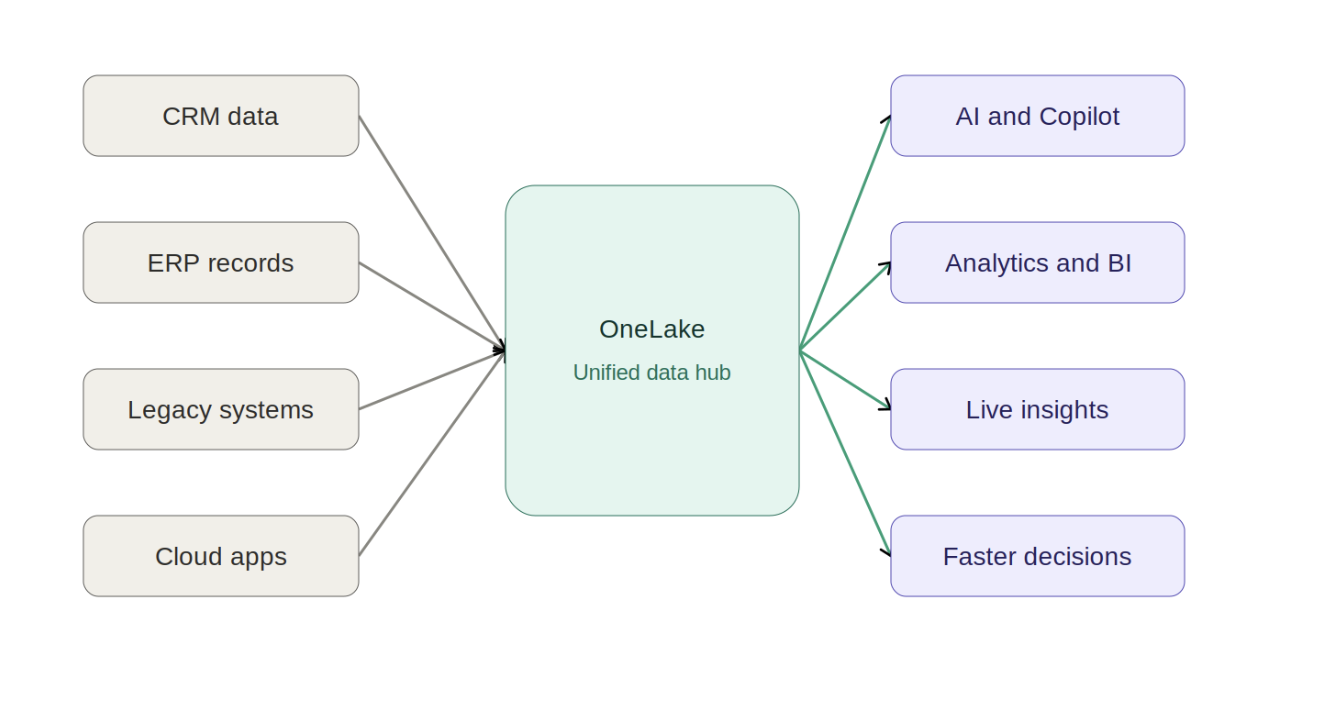
It resolves the three biggest hurdles to centralization:
Centralization is no longer a "nice to have." It is the prerequisite for the future of finance and operations.
The era of tolerating fragmented data is over. Every silo you maintain slows decisions, adds hidden costs, and blocks the AI initiatives your leadership is asking about.
Microsoft Fabric changes the underlying question organizations need to ask. Instead of "which best in class tool do we buy next?" it becomes "how do we build one trustworthy foundation everything else can plug into?" That shift, from scattered point solutions to a unified platform on OneLake, is what makes AI readiness possible as a natural outcome of good architecture, not a separate initiative.
Organizations that centralize now will be the ones actually capable of deploying Generative AI and Copilot at scale while competitors are still stitching together integrations. The question isn't whether to centralize it. It's how soon you can start.
That's where Hexaview comes in. Adopting Fabric isn't just a licensing decision, it's an architecture decision, and getting it right the first-time matters. Hexaview helps organizations assess their current data landscape, design a OneLake foundation that fits their existing systems rather than fighting them, and migrate workloads without disrupting the business along the way. From data engineering and governance setup to enabling Copilot and AI scenarios on top of a clean foundation, Hexaview brings the hands on Fabric expertise to turn this shift from a strategic idea into a working platform, so your team is spending time on insights and outcomes, not integration firefighting.
If your organization is ready to move from fragmented data to a unified, AI ready foundation, Hexaview can help you build it right.
Talk to our Fabric Consultants
What is Microsoft Fabric?
Microsoft Fabric is an all-in-one data platform that combines data integration, engineering, warehousing, real-time analytics, and business intelligence into a single SaaS product, built on a unified storage layer called OneLake, instead of stitching together separate tools for each function.
How is Microsoft Fabric different from a traditional data lake or data warehouse?
A data lake alone just stores raw data; it doesn't guarantee usability, governance, or ease of access. Fabric goes further by unifying storage (OneLake) with the engineering, warehousing, and analytics tools needed to actually turn that stored data into decisions without moving or duplicating it across systems.
Do we need to rip out our existing tools to adopt Fabric?
Not necessarily. Most organizations adopt Fabric incrementally, connecting existing data sources into OneLake and phasing out redundant point-to-point integrations over time rather than doing a full replacement on day one.
How does data centralization actually support AI and Copilot initiatives?
AI models and tools like Copilot are only as good as the data they can access. When data is fragmented across silos, AI initiatives stall on access, quality, and governance issues before they even reach the modeling stage. A unified foundation means AI tools can query trusted, current data immediately.
Is this only relevant for large enterprises?
No. Tool sprawl and data fragmentation hit mid-sized organizations just as hard, often harder, since they may lack the dedicated integration teams that larger enterprises use to paper over the problem.
What's the typical first step toward centralization?
Most organizations start with an assessment: mapping where data currently lives, identifying the most costly or highest-friction silos (finance and sales are common starting points), and piloting a single use case in OneLake before expanding platform-wide.
Does centralizing data mean giving up data security or governance control?
The opposite is usually true. Fragmented systems each need their own security and governance policies, which increases risk. A single governed platform like Fabric centralizes access controls and auditing, generally making compliance easier to enforce, not harder.






.svg)



.svg)