
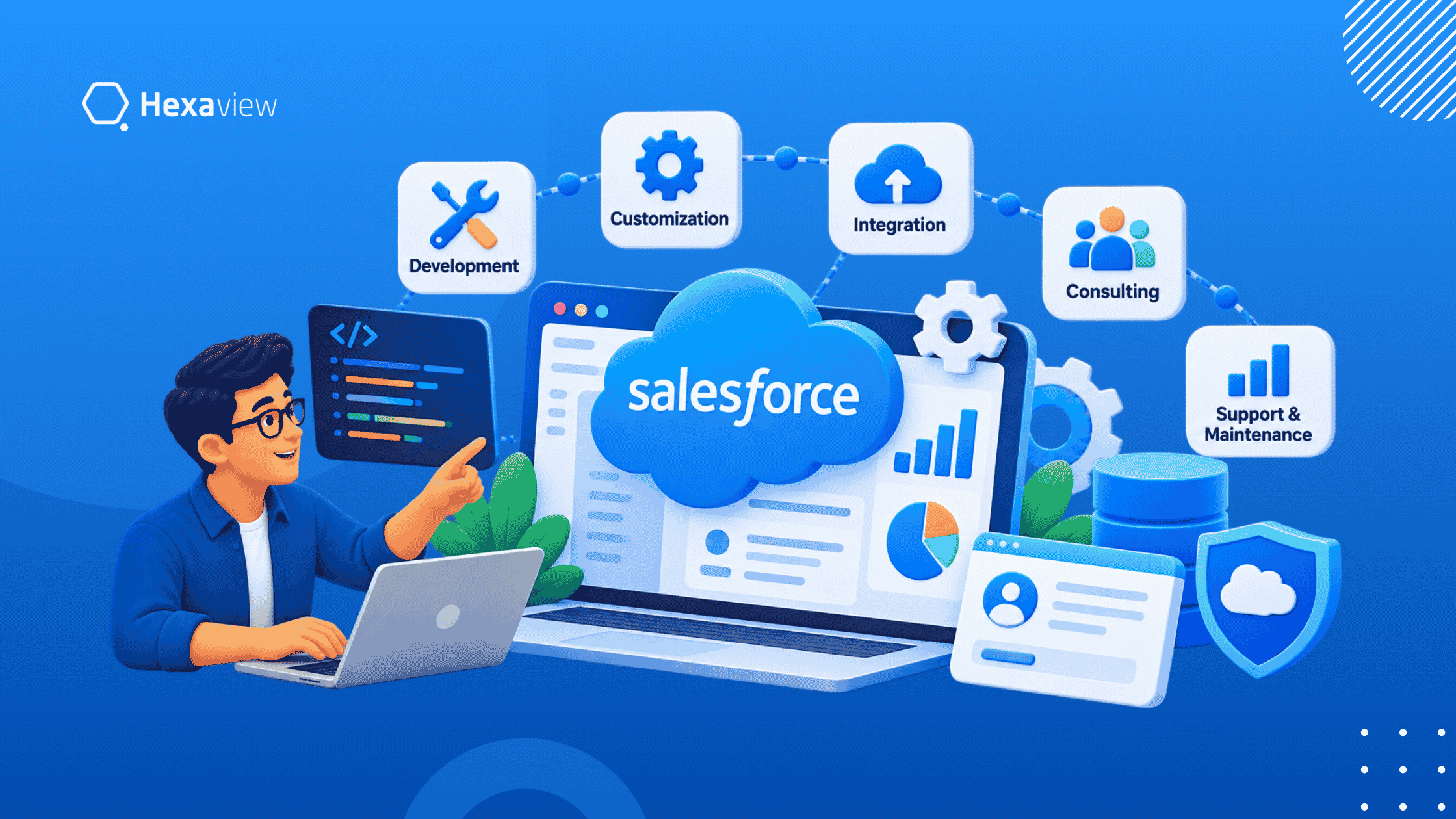
A Salesforce development company designs, builds, integrates, and maintains your Salesforce CRM so it matches how your business actually runs. Salesforce development consulting spans strategy and roadmapping, salesforce implementation across multiple clouds, custom code (Apex and Lightning Web Components), system integration, data migration, AI and Agentforce development, and ongoing managed services.
Key takeaways
A Salesforce development company is a certified partner that builds and tailors Salesforce to a specific organization's processes, data, and goals. Rather than selling licenses, these firms deliver salesforce development consulting: turning a generic CRM platform into a system that reflects how your sales, service, and operations teams actually work.
The scope is broad. It ranges from advisory and architecture, through configuration and custom code, to integration, data migration, AI enablement, and continuous optimization. In 2026, Salesforce is no longer "just a CRM" with Agentforce, Data 360 (formerly Data Cloud), and Einstein, it has become an AI-powered business operating system, and that added capability is exactly why expert help matters more than ever.
A Salesforce administrator manages day-to-day configuration: users, permissions, simple automation, and reports. That is enough for stable, lightly customized orgs. Salesforce development consulting becomes necessary when you need custom objects and code, complex integrations, multi-cloud rollouts, data migration, or AI agents — work that exceeds what a single admin can safely deliver. Many organizations use both: an internal admin for daily upkeep and a development partner for builds, migrations, and major releases.
Salesforce's partner network is enormous. There are over 4,000 consulting and service partners on the AppExchange and more than 170,000 certified experts worldwide. Partners are tiered (for example, Crest and Summit), hold product certifications (Agentforce Specialist, Data 360, and individual clouds), and often specialize by industry. Choosing within this ecosystem is less about size and more about fit; certifications, senior talent, and relevant domain experience.
Modern salesforce development consulting is delivered as a lifecycle, not a one-time build. Below are the core services you can expect from a capable partner.
Before any configuration, a good partner runs discovery: mapping current processes, defining KPIs, assessing data readiness, and producing a prioritized salesforce implementation roadmap. This phase aligns stakeholders and prevents scope creep later.
This is the heart of most engagements, standing up and configuring Sales Cloud, Service Cloud, Marketing Cloud, Experience Cloud, Commerce Cloud, or industry clouds such as Financial Services Cloud and Health Cloud. A multi-cloud salesforce implementation connects these products, so data and workflows flow across the business rather than living in silos.
When clicks aren't enough, developers write Apex, build Lightning Web Components, design Flows and approval processes, and create custom objects and apps. The guiding rule of strong salesforce development consulting is "configure before you customize" — use declarative tools first and reserve code for genuinely unique requirements.
Salesforce rarely lives alone. Partners design API-led integration architectures, using MuleSoft, Boomi, Workato, or REST/GraphQL to connect Salesforce with ERP, billing, HRIS, and data warehouses like Snowflake and Databricks. Companies that connect external platforms to Salesforce are around 2.7x more likely to achieve a strong 360-degree customer view.
Migrating clean, well-mapped data is one of the most consequential parts of any salesforce implementation. It is also where AI strategy starts: 53% of organizations cite poor data quality as their top barrier to AI adoption, and only 26% say most of their customer data actually lives in Salesforce. Data 360 unifies records across sources into a single profile that powers AI.
Agentforce, which is Salesforce's autonomous AI agent platform, surpassed $500 million in ARR with roughly 330% year-over-year growth, making it the fastest-growing product in the company's history. Development partners now build custom agents for lead qualification, Tier-1 service triage, and compliance review, with human-in-the-loop guardrails for regulated industries.
Going live is the start, not the finish. Managed services provide ongoing administration, development, monitoring, quarterly roadmaps, and continuous optimization, the model buyers increasingly prefer over one-time projects that hand off and leave.
A typical salesforce implementation follows a clear, phased structure:
A phased salesforce implementation reduces risk, lets teams learn from each stage, and surfaces issues early. A single "big bang" go-live concentrates on risk and is far more likely to produce data corruption, broken automation, and low confidence in the new system.
The most common migration failures like field-mapping errors that break automation, loss of referential integrity when child records load before parents, and PII reaching unmasked staging environments are all preventable. Teams that skip a pilot migration consistently hit these problems after production cutover. Cleansing is usually the longest phase and the one most underestimated at the start.
Looking for the Top Salesforce Implementation Partners?
Following proven salesforce implementation best practices is what separates a CRM your teams trust on day one from a platform they spend months correcting.
Always use declarative, point-and-click configuration first. Reserve custom code for requirements that genuinely cannot be met with standard features. This keeps the org maintainable, upgrade-safe, and cheaper to support.
The core data-migration best practices every partner should follow:
Technology rarely fails on its own, people do not use it. Poor user adoption is the single most-cited cause of CRM shortfalls, named by 43% of organizations that miss their ROI goals. Build for adoption with role-based training, intuitive layouts, and change management from day one.
In 2026, every implementation should ship "AI-ready", wired to Data 360 with clean, governed data so Agentforce and Einstein can deliver value. For regulated industries, compliance frameworks (ISO 27001, SOC 2, HIPAA, GDPR, SOX, KYC/AML) belong in the design from the start, not bolted on later.
A well-executed salesforce implementation can deliver up to roughly 300% ROI over three years, and AI-powered deployments show about 30% higher ROI than traditional ones. Yet results are far from guaranteed: the IBM State of Salesforce 2025–2026 report (surveying over 1,200 customers) found only 33% of Salesforce AI initiatives met their ROI targets, and 62% of organizations worried about unpredictable costs. The differentiator is almost always partner quality and the decisions made in the first six months.
Pre-built vertical solutions like Financial Services, Health, and Manufacturing clouds with compliant data models can cut implementation time by 40–60% versus fully custom builds. Domain expertise also reduces risk: a partner who understands KYC/AML or HIPAA language delivers faster, safer outcomes than one learning your industry on your budget.
Hexaview Technologies is a Salesforce Crest Partner, Agentforce Specialist, and Data 360 certified firm headquartered in New York (12 E 49th Street, 11th Floor, New York, NY 10017), well positioned for organizations seeking salesforce consulting in New York and across regulated US industries.
Hexaview's salesforce development consulting practice includes 50+ certified Salesforce professionals, 200+ projects delivered, a 98% client satisfaction (CSAT) score, and 16+ years of experience. The team delivers 12 service offerings across four strategic pillars — AI & Agentforce; Cloud Implementation & Modernization; Integration & Analytics; and Managed Services & Advisory spanning 9 Salesforce clouds.
What sets the approach apart: senior-led pods (architects and principals, not junior benches), human-in-the-loop AI with built-in guardrails, and a compliance-first design aligned to ISO 27001, SOC 2, HIPAA, and GDPR. Branded accelerators like the HexaAgent Suite, HexaData Accelerator, HexaShield compliance framework, HexaMigrate toolkit, and HexaInsight dashboards, help cut delivery timelines by 30–40%. Reported outcomes across engagements include around 30% faster case handling, 45% less manual work, and 2x user adoption.
A capable Salesforce development company turns a generic CRM into a growth engine but only when it follows proven salesforce implementation, best practices and stays engaged beyond go-live. If you are planning a new build, a rescue, or an AI-readiness upgrade, start with a discovery conversation or a free Salesforce audit.
Salesforce implementation is the end-to-end process of deploying and configuring Salesforce for your business. Salesforce development is the building component within that custom code (Apex, LWC), automation, and integrations. Most engagements include both data migration and training.
It depends on the scope. A small, clean single-cloud rollout can take a few weeks; mid-market projects commonly run 4–12 weeks; and full multi-cloud salesforce implementations typically run 3–6 months. Industry-cloud deployments are often 40–60% faster thanks to pre-built data models.
Costs vary by scope and complexity, with large enterprise projects often exceeding $150K+. Always confirm what is excluded like data migration, training, and post-go-live support are frequently left out of base quotes.
Not strictly, but many US enterprises, especially in financial services value salesforce consulting in New York for time-zone alignment, on-site collaboration, and regional regulatory familiarity. The most important factors remain certifications, senior talent, and relevant industry experience.
The highest-impact salesforce implementation best practices are: configure before you customize, treat data migration as a phased and tested discipline, design for user adoption from day one, and build AI-ready and compliance-first architecture from the start.




.svg)


.svg)