

Data modernization for banks and wealth management brings data from legacy databases, applications, reporting systems, and external sources into a more connected architecture. Microsoft Fabric can support this approach by combining data integration, engineering, warehousing, real-time analytics, governance, and Power BI within one platform. Microsoft specifically highlights Fabric for financial services use cases such as consolidating data silos, modernizing data platforms, improving governance, and enabling analytics and AI readiness.
What does data modernization solve for banks and wealth management firms? It addresses fragmented data environments that make information difficult to access, govern, analyze, and reuse. Financial institutions often operate across core banking, CRM, trading, portfolio, custody, risk, regulatory reporting, and departmental systems. Spreadsheets and separate databases can add further silos. Microsoft notes that disconnected services can increase integration overhead and slow time to insight.
The result can be duplicated data, inconsistent definitions, slower reporting, and difficulty building a complete customer or client view. These challenges also make consistent governance, lineage, and auditability harder to manage.
Modernization is therefore more than moving databases to the cloud. It improves how data is ingested, stored, transformed, governed, accessed, analyzed, and visualized. A modern architecture can also provide a stronger foundation for real-time analytics and AI.

Microsoft Fabric for financial services is a SaaS analytics platform that brings data ingestion, engineering, warehousing, real-time analytics, data science, and Power BI into one environment. Microsoft describes Fabric as supporting end-to-end data workflows, with OneLake providing the shared logical data lake across workloads.
For banks and wealth managers, the relevant capabilities include:
However, Microsoft Fabric for Banking and Wealth Management does not mean replacing every operational system. Core banking, CRM, portfolio, trading, and other platforms can continue running their specialized processes while Fabric provides an analytical and data platform layer across those systems.
How does Microsoft Fabric modernize financial data? It can support a five-step data journey: connect and ingest data, centralize it in OneLake, transform and validate it, analyze it, and deliver governed insights through Power BI. This approach helps banks and wealth managers build a connected analytical environment without requiring every operational system to be replaced.
Financial institutions can have data across banking databases, customer systems, transaction platforms, portfolio applications, custodian platforms, market data sources, and external applications. Data Factory provides data integration and orchestration capabilities for connecting and moving data between sources and destinations.
OneLake provides Fabric with a shared logical data lake. It acts as a common data foundation across Fabric workloads, helping teams work with data without creating separate copies for every analytical use case.
Data Engineering and other Fabric workloads can support cleansing, transformation, standardization, validation, reconciliation, and application of business rules. These processes help establish consistent datasets before they reach analytical and reporting workloads.
Modernized data can support financial reporting, risk analysis, customer analytics, portfolio analysis, operational analytics, and regulatory reporting. Fabric brings multiple analytical workloads into the same platform, allowing organizations to use data across different business requirements.
Power BI can connect to Fabric data to create reports and dashboards for business users. With appropriate governance and access controls, teams can build consistent views of financial, customer, risk, and operational information from a shared data foundation.
Microsoft Fabric Power BI Integration connects the modernized data layer with business-facing dashboards and reports. A typical flow is:
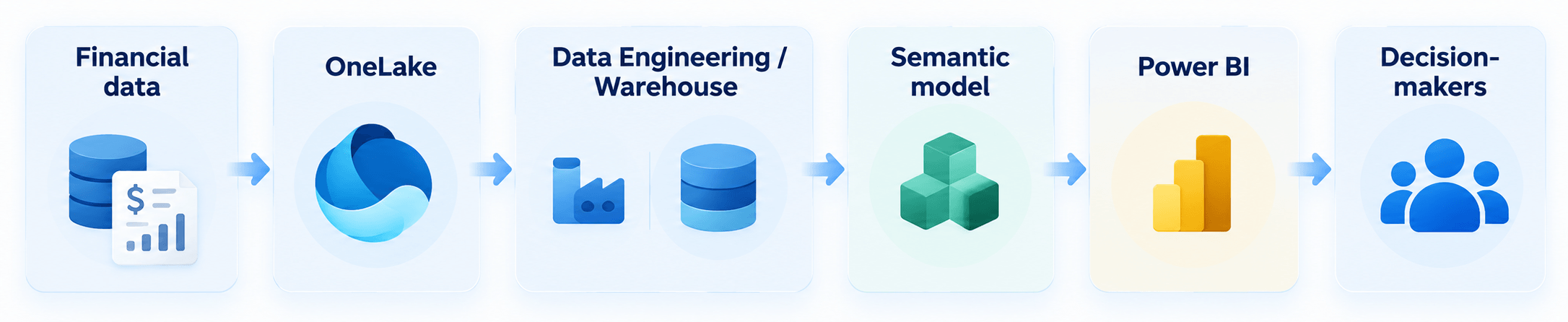
Data from banking, portfolio, transaction, CRM, and other systems can be ingested into Fabric and prepared for analysis. Power BI can then use governed semantic models to present consistent business metrics and reporting views. Microsoft also supports integration between OneLake and Power BI semantic models, including writing model data to Delta tables in OneLake for use by other Fabric workloads.
For Power BI Fabric integration financial dashboards, practical banking applications can include:
For wealth management teams, dashboards can cover:
The value comes from connecting dashboards to a governed data architecture rather than treating Power BI as a standalone reporting tool. Teams can define consistent metrics and provide decision-makers with a shared analytical view while maintaining appropriate access controls.
Microsoft Fabric can support several potential banking and wealth management use cases by connecting operational data with analytics, reporting, and AI workloads. Microsoft positions Fabric for financial services around areas including data platform modernization, analytics, AI readiness, collaboration, scalability, security, and governance. Actual outcomes depend on data quality, architecture, integrations, governance, and implementation choices.
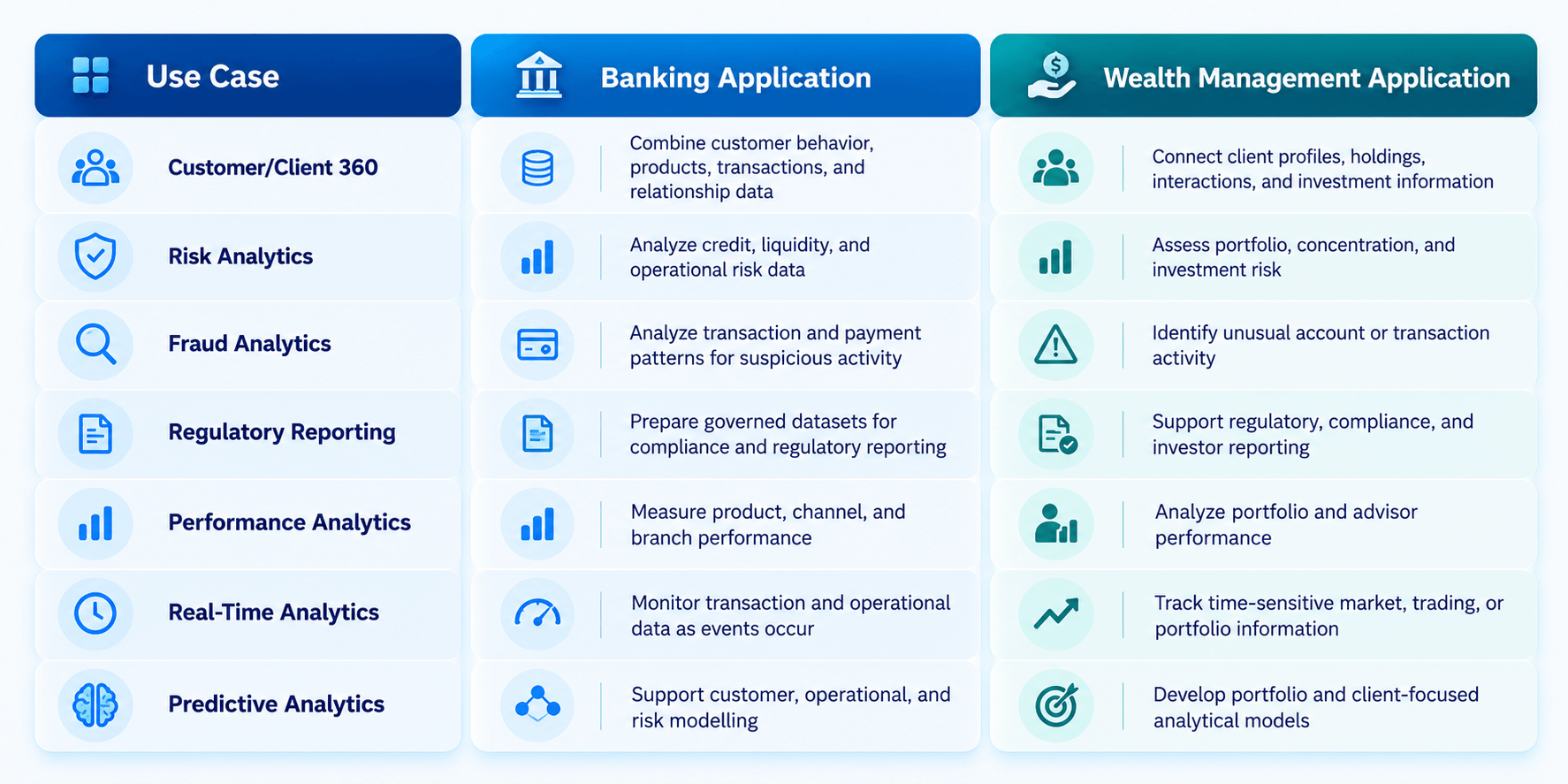
These examples demonstrate how Microsoft Fabric for Banking and Wealth Management can provide a common analytical layer across different financial datasets. However, Fabric does not automatically deliver these outcomes. Financial institutions still need suitable source integrations, data models, business rules, security controls, and governance processes for each use case.
Is Microsoft Fabric secure enough for banking and wealth management data? Fabric provides security, governance, and compliance capabilities that can support financial data environments, but security depends on how an institution designs and operates its implementation. Microsoft recommends combining Fabric capabilities with Microsoft Purview for broader data governance and protection.
Key considerations include:
For regulated institutions, these capabilities should form part of a broader governance framework covering regulatory obligations, access policies, monitoring, data architecture, retention, and compliance processes. Fabric provides technical controls; the institution remains responsible for designing and operating an appropriate control environment.
Hexaview approaches financial data modernization as a broader engineering and modernization effort, rather than a standalone platform of migration. Its services cover data modernization, data engineering, legacy modernization, business intelligence, and cloud and data services, with specific focus areas including wealth management and financial services.
Its published Microsoft Fabric case study describes a modernization project for a national trust and investment management company. The engagement unified data from trust administration, CRM, financial, and regulatory sources into a governed Fabric platform. Hexaview also built a layered Lakehouse, migrated historical reporting data, and delivered Power BI reporting.
Hexaview's legacy modernization services additionally cover data modernization, application re-engineering, infrastructure migration, integration and API enablement, and post-modernization support. Its published financial-services example includes modernizing a legacy portfolio management platform and migrating data and services to a cloud environment.
For organizations evaluating Microsoft Fabric consultants, this broader approach can help connect Fabric implementation with existing data, application, governance, and reporting requirements. The published case studies provide evidence for these capabilities without requiring unsupported claims about certifications or partnership status.
If your bank or wealth management firm is dealing with fragmented data, legacy reporting, or disconnected analytics systems, the first step is assessing the current data estate. Hexaview can help evaluate modernization priorities, data architecture, integration requirements, and analytics opportunities before defining an implementation roadmap.
Data modernization for banks and wealth management firms means improving how fragmented data from legacy systems is ingested, stored, governed, transformed, analyzed, and reported. It creates a more connected data environment for analytics and decision-making.
Microsoft Fabric can bring data ingestion, engineering, warehousing, analytics, governance, and Power BI together around OneLake. Banks can use these capabilities to build a more unified analytical environment while retaining specialized operational systems.
Fabric and Power BI can work together across the data-to-insight lifecycle. Data can be ingested and prepared in Fabric, modelled through a semantic model, and then used in Power BI reports and dashboards. This creates a connected reporting architecture rather than treating Fabric and Power BI as completely separate platforms.
Potential use cases include risk analytics, fraud analysis, customer analytics, regulatory reporting, transaction analysis, and operational dashboards. The suitability of each use case depends on available data, integration requirements, governance, and the institution's analytical objectives.
Fabric can be suitable for wealth management firms, but suitability depends on the firm's data architecture, workloads, governance requirements, existing Microsoft environment, migration needs, and implementation strategy. Organizations should assess these factors before selecting an architecture or migration approach.






.svg)

.svg)