
If you own a start-up, the first big decision will set the route to everything that follows. It includes how fast you ship, how much runway you burn, and whether the product or service is able to interact with real users.

As the numbers show, roughly 90% of start-ups eventually fail; almost 70% close within 2 to 5 years; and around 42% simply die as they build something nobody wants. So, choosing the right product engineering services companies in the USA is not just about guaranteeing success, but choosing the wrong one will surely guarantee friction.
Hence, picking the best product engineering services company is important. It is not just about comparing hourly rates; it is more about answering sharper questions. It is not just about who can build this for us, but it is about who can build this with us and keep building as we scale.
This guide will walk you through what the companies actually do, when start-ups truly require one, the seven crucial criteria that separate strong partners from forgettable ones, realistic cost ranges, and a quick look at the top 7 product engineering services companies in 2026.
A product engineering service company is one that designs, builds, tests, scales, and maintains software products across the full life cycle. They are not just about writing code, but they own product thinking, architecture, UX, and continuous improvement from discovery to post-launch.
The last part is the most differentiating factor that trips up most founders. Most teams will happily write whatever you require. Basic software development delivers what you ask for, while software product engineering services mostly focus on creating something that lasts. A product that holds up as users come in, which is easy to fix to an extent and which keeps evolving rather than being patched over time.
Comprehensive product engineering services in practice usually span product discovery, architecture, and design, full development, cloud and DevOps integration, quality engineering, AI integration, modernizing legacy systems, and long-term maintenance and scale.
Check to Learn More About Product Engineering Services
Most times, these three options get together, but they can solve different problems. Freelancers give you task execution, which is useful for a discrete, well-defined job. Staff augmentation can add additional hands that work under your direction and your management oversight. A real product engineering service takes shared ownership of outcomes, the architecture, R&D, and takes responsibility for the roadmap along with you.
For a start-up with no technical co-founder, such ownership matters a lot. When you mature, and your in-house team grows, the balance mostly shifts towards augmentation for specific skills. The choice mostly depends on your stage and not on which model sounds cheaper this quarter.
A startup generally requires a product engineering services company in three different situations. It includes when you're building something from scratch, when you’re scaling an existing product that is struggling under growth, and when you’re modernizing a legacy system that has started to slow down.
Apart from these obvious ones, there are other day-to-day signals that you have to check out. They showcase that they actually need to look for a product engineering services company.
There is also a strategic reason the pressure is rising. Gartner has projected that over 70% of enterprises will include some AI functionality within the first 3 years. For a start-up, it means we will figure out AI later, which increasingly results in competitive risk, and it is exactly the kind of capability a strong product engineering service company brings without you having the need to hire it from day one.
On the papers, most software product engineering service providers sound identical. It includes the same tech stack, the same promises and the same message - We are the best. However, the real differences start to show up in how our partner works, not in what they claim. So here are the seven criteria that you have to check while choosing the best product engineering services company.
Anyone is able to execute the list of requirements. What you want is a team that is able to comprehend why those requirements exist. Do they ask about your users, your business model and your constraints before they even start building? Or do they just start coding? Building the wrong thing efficiently will only give the wrong outcome, and start-up. It is just a wasted runway that you would not get back.
There is a massive difference between contributing to one part of the system and owning a product journey from idea to scale. You should always look for teams that have efficiently handled a complete cycle. It includes discovery, design, development, testing, iteration, and post-launch evolution. The breadth of experience clearly shows how they anticipate problems and then guide decisions long before the problems become expensive.
You might get a long list of software product engineering services companies, but only a few will have an understanding of your core requirements. A long list of technologies means little without the judgment to properly apply them. Modern product engineering is mostly aligned with cloud native engineering, platform engineering, AI engineering, DevSecOps, and data architecture. The question is simple: can they choose the right tool for your product and not just the most familiar ones? Projects mostly slow down when a team forces a stack it's comfortable with. The best software product engineering services company will choose technology based on the product and not the other way around.
Not all technical knowledge is the same. In case you're building in fintech, health tech, or wealth management, domain expertise can directly drive compliance, security and customer trust. A partner who is able to understand SOC2, HIPAA, and PCI–DSS will certainly save you from painful and expensive surprises down the road. In regulated sectors, governance is not an option, but it has to be engineered from the first architectural design.
Building is one phase, and evolving is where real work happens. You have to check if the company and its team support you as your product grows in users, features and complexity, or will they disappear after launch and leave you to find someone new? Continuity will be the only factor that lets a product move forward without constant resets. Your partner needs to grow with the product and not vanish once the MVP ships.
The major hidden cost in product development is rework. When a team is not properly aligned, you will require revisiting decisions, rebuilding features, and losing weeks. For runway-constrained start-ups, it is one of the most dangerous places that results in leaking time and money. The strongest partners will minimize rework by asking the right questions up front and validating along the way, rather than reacting to problems after they have shipped.
It matters more than most people admit. You will be closely working with the engineering team through decisions, challenges, and pressure. You would not require constant meetings, but you need to get clear updates on what is happening and what is next, quick feedback loops and minimal noise. Even technically excellent partnerships break down over poor communication or a clumsy collaboration model. The best relationship will feel like you’re working with your own team.
For a digital product, a full MVP design and build cycle with a US-based partner will typically run from about $50,000 to $150,000. Senior US hourly rates land roughly between $150-$300 per hour. Blended and offshore model costs meaningfully less, though you should always check seniority and communication carefully, as it provides better results.
Most of the providers use one of the three pricing models. A flat project fee works when the scope is properly defined and predictable, which is often favored by start-ups reporting burn to investors. A dedicated team model is suitable for a project that is actively scaling and requires engineers operating as an extension of the in-house team. A time-and-materials approach provides the most flexibility when you need to keep evolving. Here is a table to break down the common ranges.
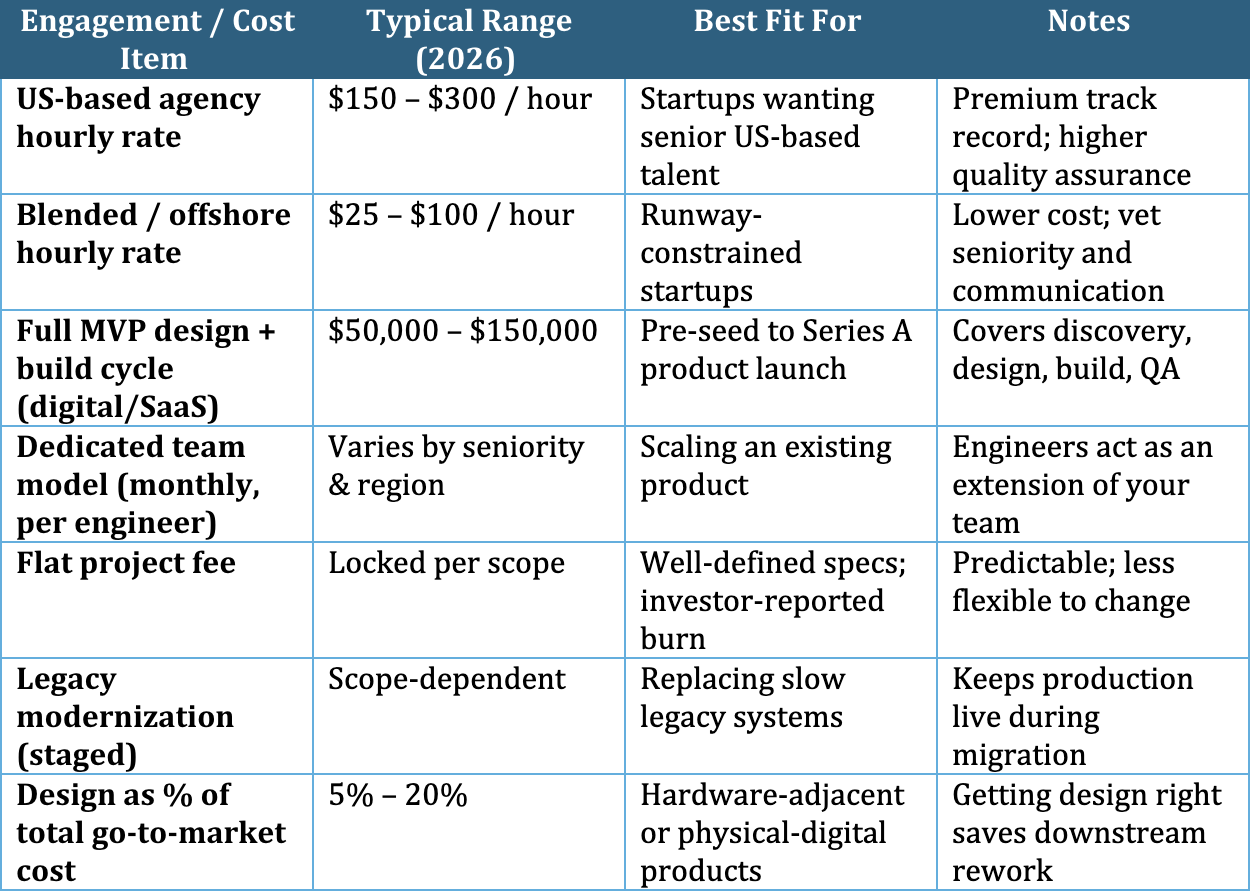
A word of caution, cheaper is not always better and expensive does not guarantee quality. What actually matters is whether the product engineering services company is able to explain precisely what you’re paying for. If a partner cannot articulate what the budget includes and where it goes, it is a certain red flag.
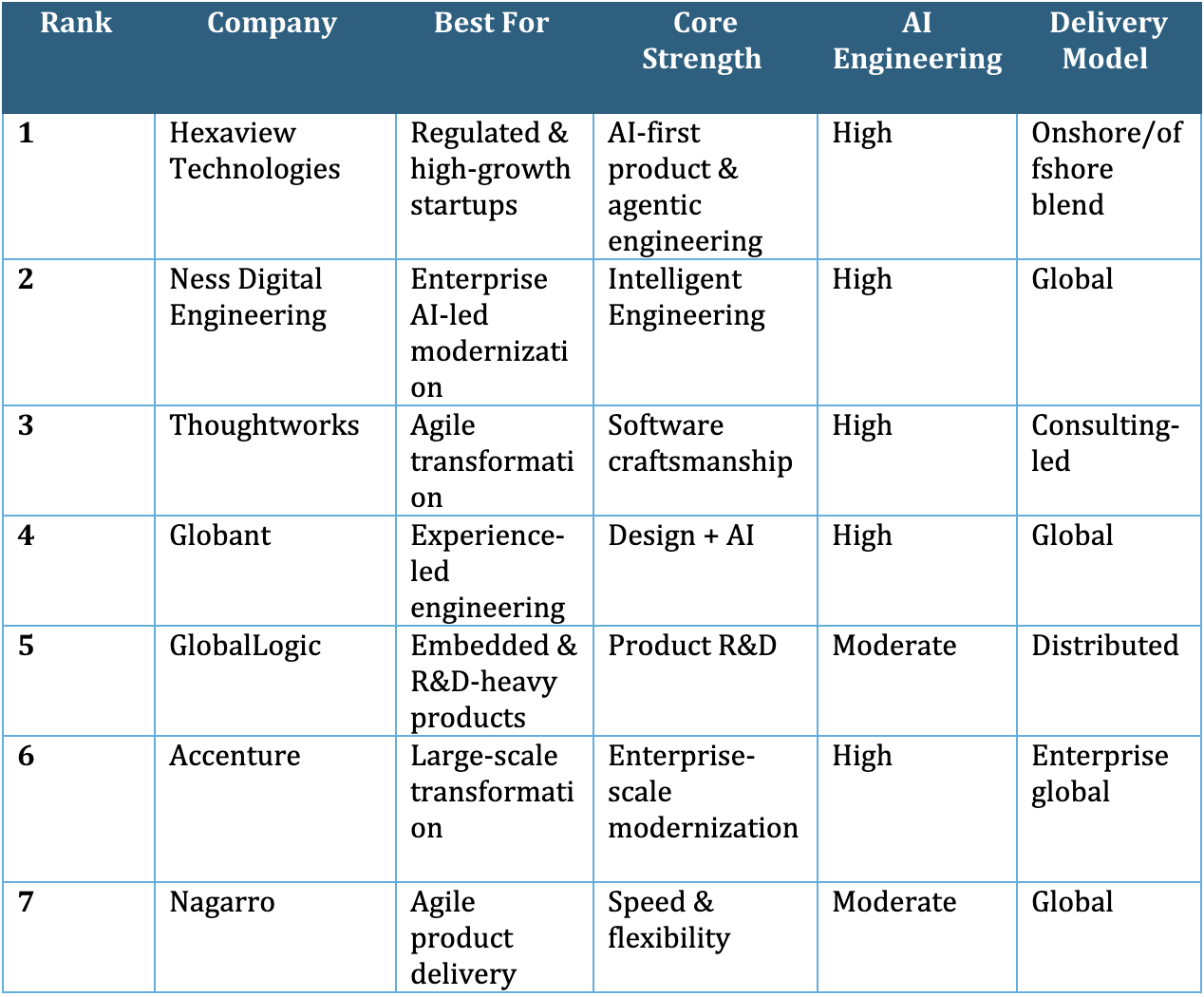
Even though the full list of top product engineering services companies is bigger, here we will give you a quick look at the top seven strong providers who are shaping the space in 2026.
A few avoidable errors will help you to choose the right product engineering services company.
While deciding, run a candidate through these questions in five minutes.
If you get the answer, yes, in most of these, you're most likely looking at the one and the best product engineering services company for your stage.
If you’re weighing your options for product engineering services, the next big step is a conversation and not just a comparison spreadsheet. Hexaview Technologies works with founders through customized demos on your own use case so that you can see how senior-led AI-first team approaches your product before you commit. You can book a discovery call and talk about where you are, and where you want to be in the next few years.
What does a product engineering company do?
It owns the full product lifecycle from discovery, design, development, testing, AI integration, scaling, and maintenance, taking shared responsibility for outcomes rather than just executing tickets.
How do I choose the best product engineering service company for my startup?
Evaluate product thinking, end-to-end lifecycle experience, technical and domain depth, scalability, right-first-time delivery, and cultural fit, not just the hourly rate or how polished the proposal looks.
How much do product engineering services cost?
For digital products, a full MVP design-and-build cycle with a US-based partner typically runs from about $50,000 to $150,000, with senior US hourly rates roughly $150–$300. Offshore and blended models cost less.
What is the difference between product engineering and software development?
Software development delivers what is specified. Product engineering builds, scales, and evolves a product for long-term business outcomes across its entire lifecycle.
What should a startup avoid when selecting a product engineering partner?
Avoid choosing on cost over capability, skipping outcome alignment, and selecting based on proposals rather than the partner's actual working style.
How can a product engineering partner improve time to market?
By reducing delays through faster alignment, smoother execution, fewer rework loops, and ready-built engineering pods that scale faster than internal hiring.
Which product engineering service companies are best for startups in the USA?
Look for product engineering services companies in the USA — or US-serving providers — with startup-friendly engagement models and regulated industry experience. Hexaview Technologies, headquartered in New York, is one example built for compliant, high-growth product builds.






.svg)



.svg)