

Microsoft Fabric is the strongest choice for Microsoft-centric enterprises seeking a unified analytics platform. Databricks remains the preferred platform for advanced AI and large-scale data engineering, while Snowflake excels in cloud-native data warehousing and secure data sharing. The right platform depends on your existing ecosystem, AI maturity, governance requirements, and budget.

Key Insights
Choosing an enterprise data platform is a vital long-term business decision. This choice goes far beyond a simple technology purchase. Modern businesses demand unified analytics to stay competitive. They require advanced AI and strong data governance. Cloud scalability is also essential for modern growth.
Today, Microsoft Fabric, Databricks, and Snowflake increasingly overlap in features. Yet each platform solves different business problems. Selecting the wrong one can lock your company into expensive multiyear commitments.
This 2026 comparison will guide your enterprise selection. You will learn about their core data architecture. We will analyze their built-in AI capabilities. This guide covers data governance and cloud interoperability. You will see how their pricing models work. We also highlight key enterprise use cases. Finally, we discuss critical implementation considerations.
Partnering with a skilled Microsoft Fabric consultant ensures a smooth transition. Proper planning makes your Microsoft Fabric implementation successful. Let us dive into the details.
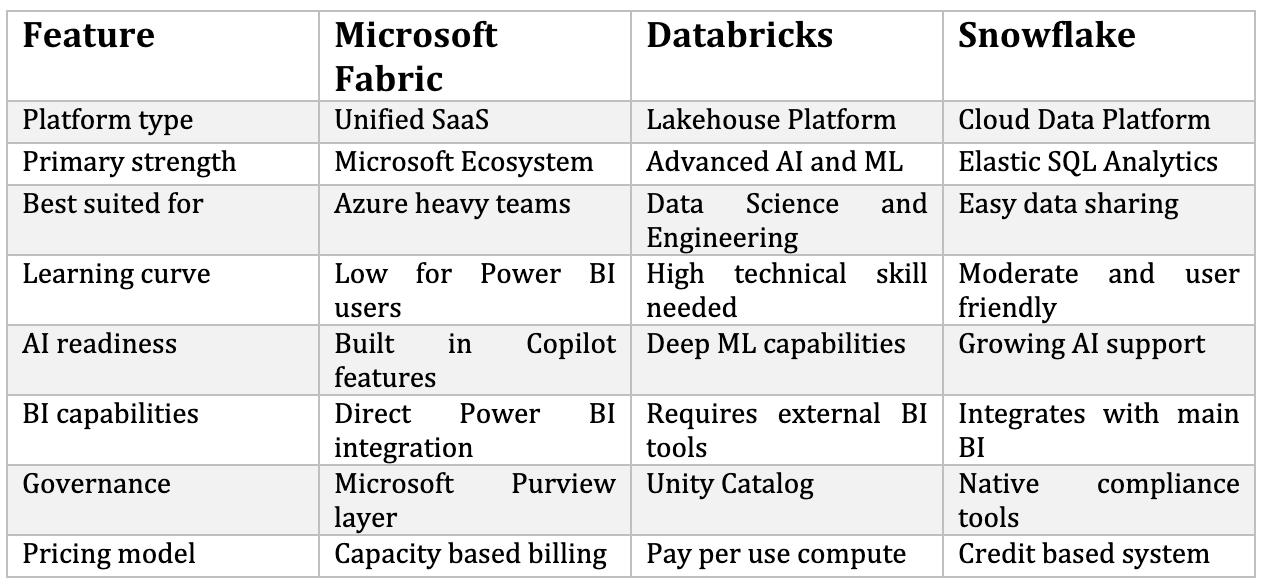
Fabric operates as a unified SaaS platform built on OneLake storage. This single copy architecture eliminates data replication entirely. It features built in analytics engines for seamless operations. The platform offers deep, native Power BI integration. It includes Data Factory for complex data integration. Teams get dedicated environments for Data Engineering and Data Science. It also provides robust tools for Real-Time Analytics.
Databricks relies on an engineering first lakehouse architecture. The platform uses a powerful Apache Spark foundation. It leverages Delta Lake to bring reliability to cloud storage. This setup combines data warehouse performance with data lake flexibility. It easily handles massive, unstructured data pipelines. It is highly optimized for complex programmatic data processing.
Learn More About Microsoft Fabric vs Databricks
Snowflake delivers a fully managed, cloud native data warehouse experience. Its signature feature is the complete separation of storage and compute. This allows independent scaling for performance and cost control. It offers a familiar, powerful SQL first user experience. The platform also boasts exceptional multi cloud capabilities across major providers.
Learn More About Microsoft Fabric Vs Snowflake
Key Insight: Architecture should align with your existing ecosystem, not just future ambitions.

Each platform excels in distinct categories based on its architectural design.
Your choice depends entirely on your priority area. Many companies use Microsoft Fabric consulting to evaluate these categories. Specialized Microsoft Fabric implementation teams can help you test these features against your workflows.
Microsoft Fabric excels at providing native AI experiences across a unified analytics workflow. It embeds generative AI directly into your day-to-day processes using Copilot capabilities. Users can build predictive models inside familiar environments. They can also push insights straight into Power BI dashboards. This makes advanced analytics highly accessible for business users.
Databricks remains the clear market leader for large scale ML workloads. The platform is built specifically for deep model development. It provides robust tools for complex AI engineering. Data scientists get full control over the machine learning lifecycle. It easily manages massive datasets for training custom deep learning models.
Snowflake approaches AI as a secure, governed data platform. It focuses on turning enterprise data into AI-ready data. This ensures your models run on clean, compliant, and secure governed datasets. It also enables smooth cross platform analytics without moving your underlying data.
Organizations seeking quick adoption and simple workflows benefit most from Microsoft Fabric services. Companies focused on heavy data science and custom AI engineering need Databricks. Businesses requiring secure, low maintenance SQL analytics and controlled data sharing should choose Snowflake. Experienced Microsoft Fabric consulting can help determine your best fit.
Each platform uses a different consumption metric to bill for resources.
Predictability varies greatly between these three structural models.
However, auto scaling can sometimes lead to unexpected monthly billing spikes.
Cost optimization requires active management across all three options. You must watch out for hidden operational costs like cloud storage. Data egress fees can also add up during multi cloud operations.
Licensing considerations should match your team skills. Fabric bundles many tools together, reducing the need for separate software licenses. Databricks might require external BI licenses, while Snowflake might need separate ingestion tools.
Instead of searching for the cheapest option, focus on overall value. Look for the platform that minimizes your total cost of ownership. Engaging a Microsoft Fabric consultant can help you model these expenses accurately.

Many modern enterprises choose to combine these platforms instead of replacing everything. Running a hybrid setup allows companies to maximize specific platform strengths.
For example, a business might pair Fabric + Snowflake. They use Snowflake as their secure global data warehouse. Then they use Fabric to provide easy business intelligence access.
Other organizations combine Fabric + Databricks. Databricks handles heavy data engineering and complex machine learning. Fabric then ingests that clean data for corporate reporting and governance. Many organizations leverage specialized Microsoft Fabric consulting services to design these hybrid data architectures safely.
Migrating to a modern platform introduces several critical operational hurdles. Legacy systems often feature undocumented logic that resists smooth translation. Data silos across departments complicate the initial consolidation process. Establishing uniform governance becomes difficult when merging disparate compliance rules.
User adoption frequently stalls if teams prefer their old tools. Performance optimization requires continuous tuning to avoid slow queries. Integration challenges arise when connecting new cloud systems to on-premise infrastructure. Finally, poor cost management can lead to immediate budget overruns.
A successful Microsoft Fabric implementation depends entirely on rigorous upfront planning. Selecting the tool is simply the first step of a larger journey. True value comes from aligning your workflows with the platform architecture.
Many organizations purchase Fabric licenses but struggle because of poor architecture. Setting up a platform requires clear structural planning from the start. Weak governance can quickly lead to security risks and compliance issues. Poor data quality will consistently produce inaccurate business insights.
Migration complexity often delays timelines when moving away from older legacy databases. A lack of internal expertise further slows down your technical team. Technology alone cannot solve deep organizational data challenges. Successful adoption requires a strategic partner to guide your entire enterprise journey.
Hexaview acts as your trusted partner to ensure a successful Microsoft Fabric implementation. We provide comprehensive Microsoft Fabric consulting services tailored to your specific business goals. Our team designs a clear migration strategy to minimize operational downtime. We accelerate data modernization across your entire corporate infrastructure.
Hexaview builds a robust governance framework to keep your data secure. Our experts specialize in advanced lakehouse architecture design using the medallion pattern. We ensure seamless Power BI integration for real-time business reporting.

With Our technical help, you can establish an AI ready data platform. Hexaview handles ongoing performance optimization to keep cloud compute costs low. Our specialize in end-to-end delivery for complex enterprise environments.
Choosing the right Microsoft Fabric services makes a massive difference for your company. Partnering with an experienced Microsoft Fabric consultants reduces overall project risk. Let Hexaview provide the professional Microsoft Fabric consulting your enterprise needs.
Every enterprise operates with entirely different business priorities. Microsoft Fabric, Databricks, and Snowflake each address distinct operational needs. There is no single superior choice for every modern corporate workflow.
The right platform depends heavily on your existing cloud data architecture. You must evaluate your specific daily workloads and future AI goals. Consider your security governance requirements alongside your long-term business strategy.
Successful platform adoption depends entirely on careful planning, migration, and structural execution. Selecting a vendor is merely the beginning of your modernization journey. True efficiency comes from aligning the tool with your organizational culture.
Hexaview provides the deep technical expertise required to navigate this critical transition safely. They deliver top tier Microsoft Fabric consulting services to map out your architecture. Their certified team ensures a highly secure, optimized Microsoft Fabric implementation. Partner with Hexaview for end-to-end modernization support that maximizes your cloud investment.
Is Microsoft Fabric replacing Azure Synapse?
Yes, Microsoft positioning clearly shows Fabric as the successor to Azure Synapse Analytics. Microsoft provides native migration assistants to help enterprises transition their Synapse pipelines and Spark workloads into Fabric. While Synapse remains active for existing deployments, future feature innovation happens entirely inside Fabric.
Is Microsoft Fabric better than Databricks?
Neither platform is universally better because they serve entirely different primary workloads. Databricks remains the industry leader for heavy data engineering, deep data science, and custom machine learning model development. Microsoft Fabric is superior for rapid business intelligence deployment, low code data orchestration, and native Power BI integration.
Is Snowflake still relevant in 2026?
Snowflake remains highly relevant as a premier enterprise cloud data platform. It excels at fast, low maintenance SQL analytics, elastic compute scaling, and secure cross corporate data sharing. Its multi cloud capabilities across AWS, Azure, and GCP provide flexibility that single cloud vendor ecosystems cannot match.
Can Microsoft Fabric work with Snowflake?
Yes, they interoperate smoothly through multiple data integration patterns. You can use Fabric Mirroring for near real time data replication into OneLake. Additionally, bidirectional Apache Iceberg table support allows Snowflake and Fabric to query the exact same data copies without moving files.
Can Microsoft Fabric integrate with Databricks?
Yes, they integrate natively because both platforms rely on open delta parquet file standards. Databricks can write clean tables directly into Azure storage lakes. Microsoft Fabric can then access those exact files instantly using OneLake shortcuts without creating duplicate data copies.
How long does Microsoft Fabric implementation typically take?
A basic Microsoft Fabric implementation for a single department can take four to eight weeks. However, a full migration for an enterprise with complex legacy infrastructure can span three to six months. The timeline depends heavily on pipeline complexity, data volume, and initial data quality.
When should businesses hire Microsoft Fabric consulting services?
Businesses should engage specialized Microsoft Fabric consulting services during the initial architecture design phase. Bringing in an experienced Microsoft Fabric consultant early prevents expensive cloud capacity over provisioning. Professional guidance also helps design proper security frameworks and ensures a predictable data modernization roadmap.






.svg)



.svg)